
Verwandte Artikel zu The Bates Method for Better Eyesight Without Glasses
Inhaltsangabe
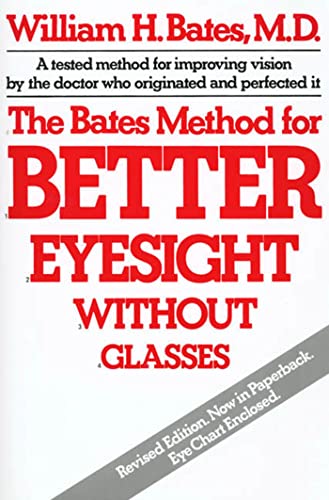
Better Eyesight Without Glasses is not only the definitive source for the classic Bates Method, it is in itself a remarkable phenomenon. Dr. William H. Bates's revolutionary and entirely commonsensical theory of self-taught improved eyesight has helped hundreds of thousands of people to triumph over normal defects of vision without the mechanical aid of eyeglasses. If you think that your eyesight could be made better by natural methods, you are right.
After years of experimentation, Dr. Bates came to the conclusion that many people who wore glasses did not need them. He gradually and carefully developed a simple group of exercises for improving the ability of the eyes themselves to see, eliminating the tension caused by poor visual habits that are the major cause of bad eyesight. These exercises are based on the firm belief that it is the natural function of the eyes to see clearly and that anyone, child or adult, can learn to see better without glasses. Featuring an eye chart for improving your vision at home, The Bates Method for Better Eyesight Without Glasses will give you all the guidance you need for relaxed and improved vision.Die Inhaltsangabe kann sich auf eine andere Ausgabe dieses Titels beziehen.
Über die Autorin bzw. den Autor
Dr. William H. Bates was a leading New York ophthalmologist, who edited Better Eyesight magazine and published The Cure of Imperfect Eyesight by Treatment without Glasses.
Auszug. © Genehmigter Nachdruck. Alle Rechte vorbehalten.
The Bates Method for Better Eyesight Without Glasses
By William H. BatesHenry Holt and Company
Copyright © 1971 Josephine V. Guffanti
All rights reserved.
ISBN: 978-0-8050-0241-6All rights reserved.
Contents
Title Page,
I - The Theory and the Facts,
II - Simultaneous Retinoscopy,
III - The Truth About Accommodation,
IV - The Variability of Refraction,
V - What Glasses Do to Us,
VI - The Cause and Treatment of Errors of Refraction,
VII - Strain,
VIII - Central Fixation,
IX - Palming,
X - Memory as an Aid to Vision,
XI - Imagination as an Aid to Vision,
XII - Shifting and Swinging,
XIII - The Illusions of Sight,
XIV - Vision Under Adverse Conditions,
XV - Optimums and Pessimums,
XVI - Presbyopia: Its Cause and Treatment,
XVII - Squint and Amblyopia: Their Cause,
XVIII - Squint and Amblyopia: Their Treatment,
XIX - Floating Specks: Their Cause and Treatment,
XX - Home Treatment,
XXI - Treatment in Schools: Methods That Failed,
XXII - Treatment in Schools: A Method That Succeeded,
XXIII - Mind and Vision,
XXIV - The Fundamental Principles of Treatment,
Notes,
Copyright Page,
CHAPTER 1
The Theory and the Facts
MOST writers on ophthalmology appear to believe that the last word about problems of refraction (the deviation of light waves as they enter the eye) has been spoken, and according to their theories the last word is a very depressing one. Almost everyone in these days suffers from some form of refractive error. Yet we are told that for these ills, which not only are inconvenient but often are distressing and dangerous, there is no cure, no palliative except those optic crutches known as eyeglasses, and, under modern conditions of life, practically no preventive measure.
It is a well-known fact that the human body is not a perfect mechanism. Nature, in the evolution of the human tenement, has been guilty of some maladjustments. She has left behind, for instance, some troublesome bits of scaffolding, like the vermiform appendix. But nowhere is she supposed to have blundered so badly as in the construction of the eye. With one accord ophthalmologists tell us that the visual organ of man was never intended for the uses to which it is now put.
Eons before there were any schools or printing presses, electric lights or moving pictures, the evolution of the eye was complete. In those days it served the needs of the human animal perfectly. Man was a hunter, a herdsman, a farmer, a fighter. He needed, we are told, mainly distant vision; and since the eye at rest is adjusted for distant vision, sight is supposed to have been ordinarily as passive as the perception of sound, requiring no muscular action whatever. Near vision, it is assumed, was the exception, necessitating a muscular adjustment of such short duration that it was accomplished without placing any appreciable burden upon the mechanism of accommodation (the adjustment of the eye to different distances). The fact that primitive woman was a seamstress, an embroiderer, a weaver, an artist in all sorts of fine and beautiful work, appears to have been generally forgotten. Yet women living under primitive conditions have just as good eyesight as the men.
When man learned how to communicate his thoughts to others by means of written and printed forms, there came some undeniably new demands upon the eye, affecting at first only a few people but gradually including more and more, until now, in the more advanced countries, the great mass of the population is subjected to their influence. A few hundred years ago even princes were not taught to read and write. Now we compel everyone to go to school, whether he wishes to or not, and even babies are sent to kindergarten. A generation or so ago books were scarce and expensive. Today, by means of libraries of all sorts, stationary and traveling, they have been brought within the reach of almost everyone. The modern newspaper, with its endless columns of badly printed reading matter, was made possible by the discovery of the art of manufacturing paper from wood, which is a thing of yesterday. Only lately has the tallow candle been displaced by the various forms of artificial lighting, which tempt most of us to prolong our vocations and avocations into hours during which primitive man was forced to rest. Even more recently has come the moving picture to complete the supposedly destructive process.
Was it reasonable to expect that Nature should have provided for all these developments and produced an organ that could respond to the new demands? It is the accepted belief of ophthalmology today that she could not and did not, and that, while the processes of civilization depend upon the sense of sight more than upon any other, the visual organ is imperfectly fitted for its tasks.
There are a great number of facts which seem to justify this conclusion. While primitive man appears to have suffered little from defects of vision, it is safe to say that of persons over twenty-one living under civilized conditions, nine out of every ten have imperfect sight, and as the age increases the proportion increases, until at forty it is almost impossible to find a person free from visual defects. Voluminous statistics prove these assertions.
For more than a hundred years the medical profession has been seeking some method of checking the ravages of civilization upon the human eye. The Germans, to whom the matter has been one of vital military importance, have spent millions of dollars in carrying out the suggestions of experts, but without avail; and it is now admitted by most students of the subject that the methods which were once confidently advocated as reliable safeguards for the eyesight of our children have accomplished little or nothing. Some take a more cheerful view of the matter, but their conclusions are hardly borne out by the facts.
For the prevailing method of treatment, by means of artificial lenses which compensate for the refractive error of the eye, very little was ever claimed except that these contrivances neutralized the effects of the various conditions for which they were prescribed, as a crutch enables a lame man to walk. It has also been believed that they sometimes checked the progress of these conditions; but every ophthalmologist now knows that their usefulness for this purpose, if any, is very limited. In the case of myopia (shortsightedness), as long ago as 1916 some ophthalmologists realized that glasses and all ordinary methods at our command "are of but little avail" in preventing either an increase in the error of refraction or the development of the very serious complications with which it is often associated.
I have been studying the refraction of the human eye for more than thirty years, and my observations fully confirm these conclusions as to the uselessness of all the methods heretofore employed for the prevention and treatment of errors of refraction. I was very early led to suspect, however, that the problem was by no means an unsolvable one.
Every ophthalmologist of any experience knows that the theory of the incurability of errors of refraction does not fit the observed facts. Not infrequently such cases recover spontaneously, or change from one form to another. It has long been the custom either to ignore these troublesome facts or to explain them away, and fortunately for those who consider it necessary to bolster up the old theories at all costs, the role attributed to the lens of the eye in accommodation offers, in the majority of cases, a plausible...
„Über diesen Titel“ kann sich auf eine andere Ausgabe dieses Titels beziehen.
Suchergebnisse für The Bates Method for Better Eyesight Without Glasses

Beispielbild für diese ISBN
The Bates Method for Better Ey
Anbieter: World of Books (was SecondSale), Montgomery, IL, USA
Verkäuferbewertung 5 von 5 Sternen

Zustand: Good. Item in good condition and has highlighting/writing on text. Used texts may not contain supplemental items such as CDs, info-trac etc. Artikel-Nr. 00106499100
Gebraucht kaufen
EUR 5,38
Versand gratis
Versand innerhalb von USA
Versand innerhalb von USA
Anzahl: 1 verfügbar
Beispielbild für diese ISBN
The Bates Method for Better Eyesight Without Glasses
Anbieter: ThriftBooks-Phoenix, Phoenix, AZ, USA
Verkäuferbewertung 5 von 5 Sternen
Paperback. Zustand: Good. No Jacket. Pages can have notes/highlighting. Spine may show signs of wear. ~ ThriftBooks: Read More, Spend Less. Artikel-Nr. G0805002413I3N00
Gebraucht kaufen
EUR 8,07
Versand gratis
Versand innerhalb von USA
Versand innerhalb von USA
Anzahl: 4 verfügbar
Beispielbild für diese ISBN
The Bates Method for Better Eyesight Without Glasses
Anbieter: ThriftBooks-Reno, Reno, NV, USA
Verkäuferbewertung 5 von 5 Sternen
Paperback. Zustand: Good. No Jacket. Pages can have notes/highlighting. Spine may show signs of wear. ~ ThriftBooks: Read More, Spend Less. Artikel-Nr. G0805002413I3N00
Gebraucht kaufen
EUR 8,07
Versand gratis
Versand innerhalb von USA
Versand innerhalb von USA
Anzahl: 5 verfügbar
Beispielbild für diese ISBN
The Bates Method for Better Eyesight Without Glasses
Anbieter: ThriftBooks-Dallas, Dallas, TX, USA
Verkäuferbewertung 5 von 5 Sternen
Paperback. Zustand: Fair. No Jacket. Readable copy. Pages may have considerable notes/highlighting. ~ ThriftBooks: Read More, Spend Less. Artikel-Nr. G0805002413I5N00
Gebraucht kaufen
EUR 8,07
Versand gratis
Versand innerhalb von USA
Versand innerhalb von USA
Anzahl: 1 verfügbar
Beispielbild für diese ISBN
The Bates Method for Better Eyesight Without Glasses
Anbieter: ThriftBooks-Dallas, Dallas, TX, USA
Verkäuferbewertung 5 von 5 Sternen
Paperback. Zustand: Good. No Jacket. Pages can have notes/highlighting. Spine may show signs of wear. ~ ThriftBooks: Read More, Spend Less. Artikel-Nr. G0805002413I3N00
Gebraucht kaufen
EUR 8,07
Versand gratis
Versand innerhalb von USA
Versand innerhalb von USA
Anzahl: 5 verfügbar
Beispielbild für diese ISBN
The Bates Method for Better Eyesight Without Glasses
Anbieter: ThriftBooks-Atlanta, AUSTELL, GA, USA
Verkäuferbewertung 5 von 5 Sternen
Paperback. Zustand: Fair. No Jacket. Readable copy. Pages may have considerable notes/highlighting. ~ ThriftBooks: Read More, Spend Less. Artikel-Nr. G0805002413I5N00
Gebraucht kaufen
EUR 8,07
Versand gratis
Versand innerhalb von USA
Versand innerhalb von USA
Anzahl: 1 verfügbar
Beispielbild für diese ISBN
The Bates Method for Better Eyesight Without Glasses
Anbieter: ThriftBooks-Atlanta, AUSTELL, GA, USA
Verkäuferbewertung 5 von 5 Sternen
Paperback. Zustand: Good. No Jacket. Pages can have notes/highlighting. Spine may show signs of wear. ~ ThriftBooks: Read More, Spend Less. Artikel-Nr. G0805002413I3N00
Gebraucht kaufen
EUR 8,07
Versand gratis
Versand innerhalb von USA
Versand innerhalb von USA
Anzahl: 5 verfügbar
Beispielbild für diese ISBN
The Bates Method for Better Eyesight Without Glasses
Anbieter: ThriftBooks-Reno, Reno, NV, USA
Verkäuferbewertung 5 von 5 Sternen
Paperback. Zustand: Fair. No Jacket. Readable copy. Pages may have considerable notes/highlighting. ~ ThriftBooks: Read More, Spend Less. Artikel-Nr. G0805002413I5N00
Gebraucht kaufen
EUR 8,07
Versand gratis
Versand innerhalb von USA
Versand innerhalb von USA
Anzahl: 1 verfügbar
Beispielbild für diese ISBN
The Bates Method for Better Eyesight Without Glasses
Anbieter: Better World Books: West, Reno, NV, USA
Verkäuferbewertung 5 von 5 Sternen
Zustand: Very Good. Revised. Former library copy. Pages intact with possible writing/highlighting. Binding strong with minor wear. Dust jackets/supplements may not be included. Includes library markings. Stock photo provided. Product includes identifying sticker. Better World Books: Buy Books. Do Good. Artikel-Nr. 4788767-6
Gebraucht kaufen
EUR 8,16
Versand gratis
Versand innerhalb von USA
Versand innerhalb von USA
Anzahl: 1 verfügbar
Beispielbild für diese ISBN
The Bates Method for Better Eyesight Without Glasses
Anbieter: Better World Books, Mishawaka, IN, USA
Verkäuferbewertung 5 von 5 Sternen
Zustand: Very Good. Revised. Pages intact with possible writing/highlighting. Binding strong with minor wear. Dust jackets/supplements may not be included. Stock photo provided. Product includes identifying sticker. Better World Books: Buy Books. Do Good. Artikel-Nr. 4027259-75
Gebraucht kaufen
EUR 8,16
Versand gratis
Versand innerhalb von USA
Versand innerhalb von USA
Anzahl: 1 verfügbar