
Verwandte Artikel zu Fast/Forward: Make Your Company Fit for the Future
Inhaltsangabe
The leading companies of the past twenty years have all harnessed the power of information to gain competitive advantage. But as access to big data becomes ubiquitous, it can no longer guarantee a leg up. Fast/Forward makes the case that we are entering a new era in which firms that understand the limits of 1s and 0s will take the lead.
Whereas the industrial age saw the rise of bureaucracy, and the information age has been described as a meritocracy, we are witnessing the rise of adhocracy. In uncertain, rapidly-changing times, adhocracic organizations scan the horizon for winning opportunities. Then, instead of questing after more analysis, they respond with agility by making smart, intuitive decisions. Combining decisive action with emotional conviction, future-facing firms seize the day.
Fast/Forward paints the big picture of a new approach to strategy and provides the necessary playbook to make your company fit for the future.
Die Inhaltsangabe kann sich auf eine andere Ausgabe dieses Titels beziehen.
Über die Autorin bzw. den Autor
Julian Birkinshaw is Professor and Chair of Strategy and Entrepreneurship at the London Business School. An acclaimed expert on innovation, entrepreneurship, and renewal in large corporations, he is the author of twelve books. His research and commentary have been featured in The Economist, The Wall Street Journal, The Huffington Post, and Bloomberg Businessweek.Jonas Ridderstråle is a renowned business thinker and speaker. Jonas' diverse client list includes Fortune 500 companies, major government bodies, sports teams, and trade unions. A Visiting Professor at Ashridge Business School, he is the author of four books: Funky Business (2000), Karaoke Capitalism (2004), Funky Business Forever (2007), and Re-energizing the Corporation (2008).
Auszug. © Genehmigter Nachdruck. Alle Rechte vorbehalten.
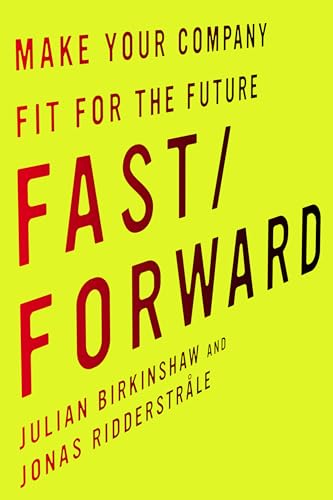
Fast/Forward
Make Your Company Fit for the Future
By Julian Birkinshaw, Jonas RidderstraleSTANFORD UNIVERSITY PRESS
Copyright © 2017 Board of Trustees of the Leland Stanford Junior University
All rights reserved.
ISBN: 978-0-8047-9953-9All rights reserved.
Contents
Preface,
Acknowledgments,
1. Staying Ahead of the Curve,
2. The Paradoxes of Progress,
3. Models of Management,
4. The Action Imperative in Strategy,
5. Linking Strategy Back to Purpose,
6. Opportunity-Focused Coordination,
7. The Overachieving Organization,
8. Ambidextrous Leadership for an Agile World,
9. Becoming an Unreasonable Manager,
Notes,
Index,
CHAPTER 1
STAYING AHEAD OF THE CURVE
WHAT IS THE BASIS of competitive advantage in today's business landscape? Many observers say it is the power to harness information. Best-selling authors Erik Brynjolfsson and Andrew McAfee have argued we are entering the "Second Machine Age," with information technology as the engine of human progress. The McKinsey Global Institute has called big data the "next frontier for innovation, competition and productivity." Academic research points to the importance of knowledge sharing, intellectual property, and R&D as the drivers of competitiveness. Firms such as IBM, American Express, and Caesar's Entertainment have emphasized business analytics and big data as key to their success.
In this book, we offer a different perspective. We believe the case for information technology, big data, and advanced analytics is overstated. These will of course continue to be important resources for staying in the race, but as information becomes ever more ubiquitous and search costs trend to zero, their capacity to provide any modern organization with a leading edge is diminishing.
That's not the only problem. Information overload at the individual level leads to distractedness, confusion, and poor decision making. At a corporate level, we end up with analysis paralysis, endless debate, and a bias toward rational, scientific evidence at the expense of intuition or gut feel. These pathologies have a deleterious effect on our companies. They lessen the quality and speed of decision making, delay action, and engender a sterile operating environment in which insightful thinking is quashed unless it is quantifiable. As a result, many companies end up standing still, even as the world around them is speeding up.
So what is the alternative to "Slow-Motion Inc."? Smart executives understand both the potential and the pitfalls of information. They recognize that the notion of competitive advantage is more fleeting than it used to be. They adopt what we call a fast/forward approach to business: they emphasize decisive action ahead of detailed analysis, and they are comfortable relying on emotional conviction alongside rational judgments.
Consider a few examples.
Amazon's phenomenal growth, from online bookseller to new economy powerhouse, defies all the established rules about firms focusing on their core competencies. Its success is built on deep insight into the needs of its customers, and an assumption that if you create value for customers, growth and profits will follow. Jeff Bezos, the company's cerebral founder, started his career developing mathematical models for a hedge fund and is a great believer in systematic analysis. But at the same time, he is known for his "harrowing leaps of faith." His most important decisions are not based on studies or spreadsheets, they are "nervy gambles on ideas that are just too big to try out reliably in small-scale tests."
Or look at WPP, which has transformed itself over the last decade from a stable of old-school ad agencies, such as JWT and Ogilvy & Mather, to the world's biggest new media communications company, with 40 percent of its revenues coming from its digital businesses, such as Internet and mobile advertising. For an industry built on fresh thinking, creative talent, and client responsiveness, bigger is not always better. So CEO Martin Sorrell allows the operating businesses to retain autonomy and to compete head-on with one another, while also encouraging collaboration when required — what one observer has called the "kiss and punch" model. Sorrell is famous for his attention to detail, his micro-managing style of leadership, yet like Jeff Bezos he is also decisive, with many of his largest acquisitions based more on gut instinct than due diligence. WPP's "weirdly effective mix of order and chaos" has enabled it to steer through the digital revolution more capably than its big rivals, and yet Sorrell feels there is more to do: "We don't believe that our existing businesses can move fast enough."
Or consider Oracle, the world's leading provider of database management software. Back in 2005, CEO Larry Ellison initiated a major project to rework the company's products as software-as-service applications. Back then, the term cloud computing hadn't even been invented, and there were many competing views about the future of computing. But Ellison made it a top priority, putting his very best developers onto a project with an uncertain future and a ten-year time horizon. In doing so, he enabled Oracle to develop one of the most comprehensive "cloud" offerings, spanning software, platform, and infrastructure elements. As observed by Thomas Kurian, Oracle president, "the heart of innovation is to decide early — in the middle of the period of ambiguity."
You might think this is a tech-sector phenomenon, but increasingly executives in large, mature industries are also embracing the fast/forward mind-set. For example, Swiss drug giant Roche is seeking to give greater decision-making freedom to its R&D scientists. As CEO Severin Schwan says, "We need a culture where people take risks because if you don't take risks, you won't have breakthrough innovation." Air Liquide, the Paris-based world leader in industrial gases, has undertaken a major shift in strategy toward innovation and retention, driven by what CEO Benoit Poitier calls the "expertise, audacity and intuition" of its sixty-eight thousand employees. Air Liquide, like Roche, is achieving impressive levels of growth in an otherwise stagnant industry.
Or look at Lloyds Banking Group in the United Kingdom. It has put digital working at the heart of its new strategy, following its post-financial-crisis turnaround. In the words of CEO António Horta-Osório, the intention is to "get closer to customers and make the decision cycle happen more quickly." A thousand-person digital team now reports in directly at board level, with a mandate to make the whole bank more agile. "This is a strategy adapting to the new world," says Horta-Osório, "We want to create a high-performing organization ... to be quicker than others to have a competitive advantage."
These brief company examples illustrate some important themes. Success in a fast-changing business world is a subtle blend of art and science. Rather than getting bogged down in analysis and introspection, fast/forward companies are open-minded, and they have operating cultures that promote action and experimentation. Their leaders know when to listen to the data and when to be decisive. As Jeff Bezos says, "There are decisions that can be made by analysis. ... These are the best kinds of decisions! They're fact-based decisions. Unfortunately, there's this whole other set of decisions that you can't ultimately boil down to a math problem," namely the big bets on new businesses like the Kindle or Amazon Web...
„Über diesen Titel“ kann sich auf eine andere Ausgabe dieses Titels beziehen.
Suchergebnisse für Fast/Forward: Make Your Company Fit for the Future

Beispielbild für diese ISBN
Fast/Forward: Make Your Company Fit for the Future
Verlag:
Stanford University Press, 2017
ISBN 10: 0804799539
ISBN 13: 9780804799539
Gebraucht
Hardcover
Anbieter: World of Books (was SecondSale), Montgomery, IL, USA
Verkäuferbewertung 5 von 5 Sternen

Hardback. Zustand: Very Good. Bureaucracies have become a relic of the industrial era. The knowledge economy is quickly becoming passe. In today's business environment, doing beats knowing. Fast/Forward presents a new way of working, teaching readers how to embrace decisive action and emotional conviction to gain tomorrow's competitive advantage. Artikel-Nr. 00096621045
Gebraucht kaufen
EUR 4,78
Versand gratis
Versand innerhalb von USA
Versand innerhalb von USA
Anzahl: 3 verfügbar
Beispielbild für diese ISBN
Fast/Forward: Make Your Company Fit for the Future
Verlag:
Stanford Business Books (edition 1), 2017
ISBN 10: 0804799539
ISBN 13: 9780804799539
Gebraucht
Hardcover
Anbieter: BooksRun, Philadelphia, PA, USA
Verkäuferbewertung 5 von 5 Sternen
Hardcover. Zustand: Very Good. 1. It's a well-cared-for item that has seen limited use. The item may show minor signs of wear. All the text is legible, with all pages included. It may have slight markings and/or highlighting. Artikel-Nr. 0804799539-8-1
Gebraucht kaufen
EUR 4,95
Versand gratis
Versand innerhalb von USA
Versand innerhalb von USA
Anzahl: 1 verfügbar
Beispielbild für diese ISBN
Fast/Forward: Make Your Company Fit for the Future
Verlag:
Stanford Business Books, 2017
ISBN 10: 0804799539
ISBN 13: 9780804799539
Gebraucht
Hardcover
Anbieter: ThriftBooks-Atlanta, AUSTELL, GA, USA
Verkäuferbewertung 5 von 5 Sternen
Hardcover. Zustand: Very Good. No Jacket. May have limited writing in cover pages. Pages are unmarked. ~ ThriftBooks: Read More, Spend Less. Artikel-Nr. G0804799539I4N00
Gebraucht kaufen
EUR 5,98
Versand gratis
Versand innerhalb von USA
Versand innerhalb von USA
Anzahl: 1 verfügbar
Beispielbild für diese ISBN
Fast/Forward: Make Your Company Fit for the Future
Verlag:
Stanford Business Books, 2017
ISBN 10: 0804799539
ISBN 13: 9780804799539
Gebraucht
Hardcover
Anbieter: ThriftBooks-Atlanta, AUSTELL, GA, USA
Verkäuferbewertung 5 von 5 Sternen
Hardcover. Zustand: As New. No Jacket. Pages are clean and are not marred by notes or folds of any kind. ~ ThriftBooks: Read More, Spend Less. Artikel-Nr. G0804799539I2N00
Gebraucht kaufen
EUR 5,98
Versand gratis
Versand innerhalb von USA
Versand innerhalb von USA
Anzahl: 1 verfügbar
Beispielbild für diese ISBN
Fast/Forward: Make Your Company Fit for the Future
Verlag:
Stanford Business Books, 2017
ISBN 10: 0804799539
ISBN 13: 9780804799539
Gebraucht
Hardcover
Anbieter: ThriftBooks-Dallas, Dallas, TX, USA
Verkäuferbewertung 5 von 5 Sternen
Hardcover. Zustand: As New. No Jacket. Pages are clean and are not marred by notes or folds of any kind. ~ ThriftBooks: Read More, Spend Less. Artikel-Nr. G0804799539I2N00
Gebraucht kaufen
EUR 6,01
Versand gratis
Versand innerhalb von USA
Versand innerhalb von USA
Anzahl: 1 verfügbar
Beispielbild für diese ISBN
Fast/Forward: Make Your Company Fit for the Future
Verlag:
Stanford Business Books, 2017
ISBN 10: 0804799539
ISBN 13: 9780804799539
Gebraucht
Hardcover
Anbieter: ThriftBooks-Dallas, Dallas, TX, USA
Verkäuferbewertung 5 von 5 Sternen
Hardcover. Zustand: Very Good. No Jacket. May have limited writing in cover pages. Pages are unmarked. ~ ThriftBooks: Read More, Spend Less. Artikel-Nr. G0804799539I4N00
Gebraucht kaufen
EUR 6,01
Versand gratis
Versand innerhalb von USA
Versand innerhalb von USA
Anzahl: 1 verfügbar
Beispielbild für diese ISBN
Fast/Forward : Make Your Company Fit for the Future
Verlag:
Stanford University Press, 2017
ISBN 10: 0804799539
ISBN 13: 9780804799539
Gebraucht
Hardcover
Anbieter: Better World Books, Mishawaka, IN, USA
Verkäuferbewertung 5 von 5 Sternen
Zustand: Fine. Used book that is in almost brand-new condition. May contain a remainder mark. Better World Books: Buy Books. Do Good. Artikel-Nr. 16316263-6
Gebraucht kaufen
EUR 6,37
Versand gratis
Versand innerhalb von USA
Versand innerhalb von USA
Anzahl: 1 verfügbar
Beispielbild für diese ISBN
Fast/Forward: Make Your Company Fit for the Future
Verlag:
Stanford Business Books, 2017
ISBN 10: 0804799539
ISBN 13: 9780804799539
Gebraucht
Paperback
Anbieter: WorldofBooks, Goring-By-Sea, WS, Vereinigtes Königreich
Verkäuferbewertung 5 von 5 Sternen
Paperback. Zustand: Very Good. The book has been read, but is in excellent condition. Pages are intact and not marred by notes or highlighting. The spine remains undamaged. Artikel-Nr. GOR008561109
Gebraucht kaufen
EUR 2,58
EUR 6,69 Versand
Versand von Vereinigtes Königreich nach USA
Versand von Vereinigtes Königreich nach USA
Anzahl: 2 verfügbar
Beispielbild für diese ISBN
Fast/Forward: Make Your Company Fit for the Future
Verlag:
Stanford Business Books 04/04/2017, 2017
ISBN 10: 0804799539
ISBN 13: 9780804799539
Gebraucht
Hardcover
Anbieter: AwesomeBooks, Wallingford, Vereinigtes Königreich
Verkäuferbewertung 5 von 5 Sternen
Zustand: Very Good. This book is in very good condition and will be shipped within 24 hours of ordering. The cover may have some limited signs of wear but the pages are clean, intact and the spine remains undamaged. This book has clearly been well maintained and looked after thus far. Money back guarantee if you are not satisfied. See all our books here, order more than 1 book and get discounted shipping. . Artikel-Nr. 7719-9780804799539
Gebraucht kaufen
EUR 5,70
EUR 4,92 Versand
Versand von Vereinigtes Königreich nach USA
Versand von Vereinigtes Königreich nach USA
Anzahl: 2 verfügbar
Beispielbild für diese ISBN
Fast/Forward : Make Your Company Fit for the Future
Verlag:
Stanford University Press, 2017
ISBN 10: 0804799539
ISBN 13: 9780804799539
Gebraucht
Hardcover
Anbieter: Better World Books Ltd, Dunfermline, Vereinigtes Königreich
Verkäuferbewertung 5 von 5 Sternen
Zustand: Very Good. Former library copy. Pages intact with possible writing/highlighting. Binding strong with minor wear. Dust jackets/supplements may not be included. Includes library markings. Stock photo provided. Product includes identifying sticker. Better World Books: Buy Books. Do Good. Artikel-Nr. 21393257-6
Gebraucht kaufen
EUR 5,77
EUR 5,97 Versand
Versand von Vereinigtes Königreich nach USA
Versand von Vereinigtes Königreich nach USA
Anzahl: 1 verfügbar