
Verwandte Artikel zu Feverish Bodies, Enlightened Minds: Science and the...
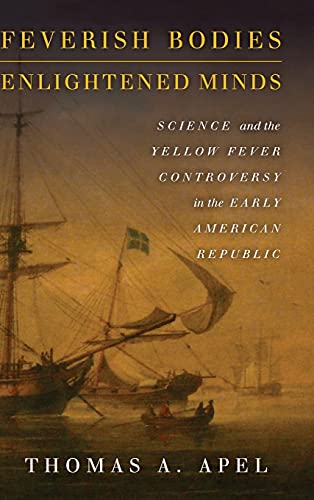
Feverish Bodies, Enlightened Minds: Science and the Yellow Fever Controversy in the Early American Republic - Hardcover
Inhaltsangabe
From 1793 to 1805, yellow fever devastated U.S. port cities in a series of terrifying epidemics. The search for the cause and prevention of the disease involved many prominent American intellectuals, including Noah Webster and Benjamin Rush. This investigation produced one of the most substantial and innovative outpourings of scientific thought in early American history. But it also led to a heated and divisive debate-both political and theological-around the place of science in American society.
Feverish Bodies, Enlightened Minds opens an important window onto the conduct of scientific inquiry in the early American republic. The debate between "contagionists," who thought the disease was imported, and "localists," who thought it came from domestic sources, reflected contemporary beliefs about God and creation, the capacities of the human mind, and even the appropriate direction of the new nation. Through this thoughtful investigation of the yellow fever epidemic and engaging examination of natural science in early America, Thomas Apel demonstrates that the scientific imaginations of early republicans were far broader than historians have realized: in order to understand their science, we must understand their ideas about God.
Die Inhaltsangabe kann sich auf eine andere Ausgabe dieses Titels beziehen.
Über die Autorinnen und Autoren
Thomas A. Apel teaches history at Menlo College.
Thomas A. Apel teaches history at Menlo College.
Auszug. © Genehmigter Nachdruck. Alle Rechte vorbehalten.
Feverish Bodies, Enlightened Minds
Science and the Yellow Fever Controversy in the Early American Republic
By Thomas A. ApelSTANFORD UNIVERSITY PRESS
Copyright © 2016 Board of Trustees of the Leland Stanford Junior University
All rights reserved.
ISBN: 978-0-8047-9740-5All rights reserved.
Contents
Acknowledgments,
Introduction,
1. Contexts and Causes,
2. "Declare the Past",
3. "Nature Is the Great Experimenter",
4. "Let Not God Intervene",
5. "In Politics As Well As Medicine"; or, The Arrogance of the Enlightened,
Conclusion: "A New Era in the Science of Medicine"?,
Notes,
Index,
CHAPTER 1
Contexts and Causes
We [doctors] are employed in ... a necessary calling that enforces to us the weakness and mortality of human nature. This earthly frame, a minute fabric, a center of wonders, is forever subject to Diseases and Death. The very air we breathe too often proves noxious, our food often is armed with poison, the very elements conspire the ruin of our constitutions, and Death forever lies lurking to deceive us.
BENJAMIN RUSH, 1761
What caused yellow fever? The question was on most everyone's mind in the United States' capital in the winter of 1793, as legions of Philadelphians, some twenty thousand in all, trudged back into the city they had abandoned only months before. Those seeking answers would have found them, lots of them; indeed, more than they would have liked. People were talking and the newspapers were all abuzz with word of the disease. According to Mathew Carey, "almost all" Philadelphians believed that the disease came from abroad, probably along with the two thousand French-speaking refugees from Saint-Domingue who had arrived in the ports of Philadelphia earlier that summer, some of them allegedly infected with yellow fever. Others implicated the conditions of the city: the stinking cesspools, the decaying animal carcasses, rotten vegetables, and stagnant pools of water that bred pestilential miasma. A pseudonymous writer for John Fenno's Gazette of the United States, masquerading as William Penn, the founder of Philadelphia writing from the "Elysian fields," chided his contemporaries for straying from his plan for the city. "It was my intention in laying the plan of Philadelphia," the ghost of Penn wrote, "to provide for the health as well as the beauty and conveniency of the place" (Figure 1.1). The author, evidently a localist, blamed city-dwellers for cutting down trees, narrowing the streets, and building where they should not. "Had you preserved my plan," the imposter informed his readers, "you might have avoided the mischief which has now befallen you."
Those learned in science and medicine set out to solve the puzzle. Benjamin Rush opened the commentary. The forty-eight-year-old professor of the theory and practice of medicine at the University of Pennsylvania was one of the foremost physicians in the United States, and an established figure in the nation's intellectual life. Born in Byberry, Pennsylvania, on Christmas Eve 1745, Rush studied medicine at the University of Edinburgh under the illustrious William Cullen. Once back in Philadelphia, Rush became the professor of chemistry at the College of Philadelphia, and he joined the American Philosophical Society. He later served in the Continental Congress and signed the Declaration of Independence. Rush labored hard to improve the medical and scientific reputation of Philadelphia, a city he rather hopefully deemed the "Edinburgh of America." To that end, he helped form the College of Physicians of Philadelphia in 178
„Über diesen Titel“ kann sich auf eine andere Ausgabe dieses Titels beziehen.
Suchergebnisse für Feverish Bodies, Enlightened Minds: Science and the...

Beispielbild für diese ISBN
Feverish Bodies, Enlightened Minds: Science and the Yellow Fever Controversy in the Early American Republic
Verlag:
Stanford University Press, 2016
ISBN 10: 0804797404
ISBN 13: 9780804797405
Gebraucht
Hardcover
Anbieter: World of Books (was SecondSale), Montgomery, IL, USA
Verkäuferbewertung 5 von 5 Sternen

Hardback. Zustand: Good. Feverish Bodies, Enlightened Minds considers the scientific controversy about the cause of yellow fever to examine and conduct of scientific practice in the early United States. Artikel-Nr. 00093152963
Gebraucht kaufen
EUR 46,02
Versand gratis
Versand innerhalb von USA
Versand innerhalb von USA
Anzahl: 2 verfügbar
Beispielbild für diese ISBN
Feverish Bodies, Enlightened Minds : Science and the Yellow Fever Controversy in the Early American Republic
Verlag:
Stanford University Press, 2016
ISBN 10: 0804797404
ISBN 13: 9780804797405
Gebraucht
Hardcover
Anbieter: Better World Books, Mishawaka, IN, USA
Verkäuferbewertung 5 von 5 Sternen
Zustand: Very Good. Former library copy. Pages intact with possible writing/highlighting. Binding strong with minor wear. Dust jackets/supplements may not be included. Includes library markings. Stock photo provided. Product includes identifying sticker. Better World Books: Buy Books. Do Good. Artikel-Nr. 9225680-6
Gebraucht kaufen
EUR 46,03
Versand gratis
Versand innerhalb von USA
Versand innerhalb von USA
Anzahl: 1 verfügbar
Beispielbild für diese ISBN
Feverish Bodies, Enlightened Minds
Anbieter: PBShop.store UK, Fairford, GLOS, Vereinigtes Königreich
Verkäuferbewertung 5 von 5 Sternen
HRD. Zustand: New. New Book. Shipped from UK. Established seller since 2000. Artikel-Nr. FW-9780804797405
Neu kaufen
EUR 78,14
EUR 4,92 Versand
Versand von Vereinigtes Königreich nach USA
Versand von Vereinigtes Königreich nach USA
Anzahl: 15 verfügbar
Beispielbild für diese ISBN
Feverish Bodies, Enlightened Minds: Science and the Yellow Fever Controversy in the Early American Republic
Anbieter: Majestic Books, Hounslow, Vereinigtes Königreich
Verkäuferbewertung 4 von 5 Sternen

Zustand: New. pp. 216. Artikel-Nr. 372763052
Neu kaufen
EUR 87,18
EUR 7,69 Versand
Versand von Vereinigtes Königreich nach USA
Versand von Vereinigtes Königreich nach USA
Anzahl: 3 verfügbar
Beispielbild für diese ISBN
Feverish Bodies, Enlightened Minds: Science and the Yellow Fever Controversy in the Early American Republic
Anbieter: Ria Christie Collections, Uxbridge, Vereinigtes Königreich
Verkäuferbewertung 5 von 5 Sternen
Zustand: New. In English. Artikel-Nr. ria9780804797405_new
Neu kaufen
EUR 88,85
EUR 13,36 Versand
Versand von Vereinigtes Königreich nach USA
Versand von Vereinigtes Königreich nach USA
Anzahl: Mehr als 20 verfügbar
Beispielbild für diese ISBN
Feverish Bodies, Enlightened Minds Science and the Yellow Fever Controversy in the Early American Republic
Anbieter: Revaluation Books, Exeter, Vereinigtes Königreich
Verkäuferbewertung 5 von 5 Sternen
Hardcover. Zustand: Brand New. 1st edition. 191 pages. 9.00x6.25x1.00 inches. In Stock. Artikel-Nr. x-0804797404
Neu kaufen
EUR 116,11
EUR 11,84 Versand
Versand von Vereinigtes Königreich nach USA
Versand von Vereinigtes Königreich nach USA
Anzahl: 2 verfügbar
Beispielbild für diese ISBN
Feverish Bodies, Enlightened Minds: Science and the Yellow Fever Controversy in the Early American Republic
Anbieter: Kennys Bookstore, Olney, MD, USA
Verkäuferbewertung 5 von 5 Sternen
Zustand: New. Feverish Bodies, Enlightened Minds considers the scientific controversy about the cause of yellow fever to examine and conduct of scientific practice in the early United States. Num Pages: 208 pages. BIC Classification: HBJK; MB; PDX. Category: (G) General (US: Trade). Dimension: 239 x 255 x 18. Weight in Grams: 446. . 2016. 1st Edition. Hardcover. . . . . Books ship from the US and Ireland. Artikel-Nr. V9780804797405
Neu kaufen
EUR 118,91
EUR 9,36 Versand
Versand innerhalb von USA
Versand innerhalb von USA
Anzahl: Mehr als 20 verfügbar
Foto des Verkäufers
Feverish Bodies, Enlightened Minds: Science and the Yellow Fever Controversy in the Early American Republic
Anbieter: moluna, Greven, Deutschland
Verkäuferbewertung 5 von 5 Sternen
Zustand: New. Feverish Bodies, Enlightened Minds considers the scientific controversy about the cause of yellow fever to examine and conduct of scientific practice in the early United States.Über den AutorThomas A. Apel teaches history. Artikel-Nr. 595016816
Neu kaufen
EUR 85,97
EUR 48,99 Versand
Versand von Deutschland nach USA
Versand von Deutschland nach USA
Anzahl: Mehr als 20 verfügbar