
Verwandte Artikel zu The Social Imperative: Race, Close Reading, and Contemporary...
Inhaltsangabe
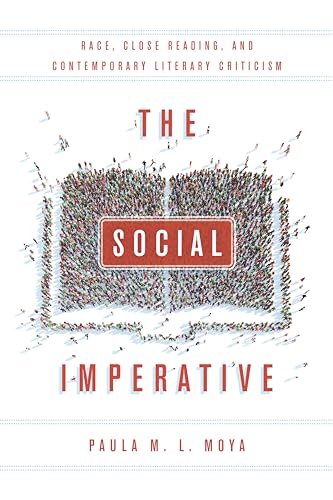
In the context of the ongoing crisis in literary criticism, The Social Imperative reminds us that while literature will never by itself change the world, it remains a powerful tool and important actor in the ongoing struggle to imagine better ways to be human and free. Figuring the relationship between reader and text as a type of friendship, the book elaborates the social-psychological concept of schema to show that our multiple social contexts affect what we perceive and how we feel when we read. Championing and modeling a kind of close reading that attends to how literature reflects, promotes, and contests pervasive sociocultural ideas about race, ethnicity, gender, and sexuality, Paula M. L. Moya demonstrates the power of works of literature by writers such as Junot Diaz, Toni Morrison, and Helena Maria Viramontes to alter perceptions and reshape cultural imaginaries. Insofar as literary fiction is a unique form of engagement with weighty social problems, it matters not only which specific works of literature we read and teach, but also how we read them, and with whom. This is what constitutes the social imperative of literature.
Die Inhaltsangabe kann sich auf eine andere Ausgabe dieses Titels beziehen.
Über die Autorinnen und Autoren
Paula M. L. Moya is Professor of English and, by courtesy, of Iberian and Latin American Cultures at Stanford University.
Paula M. L. Moya is Professor of English and, by courtesy, of Iberian and Latin American Cultures at Stanford University.
Auszug. © Genehmigter Nachdruck. Alle Rechte vorbehalten.
The Social Imperative
Race, Close Reading, and Contemporary Literary Criticism
By Paula M. L. MoyaSTANFORD UNIVERSITY PRESS
Copyright © 2016 Board of Trustees of the Leland Stanford Junior University
All rights reserved.
ISBN: 978-0-8047-9702-3All rights reserved.
Contents
Acknowledgments,
Introduction: Schemas and Racial Literacy,
1. Racism Is Not Intellectual: The Dialogic Potential of Multicultural Literature,
2. Not One and the Same Thing: The Ethical Relationship of Selves to Others in Toni Morrison's Sula,
3. Another Way to Be: Vestigial Schemas in Helena María Viramontes's "The Moths" and Manuel Muñoz's "Zigzagger",
4. Dismantling the Master's House: The Search for Decolonial Love in Junot Díaz's "How to Date a Browngirl, Blackgirl, Whitegirl, or Halfie",
5. The Misprision of Mercy: Race and Responsible Reading in Toni Morrison's A Mercy,
Conclusion: Reading Race,
Notes,
Works Cited,
Index,
CHAPTER 1
RACISM IS NOT INTELLECTUAL
The Dialogic Potential of Multicultural Literature
Racism is not intellectual.
I can not reason these scars away.
Lorna Dee Cervantes
There is no Frigate like a Book
To take us Lands away
Emily Dickinson
In a searingly powerful poem that serves as the fulcrum of her award-winning first book of poetry, Emplumada, the Chicana poet Lorna Dee Cervantes responds to a young, white male acquaintance who has charged her with being altogether too concerned with the existence of racial discord. Over the course of "Poem for the Young White Man Who Asked Me How I, an Intelligent, Well-Read Person Could Believe in the War Between Races," Cervantes attempts to explain to her interlocutor why she has been unable to transcend the emotional predispositions and what Raymond Williams has called "structures of feeling" that have mediated her race-conscious perspective on their shared social world (Marxism 129–34). Hers is a perspective, she contends, that has its roots in the emotionally toxic fallout of her everyday experiences of racism: the schoolyard experiences that have left her with an "'excuse me' tongue, and [the] / nagging preoccupation with the feeling of not being good enough"; the "slaps on the face" that her daily experiences of racism bring to her; the powerful enmity she feels from the "real enemy" outside her door who "hates [her]." In response to the young man's implied argument that any perspective that participates in the logic of race-consciousness is the result of error-prone beliefs which can and should be eradicated through education, Cervantes insists that the accusation he has leveled at her cannot be adequately answered within the terms he has set forth: "Racism," she tells him, "is not intellectual. / I can not reason these scars away" (36).
If racism is not intellectual — if a committed anti-racist cannot fight it with facts, then how can we fight it? How might we go about the process of changing people's emotional horizons? — which is clearly a part of what needs to happen if the problem of racism is to be ameliorated. In this chapter, I explore two possible avenues: interracial friendships and multicultural literature. Insofar as emotions are key to the doing of race, a sustained examination of how emotions about race figure into human motivation must be central to any attempt to move beyond the ideologies and socioeconomic arrangements that sustain racial inequa
„Über diesen Titel“ kann sich auf eine andere Ausgabe dieses Titels beziehen.
Suchergebnisse für The Social Imperative: Race, Close Reading, and Contemporary...

Beispielbild für diese ISBN
The Social Imperative: Race, Close Reading, and Contemporary Literary Criticism
Verlag:
Stanford University Press, 2015
ISBN 10: 0804797021
ISBN 13: 9780804797023
Gebraucht
Softcover
Anbieter: World of Books (was SecondSale), Montgomery, IL, USA
Verkäuferbewertung 5 von 5 Sternen

Zustand: Very Good. Item in very good condition! Textbooks may not include supplemental items i.e. CDs, access codes etc. Artikel-Nr. 00108702893
Gebraucht kaufen
EUR 5,42
Versand gratis
Versand innerhalb von USA
Versand innerhalb von USA
Anzahl: 1 verfügbar
Beispielbild für diese ISBN
The Social Imperative : Race, Close Reading, and Contemporary Literary Criticism
Verlag:
Stanford University Press, 2015
ISBN 10: 0804797021
ISBN 13: 9780804797023
Gebraucht
Softcover
Anbieter: Better World Books, Mishawaka, IN, USA
Verkäuferbewertung 5 von 5 Sternen
Zustand: Good. Pages intact with minimal writing/highlighting. The binding may be loose and creased. Dust jackets/supplements are not included. Stock photo provided. Product includes identifying sticker. Better World Books: Buy Books. Do Good. Artikel-Nr. 67513305-6
Gebraucht kaufen
EUR 9,96
Versand gratis
Versand innerhalb von USA
Versand innerhalb von USA
Anzahl: 1 verfügbar
Beispielbild für diese ISBN
The Social Imperative: Race, Close Reading, and Contemporary Literary Criticism
Verlag:
Stanford University Press, 2015
ISBN 10: 0804797021
ISBN 13: 9780804797023
Gebraucht
paperback
Anbieter: Books From California, Simi Valley, CA, USA
Verkäuferbewertung 4 von 5 Sternen

paperback. Zustand: Good. Artikel-Nr. mon0003845046
Gebraucht kaufen
EUR 15,16
EUR 4,39 Versand
Versand innerhalb von USA
Versand innerhalb von USA
Anzahl: 1 verfügbar
Beispielbild für diese ISBN
The Social Imperative: Race, Close Reading, and Contemporary Literary Criticism
Anbieter: Ria Christie Collections, Uxbridge, Vereinigtes Königreich
Verkäuferbewertung 5 von 5 Sternen
Zustand: New. In English. Artikel-Nr. ria9780804797023_new
Neu kaufen
EUR 28,64
EUR 10,88 Versand
Versand von Vereinigtes Königreich nach USA
Versand von Vereinigtes Königreich nach USA
Anzahl: 1 verfügbar
Beispielbild für diese ISBN
The Social Imperative Race, Close Reading, and Contemporary Literary Criticism
Anbieter: Revaluation Books, Exeter, Vereinigtes Königreich
Verkäuferbewertung 5 von 5 Sternen
Paperback. Zustand: Brand New. 206 pages. 8.75x6.00x0.50 inches. In Stock. Artikel-Nr. x-0804797021
Neu kaufen
EUR 30,34
EUR 11,61 Versand
Versand von Vereinigtes Königreich nach USA
Versand von Vereinigtes Königreich nach USA
Anzahl: 2 verfügbar
Beispielbild für diese ISBN
The Social Imperative: Race, Close Reading, and Contemporary Literary Criticism
Anbieter: Kennys Bookstore, Olney, MD, USA
Verkäuferbewertung 5 von 5 Sternen
Zustand: New. This book elaborates the social-psychological concept of schema while championing the literary critical practice of close reading to show how literature reflects, promotes, and contests pervasive sociocultural ideas like race, ethnicity, gender, and sexuality. Num Pages: 224 pages. BIC Classification: 1KBB; DS; HBTB; JFSL4. Category: (G) General (US: Trade). Dimension: 154 x 229 x 14. Weight in Grams: 330. . 2015. 1st Edition. Paperback. . . . . Books ship from the US and Ireland. Artikel-Nr. V9780804797023
Neu kaufen
EUR 33,67
EUR 9,23 Versand
Versand innerhalb von USA
Versand innerhalb von USA
Anzahl: 1 verfügbar
Foto des Verkäufers
The Social Imperative : Race, Close Reading, and Contemporary Literary Criticism
Verlag:
Stanford University Press Dez 2015, 2015
ISBN 10: 0804797021
ISBN 13: 9780804797023
Neu
Taschenbuch
Anbieter: AHA-BUCH GmbH, Einbeck, Deutschland
Verkäuferbewertung 5 von 5 Sternen
Taschenbuch. Zustand: Neu. Neuware - In the context of the ongoing crisis in literary criticism, The Social Imperative reminds us that while literature will never by itself change the world, it remains a powerful tool and important actor in the ongoing struggle to imagine better ways to be human and free. Figuring the relationship between reader and text as a type of friendship, the book elaborates the social-psychological concept of schema to show that our multiple social contexts affect what we perceive and how we feel when we read. Championing and modeling a kind of close reading that attends to how literature reflects, promotes, and contests pervasive sociocultural ideas about race, ethnicity, gender, and sexuality, Paula M. L. Moya demonstrates the power of works of literature by writers such as Junot Diaz, Toni Morrison, and Helena Maria Viramontes to alter perceptions and reshape cultural imaginaries. Insofar as literary fiction is a unique form of engagement with weighty social problems, it matters not only which specific works of literature we read and teach, but also how we read them, and with whom. This is what constitutes the social imperative of literature. Artikel-Nr. 9780804797023
Neu kaufen
EUR 32,72
EUR 35,00 Versand
Versand von Deutschland nach USA
Versand von Deutschland nach USA
Anzahl: 1 verfügbar
Foto des Verkäufers
The Social Imperative: Race, Close Reading, and Contemporary Literary Criticism
Anbieter: moluna, Greven, Deutschland
Verkäuferbewertung 5 von 5 Sternen
Zustand: New. This book elaborates the social-psychological concept of schema while championing the literary critical practice of close reading to show how literature reflects, promotes, and contests pervasive sociocultural ideas like race, ethnicity, gender, and sexuali. Artikel-Nr. 595016800
Neu kaufen
EUR 26,09
EUR 48,99 Versand
Versand von Deutschland nach USA
Versand von Deutschland nach USA
Anzahl: Mehr als 20 verfügbar