
Verwandte Artikel zu The Design of Insight: How to Solve Any Business Problem
Inhaltsangabe
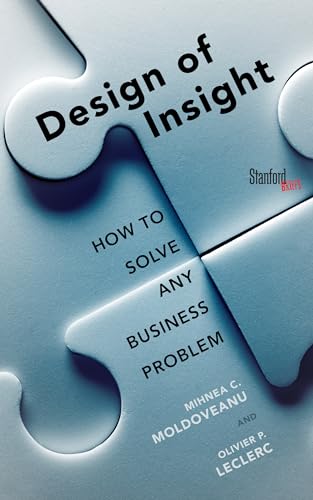
Familiar modes of problem solving may be efficient, but they often prevent us from discovering innovative solutions to more complex problems. To create meaningful change, we must train ourselves to discover previously unseen variables in day-to-day challenges. The Design of Insight is intended to be a personal problem-solving platform for decision makers and advisors who seek answers to critical business questions. It introduces an approach that uses multiple "problem-solving languages" to systematically expand our understanding of problem framing and high quality problem solving. Useful as a critical thinking approach or a think-out-loud document for strategic teams, this brief is a resource for enriching and implementing thoughtful management practices.
Die Inhaltsangabe kann sich auf eine andere Ausgabe dieses Titels beziehen.
Über die Autorinnen und Autoren
Mihnea Moldoveanu is Professor of Business Economics, Desautels Professor of Integrative Thinking, Director of the Desautels Centre of Integrative Thinking, and Founder and Director of the Mind Brain Behavior Hive at the University of Toronto's Rotman School of Management, where he is also Associate Dean of the MBA Program. He is Founder and ex-CEO of Redline Communication, Inc. Olivier Leclerc is a Director (Senior Partner) in McKinsey's West Coast office.
Mihnea Moldoveanu is Professor of Business Economics, Desautels Professor of Integrative Thinking, Director of the Desautels Centre of Integrative Thinking, and Founder and Director of the Mind Brain Behavior Hive at the University of Toronto's Rotman School of Management, where he is also Associate Dean of the MBA Program. He is Founder and ex-CEO of Redline Communication, Inc.Olivier Leclerc is a Director (Senior Partner) in McKinsey's West Coast office.
Auszug. © Genehmigter Nachdruck. Alle Rechte vorbehalten.
The Design of Insight
How to Solve Any Business Problem
By Mihnea C. Moldoveanu, Olivier LeclercSTANFORD UNIVERSITY PRESS
Copyright © 2015 McKinsey & Company, Inc., and Mihnea C. Moldoveanu
All rights reserved.
ISBN: 978-0-8047-9409-1All rights reserved.
Contents
Preface,
1. What Is This All About?,
2. The Networks Flexon,
3. The Decision Agent Flexon,
4. The System Dynamics Flexon,
5. The Evolutionary Flexon,
6. The Information Processing Flexon,
7. Problem Solving and the Design of Insight,
CHAPTER 1
WHAT IS THIS ALL ABOUT?
Innovative solutions to complex business problems are like works of art: they elicit emotions similar to the ones we feel in front of great paintings or photographs. They transform our views of the world by showing it to us from different perspectives. When Yann Arthus-Bertrand shows us a photograph of the earth from the sky, it not only expands our horizons in the literal sense but reveals unsuspected patterns in the landscapes we thought we knew well.
A new theory, like the special theory of relativity, does even more for us. Einstein's insight that light moves at the same speed in any inertial frame implies that space, time, and the mass of a moving object contract or expand as a function of the speed with which the object moves relative to a nonaccelerating frame. It is a lens that lets us make a new and valid prediction: the rate at which particles' energy states will decay as a function of the speed with which they move, something the previous picture of space-time did not predict. The new theory does not give us new information. It adds new insight to existing information—to the facts we knew when looking through the old lens—and sets our gaze on critical new information we can seek out.
A new way of looking at a business can also make unseen patterns visible and reveal innovative levers we can use to drive changes that have impact. When Coca Cola describes itself as a conditioned reflex business rather than a "soft drinks business," its marketing department begins to think about how to engineer stimuli that will trigger customers' buy-and-consume routine so reliably that it becomes a reflex. Then the company sets to work on optimizing the color of the drink, the shape of the container, and the sound patterns of the commercials to trigger consumers' desire to "have a Coke and a smile" as a matter of reflex rather than a considered choice.
Google understands itself as a company constantly searching for the best search process. Its approach to research, development, and deployment has taken on a vinelike characteristic—one that is adaptive and expanding. "Search," writ large, is its raison d'être, which encourages it to stay at the forefront of a human activity—search and re-search—that has been addictive since before we knew what the Internet was. Google Earth, Google Books, Google Scholar, Google Patents, and Google Code are all exploration vehicles that expand users' search repertoire while furthering the company's own search for better ways to search.
The business world offers up challenges involving large sets of variables on consumer behavior, trends, regulatory uncertainties, shifting competition, new technologies, and more. Finding a way to see these variables in ways that illuminate an insightful course of action is not so different from seeing the world through Bertrand's photo lens or seeing time and space through Einstein's model. The trick is to discover a lens that focuses us on the variables that matter—those we can observe and control to bring about useful change. To do so, we need to look and see differently. We get to insight by building and using a new lens, not just by collecting more data and analyzing it. That is how we design insight.
Shedding new light on a predicament is hard because we tend to gravitate toward familiar ways of seeing. Our existing models, metaphors, and frames shape our ways of looking, and precedents constrain what we end up looking for. They can provide useful shortcuts for transferring insight from one field of practice to another, but they are our enemies in producing new insight: they are the pictures we took using yesterday's lenses.
This book is an exercise regime for the business mind that seeks insight—a personal problem-framing and problem-solving assistant for business problem solvers. It can be used as a think-out-loud document for strategists, advisors, and executives, alone or in teams, and it answers the questions that should guide all insight seekers—for example:
• How can we harness thinking deeply and precisely to seeing more clearly?
• How can we broaden our line of sight into possible solutions—or narrow our focus to avoid getting sidetracked without losing perspective?
• How should we design the process by which we design business solutions?
THE ACT OF DEFINING BUSINESS PROBLEMS: WHERE THE GOLD LIES
In business, we never begin our work with a well-defined problem. We start from a difficulty, an issue, a challenge, or a predicament:
• Quarterly sales have suddenly plummeted. What now?
• Manufacturing costs have skyrocketed over the past two quarters. What do we do about it?
• Our arch-competitor has announced a new product we'd not even conceived possible a quarter ago, and it looks like a market beater. How do we respond?
• The client's top management team has gone into a motivational slump according to the chairman of the board: How do we change their behavior?
These are not problems. They are vaguely articulated predicaments, or challenges. As business problem solvers, we never "solve problems" already posed. The work we do creates most of its value through defining problems: turning predicaments into precisely articulated problems we can solve.
What does that mean? What is a well-defined problem? It is a difference between the way things are and the way we want them to be. "Precisely articulated" means just that: we want to be able to measure the most relevant variables pertaining to where we are (the current conditions) and where want to be (the desired conditions); define the time frame in which we will get there from here; and map out the space of possible solutions, that is, the permutations and combinations of all possible changes in the variables we can influence to take us from where we are to where we want to be.
The prototypical well-defined problem is a jigsaw puzzle: you have a stack of nine square tiles, each with some pattern on it. These are the current conditions. You know that the solution to the puzzle is an arrangement of the nine tiles in a square three-by-three tile array such that the patterns fit together, that is, they produce a coherent image (the desired conditions). The space of possible solutions—the solution search space—is all of the possible three-by-three arrays of tiles you can create using the nine tiles at your disposal.
This problem is not simple, but, it is well defined. You know what the solution should look like: you have some hint in or on the box of the tile package. You can verify whether any configuration of tiles fits the bill. You have the means to alter the position or rotation of any tile to get closer to the solution to the puzzle. You may also know that the solution is unique. That will help because you will be aiming to solve for one thing, not for any one of 10, or 100, or 1,000.
Once...
„Über diesen Titel“ kann sich auf eine andere Ausgabe dieses Titels beziehen.
Suchergebnisse für The Design of Insight: How to Solve Any Business Problem

Beispielbild für diese ISBN
The Design of Insight: How to Solve Any Business Problem
Anbieter: ThriftBooks-Atlanta, AUSTELL, GA, USA
Verkäuferbewertung 5 von 5 Sternen

Paperback. Zustand: Very Good. No Jacket. Former library book; May have limited writing in cover pages. Pages are unmarked. ~ ThriftBooks: Read More, Spend Less. Artikel-Nr. G080479409XI4N10
Gebraucht kaufen
EUR 5,95
Versand gratis
Versand innerhalb von USA
Versand innerhalb von USA
Anzahl: 1 verfügbar
Beispielbild für diese ISBN
The Design of Insight : How to Solve Any Business Problem
Verlag:
Stanford University Press, 2015
ISBN 10: 080479409X
ISBN 13: 9780804794091
Gebraucht
Softcover
Anbieter: Better World Books: West, Reno, NV, USA
Verkäuferbewertung 5 von 5 Sternen
Zustand: Very Good. Pages intact with possible writing/highlighting. Binding strong with minor wear. Dust jackets/supplements may not be included. Stock photo provided. Product includes identifying sticker. Better World Books: Buy Books. Do Good. Artikel-Nr. 14771632-6
Gebraucht kaufen
EUR 6,17
Versand gratis
Versand innerhalb von USA
Versand innerhalb von USA
Anzahl: 1 verfügbar
Beispielbild für diese ISBN
The Design of Insight : How to Solve Any Business Problem
Verlag:
Stanford University Press, 2015
ISBN 10: 080479409X
ISBN 13: 9780804794091
Gebraucht
Softcover
Anbieter: Better World Books, Mishawaka, IN, USA
Verkäuferbewertung 5 von 5 Sternen
Zustand: Very Good. Former library copy. Pages intact with possible writing/highlighting. Binding strong with minor wear. Dust jackets/supplements may not be included. Includes library markings. Stock photo provided. Product includes identifying sticker. Better World Books: Buy Books. Do Good. Artikel-Nr. 39707802-6
Gebraucht kaufen
EUR 6,17
Versand gratis
Versand innerhalb von USA
Versand innerhalb von USA
Anzahl: 1 verfügbar
Beispielbild für diese ISBN
The Design of Insight : How to Solve Any Business Problem
Verlag:
Stanford University Press, 2015
ISBN 10: 080479409X
ISBN 13: 9780804794091
Gebraucht
Softcover
Anbieter: Better World Books, Mishawaka, IN, USA
Verkäuferbewertung 5 von 5 Sternen
Zustand: Very Good. Pages intact with possible writing/highlighting. Binding strong with minor wear. Dust jackets/supplements may not be included. Stock photo provided. Product includes identifying sticker. Better World Books: Buy Books. Do Good. Artikel-Nr. 14771632-6
Gebraucht kaufen
EUR 6,17
Versand gratis
Versand innerhalb von USA
Versand innerhalb von USA
Anzahl: 1 verfügbar
Beispielbild für diese ISBN
The Design of Insight
Anbieter: PBShop.store UK, Fairford, GLOS, Vereinigtes Königreich
Verkäuferbewertung 5 von 5 Sternen
PAP. Zustand: New. New Book. Shipped from UK. Established seller since 2000. Artikel-Nr. FW-9780804794091
Neu kaufen
EUR 18,05
EUR 3,92 Versand
Versand von Vereinigtes Königreich nach USA
Versand von Vereinigtes Königreich nach USA
Anzahl: 15 verfügbar
Beispielbild für diese ISBN
The Design of Insight
Anbieter: Majestic Books, Hounslow, Vereinigtes Königreich
Verkäuferbewertung 4 von 5 Sternen

Zustand: New. pp. 128 31 Figures, 2 Illus. Artikel-Nr. 311923165
Neu kaufen
EUR 22,54
EUR 7,74 Versand
Versand von Vereinigtes Königreich nach USA
Versand von Vereinigtes Königreich nach USA
Anzahl: 3 verfügbar
Beispielbild für diese ISBN
The Design of Insight: How to Solve Any Business Problem
Anbieter: Kennys Bookstore, Olney, MD, USA
Verkäuferbewertung 5 von 5 Sternen
Zustand: New. 2015. 1st Edition. Paperback. . . . . . Books ship from the US and Ireland. Artikel-Nr. V9780804794091
Neu kaufen
EUR 22,34
EUR 9,35 Versand
Versand innerhalb von USA
Versand innerhalb von USA
Anzahl: Mehr als 20 verfügbar
Beispielbild für diese ISBN
The Design of Insight: How to Solve Any Business Problem
Anbieter: Ria Christie Collections, Uxbridge, Vereinigtes Königreich
Verkäuferbewertung 5 von 5 Sternen
Zustand: New. In English. Artikel-Nr. ria9780804794091_new
Neu kaufen
EUR 21,35
EUR 11,16 Versand
Versand von Vereinigtes Königreich nach USA
Versand von Vereinigtes Königreich nach USA
Anzahl: Mehr als 20 verfügbar
Beispielbild für diese ISBN
The Design of Insight How to Solve Any Business Problem
Anbieter: Revaluation Books, Exeter, Vereinigtes Königreich
Verkäuferbewertung 5 von 5 Sternen
Paperback. Zustand: Brand New. 1st edition. 156 pages. 8.00x5.00x0.50 inches. In Stock. Artikel-Nr. xr080479409X
Neu kaufen
EUR 28,23
EUR 11,91 Versand
Versand von Vereinigtes Königreich nach USA
Versand von Vereinigtes Königreich nach USA
Anzahl: 2 verfügbar
Foto des Verkäufers
The Design of Insight: How to Solve Any Business Problem
Anbieter: moluna, Greven, Deutschland
Verkäuferbewertung 5 von 5 Sternen
Zustand: New. The Design of Insight is a personal problem-solving platform that will enable readers to break out of familiar thought models and create innovative solutions for impactful change at any level in their business.Über den AutorrnrnMihnea M. Artikel-Nr. 595016675
Neu kaufen
EUR 24,99
EUR 48,99 Versand
Versand von Deutschland nach USA
Versand von Deutschland nach USA
Anzahl: Mehr als 20 verfügbar