
Verwandte Artikel zu An Early Self: Jewish Belonging in Romance Literature,...
An Early Self: Jewish Belonging in Romance Literature, 1499-1627 (Stanford Studies in Jewish History and Culture) - Hardcover
Buch 71 von 119: Stanford Studies in Jewish History and Culture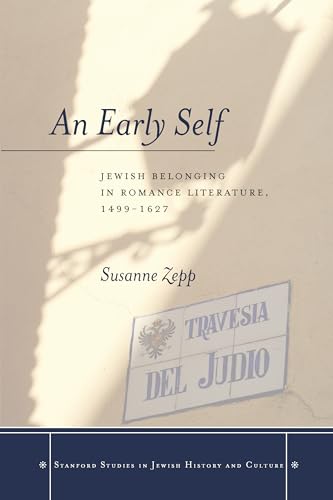
Inhaltsangabe
What role has Jewish intellectual culture played in the development of modern Romance literature? Susanne Zepp seeks to answer this question through an examination of five influential early modern texts written between 1499 and 1627: Fernando de Rojas's La Celestina, Leone Ebreo's Dialoghi d'amore, the anonymous tale Lazarillo de Tormes (the first picaresque novel), Montaigne's Essais, and the poetical renditions of the Bible by João Pinto Delgado. Forced to straddle two cultures and religions, these Iberian conversos (Jews who converted to Catholicism) prefigured the subjectivity which would come to characterize modernity.
As "New Christians" in an intolerant world, these thinkers worked within the tensions of their historical context to question norms and dogmas. In the past, scholars have focused on the Jewish origins of such major figures in literature and philosophy. Through close readings of these texts, Zepp moves the debate away from the narrow question of the authors' origins to focus on the innovative ways these authors subverted and transcended traditional genres. She interprets the changes that took place in various literary genres and works of the period within the broader historical context of the sixteenth and seventeenth centuries, demonstrating the extent to which the development of early modern subjective consciousness and its expression in literary works can be explained in part as a universalization of originally Jewish experiences.
Die Inhaltsangabe kann sich auf eine andere Ausgabe dieses Titels beziehen.
Über die Autorinnen und Autoren
Susanne Zepp is Chair for Spanish and Portuguese Literature at Freie Universität Berlin and Deputy Director of the Simon-Dubnow-Institute for Jewish History and Culture at Leipzig University.
Susanne Zepp is Chair for Spanish and Portuguese Literature at Freie Universität Berlin and Deputy Director of the Simon-Dubnow-Institute for Jewish History and Culture at Leipzig University.
Auszug. © Genehmigter Nachdruck. Alle Rechte vorbehalten.
An Early Self
Jewish Belonging in Romance Literature, 1499–1627
By Susanne Zepp, Insa KummerSTANFORD UNIVERSITY PRESS
Copyright © 2010 Vandenhoeck & Ruprecht GmbH & Co. KG
All rights reserved.
ISBN: 978-0-8047-8745-1All rights reserved.
Contents
Acknowledgments,
Introduction,
1. Skepticism and Irony: La Celestina (1499),
2. An Aesthetics of Love: Leone Ebreo's Dialoghi d'amore (1505/1535),
3. Inquisition and Conversion: El Lazarillo de Tormes (1554),
4. Marranism and Modernity: The Meaning of Form in Michel de Montaigne's Essais (1580–1588),
5. Sacred Text and Poetic Form: The Poetry of João Pinto Delgado (1627),
Conclusion: Marranic Experience as a Paradigm of the Modern Age,
Notes,
Bibliography,
Index,
CHAPTER 1
Skepticism and Irony
La Celestina (1499)
Few texts in Spanish literary history had such a lasting impact as the closet drama Tragicomedia de Calixto y Melibea. This "tragicomedy," which is considered a key literary work in Romance Europe's transition from the late Middle Ages to the early modern age, has become known under the title La Celestina, based on the name of the procuress who unites Calisto, the protagonist whose love is unrequited, with Melibea, who rejects him at first. To this day, hardly any other early modern text is edited and translated as often as this one. The history of its reception includes several film adaptations as well. For a text written in the year 1499, it is unusual in many respects. This is true of its form, which combines elements of both drama and the novel, yet even more so of its linguistic innovations, and not least with respect to its content. This explains why the peculiarities of this text, which in part cannot be explained immediately, have led to the most diverse attempts at explanation and interpretation in the course of Romance literary studies.
On Fernando de Rojas's Authorship
In 1902 the account of a trial mentioning a lawyer named Fernando de Rojas was found during research in the archives of the Inquisition tribunals. According to the historical document, he had written La Celestina in his youth and had wanted to represent his father-in-law, Álvaro de Montalbán, in an Inquisition trial in 1525. Because of his status as a converso, however, he had been rejected as counsel by the tribunal. The author's name had been known to be Fernando de Rojas since La Celestina's second edition of 1505, because he had revealed himself through an acrostic in a dedication poem. The dedication was prefaced by a letter in which the author described his work as the sequel to a literary discovery, the first act of Celestina, a text that according to the letter's author could only have been written by an author such as Juan de Mena or Rodrigo de Cota. It is not only because of this literary game regarding authorship—the first act does indeed differ from the rest of the piece—that, despite the archival discovery from the Inquisition files, it has not been decided to this day whether the text was written by one or several authors, nor has the identity of Fernando de Rojas, obscured by a play on words, been established beyond a doubt.
Nevertheless, following the archival discovery, many studies have striven to complement the interpretation of this early modern text with a consideration of its historic origins as well as a focus on the author's identity. One of the first essays of this kind was an article by Louis G. Zelson titled "The Celestina and Its Jewish Authorship," which appeared in the journal Jewish Forum in December 1930. In it Zelson demands acknowledgment of La Celestina as a work of Jewish literature. Rather than discussing the content of the literary text, he describes the discussion among scholars about the alleged author, which an article by Manuel Serrano y Sanz had triggered in 1902. Zelson also refers to a brief study by Julio Cejador presenting further archival finds on the ancestry and origin of Fernando de Rojas, which declared him a Hidalgo and thus a so-called Old Christian. In the following decades, the archival-based discussion about the Jewish, converso, or Christian origin of Celestina's author grew into a veritable research tradition.
Building upon the writings of his academic mentor, Américo Castro, Stephen Gilman has compiled essential studies that interpret La Celestina as a document of the author Fernando de Rojas's "Jewish-Christian split consciousness." While Gilman stresses overall that he does not want to unambiguously declare the literary text an inevitable result of the historical conditions of the author's existence, he interprets the tragicomedy's uniqueness from the "archivally imagined perspective of Spanish conversos," namely, the biographical experience suffered by Fernando de Rojas that was reflected in this text. This and other attempts, following Gilman, at a conjoined consideration of the author's affiliation and the extraordinariness of the text have led to a reading of La Celestina that recognizes in it a pessimism informed by true hardship as displayed by the conversos, whose only form of expression remained skeptical distance and irony. However, not one of the characters in the text is explicitly referred to as a converso, nor are questions of religious affiliation central to the plot in any way.
The passages analyzed in this chapter are taken mainly from the first and last acts of La Celestina, the latter of which has been perceived as that part of the text in which a "Jewish Skepticism" (Castro) finds its central expression in the above-mentioned interpretative tradition. My aim is to open up an alternative approach to La Celestina beyond the exclusively biographical one.
In 1499 the text of La Celestina first became available in print. This edition contained fourteen acts; in 1502 another edition with five additionally inserted acts was published, on which most editions are still based today. The text is difficult to categorize in terms of genre. Its division into acts and dialogical form point to the theater, yet, as Manfred Tietz has rightly pointed out, there was no such institution as the theater and no stage on which such a complex play could have been performed in Spain at that time:
The piece ... was probably meant for communal reading with assigned roles, yet not at court, in a mostly female dominated milieu, but instead at university, in a mostly male dominated context. This audience helps explain several stylistic traits of Celestina's truly new literary language: the use of numerous elements of education ..., but also the use of many sexual allusions as well as directness. Despite a connection to the theater, La Celestina is considered a novela dialogada today, and thus a precursor to the Spanish novel.
The plot of this dialogical novel can be summarized as follows: While out hunting with his falcon, young nobleman Calisto finds himself in the garden of Pleberio's family and falls in love with his daughter Melibea. When she rejects him, Calisto, acting on the advice of his servant Sempronio, charges the old procuress Celestina with gaining him access to Melibea's heart and bedchamber. The plan succeeds, even though Calisto's second servant, Pármeno, warns him against accepting the procuress's services. Both servants know Celestina, and when she guarantees them regular relations with Elicia and Areusa, two girls in her...
„Über diesen Titel“ kann sich auf eine andere Ausgabe dieses Titels beziehen.
Suchergebnisse für An Early Self: Jewish Belonging in Romance Literature,...

Beispielbild für diese ISBN
AN EARLY SELF. Jewish Belonging in Romance Literature, 1499-1627. Translated by Insa Kummer.
Verlag:
Stanford University, Stanford CA 2014., 2014
ISBN 10: 080478745X
ISBN 13: 9780804787451
Gebraucht
Hardcover
Erstausgabe
Anbieter: Hay Cinema Bookshop Limited, Hay on Wye, Vereinigtes Königreich
Verkäuferbewertung 5 von 5 Sternen

1st U.S. edition. 8vo. ix + 261pp. B/w. illustrations. Original beige boards lettered in navy and black, very good. ISBN 9780804787451 US$18. Artikel-Nr. 189857
Gebraucht kaufen
EUR 15,85
EUR 23,31 Versand
Versand von Vereinigtes Königreich nach USA
Versand von Vereinigtes Königreich nach USA
Anzahl: 1 verfügbar
Beispielbild für diese ISBN
An Early Self
Verlag:
MK - Stanford University Press, 2014
ISBN 10: 080478745X
ISBN 13: 9780804787451
Neu
Hardcover
Anbieter: PBShop.store UK, Fairford, GLOS, Vereinigtes Königreich
Verkäuferbewertung 5 von 5 Sternen
HRD. Zustand: New. New Book. Shipped from UK. Established seller since 2000. Artikel-Nr. FW-9780804787451
Neu kaufen
EUR 70,27
EUR 5,85 Versand
Versand von Vereinigtes Königreich nach USA
Versand von Vereinigtes Königreich nach USA
Anzahl: 15 verfügbar
Beispielbild für diese ISBN
An Early Self: Jewish Belonging in Romance Literature,.
Anbieter: Majestic Books, Hounslow, Vereinigtes Königreich
Verkäuferbewertung 4 von 5 Sternen

Zustand: New. pp. 248. Artikel-Nr. 141876914
Neu kaufen
EUR 85,39
EUR 7,58 Versand
Versand von Vereinigtes Königreich nach USA
Versand von Vereinigtes Königreich nach USA
Anzahl: 3 verfügbar
Beispielbild für diese ISBN
An Early Self: Jewish Belonging in Romance Literature, 1499-1627 (Stanford Studies in Jewish History and Culture)
Anbieter: Ria Christie Collections, Uxbridge, Vereinigtes Königreich
Verkäuferbewertung 5 von 5 Sternen
Zustand: New. In English. Artikel-Nr. ria9780804787451_new
Neu kaufen
EUR 87,50
EUR 13,16 Versand
Versand von Vereinigtes Königreich nach USA
Versand von Vereinigtes Königreich nach USA
Anzahl: Mehr als 20 verfügbar
Beispielbild für diese ISBN
An Early Self: Jewish Belonging in Romance Literature, 1499-1627
Anbieter: Kennys Bookstore, Olney, MD, USA
Verkäuferbewertung 5 von 5 Sternen
Zustand: New. 2014. Hardcover. . . . . . Books ship from the US and Ireland. Artikel-Nr. V9780804787451
Neu kaufen
EUR 114,39
EUR 9,17 Versand
Versand innerhalb von USA
Versand innerhalb von USA
Anzahl: Mehr als 20 verfügbar
Beispielbild für diese ISBN
An Early Self Jewish Belonging in Romance Literature, 14991627
Anbieter: Revaluation Books, Exeter, Vereinigtes Königreich
Verkäuferbewertung 5 von 5 Sternen
Hardcover. Zustand: Brand New. 261 pages. 9.25x6.25x0.75 inches. In Stock. Artikel-Nr. x-080478745X
Neu kaufen
EUR 113,27
EUR 11,66 Versand
Versand von Vereinigtes Königreich nach USA
Versand von Vereinigtes Königreich nach USA
Anzahl: 2 verfügbar
Foto des Verkäufers
An Early Self : Jewish Belonging in Romance Literature, 1499-1627
Verlag:
Stanford University Press Nov 2014, 2014
ISBN 10: 080478745X
ISBN 13: 9780804787451
Neu
Hardcover
Anbieter: AHA-BUCH GmbH, Einbeck, Deutschland
Verkäuferbewertung 5 von 5 Sternen
Buch. Zustand: Neu. Neuware - What role has Jewish intellectual culture played in the development of modern Romance literature Susanne Zepp seeks to answer this question through an examination of five influential early modern texts written between 1499 and 1627: Fernando de Rojas's La Celestina, Leone Ebreo's Dialoghi d'amore, the anonymous tale Lazarillo de Tormes (the first picaresque novel), Montaigne's Essais, and the poetical renditions of the Bible by João Pinto Delgado. Forced to straddle two cultures and religions, these Iberian conversos (Jews who converted to Catholicism) prefigured the subjectivity which would come to characterize modernity. As 'New Christians' in an intolerant world, these thinkers worked within the tensions of their historical context to question norms and dogmas. In the past, scholars have focused on the Jewish origins of such major figures in literature and philosophy. Through close readings of these texts, Zepp moves the debate away from the narrow question of the authors' origins to focus on the innovative ways these authors subverted and transcended traditional genres. She interprets the changes that took place in various literary genres and works of the period within the broader historical context of the sixteenth and seventeenth centuries, demonstrating the extent to which the development of early modern subjective consciousness and its expression in literary works can be explained in part as a universalization of originally Jewish experiences. Artikel-Nr. 9780804787451
Neu kaufen
EUR 164,02
EUR 35,00 Versand
Versand von Deutschland nach USA
Versand von Deutschland nach USA
Anzahl: 2 verfügbar