
Verwandte Artikel zu The Eureka Myth: Creators, Innovators, and Everyday...
Inhaltsangabe
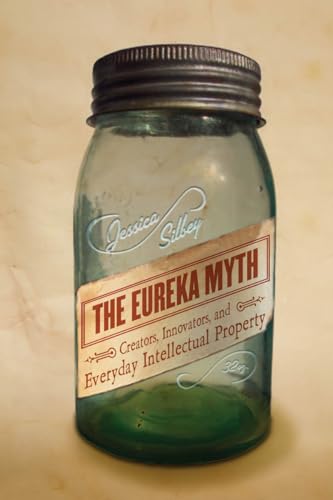
Are innovation and creativity helped or hindered by our intellectual property laws? In the two hundred plus years since the Constitution enshrined protections for those who create and innovate, we're still debating the merits of IP laws and whether or not they actually work as intended. Artists, scientists, businesses, and the lawyers who serve them, as well as the Americans who benefit from their creations all still wonder: what facilitates innovation and creativity in our digital age? And what role, if any, do our intellectual property laws play in the growth of innovation and creativity in the United States?
Incentivizing the "progress of science and the useful arts" has been the goal of intellectual property law since our constitutional beginnings. The Eureka Myth cuts through the current debates and goes straight to the source: the artists and innovators themselves. Silbey makes sense of the intersections between intellectual property law and creative and innovative activity by centering on the stories told by artists, scientists, their employers, lawyers and managers, describing how and why they create and innovate and whether or how IP law plays a role in their activities. Their employers, business partners, managers, and lawyers also describe their role in facilitating the creative and innovative work. Silbey's connections and distinctions made between the stories and statutes serve to inform present and future innovative and creative communities.
Breaking new ground in its examination of the U.S. economy and cultural identity, The Eureka Myth draws out new and surprising conclusions about the sometimes misinterpreted relationships between creativity and intellectual property protections.
Incentivizing the "progress of science and the useful arts" has been the goal of intellectual property law since our constitutional beginnings. The Eureka Myth cuts through the current debates and goes straight to the source: the artists and innovators themselves. Silbey makes sense of the intersections between intellectual property law and creative and innovative activity by centering on the stories told by artists, scientists, their employers, lawyers and managers, describing how and why they create and innovate and whether or how IP law plays a role in their activities. Their employers, business partners, managers, and lawyers also describe their role in facilitating the creative and innovative work. Silbey's connections and distinctions made between the stories and statutes serve to inform present and future innovative and creative communities.
Breaking new ground in its examination of the U.S. economy and cultural identity, The Eureka Myth draws out new and surprising conclusions about the sometimes misinterpreted relationships between creativity and intellectual property protections.
Die Inhaltsangabe kann sich auf eine andere Ausgabe dieses Titels beziehen.
Über die Autorinnen und Autoren
Jessica Silbey is Professor of Law at Suffolk University Law School. Professor Silbey's work engages a cultural analysis of law. Professor Silbey has written for various journals and news outlets, and is coeditor of Law and Justice on the Small Screen (2012).
Jessica Silbey is Professor of Law at Suffolk University Law School. Professor Silbey's work engages a cultural analysis of law. Professor Silbey has written for various journals and news outlets, and is coeditor of Law and Justice on the Small Screen (2012).
Auszug. © Genehmigter Nachdruck. Alle Rechte vorbehalten.
The Eureka Myth
Creators, Innovators, and Everyday Intellectual Property
By Jessica SilbeySTANFORD UNIVERSITY PRESS
Copyright © 2015 Board of Trustees of the Leland Stanford Junior University
All rights reserved.
ISBN: 978-0-8047-8338-5All rights reserved.
Contents
Acknowledgments,
Introduction,
1. Inspired Beginnings,
2. Daily Craft: Work Makes Work,
3. Making Do with a Mismatch,
4. Reputation,
5. Instruction: How Lawyers Harvest Intellectual Property,
6. Distribution,
Conclusion,
Appendix A. Research Methods and Data Analysis,
Appendix B. Interviewees,
Notes,
Bibliography,
Index,
CHAPTER 1
Inspired Beginnings
THE "EUREKA" MOMENT experienced by artists and scientists is a well-known cliché, depicted in cartoons as a lightbulb appearing over one's head. Indeed, artists and scientists do experience these moments of transcendent discovery as they work. Throughout the interviews I conducted for this book, I heard some version of the eureka moment in response to questions such as, "How did you become an artist?" or "What influenced your path toward scientific research?" This chapter unpacks the mythology of these moments to examine how they arise.
Despite the frequency of these moments of discovery, the language and story types that accompany them are more complex and varied than simply "I woke up one day and the idea came to me." To be sure, whether in the arts or the sciences, many of the interviewees describe ideas coming to them as if unconsciously, or as one writer says, as "a voice passing through" her. But these individuals also, at the same time, describe various activities and complex social structures that nourish their work, particular reasons for being in certain places at certain times, and diverse circumstances that led to the production of work that may eventually become intellectual property. The eureka moment is only one facet of the creation stories that interviewees tell. And yet the law that purports to govern the origination, production, and promotion of art and science does not reflect this situational complexity; instead, it appears to be structured around or explained by the stereotyped eureka moment. The law appears to rely on individual will and luck and eschews the connected and communal creativity and innovation that is the everyday work of creators and innovators.
When asked about their beginnings in the creative or innovative fields, many interviewees described some sort of origin story—a personal beginning pregnant with meaning beyond simply its causal role in producing a career or identity. Origin stories permeate our culture, from the creation of humanity in Genesis to the special meaning that the story of our children's birth takes in our own family ("the day you were born"). Genesis is the preeminent origin story, establishing the beginning of human civilization with God's creation of man in God's image and the subordination of Eve through her birth (origin) from Adam's rib. The myth of the United States' constitutional founding, the manner and motive for signing of the Declaration of Independence, and the deliberative engagement of the founding fathers continue to justify political and socioeconomic relationships among citizens and the government. Origin stories, like all narratives, make sense of the present in terms of a past moment, seeming to speak to "the essential nature of self and society." They are uniquely persuasive as explanations for an individual's life or a society's contours by conflating the inquiry "Where did we come from?" with the question "Who are we?"
I therefore analyze the origin stories in these interviews closely. When people answer questions about how they began their career or why they pursued a certain direction and not another, they do not provide just one explanation. To be sure, they often answer the question with a single starting point, to which they ascribe special importance. For example, a theoretical chemist (whom I'll call Robert) explains his start in molecular modeling this way:
My girlfriend [in graduate school] ... happened to be an applied mathematician, ... and I just learned all the applied math stuff ... [which] turned out [to be] ... useful in doing theoretical chemistry ... but a lot of people in chemistry didn't know that stuff because they hadn't had this experience.
A visual artist, Sadie, recounts her beginning in art as a consequence of her mother dying at a young age and thereafter searching to be more like her mother and close to her even in her death.
We tell stories to make sense of our lives, as individuals and a society. (Perhaps there is no other kind of sense than that which we make through narratives.) Often, these stories take recognizable forms; on their face, these inspired beginnings seem to be generically straightforward origin myths. But no story has a singular meaning or significance. Within these stories of inspired beginnings are descriptions of diverse influences and resources that shaped their paths. When studied in light of the entire extended conversation we shared and the many additional details about the interviewees' career, the "once upon a time" quality of these origin stories recedes as the complexity of life's circumstances manifests more broadly. In this chapter, I examine both the commonalities and the variations among inspired beginnings in order to move us from a clichéd beginning to a fuller comprehension of how creativity and innovation happen. This will subsequently enable a fuller critique of the law's regulation of creative and innovative production.
Law and policy discussions of creativity and innovation do not dwell on the moment of creation or discovery, although "first in time" and "originators" of work are glorified and specially protected by US law. Instead, most legal policy conversations today revolve around incentives, either conflating extrinsic motivations (e.g., financial reward) with intrinsic motivations (e.g., emotional pleasure) or presuming a hierarchical relation between them, thus subordinating intrinsic motivation to financial reward. As the Supreme Court famously wrote about copyright, quoting Samuel Johnson, "No man but a blockhead ever wrote, except for money." In other words, as the dominant legal story goes, we work (at art or science) primarily to earn a living.
Despite driving intellectual property law and policy discussions, the pecuniary gains to which an intellectual property owner is entitled are at best obliquely mentioned among the artists' and scientists' accounts of inspired beginnings, if at all. The absence of an economic incentive in the beginning correlates with recent studies that highlight the role of intellectual challenge and personal interest as intrinsic motivations. Empirical studies also track the positive role that attribution and contribution have on collective social goods in motivating artistic and scientific production. In asking interviewees questions about how they got started writing a draft novel or conducting a scientific experiment, such as "How did you get into this line of work?" or "What prompted you to embark on that project?" I expected to hear a variety of answers, including "To earn a living" or "I was looking for remunerative work." But these were rarely the responses. In fact, when pushed, many interviewees expressed surprise that they could earn a modest living from the artistic or scientific work about which they were passionate.
The dynamics of these origin stories do not completely displace...
„Über diesen Titel“ kann sich auf eine andere Ausgabe dieses Titels beziehen.
Suchergebnisse für The Eureka Myth: Creators, Innovators, and Everyday...

Beispielbild für diese ISBN
The Eureka Myth : Creators, Innovators, and Everyday Intellectual Property
Verlag:
Stanford University Press, 2014
ISBN 10: 0804783381
ISBN 13: 9780804783385
Gebraucht
Softcover
Anbieter: Better World Books, Mishawaka, IN, USA
Verkäuferbewertung 5 von 5 Sternen

Zustand: Good. Pages intact with minimal writing/highlighting. The binding may be loose and creased. Dust jackets/supplements are not included. Stock photo provided. Product includes identifying sticker. Better World Books: Buy Books. Do Good. Artikel-Nr. 68664129-6
Gebraucht kaufen
EUR 12,70
Versand gratis
Versand innerhalb von USA
Versand innerhalb von USA
Anzahl: 1 verfügbar
Beispielbild für diese ISBN
The Eureka Myth: Creators, Innovators, and Everyday Intellectual Property
Anbieter: Anybook.com, Lincoln, Vereinigtes Königreich
Verkäuferbewertung 5 von 5 Sternen
Zustand: Good. This is an ex-library book and may have the usual library/used-book markings inside.This book has soft covers. In good all round condition. Library sticker on front cover. Please note the Image in this listing is a stock photo and may not match the covers of the actual item,600grams, ISBN:9780804783385. Artikel-Nr. 3969558
Gebraucht kaufen
EUR 16,29
EUR 15,57 Versand
Versand von Vereinigtes Königreich nach USA
Versand von Vereinigtes Königreich nach USA
Anzahl: 1 verfügbar
Beispielbild für diese ISBN
The Eureka Myth
Anbieter: PBShop.store UK, Fairford, GLOS, Vereinigtes Königreich
Verkäuferbewertung 5 von 5 Sternen
PAP. Zustand: New. New Book. Shipped from UK. Established seller since 2000. Artikel-Nr. GB-9780804783385
Neu kaufen
EUR 31,78
EUR 5,99 Versand
Versand von Vereinigtes Königreich nach USA
Versand von Vereinigtes Königreich nach USA
Anzahl: 1 verfügbar
Beispielbild für diese ISBN
The Eureka Myth: Creators, Innovators, and Everyday Intellectual Property
Anbieter: Ria Christie Collections, Uxbridge, Vereinigtes Königreich
Verkäuferbewertung 5 von 5 Sternen
Zustand: New. In English. Artikel-Nr. ria9780804783385_new
Neu kaufen
EUR 34,24
EUR 13,48 Versand
Versand von Vereinigtes Königreich nach USA
Versand von Vereinigtes Königreich nach USA
Anzahl: 2 verfügbar
Beispielbild für diese ISBN
Eureka Myth
Anbieter: Kennys Bookstore, Olney, MD, USA
Verkäuferbewertung 5 von 5 Sternen
Zustand: New. 2014. 1st Edition. paperback. . . . . . Books ship from the US and Ireland. Artikel-Nr. V9780804783385
Neu kaufen
EUR 41,14
EUR 9,37 Versand
Versand innerhalb von USA
Versand innerhalb von USA
Anzahl: 1 verfügbar
Beispielbild für diese ISBN
The Eureka Myth Creators, Innovators, and Everyday Intellectual Property
Anbieter: Revaluation Books, Exeter, Vereinigtes Königreich
Verkäuferbewertung 5 von 5 Sternen
Paperback. Zustand: Brand New. 320 pages. 8.75x6.00x1.00 inches. In Stock. Artikel-Nr. xr0804783381
Neu kaufen
EUR 38,17
EUR 14,93 Versand
Versand von Vereinigtes Königreich nach USA
Versand von Vereinigtes Königreich nach USA
Anzahl: 2 verfügbar
Foto des Verkäufers
The Eureka Myth : Creators, Innovators, and Everyday Intellectual Property
Verlag:
Stanford University Press Dez 2014, 2014
ISBN 10: 0804783381
ISBN 13: 9780804783385
Neu
Taschenbuch
Anbieter: AHA-BUCH GmbH, Einbeck, Deutschland
Verkäuferbewertung 5 von 5 Sternen
Taschenbuch. Zustand: Neu. Neuware - Are innovation and creativity helped or hindered by our intellectual property laws In the two hundred plus years since the Constitution enshrined protections for those who create and innovate, we're still debating the merits of IP laws and whether or not they actually work as intended. Artists, scientists, businesses, and the lawyers who serve them, as well as the Americans who benefit from their creations all still wonder: what facilitates innovation and creativity in our digital age And what role, if any, do our intellectual property laws play in the growth of innovation and creativity in the United States Incentivizing the 'progress of science and the useful arts' has been the goal of intellectual property law since our constitutional beginnings. The Eureka Myth cuts through the current debates and goes straight to the source: the artists and innovators themselves. Silbey makes sense of the intersections between intellectual property law and creative and innovative activity by centering on the stories told by artists, scientists, their employers, lawyers and managers, describing how and why they create and innovate and whether or how IP law plays a role in their activities. Their employers, business partners, managers, and lawyers also describe their role in facilitating the creative and innovative work. Silbey's connections and distinctions made between the stories and statutes serve to inform present and future innovative and creative communities. Breaking new ground in its examination of the U.S. economy and cultural identity, The Eureka Myth draws out new and surprising conclusions about the sometimes misinterpreted relationships between creativity and intellectual property protections. Artikel-Nr. 9780804783385
Neu kaufen
EUR 35,29
EUR 35,00 Versand
Versand von Deutschland nach USA
Versand von Deutschland nach USA
Anzahl: 1 verfügbar
Beispielbild für diese ISBN
THE EUREKA MYTH CREATORS INNOVATORS A
Anbieter: Speedyhen, Hertfordshire, Vereinigtes Königreich
Verkäuferbewertung 5 von 5 Sternen
Zustand: NEW. Artikel-Nr. NW9780804783385
Neu kaufen
EUR 25,28
EUR 48,95 Versand
Versand von Vereinigtes Königreich nach USA
Versand von Vereinigtes Königreich nach USA
Anzahl: 1 verfügbar
Foto des Verkäufers
The Eureka Myth: Creators, Innovators, and Everyday Intellectual Property
Anbieter: moluna, Greven, Deutschland
Verkäuferbewertung 5 von 5 Sternen
Zustand: New. Über den AutorrnrnJessica Silbey is Professor of Law at Suffolk University Law School. Professor Silbey s work engages a cultural analysis of law. Professor Silbey has written for various journals and news outlets, and is coeditor of. Artikel-Nr. 867670832
Neu kaufen
EUR 32,08
EUR 48,99 Versand
Versand von Deutschland nach USA
Versand von Deutschland nach USA
Anzahl: 1 verfügbar
Foto des Verkäufers
The Eureka Myth | Creators, Innovators, and Everyday Intellectual Property
Anbieter: preigu, Osnabrück, Deutschland
Verkäuferbewertung 5 von 5 Sternen
Taschenbuch. Zustand: Neu. The Eureka Myth | Creators, Innovators, and Everyday Intellectual Property | Jessica Silbey | Taschenbuch | Einband - flex.(Paperback) | Englisch | 2014 | Stanford University Press | EAN 9780804783385 | Verantwortliche Person für die EU: Libri GmbH, Europaallee 1, 36244 Bad Hersfeld, gpsr[at]libri[dot]de | Anbieter: preigu. Artikel-Nr. 121029365
Neu kaufen
EUR 36,70
EUR 70,00 Versand
Versand von Deutschland nach USA
Versand von Deutschland nach USA
Anzahl: 1 verfügbar