
Verwandte Artikel zu Getting to Zero: The Path to Nuclear Disarmament
Inhaltsangabe
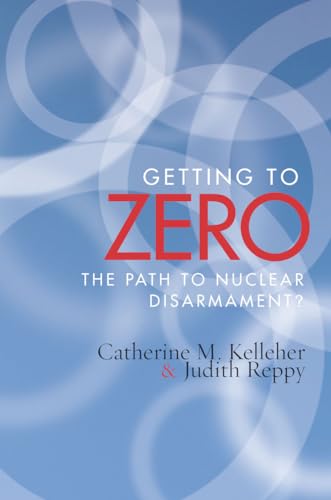
Getting to Zero takes on the much-debated goal of nuclear zero-exploring the serious policy questions raised by nuclear disarmament and suggesting practical steps for the nuclear weapon states to take to achieve it.
It documents the successes and failures of six decades of attempts to control nuclear weapons proliferation and, within this context, asks the urgent questions that world leaders, politicians, NGOs, and scholars must address in the years ahead.
Die Inhaltsangabe kann sich auf eine andere Ausgabe dieses Titels beziehen.
Über die Autorinnen und Autoren
Catherine M. Kelleher is a Senior Fellow at the Watson Institute, Brown University, a College Park Professor at the University of Maryland, and Professor Emerita at the U.S. Naval War College. Judith Reppy is Professor Emerita in the Department of Science and Technology Studies and Associate Director of the Judith Reppy Institute for Peace and Conflict Studies at Cornell University.
Catherine M. Kelleher is a Senior Fellow at the Watson Institute, Brown University, a College Park Professor at the University of Maryland, and Professor Emerita at the U.S. Naval War College.Judith Reppy is Professor Emerita in the Department of Science and Technology Studies and Associate Director of the Judith Reppy Institute for Peace and Conflict Studies at Cornell University.
Auszug. © Genehmigter Nachdruck. Alle Rechte vorbehalten.
GETTING TO ZERO
THE PATH TO NUCLEAR DISARMAMENTStanford University Press
Copyright © 2011 Board of Trustees of the Leland Stanford Junior UniversityAll right reserved.
ISBN: 978-0-8047-7702-5
Contents
Acknowledgments.........................................................................................................................ixAbbreviations...........................................................................................................................xiIntroduction Catherine McArdle Kelleher................................................................................................11 The Vision of a World Free of Nuclear Weapons David Holloway.........................................................................112 Advocacy for Nuclear Disarmament: A Global Revival? Randy Rydell.....................................................................283 Is a World without Nuclear Weapons Attainable? Comparative Perspectives on Goals and Prospects Götz Neuneck.....................434 The U.S. Nuclear Arsenal and Zero: Sizing and Planning for Use—Past, Present, and Future Lynn Eden.............................695 Nuclear Deterrence, Disarmament, and Nonproliferation Alexei G. Arbatov..............................................................906 British Thinking on Nuclear Weapons Ian Anthony......................................................................................1027 France's Nuclear Stance: Independence, Unilateralism, and Adaptation Venance Journé.............................................1248 Challenges for U.S.-China Strategic Stability in the Obama Administration Jeffrey lewis..............................................1499 Europe, Nuclear Disarmament, and Nonproliferation: What Next? Nadia Alexandrova-Arbatova.............................................16710 Israel's Nuclear Future: Iran, Opacity, and the Vision of Global Zero Avner Cohen...................................................18711 Iran Policy on the Way to Zero Jill Marie Lewis with Laicie Olson...................................................................20612 India and Nuclear Zero Waheguru Pal Singh Sidhu.....................................................................................22413 Fissile Materials and Disarmament: Long-term Goals, Short-term Steps James M. Acton.................................................24514 Nuclear Zero at the Weapons Laboratories Judith Reppy...............................................................................26015 Is the Civil Nuclear Industry Relevant to Nuclear Disarmament? Marco Deandreis and Simon Moore......................................28316 Nuclear Abolition or Nuclear Umbrella? Choices and Contradictions in U.S. Proposals Matthew Evangelista.............................29617 American Conventional Superiority: The Balancing Act Dennis M. Gormley..............................................................31718 Steps toward a World Free of Nuclear Weapons David Holloway.........................................................................34719 Practical Steps toward Nuclear Zero Peter Dombrowski................................................................................360Contributor Biographies.................................................................................................................385Index...................................................................................................................................391
Chapter One
The vision of a World Free of Nuclear WeaponsDavid Holloway
INTRODUCTION
The Reykjavik Summit meeting between General Secretary Mikhail Gorbachev and President Ronald Reagan, which took place in October 1986, was a very dramatic occasion. Deep reductions in strategic nuclear forces were discussed, and agreements seemed very close at hand. An additional session was arranged to try to resolve differences over SDI (the Strategic Defense Initiative). In the end no agreements were reached. At the time Reykjavik seemed to many to be a terrible failure, but historians now regard it as one of the most important of the Cold War summit meetings.
The possibility of getting rid of nuclear weapons altogether came up at the Reykjavik meeting, but it was not the central issue. Neither side formally proposed the elimination of nuclear weapons, though Gorbachev had made such a proposal in January 1986. The issue arose at Reykjavik in the heat of a discussion about the shape of START (the Strategic Arms Reduction Treaty) and the elimination of strategic weapons. Reagan and Gorbachev found themselves at cross purposes. The United States proposed that each side reduce its strategic offensive arms by 50 percent in the first five years of an agreement; during the following five years "the remaining fifty percent of the two sides' offensive ballistic missiles shall be reduced." Gorbachev wanted to know what would happen to the bombers in the second five years. What ensued seems from the transcript to have been an increasingly testy exchange, in which Reagan said, in apparent irritation: "It would be fine with [me] if we eliminated all nuclear weapons." Gorbachev responded: "We can do that. We can eliminate them." Secretary of State George Shultz added, "Let's do it." Reagan then went on to say that if they could agree to eliminate all nuclear weapons, [Reagan] thought they could turn it over to their Geneva people with that understanding, for them to draft up that agreement, and Gorbachev could come to the U.S. and sign it." Gorbachev agreed and then went on to talk about the treaty on strategic arms reductions.
Not everyone was happy that the issue of eliminating nuclear weapons had been raised at Reykjavik. There was a great deal of criticism in the United States and from NATO allies. According to Shultz, Secretary of Defense Casper Weinberger, National Security Advisor John Poindexter, and many in the State Department regarded Reykjavik "as a blunder of the greatest magnitude." Admiral William Crowe, chairman of the Joint Chiefs of Staff, told Reagan that the chiefs were alarmed by the idea of giving up ballistic missiles. Margaret Thatcher, who believed that nuclear weapons were absolutely essential for British security and for NATO, soon flew to Washington to make her displeasure clear to President Reagan. "Any leader who indulges in the Soviets' disingenuous fantasies of a nuclear-free world courts unimaginable perils," former president Richard Nixon and Henry Kissinger wrote six months later.
The brief discussion at Reykjavik of the elimination of nuclear weapons elicited another, more propitious, response. In October 2006, the Hoover Institution at Stanford University held a conference to mark the twentieth anniversary of the Reykjavik meeting. (Hoover is a conservative research institute often associated with the Republican Party.) The primary organizers were George Shultz, Reagan's secretary of state, and Sidney Drell, a Stanford physicist with a long involvement in national security issues and arms control. The aim of the conference was to rekindle the Reagan-Gorbachev vision of a world free of nuclear weapons. The participants were overwhelmingly American, and many of those present had taken part in the Reykjavik meeting.
The atmosphere at the conference was gloomy about the nuclear state of the world; the first North Korean nuclear test had taken place some days earlier. The Bush administration's efforts to stop nuclear proliferation were not working. The nonproliferation regime appeared to be failing, and there was a sense that something...
„Über diesen Titel“ kann sich auf eine andere Ausgabe dieses Titels beziehen.
Suchergebnisse für Getting to Zero: The Path to Nuclear Disarmament

Beispielbild für diese ISBN
Getting to Zero
Anbieter: PBShop.store UK, Fairford, GLOS, Vereinigtes Königreich
Verkäuferbewertung 5 von 5 Sternen

PAP. Zustand: New. New Book. Shipped from UK. Established seller since 2000. Artikel-Nr. FW-9780804777025
Neu kaufen
EUR 34,65
EUR 5,93 Versand
Versand von Vereinigtes Königreich nach USA
Versand von Vereinigtes Königreich nach USA
Anzahl: 15 verfügbar
Beispielbild für diese ISBN
Getting to Zero
Anbieter: Majestic Books, Hounslow, Vereinigtes Königreich
Verkäuferbewertung 4 von 5 Sternen

Zustand: New. pp. 432. Artikel-Nr. 5481298
Neu kaufen
EUR 40,88
EUR 7,68 Versand
Versand von Vereinigtes Königreich nach USA
Versand von Vereinigtes Königreich nach USA
Anzahl: 3 verfügbar
Beispielbild für diese ISBN
Getting to Zero: The Path to Nuclear Disarmament
Anbieter: Ria Christie Collections, Uxbridge, Vereinigtes Königreich
Verkäuferbewertung 5 von 5 Sternen
Zustand: New. In English. Artikel-Nr. ria9780804777025_new
Neu kaufen
EUR 38,74
EUR 13,34 Versand
Versand von Vereinigtes Königreich nach USA
Versand von Vereinigtes Königreich nach USA
Anzahl: Mehr als 20 verfügbar
Beispielbild für diese ISBN
Getting to Zero: The Path to Nuclear Disarmament
Anbieter: Kennys Bookstore, Olney, MD, USA
Verkäuferbewertung 5 von 5 Sternen
Zustand: New. Getting to Zero is an edited volume of chapters about the implications of total nuclear disarmament for international security and national security covering a range of perspectives. Num Pages: 432 pages. BIC Classification: JPSF. Category: (P) Professional & Vocational. Dimension: 229 x 157 x 24. Weight in Grams: 596. . 2011. Paperback. . . . . Books ship from the US and Ireland. Artikel-Nr. V9780804777025
Neu kaufen
EUR 48,81
EUR 9,38 Versand
Versand innerhalb von USA
Versand innerhalb von USA
Anzahl: Mehr als 20 verfügbar
Beispielbild für diese ISBN
Getting to Zero The Path to Nuclear Disarmament
Anbieter: Revaluation Books, Exeter, Vereinigtes Königreich
Verkäuferbewertung 5 von 5 Sternen
Paperback. Zustand: Brand New. 404 pages. 8.50x5.75x0.75 inches. In Stock. Artikel-Nr. x-0804777020
Neu kaufen
EUR 45,14
EUR 14,77 Versand
Versand von Vereinigtes Königreich nach USA
Versand von Vereinigtes Königreich nach USA
Anzahl: 2 verfügbar
Foto des Verkäufers
Getting to Zero: The Path to Nuclear Disarmament
Verlag:
STANFORD SECURITY STUDIES, 2011
ISBN 10: 0804777020
ISBN 13: 9780804777025
Neu
Kartoniert / Broschiert
Anbieter: moluna, Greven, Deutschland
Verkäuferbewertung 5 von 5 Sternen
Kartoniert / Broschiert. Zustand: New. Getting to Zero is an edited volume of chapters about the implications of total nuclear disarmament for international security and national security covering a range of perspectives.Über den AutorrnrnCatherine M. Kelleher is a Senior Fe. Artikel-Nr. 867670776
Neu kaufen
EUR 35,83
EUR 48,99 Versand
Versand von Deutschland nach USA
Versand von Deutschland nach USA
Anzahl: Mehr als 20 verfügbar
Foto des Verkäufers
Getting to Zero | The Path to Nuclear Disarmament
Anbieter: preigu, Osnabrück, Deutschland
Verkäuferbewertung 5 von 5 Sternen
Taschenbuch. Zustand: Neu. Getting to Zero | The Path to Nuclear Disarmament | Catherine M Kelleher (u. a.) | Taschenbuch | Einband - flex.(Paperback) | Englisch | 2011 | Stanford University Press | EAN 9780804777025 | Verantwortliche Person für die EU: Mare Nostrum Group B.V., Doelen 72, 4831 GR BREDA, NIEDERLANDE, gpsr[at]mare-nostrum[dot]co[dot]uk | Anbieter: preigu. Artikel-Nr. 107158130
Neu kaufen
EUR 33,05
EUR 70,00 Versand
Versand von Deutschland nach USA
Versand von Deutschland nach USA
Anzahl: 5 verfügbar