
Verwandte Artikel zu Effective Human Resource Management: A Global Analysis...
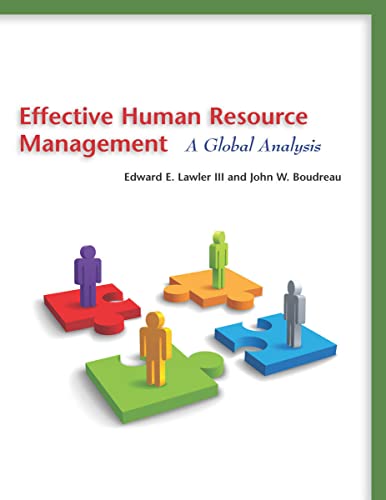
Effective Human Resource Management: A Global Analysis (Stanford Business Books (Paperback)) - Softcover
Inhaltsangabe
Effective Human Resource Management is the Center for Effective Organizations' (CEO) sixth report of a fifteen-year study of HR management in today's organizations. The only long-term analysis of its kind, this book compares the findings from CEO's earlier studies to new data collected in 2010. Edward E. Lawler III and John W. Boudreau measure how HR management is changing, paying particular attention to what creates a successful HR function—one that contributes to a strategic partnership and overall organizational effectiveness. Moreover, the book identifies best practices in areas such as the design of the HR organization and HR metrics. It clearly points out how the HR function can and should change to meet the future demands of a global and dynamic labor market.
For the first time, the study features comparisons between U.S.-based firms and companies in China, Canada, Australia, the United Kingdom, and other European countries. With this new analysis, organizations can measure their HR organization against a worldwide sample, assessing their positioning in the global marketplace, while creating an international standard for HR management.
Note on electronic editions: This book contains large tables that may not display clearly on a small screen. To easily read some of the tables, you may wish to use the desktop version of your selected reading system.BV_PDF
BV_EPUB
For the first time, the study features comparisons between U.S.-based firms and companies in China, Canada, Australia, the United Kingdom, and other European countries. With this new analysis, organizations can measure their HR organization against a worldwide sample, assessing their positioning in the global marketplace, while creating an international standard for HR management.
Note on electronic editions: This book contains large tables that may not display clearly on a small screen. To easily read some of the tables, you may wish to use the desktop version of your selected reading system.BV_PDF
BV_EPUB
Die Inhaltsangabe kann sich auf eine andere Ausgabe dieses Titels beziehen.
Über die Autorinnen und Autoren
Edward E. Lawler III is Distinguished Professor of Business and Founder and Director of the Center for Effective Organizations at the University of Southern California. John Boudreau is Professor at the Marshall School of Business, University of Southern California and Research Director at the Center for Effective Organizations.
Edward E. Lawler III is Distinguished Professor of Business and Founder and Director of the Center for Effective Organizations at the University of Southern California. John Boudreau is Professor at the Marshall School of Business, University of Southern California and Research Director at the Center for Effective Organizations.
Auszug. © Genehmigter Nachdruck. Alle Rechte vorbehalten.
Effective Human Resource Management
A Global Analysis
By Edward E. Lawler III, John W. BoudreauSTANFORD UNIVERSITY PRESS
Copyright © 2012 Board of Trustees of the Leland Stanford Junior University
All rights reserved.
ISBN: 978-0-8047-7687-5All rights reserved.
Contents
Copyright,
Title Page,
Tables and Exhibits,
Preface and Acknowledgments,
The Authors,
1 What HR Needs to Do,
2 Research Design,
3 Role of Human Resources,
4 Human Resources Role with Boards,
5 Business and HR Strategy,
6 HR Decision Science,
7 Design of the HR Organization,
8 Activities of the HR Organization,
9 HR Metrics and Analytics: Uses and Comprehensiveness,
10 HR Metrics and Analytics: Effectiveness,
11 Outsourcing,
12 Use of Information Technology,
13 Human Resources Skills,
14 Effectiveness of the HR Organization,
15 Determinants of HR Effectiveness,
16 Determinants of Organizational Performance,
17 How HR Has Changed,
18 What the Future of HR Should Be,
References,
Appendices,
CHAPTER 1
What HR Needs to Do
A changing workforce, global competition, advances in information technology, new knowledge, the 2008 global recession, demands for sustainable performance, and a host of other changes are forcing organizations to constantly examine and reevaluate how they operate (Lawler and Worley 2011). They are utilizing new technologies, changing their structures, redesigning work, relocating their workforces, and improving work processes to respond to an increasingly demanding, unpredictable, and global competitive environment. These important changes have significant implications for how their human capital should be managed and their human resources functions should operate. But are organizations changing their human capital management policies, practices, and processes? Are they redesigning their HR functions?
During the last decade it has been difficult to find a management book or business magazine that doesn't point out how many of the changes in the business world have made human capital—people—an organization's most important asset in the United States as well as in the rest of the developed world. Human capital management has been the focus of a great deal of writing focused on finding, motivating, developing, and monitoring the "right talent."
The annual reports of many corporations in North America, Europe, and Australia argue that their human capital and intellectual property are their most important assets. In many organizations, compensation is one of the largest, if not the largest, cost. In service organizations it often represents 70 to 80 percent of the total cost of doing business. Adding the costs of training and other human resources management activities to compensation costs means that the human resources function often has responsibility for a very large portion of an organization's total expenditures, and this portion is growing.
In most organizations the cost of human capital is not the only, or even the most important, determinant of an organization's effectiveness. Even when compensation accounts for very little of the cost of doing business, human capital has a significant impact on the performance of most organizations (Cascio 2000; Cascio and Boudreau 2011). In essence, without effective human capital, organizations are likely to have little or no revenue. Even the most automated production facilities require skilled, motivated employees to operate them. Knowledge-work organizations depend on employees to develop, use, and manage their most important asset, knowledge. Thus, although the human capital of a company does not appear on the balance sheet of corporations, it represents an increasingly large percentage of many organizations' market valuation (Lev 2001; Huselid, Becker, and Beatty 2005).
Not all organizations can or should look upon their human capital as a major source of competitive advantage (Lawler 2008). In some organizations it may be sufficient to simply have talent that can and will adequately do relatively simple jobs. But in an increasing number of organizations, having the best talent and talent management processes can be a source of competitive advantage. It can make it possible for companies to be more innovative and agile, develop superior products and customer knowledge, and offer superior services.
Role of the Human Resources Organization
The HR function typically adds value by performing an administrative role. The human resources function in most organizations plays a key role in determining how their human capital is managed and serviced. How well it does this helps determine how much value it adds. But two other roles that it can take on allow it to add greater value. Lawler (1995) has developed this line of thought by describing three roles HR can take on. The first is the familiar human resources management role (Exhibit 1.1).
The second is the role of business partner (Exhibit 1.2). It emphasizes developing systems and practices to ensure that a company's human resources have the needed competencies and motivation to perform effectively. In this approach, HR has a seat at the table when business issues are discussed and brings an HR perspective to these discussions. When it comes to designing HR systems and practices, this approach focuses on creating systems and practices that support the business strategy. HR focuses on the effectiveness of the human capital management practices and on process improvements in them. HR is expected to help implement changes and to help managers effectively deal with "people issues."
The business partner approach positions the HR function as a value-added part of an organization, so that it can contribute to business performance by effectively managing what is the most important capital of most organizations, their human capital (Ulrich 1997; Ulrich, Losey, and Lake 1997; Ulrich and Brockbank 2005). But this approach may not be the one that enables the HR function to add the greatest value given the increasingly important role that talent plays in determining organization performance. By becoming a strategic partner (see Exhibit 1.3), HR has the potential to add more value in those situations where human capital can be a difference maker.
In acting as a strategic partner, HR plays a role that includes helping the organization develop its strategy. Not only does HR have a seat at the strategy table, HR helps to set the table with information about organizational capabilities, talent analytics, and the labor market. It helps shape and enhance strategies by bringing a human capital decision science to strategy discussion.
In a knowledge business, a firm's strategy must be closely linked to its talent. Thus, the human resources function is well positioned to do both strategy formulation and implementation. Its expertise in attracting, retaining, developing, deploying, motivating, and organizing human capital is critical to both. Ideally, the HR function should be knowledgeable about the business and expert in organizational and work design issues so that it can help develop needed organizational capabilities and facilitate organizational change as new opportunities become available.
To be a strategic partner, HR executives need an expert understanding of business strategy, organization design, and change management, and they need to know how integrated human resources practices and strategies can support organization designs and...
„Über diesen Titel“ kann sich auf eine andere Ausgabe dieses Titels beziehen.
Suchergebnisse für Effective Human Resource Management: A Global Analysis...

Beispielbild für diese ISBN
Effective Human Resource Management: A Global Analysis (Stanford Business Books (Paperback))
Verlag:
Stanford University Press, 2012
ISBN 10: 0804776873
ISBN 13: 9780804776875
Gebraucht
Softcover
Anbieter: World of Books (was SecondSale), Montgomery, IL, USA
Verkäuferbewertung 5 von 5 Sternen

Zustand: Good. Item in good condition. Textbooks may not include supplemental items i.e. CDs, access codes etc. Artikel-Nr. 00102810784
Gebraucht kaufen
EUR 7,31
Versand gratis
Versand innerhalb von USA
Versand innerhalb von USA
Anzahl: 1 verfügbar
Beispielbild für diese ISBN
Effective Human Resource Management : A Global Analysis
Verlag:
Stanford University Press, 2012
ISBN 10: 0804776873
ISBN 13: 9780804776875
Gebraucht
Softcover
Anbieter: Better World Books, Mishawaka, IN, USA
Verkäuferbewertung 5 von 5 Sternen
Zustand: Very Good. Former library copy. Pages intact with possible writing/highlighting. Binding strong with minor wear. Dust jackets/supplements may not be included. Includes library markings. Stock photo provided. Product includes identifying sticker. Better World Books: Buy Books. Do Good. Artikel-Nr. 14336652-75
Gebraucht kaufen
EUR 7,32
Versand gratis
Versand innerhalb von USA
Versand innerhalb von USA
Anzahl: 1 verfügbar
Beispielbild für diese ISBN
Effective Human Resource Management : A Global Analysis
Verlag:
Stanford University Press, 2012
ISBN 10: 0804776873
ISBN 13: 9780804776875
Gebraucht
Softcover
Anbieter: Better World Books, Mishawaka, IN, USA
Verkäuferbewertung 5 von 5 Sternen
Zustand: Good. Former library copy. Pages intact with minimal writing/highlighting. The binding may be loose and creased. Dust jackets/supplements are not included. Includes library markings. Stock photo provided. Product includes identifying sticker. Better World Books: Buy Books. Do Good. Artikel-Nr. 42567286-75
Gebraucht kaufen
EUR 7,32
Versand gratis
Versand innerhalb von USA
Versand innerhalb von USA
Anzahl: 1 verfügbar
Beispielbild für diese ISBN
Effective Human Resource Management: A Global Analysis (Stanford Business Books (Paperback))
Verlag:
Stanford University Press (edition 1), 2012
ISBN 10: 0804776873
ISBN 13: 9780804776875
Gebraucht
Paperback
Anbieter: BooksRun, Philadelphia, PA, USA
Verkäuferbewertung 5 von 5 Sternen
Paperback. Zustand: Very Good. 1. It's a well-cared-for item that has seen limited use. The item may show minor signs of wear. All the text is legible, with all pages included. It may have slight markings and/or highlighting. Artikel-Nr. 0804776873-11-1
Gebraucht kaufen
EUR 7,34
Versand gratis
Versand innerhalb von USA
Versand innerhalb von USA
Anzahl: 1 verfügbar
Beispielbild für diese ISBN
Effective Human Resource Management: A Global Analysis (Stanford Business Books (Paperback))
Verlag:
Stanford University Press July 2012, 2012
ISBN 10: 0804776873
ISBN 13: 9780804776875
Gebraucht
Paper Back
Anbieter: Eagle Eye Books, Decatur, GA, USA
Verkäuferbewertung 4 von 5 Sternen

Paper Back. Zustand: Used. Artikel-Nr. 673042
Gebraucht kaufen
EUR 10,99
EUR 3,42 Versand
Versand innerhalb von USA
Versand innerhalb von USA
Anzahl: 1 verfügbar
Beispielbild für diese ISBN
Effective Human Resource Management
Anbieter: PBShop.store UK, Fairford, GLOS, Vereinigtes Königreich
Verkäuferbewertung 5 von 5 Sternen
PAP. Zustand: New. New Book. Shipped from UK. Established seller since 2000. Artikel-Nr. FW-9780804776875
Neu kaufen
EUR 37,69
EUR 5,86 Versand
Versand von Vereinigtes Königreich nach USA
Versand von Vereinigtes Königreich nach USA
Anzahl: 1 verfügbar
Foto des Verkäufers
Effective Human Resource Management : A Global Analysis
Verlag:
Stanford University Press Jul 2012, 2012
ISBN 10: 0804776873
ISBN 13: 9780804776875
Neu
Taschenbuch
Anbieter: AHA-BUCH GmbH, Einbeck, Deutschland
Verkäuferbewertung 5 von 5 Sternen
Taschenbuch. Zustand: Neu. Neuware - Effective Human Resource Management is the Center for Effective Organizations' (CEO) sixth report of a fifteen-year study of HR management in today's organizations. The only long-term analysis of its kind, this book compares the findings from CEO's earlier studies to new data collected in 2010. Edward E. Lawler III and John W. Boudreau measure how HR management is changing, paying particular attention to what creates a successful HR function-one that contributes to a strategic partnership and overall organizational effectiveness. Moreover, the book identifies best practices in areas such as the design of the HR organization and HR metrics. It clearly points out how the HR function can and should change to meet the future demands of a global and dynamic labor market. For the first time, the study features comparisons between U.S.-based firms and companies in China, Canada, Australia, the United Kingdom, and other European countries. With this new analysis, organizations can measure their HR organization against a worldwide sample, assessing their positioning in the global marketplace, while creating an international standard for HR management. Artikel-Nr. 9780804776875
Neu kaufen
EUR 35,00
EUR 30,50 Versand
Versand von Deutschland nach USA
Versand von Deutschland nach USA
Anzahl: 1 verfügbar
Beispielbild für diese ISBN
Effective Human Resource Management A Global Analysis
Anbieter: Revaluation Books, Exeter, Vereinigtes Königreich
Verkäuferbewertung 5 von 5 Sternen
Paperback. Zustand: Brand New. 196 pages. 11.00x8.00x0.50 inches. In Stock. Artikel-Nr. x-0804776873
Neu kaufen
EUR 52,95
EUR 14,60 Versand
Versand von Vereinigtes Königreich nach USA
Versand von Vereinigtes Königreich nach USA
Anzahl: 2 verfügbar
Beispielbild für diese ISBN
Effective Human Resource Management: A Global Analysis
Anbieter: Kennys Bookstore, Olney, MD, USA
Verkäuferbewertung 5 von 5 Sternen
Zustand: New. 2012. Paperback. . . . . . Books ship from the US and Ireland. Artikel-Nr. V9780804776875
Neu kaufen
EUR 58,72
EUR 8,99 Versand
Versand innerhalb von USA
Versand innerhalb von USA
Anzahl: 1 verfügbar
Foto des Verkäufers
Effective Human Resource Management: A Global Analysis
Anbieter: moluna, Greven, Deutschland
Verkäuferbewertung 5 von 5 Sternen
Zustand: New. This book presents an evidence-based analysis of the human resources function in an international sample of organizations, showing how the HR function is changing, how it needs to change, and what makes for an effective human resources management strategy. Artikel-Nr. 595016154
Neu kaufen
EUR 34,41
EUR 48,99 Versand
Versand von Deutschland nach USA
Versand von Deutschland nach USA
Anzahl: 1 verfügbar