
Verwandte Artikel zu On Uneven Ground: Miyazawa Kenji and the Making of...
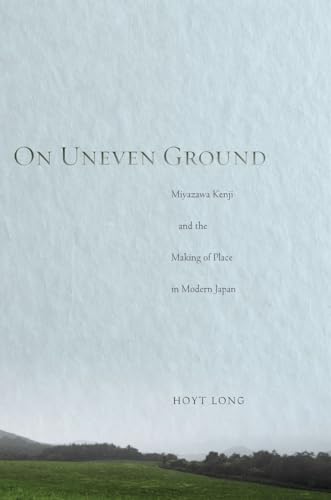
Inhaltsangabe
The history of literary and artistic production in modern Japan has typically centered on the literature and art of Tokyo, yet cultural activity in the country's regional cities and rural towns was no less vibrant. On Uneven Ground recovers pieces of this neglected history through the figure of Miyazawa Kenji (1896-1933). While alive, he remained a mostly unknown and unread provincial author whose experiments with narrative fiction, amateur theater, and farmer's art reveal an intense determination to reimagine and remake his native place, in the northeast of Japan, meaningful.
Today, Miyazawa is one of the most recognized figures in Japan's modern literary canon. The story of his radical posthumous rise presents an opportunity to examine the larger history of how writing and other forms of artistic practice have intersected with place-based identity and the uneven geography of cultural production. The first book-length study of Miyazawa in English, On Uneven Ground centers on Miyazawa's life and writing to recreate a sense of what it was to write about and remake place from a spatially marginal position in the cultural field.
Die Inhaltsangabe kann sich auf eine andere Ausgabe dieses Titels beziehen.
Über die Autorin bzw. den Autor
Hoyt Long is Assistant Professor of Japanese Literature, Department of East Asian Languages and Civilizations, University of Chicago.
Auszug. © Genehmigter Nachdruck. Alle Rechte vorbehalten.
On Uneven Ground
MIYAZAWA KENJI AND THE MAKING OF PLACE IN MODERN JAPANBy Hoyt LongSTANFORD UNIVERSITY PRESS
Copyright © 2012 Board of Trustees of the Leland Stanford Junior UniversityAll right reserved.
ISBN: 978-0-8047-7686-8
Contents
Acknowledgments...................................................................viiA Note on Naming..................................................................ixPrologue: Making Place for the Author.............................................11. Finding Value in Locality......................................................173. Toward a Provincializing Literary Production...................................554. Making Space for a New Literary Region.........................................795. Conversations with Nature......................................................1036. Performing the Village Square..................................................1337. Farmers' Art in an Age of Cosmopolitan Agrarianism.............................159Epilogue: Trading Places..........................................................193Notes.............................................................................209Bibliography......................................................................271Index.............................................................................287
Chapter One
Finding Value in Locality
Capitalizing on Place
In the late 1990s, Tokyo's Ginza district welcomed a new member to its collection of high-end department stores, brand-name outlets, and trendy boutiques. Under the banner of "Iwate Ginga Puraza" (Iwate Milky Way Plaza), this new addition, situated across from the famous Kabuki-za Theater, was a retail outlet designed to offer a number of distinct services to the Tokyo consumer curious about Japan's northern prefecture of Iwate. Travel advice and business consultation were among some of the primary services on hand, but the biggest draw was to be the ready availability of traditional souvenirs and local foodstuffs shipped direct from "chilly Iwate." Here was a chance to consume the region, or at least a small piece of it, without actually having to be there. If the flavors of Iwate failed to suit you, however, you could always sample from one of the many other "antenna shops" (so-called because they help to feel out consumer response) to appear in Tokyo's trendiest neighborhoods at this time. It was a concept that proved so successful that by 2009, 35 of the country's 47 prefectures were represented by one or more of these shops, each seeking to enhance the brand recognition of their respective locales against a wash of other designer names and labels.
If the Iwate Ginga Plaza set itself apart from the competition in any way, it was with its name. Ginga (Milky Way) is a deliberate reference to Night of the Milky Way Railroad (Ginga tetsudo no yoru), the famous novella by native son Miyazawa Kenji. This fantastic tale depicting the spiritual journey of two young boys who hurdle through space on a galactic train is arguably one of his most recognized works. Because of this, the word ginga has come to assume a metonymic role by which it infuses objects from Iwate—whether beer (Ginga Alpine Beer), a rail line (Iwate Ginga Railway), or an assisted living home (Ginga Village)—with any positive connotations that the term, and by extension the figure of Miyazawa, can be made to conjure up. Thus its adoption by the Plaza. Ginga, however, only scratches the surface of the work that Miyazawa and his texts have been made to perform in the service of acts of place making.
This work began almost immediately after his death and initially followed a conventional trajectory. Friends, fellow poets, and fans would, in the interest of commemorating his passing, collect funds for large poetry stones to be placed near landmarks and topographical features alluded to in his verse. Seventy of these impressive stones are now scattered throughout Iwate, and if plotted on a map would serve as a cartographic record of his extensive wanderings. By the 1980s, this traditional form of intersection between text, author, and locality gradually came to be superseded by more capital intensive projects. In 1982, for instance, fans of his work raised funds for a Miyazawa Kenji museum to be erected near his hometown. Built on a forested hilltop (Koshio-zan) that appears in several of his poems as a sacred site, it soon attracted visitors from all across the country and by the late 1990s was one of the most popular literary museums of its kind. The realization that Miyazawa had such popular appeal opened the door to more commercial ventures, including a water park called "Kenji World" built in 1995; a small-scale amusement park built in 1996 to bring his fictional world to life via diorama and high-tech display; and an assortment of tours and guidebooks meant to introduce visitors to sites associated with him or his writings. Today, his connection with the Iwate landscape is so entrenched that the mere fact of his association with a particular built structure or natural site can determine how that site is developed or otherwise utilized by the community. In 2005, to cite but a recent example, a famous geodetic observatory built in 1920 was spared demolition when fans, who claimed it as a key inspiration for Night of the Milky Way Railroad, successfully lobbied for its preservation.
Part of the reason I began On Uneven Ground was to understand why Miyazawa and his artistic legacy have proved so successful in contemporary practices of place construction and local branding, and so infinitely more adaptable to these practices than some of the more staid faces of the literary canon. What have made his narratives and biography so good for thinking and constructing a version of locality that others find valuable? And why, for instance, has the Iwate Ginga Plaza been so willing to invest in him as a symbol of Iwate, going so far as to have once renamed the boulevard in front of the store "Kenji Street" as part of a two-day exhibition of regional foods, crafts, and folk performance? As I proceeded to wrestle with these questions, the problem became for me both a historical and a theoretical one. Historical because the success of Miyazawa in this regard has, as we will see, much to do with the conditions under which his fiction was produced and the ways he and his work were rescued from obscurity. Theoretical because the history of his relation to a particular locality and to acts of place making cannot be told without inquiring first into the nature of locality as an object of social and cultural value. How and under what conditions is this value produced? How and why is it sustained? Are there transhistorical processes underpinning its production? How should we situate this value in a system of competing values? And most critically, how do values assigned to a locale intersect with the physical locality itself? It soon became apparent that to try to understand why Miyazawa holds such significance for contemporary practices of place making was to ask after the longer history of how locality has been made and made relevant in modern Japan, but also how it is we can measure that relevance at all.
The simplest answer to the question of how the value of a place or locality is produced is to say that it is through the notion of "difference." A local product, for instance, comes to have value for both seller and consumer because it is perceived to be only here or there and nowhere...
„Über diesen Titel“ kann sich auf eine andere Ausgabe dieses Titels beziehen.
Suchergebnisse für On Uneven Ground: Miyazawa Kenji and the Making of...

Foto des Verkäufers
On Uneven Ground - Miyazawa Kenji and the Making of Place in Modern Japan
Verlag:
Stanford University Press, 2011
ISBN 10: 0804776865
ISBN 13: 9780804776868
Gebraucht
Hardcover
Erstausgabe
Anbieter: Milbury Books, New Romney, Vereinigtes Königreich
Verkäuferbewertung 5 von 5 Sternen

Hardcover. Zustand: Fine. Zustand des Schutzumschlags: Near Fine. 1st Edition. A Fine (As New) 1st Edition copy in a Near Fine dust wrapper which displays only very light hints of use. The first major study of Miyazawa Kenji (1896-1933) in English. Please see five pictures attached for a closer look. Artikel-Nr. ABE-1764090546743
Gebraucht kaufen
EUR 45,57
EUR 25,36 Versand
Versand von Vereinigtes Königreich nach USA
Versand von Vereinigtes Königreich nach USA
Anzahl: 1 verfügbar
Beispielbild für diese ISBN
On Uneven Ground
Anbieter: PBShop.store UK, Fairford, GLOS, Vereinigtes Königreich
Verkäuferbewertung 5 von 5 Sternen
HRD. Zustand: New. New Book. Shipped from UK. Established seller since 2000. Artikel-Nr. FW-9780804776868
Neu kaufen
EUR 83,18
EUR 5,92 Versand
Versand von Vereinigtes Königreich nach USA
Versand von Vereinigtes Königreich nach USA
Anzahl: 1 verfügbar
Beispielbild für diese ISBN
On Uneven Ground: Miyazawa Kenji and the Making of Place in Modern Japan
Anbieter: Ria Christie Collections, Uxbridge, Vereinigtes Königreich
Verkäuferbewertung 5 von 5 Sternen
Zustand: New. In English. Artikel-Nr. ria9780804776868_new
Neu kaufen
EUR 88,56
EUR 13,32 Versand
Versand von Vereinigtes Königreich nach USA
Versand von Vereinigtes Königreich nach USA
Anzahl: 1 verfügbar
Beispielbild für diese ISBN
On Uneven Ground: Miyazawa Kenji and the Making of Place in Modern Japan
Anbieter: Kennys Bookstore, Olney, MD, USA
Verkäuferbewertung 5 von 5 Sternen
Zustand: New. Num Pages: 312 pages. BIC Classification: 2GJ; DSBH; DSC. Category: (P) Professional & Vocational. Dimension: 5817 x 3887 x 585. Weight in Grams: 556. . 2011. Hardcover. . . . . Books ship from the US and Ireland. Artikel-Nr. V9780804776868
Neu kaufen
EUR 116,92
EUR 9,37 Versand
Versand innerhalb von USA
Versand innerhalb von USA
Anzahl: 1 verfügbar
Beispielbild für diese ISBN
On Uneven Ground Miyazawa Kenji and the Making of Place in Modern Japan
Anbieter: Revaluation Books, Exeter, Vereinigtes Königreich
Verkäuferbewertung 5 von 5 Sternen
Hardcover. Zustand: Brand New. 298 pages. 9.50x6.25x0.75 inches. In Stock. Artikel-Nr. x-0804776865
Neu kaufen
EUR 116,23
EUR 14,75 Versand
Versand von Vereinigtes Königreich nach USA
Versand von Vereinigtes Königreich nach USA
Anzahl: 2 verfügbar
Foto des Verkäufers
On Uneven Ground: Miyazawa Kenji and the Making of Place in Modern Japan
Anbieter: moluna, Greven, Deutschland
Verkäuferbewertung 5 von 5 Sternen
Zustand: New. Über den AutorrnrnHoyt Long is Assistant Professor of Japanese Literature, Department of East Asian Languages and Civilizations, University of Chicago.KlappentextThe history of literary and artistic production. Artikel-Nr. 595016153
Neu kaufen
EUR 88,07
EUR 48,99 Versand
Versand von Deutschland nach USA
Versand von Deutschland nach USA
Anzahl: Mehr als 20 verfügbar
Foto des Verkäufers
On Uneven Ground : Miyazawa Kenji and the Making of Place in Modern Japan
Verlag:
Stanford University Press Dez 2011, 2011
ISBN 10: 0804776865
ISBN 13: 9780804776868
Neu
Hardcover
Anbieter: AHA-BUCH GmbH, Einbeck, Deutschland
Verkäuferbewertung 5 von 5 Sternen
Buch. Zustand: Neu. Neuware - The history of literary and artistic production in modern Japan has typically centered on the literature and art of Tokyo, yet cultural activity in the country's regional cities and rural towns was no less vibrant. On Uneven Ground recovers pieces of this neglected history through the figure of Miyazawa Kenji (1896-1933). While alive, he remained a mostly unknown and unread provincial author whose experiments with narrative fiction, amateur theater, and farmer's art reveal an intense determination to reimagine and remake his native place, in the northeast of Japan, meaningful. Today, Miyazawa is one of the most recognized figures in Japan's modern literary canon. The story of his radical posthumous rise presents an opportunity to examine the larger history of how writing and other forms of artistic practice have intersected with place-based identity and the uneven geography of cultural production. The first book-length study of Miyazawa in English, On Uneven Ground centers on Miyazawa's life and writing to recreate a sense of what it was to write about and remake place from a spatially marginal position in the cultural field. Artikel-Nr. 9780804776868
Neu kaufen
EUR 119,42
EUR 35,00 Versand
Versand von Deutschland nach USA
Versand von Deutschland nach USA
Anzahl: 1 verfügbar