
Verwandte Artikel zu Bazaar Politics: Power and Pottery in an Afghan Market...
Bazaar Politics: Power and Pottery in an Afghan Market Town (Stanford Studies in Middle Eastern and Islamic Societies and Cultures) - Hardcover
Buch 6 von 51: Stanford Studies in Middle Eastern and Islamic Societies and Cultures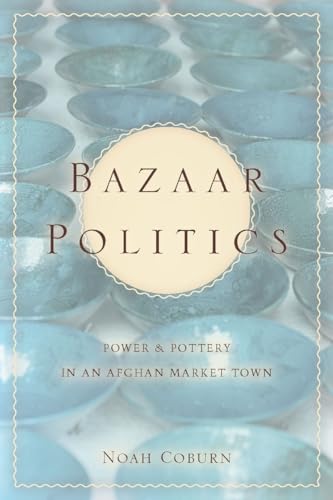
Inhaltsangabe
After the fall of the Taliban, instability reigned across Afghanistan. However, in the small town of Istalif, located a little over an hour north of Kabul and not far from Bagram on the Shomali Plain, local politics remained relatively violence-free. Bazaar Politics examines this seemingly paradoxical situation, exploring how the town's local politics maintained peace despite a long, violent history in a country dealing with a growing insurgency.
At the heart of this story are the Istalifi potters, skilled craftsmen trained over generations. With workshops organized around extended families and competition between workshops strong, kinship relations become political and subtle negotiations over power and authority underscore most interactions. Starting from this microcosm, Noah Coburn then investigates power and relationships at various levels, from the potters' families; to the local officials, religious figures, and former warlords; and ultimately to the international community and NGO workers.
Offering the first long-term on-the-ground study since the arrival of allied forces in 2001, Noah Coburn introduces readers to daily life in Afghanistan through portraits of local residents and stories of his own experiences. He reveals the ways in which the international community has misunderstood the forces driving local conflict and the insurgency, misunderstandings that have ultimately contributed to the political unrest rather than resolved it. Though on first blush the potters of Istalif may seem far removed from international affairs, it is only through understanding politics, power, and culture on the local level that we can then shed new light on Afghanistan's difficult search for peace.
Die Inhaltsangabe kann sich auf eine andere Ausgabe dieses Titels beziehen.
Über die Autorinnen und Autoren
Noah Coburn has worked as a specialist for the United States Institute of Peace in Kabul, Afghanistan, as well as a researcher for the Afghanistan Research and Evaluation Unit and the Aga Khan Trust for Culture. Between 2006 and 2008, he spent eighteen months doing research in an Afghan village on the Shomali Plain. He holds a PhD in anthropology from Boston University, and has taught at the University of Michigan, Boston University, and Skidmore College.
Noah Coburn has worked as a specialist for the United States Institute of Peace in Kabul, Afghanistan, as well as a researcher for the Afghanistan Research and Evaluation Unit and the Aga Khan Trust for Culture. Between 2006 and 2008, he spent eighteen months doing research in an Afghan village on the Shomali Plain. He holds a PhD in anthropology from Boston University, and has taught at the University of Michigan, Boston University, and Skidmore College.
Auszug. © Genehmigter Nachdruck. Alle Rechte vorbehalten.
Bazaar Politics
POWER AND POTTERY IN AN AFGHAN MARKET TOWNBy Noah CoburnStanford University Press
Copyright © 2011 Board of Trustees of the Leland Stanford Junior UniversityAll right reserved.
ISBN: 978-0-8047-7671-4
Contents
Preface............................................................................................ixA Rocky Road.......................................................................................11 Groups and Violence..............................................................................5Ethnography and Suspicion..........................................................................172 Social Organization in Istalif...................................................................22Making Pots........................................................................................323 How Making Pots Bound People Together............................................................34The Art of Finding a Bargain.......................................................................504 How Selling Pots Tore People Apart...............................................................53Telling Stories....................................................................................735 Leadership, Descent, and Marriage................................................................76Dinner.............................................................................................1036 Cultural Definitions of Power in Istalif.........................................................106Election Day.......................................................................................1427 Masterly Inactivity: The Politics of Stagnation..................................................145The Director of Intelligence.......................................................................1808 The Afghan State as a Useful Fiction.............................................................182Paktya-Eighteen Months Later.......................................................................2069 Thinking About Violence, Social Organization, and International Intervention.....................208Notes..............................................................................................225Bibliography.......................................................................................239Index..............................................................................................247
Chapter One
GROUPS AND VIOLENCE
AFTER THE FALL OF THE TALIBAN IN ISTALIF, a small town west of the Shomali Plain, there was a high degree of political tension, as well as numerous disputes over land and water, a tendency toward factionalism and feuding, and a reluctance to cooperate. Simultaneously, local politics remained relatively peaceful and free of violence. What created this seemingly paradoxical situation?
It is inadequate to say that the low rate of violence was a consequence of government and international military intervention, because these forces had little presence in Istalif. Towns that were closer to urban centers, and thus more susceptible to intervention, experienced significant violence. At the same time, the region was deeply divided ethnically, and there was intense competition for limited resources, as well as a general disillusionment with the Afghan government and the international presence. An examination of why Istalif remained peaceful has implications not only for how local politics in Afghanistan have shifted in the post-Taliban period, but also, more generally, how group organization shapes the presence or absence of violence. In many ways, academics and policy makers have misunderstood the forces driving local disputes and insurgency in Afghanistan, and, as a result, these elements have not been addressed very effectively by either the Afghan government or the international community.
Political power in Istalif was fractured. It coalesced around groups and categories of authority, such as maliks (local elders), who led patrilineal descent groups, and commanders (warlords), who led former militias. Some of the men referred to as warlords committed countless crimes against humanity during the civil war and Taliban period, but others were instrumental in filling the void left by the lack of a central government, keeping schools open, and providing security. In fact, most "warlords" in Istalif who were active in town politics during my research fall into this second category.
All of these groups were produced, and reproduced, by social and economic processes. They were distinguished from one another and represented by symbols, ranging from the hats they wore to the language they used. I initially looked at several lineages of potters who formed a guild-like group that cooperated—politically and economically—using the idiom of kinship. Often, however, these ties broke apart, particularly when potters competed in the marketplace. Other sources of political power, job opportunities in Kabul, and economic resources offered by aid groups also caused young men to attempt to build personal, semi-covert networks of allies outside their group.
Although tribe–state relations were the central focus of many anthropological studies in Afghanistan during the 1960s and 1970s, my research shows that the next thirty years of war and reconstruction significantly complicated political relations. In attendance at the meeting with the engineers from the Ministry of Rural Rehabilitation and Development described in the interlude "A Rocky Road," for example, were the district governor representing the central government, traditional elders, a former warlord, and two wealthy businessmen. Others vying for power in town included the mullah (the town's chief religious leader), French forces that regularly patrolled the area, an assortment of mostly small-sized non-governmental organizations (NGOs), and a police chief. A more structural study of Istalif might focus on the differences between groups. However, by abandoning traditional categorical approaches that focus on kinship or political terms such as tribe, clan, or state, and by using a more Barthian model of social formation focusing on the maintenance of boundaries, it becomes apparent that these were flexible groups that created a coherent political system in which all struggled for power. The system, in fact, created a struggle of "all versus all" that led not to a Hobbesian war and violence, but to temporary peace and stability.
My analysis focuses on patrilineal descent groups (qaums), religious leaders, a newly wealthy merchant class, former militia groups, the district government, the police, and international groups, including the military and NGOs. The chapters examine these models of social organization and cultural definitions of power, and explore how they shaped violence and local stability.
TIME AND PLACE
Istalif sits in the western foothills of the Shomali Plain. In older accounts this area was often referred to as Koh-e Dahman, skirt of the mountains. Occasionally it is included in the region called Kohistan, which more accurately refers to the mountains further north of Istalif. Today most people simply refer to Istalif as part of the Shomali Plain that includes the northern districts of Kabul Province and Parwan Province north to the Hindu Kush. People in Kabul often refer to Istalifis simply as Shomalis.
Istalif 's green hills and cool breezes offer a respite from the dusty heat of the plains below. Its fertile orchards and...
„Über diesen Titel“ kann sich auf eine andere Ausgabe dieses Titels beziehen.
Weitere beliebte Ausgaben desselben Titels

Suchergebnisse für Bazaar Politics: Power and Pottery in an Afghan Market...

Beispielbild für diese ISBN
Bazaar Politics
Anbieter: PBShop.store UK, Fairford, GLOS, Vereinigtes Königreich
Verkäuferbewertung 5 von 5 Sternen

HRD. Zustand: New. New Book. Shipped from UK. Established seller since 2000. Artikel-Nr. FW-9780804776714
Neu kaufen
EUR 89,76
EUR 5,87 Versand
Versand von Vereinigtes Königreich nach USA
Versand von Vereinigtes Königreich nach USA
Anzahl: 15 verfügbar
Beispielbild für diese ISBN
Bazaar Politics: Power and Pottery in an Afghan Market Town (Stanford Studies in Middle Eastern and I)
Anbieter: Majestic Books, Hounslow, Vereinigtes Königreich
Verkäuferbewertung 4 von 5 Sternen

Zustand: New. pp. 272. Artikel-Nr. 4268301
Neu kaufen
EUR 122,98
EUR 7,60 Versand
Versand von Vereinigtes Königreich nach USA
Versand von Vereinigtes Königreich nach USA
Anzahl: 3 verfügbar
Beispielbild für diese ISBN
Bazaar Politics
Anbieter: Kennys Bookstore, Olney, MD, USA
Verkäuferbewertung 5 von 5 Sternen
Zustand: New. Examining politics in a small Afghan town that managed to remain relatively peaceful in the years following the fall of the Taliban, this book calls examines how and when violence erupts and calls into question the international community's approach to developing stability in Afghanistan. Series: Stanford Studies in Middle Eastern and Islamic Societies and Cultures. Num Pages: 272 pages, Illustrations, map. BIC Classification: 1FCA; HBJF; JFC; JHMC. Category: (P) Professional & Vocational. Dimension: 5817 x 3887 x 23. Weight in Grams: 456. . 2011. 1st Edition. hardcover. . . . . Books ship from the US and Ireland. Artikel-Nr. V9780804776714
Neu kaufen
EUR 162,29
EUR 9,10 Versand
Versand innerhalb von USA
Versand innerhalb von USA
Anzahl: Mehr als 20 verfügbar
Foto des Verkäufers
Bazaar Politics: Power and Pottery in an Afghan Market Town
Anbieter: moluna, Greven, Deutschland
Verkäuferbewertung 5 von 5 Sternen
Zustand: New. Examining politics in a small Afghan town that managed to remain relatively peaceful in the years following the fall of the Taliban, this book calls examines how and when violence erupts and calls into question the international community s approach to deve. Artikel-Nr. 595016146
Neu kaufen
EUR 122,66
EUR 48,99 Versand
Versand von Deutschland nach USA
Versand von Deutschland nach USA
Anzahl: Mehr als 20 verfügbar
Beispielbild für diese ISBN
Bazaar Politics Power and Pottery in an Afghan Market Town
Anbieter: Revaluation Books, Exeter, Vereinigtes Königreich
Verkäuferbewertung 5 von 5 Sternen
Hardcover. Zustand: Brand New. 254 pages. 9.00x6.00x0.75 inches. In Stock. Artikel-Nr. x-0804776717
Neu kaufen
EUR 161,90
EUR 11,70 Versand
Versand von Vereinigtes Königreich nach USA
Versand von Vereinigtes Königreich nach USA
Anzahl: 2 verfügbar
Foto des Verkäufers
Bazaar Politics : Power and Pottery in an Afghan Market Town
Verlag:
Stanford University Press Sep 2011, 2011
ISBN 10: 0804776717
ISBN 13: 9780804776714
Neu
Hardcover
Anbieter: AHA-BUCH GmbH, Einbeck, Deutschland
Verkäuferbewertung 5 von 5 Sternen
Buch. Zustand: Neu. Neuware - After the fall of the Taliban, instability reigned across Afghanistan. However, in the small town of Istalif, located a little over an hour north of Kabul and not far from Bagram on the Shomali Plain, local politics remained relatively violence-free. Bazaar Politics examines this seemingly paradoxical situation, exploring how the town's local politics maintained peace despite a long, violent history in a country dealing with a growing insurgency. At the heart of this story are the Istalifi potters, skilled craftsmen trained over generations. With workshops organized around extended families and competition between workshops strong, kinship relations become political and subtle negotiations over power and authority underscore most interactions. Starting from this microcosm, Noah Coburn then investigates power and relationships at various levels, from the potters' families; to the local officials, religious figures, and former warlords; and ultimately to the international community and NGO workers. Offering the first long-term on-the-ground study since the arrival of allied forces in 2001, Noah Coburn introduces readers to daily life in Afghanistan through portraits of local residents and stories of his own experiences. He reveals the ways in which the international community has misunderstood the forces driving local conflict and the insurgency, misunderstandings that have ultimately contributed to the political unrest rather than resolved it. Though on first blush the potters of Istalif may seem far removed from international affairs, it is only through understanding politics, power, and culture on the local level that we can then shed new light on Afghanistan's difficult search for peace. Artikel-Nr. 9780804776714
Neu kaufen
EUR 167,00
EUR 62,45 Versand
Versand von Deutschland nach USA
Versand von Deutschland nach USA
Anzahl: 2 verfügbar