
Verwandte Artikel zu Asian Rivalries: Conflict, Escalation, and Limitations...
Inhaltsangabe
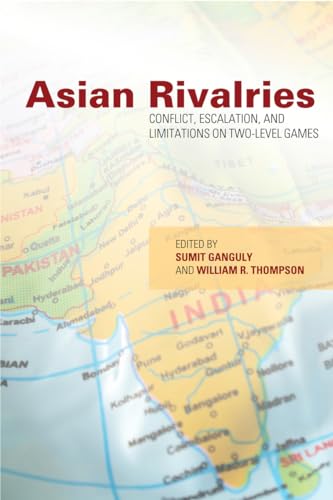
The most typical treatment of international relations is to conceive it as a battle between two antagonistic states volleying back and forth. In reality, interstate relations are often at least two-level games in which decision-makers operate not only in an international environment but also in a competitive domestic context.
Given that interstate rivalries are responsible for a disproportionate share of discord in world politics, this book sets out to explain just how these two-level rivalries really work.
By reference to specific cases, specialists on Asian rivalries examine three related questions: what is the mix of internal (domestic politics) and external (interstate politics) stimuli in the dynamics of their rivalries; in what types of circumstances do domestic politics become the predominant influence on rivalry dynamics; when domestic politics become predominant, is their effect more likely to lead to the escalation or de-escalation of rivalry hostility? By pulling together the threads laid out by each contributor, the editors create a 'grounded theory' for interstate rivalries that breaks new ground in international relations theory.
Die Inhaltsangabe kann sich auf eine andere Ausgabe dieses Titels beziehen.
Über die Autorinnen und Autoren
Sumit Ganguly holds the Rabindranath Tagore Chair in Indian Cultures and Civilizations at Indiana/Bloomington. William R. Thompson is Distinguished Professor & Donald A. Rogers Professor of Political Science at Indiana/Bloomington.
Sumit Ganguly holds the Rabindranath Tagore Chair in Indian Cultures and Civilizations at Indiana/Bloomington. William R. Thompson is Distinguished Professor & Donald A. Rogers Professor of Political Science at Indiana/Bloomington.
Auszug. © Genehmigter Nachdruck. Alle Rechte vorbehalten.
ASIAN RIVALRIES
Conflict, Escalation, and Limitations on Two-level GamesStanford University Press
Copyright © 2011 Board of Trustees of the Leland Stanford Junior UniversityAll right reserved.
ISBN: 978-0-8047-7596-0
Contents
List of Contributors...............................................................................................................vii1 Conflict Propensities in Asian Rivalries Sumit Ganguly and William R. Thompson..................................................12 China and Taiwan: Balance of Rivalry with Weapons of Mass Democratization Andrew Scobell.......................................263 Domestic Politics and the U.S.-China Rivalry Lyle J. Goldstein..................................................................444 Peace and Conflict in the Indo-Pakistani Rivalry: Domestic and Strategic Causes S. Paul Kapur...................................615 Instability in Tibet and the Sino-Indian Strategic Rivalry: Do Domestic Politics Matter? Manjeet S. Pardesi.....................796 The Sino-Russian Strategic Partnership: The End of Rivalry? Lowell Dittmer......................................................1187 The Rivalry Between the Two Koreas Samuel S. Kim................................................................................1458 Asymmetric Rivals: China and Vietnam Brantly Womack.............................................................................1769 Two-level Games in Asian Rivalries Sumit Ganguly and William R. Thompson........................................................195Notes..............................................................................................................................211Index..............................................................................................................................247
Chapter One
Conflict Propensities in Asian Rivalries Sumit Ganguly and William R. Thompson
It is possible to argue that the past decade has focused attention disproportionately on Middle Eastern international relations. This observation is not meant to slight the significance of Middle Eastern politics but only to note that we tend to focus mightily on the regions in which the most lethal activity is prominent. Middle Eastern international relations, without doubt, have been active and prominent. Other regions, therefore, have tended to receive less attention even though, ultimately, they may prove to be more significant to the fate of the twenty-first century. For instance, an easy case can be made that Asia will prove to be relatively more important than most other regions in this century. Compared to other regions, Asia contains more population and is becoming increasingly more central to the world economy. It also possesses the highest potential for conflict over regional hegemony and global leadership of any region. Wars between major powers may well be a thing of the past, but if they have any potential to take place at all, Asia is a most likely venue. Hence, if for no other reason, Asian international relations should have a strong claim on our attention.
But Asian international relations represent a rather broad set of phenomena—too broad to provide a good focus. We concentrate in this book on interstate rivalries—relationships between two states in which the antagonistic decision-makers perceive each other as competitors who see their adversaries as threatening enemies. Rivalries provide a good focus because they are one of the main vehicles for interstate conflict. That is, most states do not conflict with one another; rivals do and do so repeatedly as serial disputants. They certainly are responsible for much more than their proportional share of discord in world politics. If we are interested in the interstate conflict potential of Asia, then rivalries are the processes to watch. They are not exactly the canaries in the mineshaft; rather, they are the mineshaft.
This book brings together seven treatments of rivalry in Asia. We are certainly not the first to write about Asian rivalries, but we may be among the first to write about Asian rivalry processes in general—as opposed to the many studies of various aspects of specific, individual rivalries. One of our main goals in bringing together these essays is to make a pitch for more explicit study of Asian rivalries as rivalries—and not as simply long-term conflicts or disputes, each of which is entirely different. We do not argue that all Asian conflict is precisely the same. Far from it. But many Asian conflicts are framed by interstate rivalries, and it is the rivalry relationship per se that carries some potential for generalization. Yet that type of generalization can only come about if we recognize that some types of disputes are rivalries and treat them as representatives of a more general category. Greater sensitivity to the utility of explicit rivalry analysis should serve us well in deciphering the nature and implications of Asian conflict.
Analysts of Asian international politics engage in implicit rivalry analysis all the time. Making such analysis more explicit involves recognizing that some (but not all) interstate relationships qualify as rivalries and that rivalries are characterized by processes that bear some potential for generalization, as opposed to dealing with each pair of antagonists as a unique set of adversaries. In other words, the premise is that we should not be dependent solely on area expertise in decoding what hostile states are up to. If we improve our understanding of how rivalries work in general, then the possibility of marrying area expertise with rivalry theory should enhance our ability to understand and cope with dangerous situations.
Our second motivation for bringing together these essays is to address a particular question about international politics in general and Asian rivalries in particular. The most typical treatment of international relations is to conceive it as a tennis match between two states. Beijing did X to Washington and Washington responded with Y. This imagery reflects a conceptualization involving two mythical, unitary decision-makers volleying back and forth. Sometimes, the conceptualization reflects a shorthand way of focusing on who is doing what to whom, but all too often people (journalists, analysts, decision-makers, and the proverbial man/woman-in-the-street) actually perceive international relations between two states operating along these lines. We know better. We know that interstate relations are often at least two-level games in which decision-makers operate in competitive domestic and international environments. Action X by a state may represent a signal to another state, it may be oriented toward domestic political consumption, or both at the same time. The problem is that elites compete for control of governments and governmental policies while at the same time they devise strategies for competing with other states.
Which type of competition is more important in understanding interstate actions? Do we need to integrate both levels to make sense of international relations? Or, does this "need" vary by place, time, or issue area? Are some regions less susceptible to two-level games than others? Have two-level games become more likely than they were in the past due to democratization or the increased availability of information? Are all types of international politics equally susceptible to two-level gaming? For example, it may be one thing to threaten trade protectionism with a domestic audience...
„Über diesen Titel“ kann sich auf eine andere Ausgabe dieses Titels beziehen.
Suchergebnisse für Asian Rivalries: Conflict, Escalation, and Limitations...

Beispielbild für diese ISBN
Asian Rivalries
Anbieter: PBShop.store UK, Fairford, GLOS, Vereinigtes Königreich
Verkäuferbewertung 5 von 5 Sternen

PAP. Zustand: New. New Book. Shipped from UK. Established seller since 2000. Artikel-Nr. FW-9780804775960
Neu kaufen
EUR 29,83
EUR 4,84 Versand
Versand von Vereinigtes Königreich nach USA
Versand von Vereinigtes Königreich nach USA
Anzahl: 15 verfügbar
Beispielbild für diese ISBN
Asian Rivalries: Conflict, Escalation, and Limitations on Two-level Games
Anbieter: Majestic Books, Hounslow, Vereinigtes Königreich
Verkäuferbewertung 4 von 5 Sternen

Zustand: New. pp. 272. Artikel-Nr. 4270598
Neu kaufen
EUR 34,70
EUR 7,56 Versand
Versand von Vereinigtes Königreich nach USA
Versand von Vereinigtes Königreich nach USA
Anzahl: 3 verfügbar
Beispielbild für diese ISBN
Asian Rivalries: Conflict, Escalation, and Limitations on Two-level Games
Anbieter: Ria Christie Collections, Uxbridge, Vereinigtes Königreich
Verkäuferbewertung 5 von 5 Sternen
Zustand: New. In English. Artikel-Nr. ria9780804775960_new
Neu kaufen
EUR 33,40
EUR 10,89 Versand
Versand von Vereinigtes Königreich nach USA
Versand von Vereinigtes Königreich nach USA
Anzahl: Mehr als 20 verfügbar
Beispielbild für diese ISBN
Asian Rivalries Conflict, Escalation, and Limitations on Twolevel Games
Anbieter: Revaluation Books, Exeter, Vereinigtes Königreich
Verkäuferbewertung 5 von 5 Sternen
Paperback. Zustand: Brand New. 259 pages. 9.00x6.00x0.75 inches. In Stock. Artikel-Nr. x-0804775966
Neu kaufen
EUR 35,96
EUR 11,63 Versand
Versand von Vereinigtes Königreich nach USA
Versand von Vereinigtes Königreich nach USA
Anzahl: 2 verfügbar
Beispielbild für diese ISBN
Asian Rivalries: Conflict, Escalation, and Limitations on Two-Level Games
Anbieter: Kennys Bookstore, Olney, MD, USA
Verkäuferbewertung 5 von 5 Sternen
Zustand: New. 2011. 1st Edition. paperback. . . . . . Books ship from the US and Ireland. Artikel-Nr. V9780804775960
Neu kaufen
EUR 41,88
EUR 9,23 Versand
Versand innerhalb von USA
Versand innerhalb von USA
Anzahl: Mehr als 20 verfügbar
Foto des Verkäufers
Asian Rivalries: Conflict, Escalation, and Limitations on Two-Level Games
Verlag:
STANFORD SECURITY STUDIES, 2011
ISBN 10: 0804775966
ISBN 13: 9780804775960
Neu
Kartoniert / Broschiert
Anbieter: moluna, Greven, Deutschland
Verkäuferbewertung 5 von 5 Sternen
Kartoniert / Broschiert. Zustand: New. The first book that explores and explains the complex two-level rivalries (domestic and inter-state) that exist between states-such as India and Pakistan-that are engaged in serial conflict .Über den AutorrnrnSumit Ganguly holds the Ra. Artikel-Nr. 595016112
Neu kaufen
EUR 29,87
EUR 48,99 Versand
Versand von Deutschland nach USA
Versand von Deutschland nach USA
Anzahl: Mehr als 20 verfügbar
Foto des Verkäufers
Asian Rivalries | Conflict, Escalation, and Limitations on Two-Level Games
Anbieter: preigu, Osnabrück, Deutschland
Verkäuferbewertung 5 von 5 Sternen
Taschenbuch. Zustand: Neu. Asian Rivalries | Conflict, Escalation, and Limitations on Two-Level Games | Sumit Ganguly (u. a.) | Taschenbuch | Einband - flex.(Paperback) | Englisch | 2011 | Stanford University Press | EAN 9780804775960 | Verantwortliche Person für die EU: Mare Nostrum Group B.V., Doelen 72, 4831 GR BREDA, NIEDERLANDE, gpsr[at]mare-nostrum[dot]co[dot]uk | Anbieter: preigu. Artikel-Nr. 107853831
Neu kaufen
EUR 28,00
EUR 70,00 Versand
Versand von Deutschland nach USA
Versand von Deutschland nach USA
Anzahl: 5 verfügbar
Beispielbild für diese ISBN
Asian Rivalries : Conflict, Escalation, and Limitations on Two-Level Games
Verlag:
Stanford University Press, 2011
ISBN 10: 0804775966
ISBN 13: 9780804775960
Gebraucht
Softcover
Anbieter: Buchpark, Trebbin, Deutschland
Verkäuferbewertung 5 von 5 Sternen
Zustand: Sehr gut. Zustand: Sehr gut | Seiten: 272 | Sprache: Englisch | Produktart: Bücher | The first book that explores and explains the complex two-level rivalries (domestic and inter-state) that exist between states-such as India and Pakistan-that are engaged in "serial conflict". Artikel-Nr. 10888630/122
Gebraucht kaufen
EUR 20,22
EUR 105,00 Versand
Versand von Deutschland nach USA
Versand von Deutschland nach USA
Anzahl: 1 verfügbar