
Verwandte Artikel zu Beyond Expulsion: Jews, Christians, and Reformation...
Beyond Expulsion: Jews, Christians, and Reformation Strasbourg (Stanford Studies in Jewish History and Culture) - Hardcover
Buch 43 von 119: Stanford Studies in Jewish History and Culture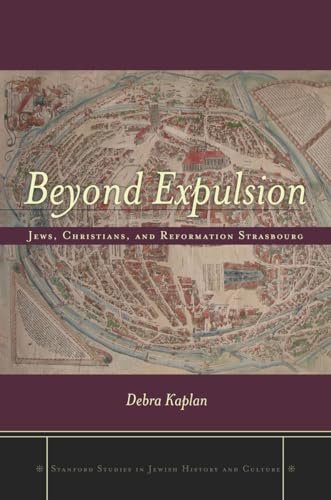
Inhaltsangabe
Beyond Expulsion is a history of Jewish-Christian interactions in early modern Strasbourg, a city from which the Jews had been expelled and banned from residence in the late fourteenth century. This study shows that the Jews who remained in the Alsatian countryside continued to maintain relationships with the city and its residents in the ensuing period. During most of the sixteenth century, Jews entered Strasbourg on a daily basis, where they participated in the city's markets, litigated in its courts, and shared their knowledge of Hebrew and Judaica with Protestant Reformers. By the end of the sixteenth century, Strasbourg became an increasingly orthodox Lutheran city, and city magistrates and religious leaders sought to curtail contact between Jews and Christians. This book unearths the active Jewish participation in early modern society, traces the impact of the Reformation on local Jews, discusses the meaning of tolerance, and describes the shifting boundaries that divided Jewish and Christian communities.
Die Inhaltsangabe kann sich auf eine andere Ausgabe dieses Titels beziehen.
Über die Autorin bzw. den Autor
Debra Kaplan is Dr. Pinkhos Churgin Memorial Assistant Professor at Yeshiva University.
Auszug. © Genehmigter Nachdruck. Alle Rechte vorbehalten.
Beyond Expulsion
Jews, Christians, and Reformation StrasbourgBy Debra KaplanSTANFORD UNIVERSITY PRESS
Copyright © 2011 Debra KaplanAll right reserved.
ISBN: 978-0-8047-7442-0
Contents
List of Illustrations......................................................................................................................................ixAcknowledgments............................................................................................................................................xiNote on Currency, Spelling, and Translations...............................................................................................................xvIntroduction: Beyond Expulsion: A Paradigm Shift...........................................................................................................11. "Our City Is Seen as Greatly Superior": Strasbourg and Its Reformation..................................................................................122. "Without Trees, the Fire Will Be Extinguished": Reinventing Jewish Life in the Rural Sphere.............................................................263. Shared Spaces: Social Interactions in the Countryside...................................................................................................494. Creating Jewish Space in the Christian City: The Jews and Strasbourg's Markets..........................................................................695. "As Is Also Apparent in the Old Chronicles and History Books": Magisterial Laws, Confession Building, and Reformation-Era Tolerance.....................936. "I Listened to the Account of a Jew": Christian Hebraism in Strasbourg..................................................................................1197. Constructing Jewish Memory: Self-Texts, the Reformation, and Narratives of Jewish History...............................................................144Conclusion: Becoming French: Alsatian Jews in the Wake of Confession Building..............................................................................165Notes......................................................................................................................................................173Bibliography...............................................................................................................................................221Index......................................................................................................................................................247
Chapter One
One "Our City Is Seen as Greatly Superior" Strasbourg and Its Reformation
At the turn of the sixteenth century, Strasbourg's renowned humanist, Jacob Wimpheling, described the "greatly superior" city of Strasbourg:
In these things, our city is seen as greatly superior, and more complete than other cities: with churches, chapels, relics, hospitals, convents; with a decorated cathedral; with an Episcopal see; libraries of books; men who are learned in all the arts; with schools of the mendicant orders; architects; the expulsion of the Jews; delightful buildings, beautiful streets and areas; with ramparts, trenches, towers, enclosures, bulwarks, chutes; common land, surrounding countryside; arms, weapons, horses, artillery, rifles; guardians, nobles, knighthood, models of artisanship; a history of reason; the beginning and origin of print; with the health and good of the air, with gentle wind; with wonderful, plentiful water; with communal freedom to hunt [animals and birds]; with fertile land, pastures, meadows, gardens; fish flowing in the current [to be] caught; also cattle, wild game, birds; corn, wine, fruit; wealth and poverty; commerce; tolls, debt collectors, interest; a model, beautiful fish market; fortresses and castles; countryside and people; cities and villages.
Despite the obvious embellishment, Strasbourg did possess many of these features. Its location was a desirable one, for the city was situated on the Rhine and Ill rivers, in close proximity to the fertile Vosges Mountains. It was these resources that led to the establishment of the city, then called Argentoratum, in Roman times. Taking great pride in the city's ancient history, later residents, especially Strasbourg's humanists, often referred to it by its old Latin name. Similarly, the painter Conrad Morant described the city on a map he designed in 1548:
Argentoratum, which is as old as Ptolemy, Saint Jerome, Orosius, Eutropius, Marcellinus and other memorable people. The metropolis of Alsace, next to the Rhine River ... in vernacular called Strasbourg, a city of pious doctrine and virtue.... (See Figure 1.)
The geographic appeal of Strasbourg served it well during the medieval and early modern periods, for it became the major center in the Lower Rhine, especially in terms of trade. Wine produced from grapes grown in Alsatian vineyards in the Vosges was shipped north on the Ill and on the Rhine, as were wheat and barley grown in the surrounding countryside. Madder, a crop that was used industrially as a dye, was shipped south. Strasbourg was a center for the redistribution of cattle, and served as a market for the textiles produced in Lower Alsace.
The Medieval City
During the Middle Ages, Strasbourg's natural encirclement of the Ill River was reinforced with the construction of walls, towers, and gates. In addition, seven churches and a cathedral chapter were constructed. Renovations on the city's cathedral, l'Oeuvre Notre Dame, began at the end of the thirteenth century and continued through the mid-fourteenth century. Icons, stained glass windows, and scenes from the Song of Songs, the Last Judgment, and other sources in the Old and New Testaments were designed to adorn the cathedral. Several convents were also built, as were houses of the mendicant orders. There were several large plazas in the city, including one just outside the cathedral, as well as the Kornmarkt and Rossmarkt, the corn and horse markets. By the twelfth century, Strasbourg also had a Jewish population, attracted by its location and marketplaces. Strasbourg's Jewish community was largely situated in the city center, its synagogue and ritual bath located just blocks from the cathedral and some of the marketplaces.
The economic centrality and religious vibrancy of medieval Strasbourg made it an important center beyond the Lower Rhine. Its significance in the Holy Roman Empire was also due to the independent legal status that the city had won. The Empire comprised many overlapping political jurisdictions, and while the emperor nominally ruled over the entire Empire, powerful princes, both ecclesiastical and lay, controlled vast territories and wielded great political power. In the early medieval period, Strasbourg had been governed by its bishop, the largest landowner in Lower Alsace. As the city grew institutionally and economically, the city council wrested control from its bishop, gaining legal independence after a war that lasted from 1260 to 1262. The bishop's official residence was moved from Strasbourg to Saverne. From that point on, the council, comprised mainly of patricians called Constoffler, assumed responsibility for governing the city's affairs. The bishop was still tied to the city, for he was elected by the church canons residing there. The city remained part of his diocese, theoretically under his religious guidance, although no longer legally under his political authority.
Strasbourg's status as a self-governing city...
„Über diesen Titel“ kann sich auf eine andere Ausgabe dieses Titels beziehen.
Suchergebnisse für Beyond Expulsion: Jews, Christians, and Reformation...

Beispielbild für diese ISBN
Beyond Expulsion
Verlag:
MK - Stanford University Press, 2011
ISBN 10: 0804774420
ISBN 13: 9780804774420
Neu
Hardcover
Anbieter: PBShop.store UK, Fairford, GLOS, Vereinigtes Königreich
Verkäuferbewertung 5 von 5 Sternen

HRD. Zustand: New. New Book. Shipped from UK. Established seller since 2000. Artikel-Nr. FW-9780804774420
Neu kaufen
EUR 83,51
EUR 5,94 Versand
Versand von Vereinigtes Königreich nach USA
Versand von Vereinigtes Königreich nach USA
Anzahl: 1 verfügbar
Beispielbild für diese ISBN
Beyond Expulsion: Jews, Christians, and Reformation Strasbourg (Stanford Studies in Jewish History and Culture)
Anbieter: Ria Christie Collections, Uxbridge, Vereinigtes Königreich
Verkäuferbewertung 5 von 5 Sternen
Zustand: New. In English. Artikel-Nr. ria9780804774420_new
Neu kaufen
EUR 88,85
EUR 13,36 Versand
Versand von Vereinigtes Königreich nach USA
Versand von Vereinigtes Königreich nach USA
Anzahl: 1 verfügbar
Beispielbild für diese ISBN
Beyond expulsion: Jews, Christians, and Reformation Strasbourg
Verlag:
Stanford University Press, 2011
ISBN 10: 0804774420
ISBN 13: 9780804774420
Gebraucht
Softcover/Taschenbuch
Anbieter: Antiquariat Wortschatz, Markt Hartmannsdorf, Österreich
Verkäuferbewertung 5 von 5 Sternen
Softcover/Taschenbuch. Zustand: Sehr gut. k.A. (illustrator). . Auflage. Anzahl Bände: - Bd.Nr.: - Sprache: en - Einband: Paperback - Gewicht: 501 - Illust.: k.A. - Zustand: Sehr gut - leichte Lager- und Gebrauchsspuren. Artikel-Nr. 275702
Gebraucht kaufen
EUR 47,00
EUR 60,00 Versand
Versand von Österreich nach USA
Versand von Österreich nach USA
Anzahl: 1 verfügbar
Beispielbild für diese ISBN
Beyond Expulsion
Anbieter: Majestic Books, Hounslow, Vereinigtes Königreich
Verkäuferbewertung 4 von 5 Sternen

Zustand: New. pp. 272. Artikel-Nr. 3543885
Neu kaufen
EUR 104,21
EUR 7,69 Versand
Versand von Vereinigtes Königreich nach USA
Versand von Vereinigtes Königreich nach USA
Anzahl: 1 verfügbar
Beispielbild für diese ISBN
Beyond Expulsion: Jews, Christians, and Reformation Strasbourg
Anbieter: Kennys Bookstore, Olney, MD, USA
Verkäuferbewertung 5 von 5 Sternen
Zustand: New. Beyond Expulsion is the history of Jewish-Christian relations during the Protestant Reformation in Strasbourg, a city from which Jews had been expelled and banned. Series: Stanford Studies in Jewish History and Culture. Num Pages: 272 pages, Illustrations, map. BIC Classification: HRJP. Category: (P) Professional & Vocational. Dimension: 5817 x 3887 x 23. Weight in Grams: 456. . 2011. Hardcover. . . . . Books ship from the US and Ireland. Artikel-Nr. V9780804774420
Neu kaufen
EUR 111,44
EUR 9,36 Versand
Versand innerhalb von USA
Versand innerhalb von USA
Anzahl: 1 verfügbar
Beispielbild für diese ISBN
Beyond Expulsion Jews, Christians, and Reformation Strasbourg
Anbieter: Revaluation Books, Exeter, Vereinigtes Königreich
Verkäuferbewertung 5 von 5 Sternen
Hardcover. Zustand: Brand New. 254 pages. 9.00x6.00x1.00 inches. In Stock. Artikel-Nr. x-0804774420
Neu kaufen
EUR 116,94
EUR 14,79 Versand
Versand von Vereinigtes Königreich nach USA
Versand von Vereinigtes Königreich nach USA
Anzahl: 2 verfügbar
Foto des Verkäufers
Beyond Expulsion : Jews, Christians, and Reformation Strasbourg
Verlag:
Stanford University Press Jul 2011, 2011
ISBN 10: 0804774420
ISBN 13: 9780804774420
Neu
Hardcover
Anbieter: AHA-BUCH GmbH, Einbeck, Deutschland
Verkäuferbewertung 5 von 5 Sternen
Buch. Zustand: Neu. Neuware - Beyond Expulsion is a history of Jewish-Christian interactions in early modern Strasbourg, a city from which the Jews had been expelled and banned from residence in the late fourteenth century. This study shows that the Jews who remained in the Alsatian countryside continued to maintain relationships with the city and its residents in the ensuing period. During most of the sixteenth century, Jews entered Strasbourg on a daily basis, where they participated in the city's markets, litigated in its courts, and shared their knowledge of Hebrew and Judaica with Protestant Reformers. By the end of the sixteenth century, Strasbourg became an increasingly orthodox Lutheran city, and city magistrates and religious leaders sought to curtail contact between Jews and Christians. This book unearths the active Jewish participation in early modern society, traces the impact of the Reformation on local Jews, discusses the meaning of tolerance, and describes the shifting boundaries that divided Jewish and Christian communities. Artikel-Nr. 9780804774420
Neu kaufen
EUR 109,66
EUR 35,00 Versand
Versand von Deutschland nach USA
Versand von Deutschland nach USA
Anzahl: 2 verfügbar
Foto des Verkäufers
Beyond Expulsion
Verlag:
Stanford University Press Jul 2011, 2011
ISBN 10: 0804774420
ISBN 13: 9780804774420
Neu
Hardcover
Anbieter: Books-by-Floh, Paderborn, Deutschland
Verkäuferbewertung 4 von 5 Sternen
Buch. Zustand: Neu. Neuware -Beyond Expulsion is a history of Jewish-Christian interactions in early modern Strasbourg, a city from which the Jews had been expelled and banned from residence in the late fourteenth century. This study shows that the Jews who remained in the Alsatian countryside continued to maintain relationships with the city and its residents in the ensuing period. During most of the sixteenth century, Jews entered Strasbourg on a daily basis, where they participated in the city's markets, litigated in its courts, and shared their knowledge of Hebrew and Judaica with Protestant Reformers. By the end of the sixteenth century, Strasbourg became an increasingly orthodox Lutheran city, and city magistrates and religious leaders sought to curtail contact between Jews and Christians. This book unearths the active Jewish participation in early modern society, traces the impact of the Reformation on local Jews, discusses the meaning of tolerance, and describes the shifting boundaries that divided Jewish and Christian communities. 272 pp. Englisch. Artikel-Nr. 9780804774420
Neu kaufen
EUR 103,25
EUR 105,00 Versand
Versand von Deutschland nach USA
Versand von Deutschland nach USA
Anzahl: 2 verfügbar