
Verwandte Artikel zu Modern China's Network Revolution: Chambers of...
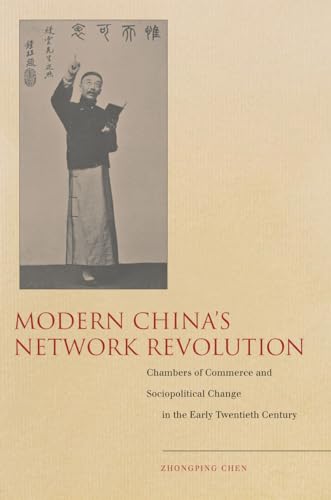
Modern China's Network Revolution: Chambers of Commerce and Sociopolitical Change in the Early Twentieth Century - Hardcover
Inhaltsangabe
Chambers of commerce developed in China as a key part of its sociopolitical changes. In 1902, the first Chinese chamber of commerce appeared in Shanghai. By the time the Qing dynasty ended, over 1,000 general chambers, affiliated chambers, and branch chambers had been established throughout China.
In this new work, author Zhongping Chen examines Chinese chambers of commerce and their network development across Lower Yangzi cities and towns, as well as the nationwide arena. He details how they achieved increasing integration, and how their collective actions deeply influenced nationalistic, reformist, and revolutionary movements. His use of network analysis reveals how these chambers promoted social integration beyond the bourgeoisie and other elites, and helped bring society and the state into broader and more complicated interactions than existing theories of civil society and public sphere suggest. With both historical narrative and theoretical analysis of the long neglected local chamber networks, this study offers a keen historical understanding of the interaction of Chinese society, business, and politics in the early twentieth century. It also provides new knowledge produced from network theory within the humanities and social sciences.
Die Inhaltsangabe kann sich auf eine andere Ausgabe dieses Titels beziehen.
Über die Autorin bzw. den Autor
Zhongping Chen is Associate Professor of History at the University of Victoria in British Columbia.
Auszug. © Genehmigter Nachdruck. Alle Rechte vorbehalten.
Modern China's Network Revolution
CHAMBERS OF COMMERCE AND SOCIOPOLITICAL CHANGE IN THE EARLY TWENTIETH CENTURYBy Zhongping ChenStanford University Press
Copyright © 2011 Board of Trustees of the Leland Stanford Junior UniversityAll right reserved.
ISBN: 978-0-8047-7409-3
Contents
List of Illustrations.......................................................................................ixPreface: In Search of a Broader and More Dynamic Network Approach to Chinese Studies........................xiAcknowledgments.............................................................................................xviiAbbreviations...............................................................................................xxIntroduction................................................................................................11 Guilds and Elites in the Face of Domestic and Foreign Challenges..........................................182 Elite and Official Interactive Movements toward Chambers of Commerce......................................473 Changes in Organizational Composition and Interrelations..................................................764 The Expansion of Associational Networks and Influences....................................................1095 Political Maneuvers in Commercial and Industrial Affairs..................................................1386 Joint Actions in the Constitutional and Revolutionary Movements...........................................1697 Nationwide Chamber Networks and the Republican Governments................................................199Conclusion..................................................................................................208Appendix 1. General Chambers of Commerce in the Lower Yangzi Region, 1904–1911........................217Appendix 2. Affiliated Chambers of Commerce in the Lower Yangzi Region, 1904–1911.....................219Appendix 3. Branch Chambers of Commerce in the Lower Yangzi Region, 1906–1911.........................223Notes.......................................................................................................225Character List..............................................................................................253Bibliography................................................................................................261Index.......................................................................................................279
Chapter One
Guilds and Elites in the Face of Domestic and Foreign Challenges
For Western visitors to late nineteenth-century China, one striking discovery was that "the people crystallize into associations; in the town and in the country, in buying and selling, in studies, in fights, and in politics." Foreign intrusion from the mid-nineteenth century reinforced the Chinese tendency to act as social groups for self-defense, while the influence of social Darwinism also galvanized late Qing elites to organize themselves for national survival and revival. Thus, in addition to the traditional clans, guilds, charitable institutions, secret societies, and so on, anti-Qing revolutionary organizations began to appear from 1894, and reformist associations such as study societies also experienced ephemeral development before the failure of the 1898 Reform. Among these organizations, merchant guilds were the direct predecessors of Chinese chambers of commerce, which also displayed strong foreign influence.
However, the Lower Yangzi chambers of commerce were neither the natural results of guild evolution nor simple imitations of their Western counterparts. Like the late Qing reformist and revolutionary organizations, these chambers represented the collective responses of social elites, especially guild leaders and other elite merchants, to domestic and foreign challenges. Therefore, the rise of such elite merchant leadership in the guilds preconditioned the development of chambers of commerce. It also reflected relational changes more important than organizational evolution from guilds into chambers.
Chinese guilds have usually been divided by previous studies into regional guilds of merchants from the same native places and occupational guilds of people within specific trades. Actually, the guilds in late Qing China developed along both regional and occupational principles, as is shown by Goodman's research on native-place associations and other merchant organizations in Shanghai. Nevertheless, these merchant guilds are still treated roughly as native-place or common-trade associations in my study simply because they emphasized one or the other of the two organizational principles in their titles, memberships, functions, and so on. Such merchant guilds could develop because of informal patronage rather than legal guarantee from local governments, and their elite leaders were crucial in helping them acquire such patronage from local officials.
In order to develop, defend, and dominate such merchant groups under business competition, governmental intervention, social unrest, and foreign economic intrusion, guild leaders in the Lower Yangzi region made constant efforts to expand and intensify their regional, occupational, and official connections. As a result, they promoted guild development and also turned their personal and familial dominance into formal elite leadership. In the face of domestic and foreign challenges from the mid-nineteenth century onward, these guild leaders expanded their associational activities from business into community affairs such as charities, because of their concern not only for market and social crises but also personal wealth and power. Such elite merchants also joined radical reformers in response to the challenge from Western chambers of commerce in treaty ports, and they planned similar Chinese organizations with the double purpose of strengthening their socioeconomic dominance and saving Chinese business and the nation. However, their plans also included designs for widespread chamber networks, a matrix of the future relational revolution.
The Growth of Guilds and Elite Merchant Leadership: The Shanghai Case
The guilds in late imperial China included urban organizations with various titles, such as huiguan (meeting hall) and gongsuo (public office). The Lower Yangzi region nurtured some of the earliest merchant guilds in late imperial China, and it was also one of the few regions with large numbers of guilds by the late Qing period. Although this study argues against the assumption that these guilds directly federated themselves into chambers of commerce, their organizational development still provided an institutional foundation for the latter. In particular, the institutionalization and expansion of their elite merchant leadership and their interrelations directly prepared for the advent of the Shanghai CCA and successive Lower Yangzi chambers.
After huiguan began to appear as native-place club houses for officials in the imperial capital of Beijing from the 1420s, sojourning merchants and officials from the same native places also founded similarly titled organizations in Suzhou around the beginning of the seventeenth century. In this Lower Yangzi city, a gongsuo for silk weavers had probably existed as early as 1295, although merchants did not make wide use of this term for their associations until the mid-seventeenth century. The unique features of these Chinese guilds, especially their regional and official connections, contrasted...
„Über diesen Titel“ kann sich auf eine andere Ausgabe dieses Titels beziehen.
Suchergebnisse für Modern China's Network Revolution: Chambers of...

Beispielbild für diese ISBN
Modern Chinaâs Network Revolution: Chambers of Commerce and Sociopolitical Change in the Early Twentieth Century
Verlag:
Stanford University Press, 2011
ISBN 10: 0804774099
ISBN 13: 9780804774093
Gebraucht
Hardcover
Anbieter: Books From California, Simi Valley, CA, USA
Verkäuferbewertung 4 von 5 Sternen

hardcover. Zustand: Good. Some markings and underlining throughout. Artikel-Nr. mon0003941072
Gebraucht kaufen
EUR 39,25
EUR 4,45 Versand
Versand innerhalb von USA
Versand innerhalb von USA
Anzahl: 1 verfügbar
Beispielbild für diese ISBN
Modern China's Network Revolution
Anbieter: PBShop.store UK, Fairford, GLOS, Vereinigtes Königreich
Verkäuferbewertung 5 von 5 Sternen

HRD. Zustand: New. New Book. Shipped from UK. Established seller since 2000. Artikel-Nr. FW-9780804774093
Neu kaufen
EUR 98,71
EUR 5,93 Versand
Versand von Vereinigtes Königreich nach USA
Versand von Vereinigtes Königreich nach USA
Anzahl: 1 verfügbar
Beispielbild für diese ISBN
Modern China's Network Revolution: Chambers of Commerce and Sociopolitical Change in the Early Twentieth Century
Anbieter: Ria Christie Collections, Uxbridge, Vereinigtes Königreich
Verkäuferbewertung 5 von 5 Sternen
Zustand: New. In English. Artikel-Nr. ria9780804774093_new
Neu kaufen
EUR 94,17
EUR 13,34 Versand
Versand von Vereinigtes Königreich nach USA
Versand von Vereinigtes Königreich nach USA
Anzahl: 1 verfügbar
Beispielbild für diese ISBN
Modern China's Network Revolution
Anbieter: Majestic Books, Hounslow, Vereinigtes Königreich
Verkäuferbewertung 4 von 5 Sternen
Zustand: New. pp. 312. Artikel-Nr. 5481055
Neu kaufen
EUR 114,02
EUR 7,68 Versand
Versand von Vereinigtes Königreich nach USA
Versand von Vereinigtes Königreich nach USA
Anzahl: 1 verfügbar
Beispielbild für diese ISBN
Modern China?s Network Revolution: Chambers of Commerce and Sociopolitical Change in the Early Twentieth Century
Anbieter: Kennys Bookstore, Olney, MD, USA
Verkäuferbewertung 5 von 5 Sternen
Zustand: New. Num Pages: 312 pages. BIC Classification: 1FPC; 3JJ; HBJF; HBLW; HBTB. Category: (P) Professional & Vocational. Dimension: 5817 x 3887 x 25. Weight in Grams: 552. . 2011. 1st Edition. Hardcover. . . . . Books ship from the US and Ireland. Artikel-Nr. V9780804774093
Neu kaufen
EUR 118,85
EUR 9,37 Versand
Versand innerhalb von USA
Versand innerhalb von USA
Anzahl: 1 verfügbar
Beispielbild für diese ISBN
Modern China's Network Revolution Chambers of Commerce and Sociopolitical Change in the Early Twentieth Century
Anbieter: Revaluation Books, Exeter, Vereinigtes Königreich
Verkäuferbewertung 5 von 5 Sternen
Hardcover. Zustand: Brand New. 289 pages. 9.00x6.00x0.75 inches. In Stock. Artikel-Nr. x-0804774099
Neu kaufen
EUR 124,03
EUR 14,77 Versand
Versand von Vereinigtes Königreich nach USA
Versand von Vereinigtes Königreich nach USA
Anzahl: 2 verfügbar
Foto des Verkäufers
Modern China\ s Network Revolution: Chambers of Commerce and Sociopolitical Change in the Early Twentieth Century
Anbieter: moluna, Greven, Deutschland
Verkäuferbewertung 5 von 5 Sternen
Zustand: New. Über den AutorZhongping Chen is Associate Professor of History at the University of Victoria in British Columbia.KlappentextrnrnZhongping Chen is Associate Professor of History at the University of Victoria in Br. Artikel-Nr. 595016047
Neu kaufen
EUR 92,17
EUR 48,99 Versand
Versand von Deutschland nach USA
Versand von Deutschland nach USA
Anzahl: Mehr als 20 verfügbar
Foto des Verkäufers
Modern China's Network Revolution : Chambers of Commerce and Sociopolitical Change in the Early Twentieth Century
Verlag:
Stanford University Press Jun 2011, 2011
ISBN 10: 0804774099
ISBN 13: 9780804774093
Neu
Hardcover
Anbieter: AHA-BUCH GmbH, Einbeck, Deutschland
Verkäuferbewertung 5 von 5 Sternen
Buch. Zustand: Neu. Neuware - Chambers of commerce developed in China as a key part of its sociopolitical changes. In 1902, the first Chinese chamber of commerce appeared in Shanghai. By the time the Qing dynasty ended, over 1,000 general chambers, affiliated chambers, and branch chambers had been established throughout China. In this new work, author Zhongping Chen examines Chinese chambers of commerce and their network development across Lower Yangzi cities and towns, as well as the nationwide arena. He details how they achieved increasing integration, and how their collective actions deeply influenced nationalistic, reformist, and revolutionary movements. His use of network analysis reveals how these chambers promoted social integration beyond the bourgeoisie and other elites, and helped bring society and the state into broader and more complicated interactions than existing theories of civil society and public sphere suggest. With both historical narrative and theoretical analysis of the long neglected local chamber networks, this study offers a keen historical understanding of the interaction of Chinese society, business, and politics in the early twentieth century. It also provides new knowledge produced from network theory within the humanities and social sciences. Artikel-Nr. 9780804774093
Neu kaufen
EUR 125,49
EUR 35,00 Versand
Versand von Deutschland nach USA
Versand von Deutschland nach USA
Anzahl: 1 verfügbar