
Verwandte Artikel zu Between Threats and War: U.S. Discrete Military Operations...
Between Threats and War: U.S. Discrete Military Operations in the Post-Cold War World (A Council on Foreign Relations) - Softcover
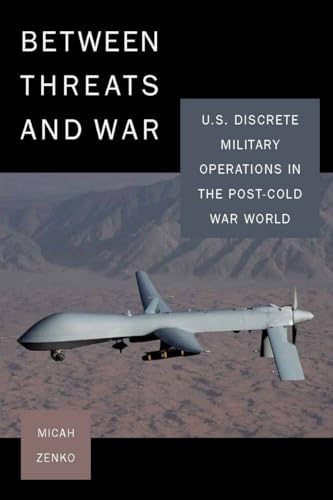
Inhaltsangabe
When confronted with a persistent foreign policy problem that threatens U.S. interests, and that cannot be adequately addressed through economic or political pressure, American policymakers and opinion formers have increasingly resorted to recommending the use of limited military force: that is, enough force to attempt to resolve the problem while minimizing U.S. military deaths, local civilian casualties, and collateral damage.
These recommendations have ranged from the bizarre-such as a Predator missile strike to kill Zimbabwean President Robert Mugabe, or the assassination of Venezuelan President Hugo Chavez-to the unwise-the preemptive bombing of North Korean ballistic missile sites-to the demonstrably practical-air raids into Bosnia and Somalia, and drone strikes in Yemen and Pakistan.
However, even though they have been a regular feature of America's uses of military force through four successive administrations, the efficacy of these "Discrete Military Operations" (DMOs) remains largely unanalyzed, leaving unanswered the important question of whether or not they have succeeded in achieving their intended military and political objectives.
In response, Micah Zenko examines the thirty-six DMOs undertaken by the US over the past 20 years, in order to discern why they were used, if they achieved their objectives, and what determined their success or failure. In the process, he both evaluates U.S. policy choices and recommends ways in which limited military force can be better used in the future. The insights and recommendations made by Zenko will be increasingly relevant to making decisions and predictions about the development of American grand strategy and future military policy.
Die Inhaltsangabe kann sich auf eine andere Ausgabe dieses Titels beziehen.
Über die Autorinnen und Autoren
A Council on Foreign Relations Book Micah Zenko is a Fellow for Conflict Prevention in the Center for Preventive Action at the Council on Foreign Relations. He has expertise in U.S. national security policy, military planning and operations, and nuclear weapons policy.
A Council on Foreign Relations BookMicah Zenko is a Fellow for Conflict Prevention in the Center for Preventive Action at the Council on Foreign Relations. He has expertise in U.S. national security policy, military planning and operations, and nuclear weapons policy.
Auszug. © Genehmigter Nachdruck. Alle Rechte vorbehalten.
Between Threats and War
U.S. DISCRETE MILITARY OPERATIONS IN THE POST-COLD WAR WORLDBy Micah ZenkoStanford University Press
Copyright © 2010 Board of Trustees of the Leland Stanford Junior UniversityAll right reserved.
ISBN: 978-0-8047-7191-7
Contents
Acknowledgments........................................................................................................viiAcronyms Used in This Book.............................................................................................xi1 Introduction.........................................................................................................12 Political Uses of Force and the Civilian-Military Split..............................................................173 Iraqi No-Fly Zones: 1991-2003........................................................................................284 Sudan and Afghanistan: August 20, 1998...............................................................................525 Yemen: November 3, 2002..............................................................................................736 Khurmal, Iraq: Summer 2002...........................................................................................917 Conclusion and Policy Recommendations................................................................................114Appendix I: Coding Cases and Descriptions: U.S. Discrete Military Operations, 1991 to June 1, 2009.....................127Appendix II: Non-Uses of U.S. Discrete Military Operations, 1991 to June 1, 2009.......................................155Notes..................................................................................................................159Index..................................................................................................................221
Chapter One
INTRODUCTION
"The thesis, then, must be repeated: war is an act of force, and there is no logical limit to the application of that force." Major General Carl von Clausewitz, Prussian Army "[The use of force] doesn't have to be all or nothing. We should be able to use limited force in limited areas." Madeline Albright, U.S. Secretary of State "As soon as they tell me it is limited, it means they do not care whether you achieve a result or not. As soon as they me tell me 'surgical,' I head for the bunker." General Colin Powell, Chairman of the Joint Chiefs of Staff
WHEN CONFRONTED with a persistent foreign policy problem that threatens U.S. interests, one that cannot be adequately addressed through economic or political pressure, American policymakers routinely resort to using limited military force. Current and former government officials, foreign policy analysts, and citizens call for the limited use of force with the belief that it potentially can resolve the problem expediently and without resulting in unwanted U.S. military or local civilian casualties. Proponents of such operations are found across the entire political spectrum, and their proposals range from the practical to the satirical: from centrist former senior Pentagon and State Department officials proposing to bomb North Korean ballistic missiles poised to launch; to a liberal Washington Post columnist calling for a Predator missile strike to kill Zimbabwean president Robert Mugabe-a scheme that was one-upped by a former diplomat and human rights advocate who suggested a "messy in the short run" invasion to oust Mugabe; to a White House spokesperson advocating the assassination of Iraqi president Saddam Hussein because "the cost of one bullet ... is substantially less" than the cost of war-a scheme echoed by a conservative pastor who himself encouraged the assassination of Venezuelan president Hugo Chavez because "it's a whole lot cheaper than starting a war." Out of anger, empathy, or impatience with an ongoing foreign policy dilemma, advocates in and out of the U.S. government continually propose the subject of this book-Discrete Military Operations (DMOs).
America's use of limited military force and DMOs since the end of the Cold War is important because the United States continues to be the dominant international actor and because U.S. decisionmakers have increasingly turned to the use of limited force against other states or non-state actors to achieve their policy goals. In addition, rapid technological advances in the U.S. military's capacity to conduct precise strikes from a safe distance, and an international setting in which the United States faces a potentially open-ended threat from non-state terrorist networks, make it likely that the reliance on limited force will remain a persistent feature of U.S. foreign policy. Despite the rising significance of DMOs, however, it is unclear and understudied whether limited uses of force have succeeded at achieving their intended military and political objectives.
To clarify and illuminate recent U.S. limited uses of force, this book presents a new concept: "Discrete Military Operations." Here, DMOs are defined as a single or serial physical use of kinetic military force to achieve a defined military and political goal by inflicting casualties or causing destruction, without seeking to conquer an opposing army or to capture or control territory. DMOs usually consist of a single attack or series of sortie strikes, lasting just minutes, hours, or a few days. DMOs usually involve only one combat arm and one mode of attack directed against an adversary's military capabilities or infrastructure, regime or organizational assets, or key leadership. DMOs are also proscribed by strict rules of engagement to ensure that the intensity and scope of the strike does not exceed levels necessary to attempt to achieve the political objectives.
In investigating U.S. DMOs from 1991 through June 1, 2009, thirty-six in all, this book answers three basic questions: "Why were they used?" "Did they achieve their intended military and political objectives?" and "What variables determined their success or failure?" By broadly addressing these questions, the book evaluates the policy choices of U.S. officials over the past two decades and offers recommendations for how limited military force can be better used in the future. In addition, because U.S. uses of DMOs have now been a reality for four successive administrations, the insights and recommendations from this book are increasingly relevant to making predictions about the development of American grand strategy and military policy.
The available evidence demonstrates that U.S. DMOs achieved all of their military objectives just over half of the time, and all political objectives less than 6 percent of the time. However, this large gap between political goals and military outcomes is predictable: identifying and destroying a target is a far easier task than affecting the behavior of an adversary, or potential future adversaries, through the use of force. The primary political objectives can be summarized as any one, or a combination, of the following goals: punishment, or revenge, for an adversary's past behavior with no intention of altering future behavior; deterrence, to attempt to maintain the status quo by discouraging an adversary from initiating a specific action; and coercion, to attempt to compel a change in an adversary's future behavior. For punishment to succeed, the military objective of a DMO must be met: if you miss the target, your adversary experiences...
„Über diesen Titel“ kann sich auf eine andere Ausgabe dieses Titels beziehen.
Suchergebnisse für Between Threats and War: U.S. Discrete Military Operations...

Beispielbild für diese ISBN
Between Threats and War: U.S. Discrete Military Operations in the Post-Cold War World (A Council on Foreign Relations)
Verlag:
Stanford Security Studies (edition 1), 2010
ISBN 10: 080477191X
ISBN 13: 9780804771917
Gebraucht
Paperback
Anbieter: BooksRun, Philadelphia, PA, USA
Verkäuferbewertung 5 von 5 Sternen

Paperback. Zustand: Very Good. 1. It's a well-cared-for item that has seen limited use. The item may show minor signs of wear. All the text is legible, with all pages included. It may have slight markings and/or highlighting. Artikel-Nr. 080477191X-11-18
Gebraucht kaufen
EUR 5,39
Versand gratis
Versand innerhalb von USA
Versand innerhalb von USA
Anzahl: 1 verfügbar
Beispielbild für diese ISBN
Between Threats and War: U.S. Discrete Military Operations in the Post-Cold War World (A Council on Foreign Relations)
Verlag:
Stanford Security Studies, 2010
ISBN 10: 080477191X
ISBN 13: 9780804771917
Gebraucht
Softcover
Anbieter: Wonder Book, Frederick, MD, USA
Verkäuferbewertung 5 von 5 Sternen
Zustand: Very Good. Very Good condition. A copy that may have a few cosmetic defects. May also contain light spine creasing or a few markings such as an owner's name, short gifter's inscription or light stamp. Artikel-Nr. L09D-03003
Gebraucht kaufen
EUR 6,33
Versand gratis
Versand innerhalb von USA
Versand innerhalb von USA
Anzahl: 1 verfügbar
Beispielbild für diese ISBN
Between Threats and War: U.S. Discrete Military Operations in the Post-Cold War World
Verlag:
Stanford Security Studies, 2010
ISBN 10: 080477191X
ISBN 13: 9780804771917
Gebraucht
Paperback
Anbieter: ThriftBooks-Atlanta, AUSTELL, GA, USA
Verkäuferbewertung 5 von 5 Sternen
Paperback. Zustand: Good. No Jacket. Pages can have notes/highlighting. Spine may show signs of wear. ~ ThriftBooks: Read More, Spend Less. Artikel-Nr. G080477191XI3N00
Gebraucht kaufen
EUR 7,15
Versand gratis
Versand innerhalb von USA
Versand innerhalb von USA
Anzahl: 1 verfügbar
Beispielbild für diese ISBN
Between Threats and War : U. S. Discrete Military Operations in the Post-Cold War World
Verlag:
Stanford University Press, 2010
ISBN 10: 080477191X
ISBN 13: 9780804771917
Gebraucht
Softcover
Anbieter: Better World Books, Mishawaka, IN, USA
Verkäuferbewertung 5 von 5 Sternen
Zustand: Fine. Used book that is in almost brand-new condition. May contain a remainder mark. Better World Books: Buy Books. Do Good. Artikel-Nr. 10402088-75
Gebraucht kaufen
EUR 8,21
Versand gratis
Versand innerhalb von USA
Versand innerhalb von USA
Anzahl: 1 verfügbar
Beispielbild für diese ISBN
Between Threats and War
Anbieter: PBShop.store UK, Fairford, GLOS, Vereinigtes Königreich
Verkäuferbewertung 5 von 5 Sternen
PAP. Zustand: New. New Book. Shipped from UK. Established seller since 2000. Artikel-Nr. FW-9780804771917
Neu kaufen
EUR 23,17
EUR 4,84 Versand
Versand von Vereinigtes Königreich nach USA
Versand von Vereinigtes Königreich nach USA
Anzahl: 15 verfügbar
Beispielbild für diese ISBN
Between Threats and War: U.S. Discrete Military Operations in the Post-Cold War World
Anbieter: Majestic Books, Hounslow, Vereinigtes Königreich
Verkäuferbewertung 4 von 5 Sternen

Zustand: New. pp. 240. Artikel-Nr. 7990552
Neu kaufen
EUR 29,15
EUR 7,56 Versand
Versand von Vereinigtes Königreich nach USA
Versand von Vereinigtes Königreich nach USA
Anzahl: 3 verfügbar
Beispielbild für diese ISBN
Between Threats and War: U.S. Discrete Military Operations in the Post-Cold War World (A Council on Foreign Relations)
Anbieter: Ria Christie Collections, Uxbridge, Vereinigtes Königreich
Verkäuferbewertung 5 von 5 Sternen
Zustand: New. In English. Artikel-Nr. ria9780804771917_new
Neu kaufen
EUR 28,68
EUR 10,90 Versand
Versand von Vereinigtes Königreich nach USA
Versand von Vereinigtes Königreich nach USA
Anzahl: Mehr als 20 verfügbar
Beispielbild für diese ISBN
Between Threats and War U.S. Discrete Military Operations in the PostCold War World
Anbieter: Revaluation Books, Exeter, Vereinigtes Königreich
Verkäuferbewertung 5 von 5 Sternen
Paperback. Zustand: Brand New. 228 pages. 8.75x6.00x0.50 inches. In Stock. Artikel-Nr. x-080477191X
Neu kaufen
EUR 30,36
EUR 14,54 Versand
Versand von Vereinigtes Königreich nach USA
Versand von Vereinigtes Königreich nach USA
Anzahl: 2 verfügbar
Beispielbild für diese ISBN
Between Threats and War: U.S. Discrete Military Operations in the Post-Cold War World
Anbieter: Kennys Bookstore, Olney, MD, USA
Verkäuferbewertung 5 von 5 Sternen
Zustand: New. 2010. 1st Edition. Paperback. . . . . . Books ship from the US and Ireland. Artikel-Nr. V9780804771917
Neu kaufen
EUR 35,75
EUR 9,23 Versand
Versand innerhalb von USA
Versand innerhalb von USA
Anzahl: Mehr als 20 verfügbar
Foto des Verkäufers
Between Threats and War: U.S. Discrete Military Operations in the Post-Cold War World
Anbieter: moluna, Greven, Deutschland
Verkäuferbewertung 5 von 5 Sternen
Zustand: New. In Between Threats and War: U.S. Discrete Military Operations in the Post-Cold War World, author Micah Zenko presents a new concept to capture and illuminate the phenomenon: Discrete Military Operations. Über den AutorA Council. Artikel-Nr. 595015964
Neu kaufen
EUR 26,27
EUR 48,99 Versand
Versand von Deutschland nach USA
Versand von Deutschland nach USA
Anzahl: Mehr als 20 verfügbar