
Verwandte Artikel zu Ungoverned Spaces: Alternatives to State Authority...
Inhaltsangabe
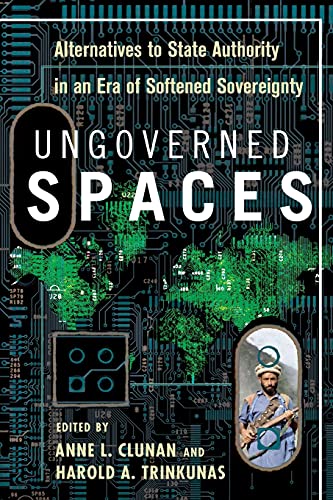
"Ungoverned spaces" are often cited as key threats to national and international security and are increasingly targeted by the international community for external interventions-both armed and otherwise. This book examines exactly when and how these spaces contribute to global insecurity, and it incorporates the many spaces where state authority is contested-from tribal, sectarian, or clan-based governance in such places as Pakistani Waziristan, to areas ruled by persistent insurgencies, such as Colombia, to nonphysical spaces, such as the internet and global finance.
Within this multiplicity of contexts, the book addresses a range of security concerns, including weapons of mass destruction, migrants, dirty money, cyberdata, terrorists, drug lords, warlords, insurgents, radical Islamist groups, and human privacy and security.
Ultimately, Ungoverned Spaces demonstrates that state-centric approaches to these concerns are unlikely to supplant the many sites of authority that provide governance in a world of softened sovereignty.
Die Inhaltsangabe kann sich auf eine andere Ausgabe dieses Titels beziehen.
Über die Autorinnen und Autoren
Anne L. Clunan is an Associate Professor in the Department of National Security Affairs at the Naval Post Graduate School. Harold A. Trinkunas is an Associate Professor and Chair of the Department of National Security Affairs at the Naval Postgraduate School.
Anne L. Clunan is an Associate Professor in the Department of National Security Affairs at the Naval Post Graduate School. Harold A. Trinkunas is an Associate Professor and Chair of the Department of National Security Affairs at the Naval Postgraduate School.
Anne L. Clunan is an Associate Professor in the Department of National Security Affairs and Director of the Center for Contemporary Conflict at the Naval Postgraduate School. She is the editor, with Peter R. Lavoy and Susan B. Martin, of Terrorism, War, or Disease? Unraveling the Use of Biological Weapons (Stanford University Press, 2008).
Harold A. Trinkunas is an Associate Professor and Chair of the Department of National Security Affairs at the Naval Postgraduate School. He is the editor, with Jeanne Giraldo, of Terrorism Financing and State Responses: A Comparative Perspective (Stanford University Press, 2007).
Auszug. © Genehmigter Nachdruck. Alle Rechte vorbehalten.
UNGOVERNED SPACES
Alternatives to State Authority in an Era of Softened SovereigntyStanford University Press
Copyright © 2010 Board of Trustees of the Leland Stanford Junior UniversityAll right reserved.
ISBN: 978-0-8047-7013-2
Contents
Acknowledgments........................................................................................................................................................xiINTRODUCTION Ungoverned Spaces? The Need for Reevaluation Anne L. Clunan.............................................................................................31 Conceptualizing Ungoverned Spaces: Territorial Statehood, Contested Authority, and Softened Sovereignty Anne L. Clunan and Harold A. Trinkunas.....................172 Here Be Dragons: Dangerous Spaces and International Security Phil Williams.........................................................................................343 Persistent Insurgencies and Warlords: Who Is Nasty, Who Is nice, and Why? William Reno.............................................................................574 Non-state Actors and Failed States: Lessons from Al-Qa'ida's Experiences in the Horn of Africa Ken Menkhaus and Jacob N. Shapiro...................................775 A Fortress without Walls: Alternative Governance Structures on the Afghan-Pakistan Frontier Ty L. Groh.............................................................956 Understanding Criminal Networks, Political Order, and Politics in Latin America Enrique Desmond Arias..............................................................1157 Authority outside the State: Non-state Actors and New Institutions in the Middle East Anne Marie Baylouny..........................................................1368 Immigration and Subterranean Sovereignty in South African Cities Loren B. Landau and Tamlyn Monson.................................................................1539 Rules and Regulations in Ungoverned Spaces: Illicit Economies, Criminals, and Belligerents Vanda Felbab-Brown......................................................17510 Nuclear Trafficking in Ungoverned Spaces and Failed States Lyudmila Zaitseva......................................................................................19311 From Anti-Money Laundering to ... What? Formal Sovereignty and Feudalism in Offshore Financial Services Bill Maurer...............................................21512 Negotiating Internet Governance: Security Implications of Multilateral Approaches J. P. Singh.....................................................................23213 Under Cover of the Net: The Hidden Governance Mechanisms of Cyberspace Ronald J. Deibert and Rafal Rohozinski.....................................................25514 Alternative Governance and Security Anne L. Clunan and Harold A. Trinkunas........................................................................................275List of Contributors...................................................................................................................................................295Index..................................................................................................................................................................301
Chapter One
Conceptualizing Ungoverned SpacesTerritorial Statehood, Contested Authority, and Softened Sovereignty
Anne L. Clunan and Harold A. Trinkunas
What are Ungoverned Spaces?
The term "ungoverned spaces" is a misnomer. It originally arose from the state-centered conceptualization developed by many governments and international organizations confronting the apparent emergence following the Cold War of politically disordered territories in which state provision of governance goods had collapsed. Ungoverned spaces are viewed as social, political, and economic arenas where states do not exercise "effective sovereignty" or where state control is absent, weak, or contested. In reality, many so-called ungoverned spaces are simply "differently" governed. These can range from tribal or clan-based governments in Somalia or Pakistani Waziristan, to areas ruled by persistent insurgencies such as the Revolutionary Armed Forces of Colombia (Fuerzas Armadas Revolucionarias de Colombia, FARC), to major swathes of the Internet controlled by corporate entities such as the Internet Corporation for Assigned Names and Numbers (ICANN), or the creation of corporate transnational governance structures such as the lex mercatoria. It is not so much ungoverned spaces that should concern us, since these are effectively quite rare, but rather the contested spaces within and between states where other types of actors rule. Here, we move from definitions of ungoverned spaces based on the absence of state governance to a focus on the idea of "softened sovereignty." Ungoverned spaces therefore exist where territorial state control has been voluntarily or involuntarily ceded in whole or part to actors other than the relevant legally recognized sovereign authorities.
This conception of ungoverned spaces also serves to differentiate the focus of this project from the debate over fragile, failing, and failed states found in the academic and policy literature. While the weakening of the state clearly contributes to the phenomenon we seek to explain, whether it becomes a threat to the security of other states depends on what alternative actors arise to take the place of the state, and whether they produce an environment that threatens others. The attention to failed states is really the product of a 1990s concern with the consequences of the end of the Cold War and the twenty-first-century fear that transnational terrorists may be using failed states as safe havens or staging areas.
We argue that this focus is too narrow because it misses the ungoverned spaces that exist in the international system, within otherwise consolidated states, and in new virtual domains. A broader definition of ungoverned spaces allows us to examine challenges to sovereignty posed by phenomena such as transnational actors. These include political entities such as intergovernmental organizations and nongovernmental organizations (NGOs) or terrorist networks, and economic ones such as major corporations or transnational criminal enterprises. It also allows us to examine the implications of lack of effective sovereignty within otherwise organized states, such as in border areas and inner cities of the United States and the suburban banlieus in France. In addition, it highlights the growing importance of virtual realms: politically as channels for terrorists, social movements, and political parties to mobilize, but also economically for new forms of corporate and international governance.
More fundamentally, the current policy approach to ungoverned spaces rests on an underspecified conceptualization of "good governance" and "effective sovereignty" that appears to take the Western welfare state of the twentieth century as its model and as the basis for global order in the twenty-first century. We maintain that such a view of sovereignty must be revised to place it within a broad historical evolutionary context that recognizes the Western welfare state as a form of political organization that arose out of specific political, ideological, and economic conditions. The revision should take into account the effects of globalization (broadly construed) that pose fundamental challenges to well-established states in the West, let alone less-developed states elsewhere, as well as to the concept of statehood and state...
„Über diesen Titel“ kann sich auf eine andere Ausgabe dieses Titels beziehen.
Suchergebnisse für Ungoverned Spaces: Alternatives to State Authority...

Beispielbild für diese ISBN
Ungoverned Spaces : Alternatives to State Authority in an Era of Softened Sovereignty
Verlag:
Stanford University Press, 2010
ISBN 10: 0804770131
ISBN 13: 9780804770132
Gebraucht
Softcover
Anbieter: Better World Books, Mishawaka, IN, USA
Verkäuferbewertung 5 von 5 Sternen

Zustand: Good. Pages intact with minimal writing/highlighting. The binding may be loose and creased. Dust jackets/supplements are not included. Stock photo provided. Product includes identifying sticker. Better World Books: Buy Books. Do Good. Artikel-Nr. 58000963-6
Gebraucht kaufen
EUR 16,58
Versand gratis
Versand innerhalb von USA
Versand innerhalb von USA
Anzahl: 1 verfügbar
Beispielbild für diese ISBN
Ungoverned Spaces : Alternatives to State Authority in an Era of Softened Sovereignty
Verlag:
Stanford University Press, 2010
ISBN 10: 0804770131
ISBN 13: 9780804770132
Gebraucht
Softcover
Anbieter: Better World Books: West, Reno, NV, USA
Verkäuferbewertung 5 von 5 Sternen
Zustand: Very Good. Former library copy. Pages intact with possible writing/highlighting. Binding strong with minor wear. Dust jackets/supplements may not be included. Includes library markings. Stock photo provided. Product includes identifying sticker. Better World Books: Buy Books. Do Good. Artikel-Nr. 40829350-6
Gebraucht kaufen
EUR 16,58
Versand gratis
Versand innerhalb von USA
Versand innerhalb von USA
Anzahl: 1 verfügbar
Beispielbild für diese ISBN
Ungoverned Spaces
Anbieter: PBShop.store UK, Fairford, GLOS, Vereinigtes Königreich
Verkäuferbewertung 5 von 5 Sternen
PAP. Zustand: New. New Book. Shipped from UK. Established seller since 2000. Artikel-Nr. FW-9780804770132
Neu kaufen
EUR 29,00
EUR 5,84 Versand
Versand von Vereinigtes Königreich nach USA
Versand von Vereinigtes Königreich nach USA
Anzahl: 15 verfügbar
Beispielbild für diese ISBN
Ungoverned Spaces: Alternatives to State Authority in an Era of Softened Sovereignty
Anbieter: Majestic Books, Hounslow, Vereinigtes Königreich
Verkäuferbewertung 4 von 5 Sternen

Zustand: New. pp. 328. Artikel-Nr. 7990468
Neu kaufen
EUR 34,66
EUR 7,56 Versand
Versand von Vereinigtes Königreich nach USA
Versand von Vereinigtes Königreich nach USA
Anzahl: 3 verfügbar
Beispielbild für diese ISBN
Ungoverned Spaces: Alternatives to State Authority in an Era of Softened Sovereignty
Anbieter: Ria Christie Collections, Uxbridge, Vereinigtes Königreich
Verkäuferbewertung 5 von 5 Sternen
Zustand: New. In English. Artikel-Nr. ria9780804770132_new
Neu kaufen
EUR 33,41
EUR 13,13 Versand
Versand von Vereinigtes Königreich nach USA
Versand von Vereinigtes Königreich nach USA
Anzahl: Mehr als 20 verfügbar
Beispielbild für diese ISBN
Ungoverned Spaces Alternatives to State Authority in an Era of Softened Sovereignty
Anbieter: Revaluation Books, Exeter, Vereinigtes Königreich
Verkäuferbewertung 5 von 5 Sternen
Paperback. Zustand: Brand New. 328 pages. 8.90x5.90x0.80 inches. In Stock. Artikel-Nr. x-0804770131
Neu kaufen
EUR 37,03
EUR 11,63 Versand
Versand von Vereinigtes Königreich nach USA
Versand von Vereinigtes Königreich nach USA
Anzahl: 2 verfügbar
Beispielbild für diese ISBN
Ungoverned Spaces: Alternatives to State Authority in an Era of Softened Sovereignty
Anbieter: Kennys Bookstore, Olney, MD, USA
Verkäuferbewertung 5 von 5 Sternen
Zustand: New. This book provides a comprehensive critique of the prevailing view of ungoverned spaces and the threat they pose to human, national and international security. Editor(s): Clunan, Anne L.; Trinkunas, Harold A. Num Pages: 328 pages, 9 tables. BIC Classification: GTJ; JPS; JWL. Category: (P) Professional & Vocational; (U) Tertiary Education (US: College). Dimension: 5817 x 3887 x 20. Weight in Grams: 444. . 2010. 1st Edition. paperback. . . . . Books ship from the US and Ireland. Artikel-Nr. V9780804770132
Neu kaufen
EUR 41,73
EUR 9,22 Versand
Versand innerhalb von USA
Versand innerhalb von USA
Anzahl: Mehr als 20 verfügbar
Foto des Verkäufers
Ungoverned Spaces: Alternatives to State Authority in an Era of Softened Sovereignty
Verlag:
STANFORD SECURITY STUDIES, 2010
ISBN 10: 0804770131
ISBN 13: 9780804770132
Neu
Kartoniert / Broschiert
Anbieter: moluna, Greven, Deutschland
Verkäuferbewertung 5 von 5 Sternen
Kartoniert / Broschiert. Zustand: New. This book provides a comprehensive critique of the prevailing view of ungoverned spaces and the threat they pose to human, national and international security.Über den AutorAnne L. Clunan is an Associate Professor in the Departm. Artikel-Nr. 595015889
Neu kaufen
EUR 30,79
EUR 48,99 Versand
Versand von Deutschland nach USA
Versand von Deutschland nach USA
Anzahl: Mehr als 20 verfügbar
Foto des Verkäufers
Ungoverned Spaces | Alternatives to State Authority in an Era of Softened Sovereignty
Anbieter: preigu, Osnabrück, Deutschland
Verkäuferbewertung 5 von 5 Sternen
Taschenbuch. Zustand: Neu. Ungoverned Spaces | Alternatives to State Authority in an Era of Softened Sovereignty | Anne Clunan (u. a.) | Taschenbuch | Einband - flex.(Paperback) | Englisch | 2010 | Stanford University Press | EAN 9780804770132 | Verantwortliche Person für die EU: Mare Nostrum Group B.V., Doelen 72, 4831 GR BREDA, NIEDERLANDE, gpsr[at]mare-nostrum[dot]co[dot]uk | Anbieter: preigu. Artikel-Nr. 108386286
Neu kaufen
EUR 28,00
EUR 70,00 Versand
Versand von Deutschland nach USA
Versand von Deutschland nach USA
Anzahl: 5 verfügbar