
Verwandte Artikel zu Chimalpahin's Conquest: A Nahua Historian's...
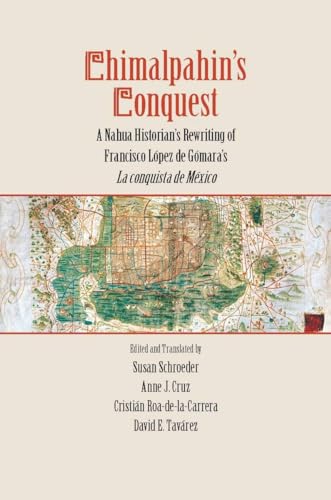
Chimalpahin's Conquest: A Nahua Historian's Rewriting of Francisco Lopez de Gomara's La conquista de Mexico (Series Chimalpahin) - Hardcover
Inhaltsangabe
This volume presents the story of Hernando Cortés's conquest of Mexico, as recounted by a contemporary Spanish historian and edited by Mexico's premier Nahua historian.
Francisco López de Gómara's monumental Historia de las Indias y Conquista de México was published in 1552 to instant success. Despite being banned from the Americas by Prince Philip of Spain, La conquista fell into the hands of the seventeenth-century Nahua historian Chimalpahin, who took it upon himself to make a copy of the tome. As he copied, Chimalpahin rewrote large sections of La conquista, adding information about Emperor Moctezuma and other key indigenous people who participated in those first encounters.
Chialpahin's Conquest is thus not only the first complete modern English translation of López de Gómara's La conquista, an invaluable source in itself of information about the conquest and native peoples; it also adds Chimalpahin's unique perspective of Nahua culture to what has traditionally been a very Hispanic portrayal of the conquest.
Die Inhaltsangabe kann sich auf eine andere Ausgabe dieses Titels beziehen.
Über die Autorinnen und Autoren
Susan Schroeder is the Scholes Professor of Colonial Latin American History at Tulane.Anne J. Cruz is Professor of Spanish at the University of Miami.Cristián Roa-de-la-Carrera is Associate Professor of Spanish and Latin American and Latino Studies at the University of Illinois. David E. Tavárez is Associate Professor of Anthropology at Vassar College.
Susan Schroeder is France Vinton Scholes Professor of Colonial Latin American History at Tulane University.
Anne J. Cruz is Professor of Spanish at the University of Miami
Cristian Roa-De-La-Carrera is Associate Professor of Spanish and Latin American and Latino Studies at the University of Illinois, Chicago
David E. Tavarez is Associate Professor of Anthropology at Vassar College
Auszug. © Genehmigter Nachdruck. Alle Rechte vorbehalten.
Chimalpahin's Conquest
A Nahua Historian's Rewriting of Francisco Lpez de Gmara's La conquista de MxicoSTANFORD UNIVERSITY PRESS
Copyright © 2010 Board of Trustees of the Leland Stanford Junior UniversityAll right reserved.
ISBN: 978-0-8047-6948-8
Chapter One
The History of Chimalpahin's "Conquista" ManuscriptSusan Schroeder
In 1552 the historian Francisco Lpez de Gmara (1511-c. 1559) published his monumental Historia de las Indias y Conquista de Mxico. The book was an instant success, and five additional Spanish-language editions were published over the course of the next five years, as well as numerous translations. Lpez de Gmara knew Hernando Corts (1482-1547) well, reportedly served as his priest for a time, and can be considered his biographer. La conquista is a recounting of the circumstances of Corts's birth, the travails he experienced as a young man in Medelln and later in Seville as he waited to set sail for Santo Domingo, and his activities, including his marriage, while living in Cuba. By far the greatest detail, however, is devoted to the conqueror's exploits as he explored the land that he eventually named New Spain, his negotiations with local peoples, and his inexorable march toward and defeat of Mexico Tenochtitlan, the capital of the Aztec empire. Lpez de Gmara aimed to furnish the best of all insight into the thought and will of the great captain and included, purportedly verbatim, the eloquent speeches that Corts made to rally his men and exalt the glory of imperial Spain and their Christian mission. Corts was inevitably Gmara's hero.
However, in the interest of maintaining stability in the colonies, Prince Philip of Spain came to be concerned about the tone of the portrayal of Corts and the other conquerors of New Spain, and in 1553 the Council of the Indies ordered the suppression of the printing and sale of the book. In 1566, as King Philip II, he prohibited its reading in Castile and in the Americas and imposed large fines for infringement of this order. Nevertheless, the censorship did little to prevent the work from being shipped to the colonies and read by the inhabitants of New Spain and even indigenous peoples in Mexico City. It warrants noting that, by 1573, the use of the term conquista was prohibited, although the term continued to be used by some Spanish authors. To date, there is no evidence of its use as a loanword in any native-authored, native-language text in the Americas.
At some point, La conquista fell into the hands of the seventeenth-century Nahua historian Chimalpahin (b. 1579), who lived and worked at the church of San Antonio Abad in the district of Xoloco, site of the famous first encounter of the conqueror Hernando Corts and Emperor Moteuczoma Xocoyotl, "the younger." Chimalpahin is best known for his epic histories of Indian Mexico in the Nahuatl language, but he occasionally worked with Latin- and Spanish-language documents as well. His histories represent the most comprehensive extant corpus of the history of Indian Mexico written by a known indigenous author in his own language. Chimalpahin had access to an extraordinary collection of ancient pictorial manuscripts; writings in alphabetic Nahuatl, his native language; and published books in Spanish and Latin. Moreover, because he was located in Mexico City, he was able to furnish copious firsthand reports on the contemporary goings-on in the capital. Chimalpahin's histories are therefore invaluable, as they provide a unique, indigenous perspective on life in the colony.
Chimalpahin took it upon himself to make a copy of Lpez de Gmara's great tome. It is said that he also translated the work into Nahuatl, but the whereabouts of that manuscript are unknown. He did transcribe the Spanish book, and as he copied it he deleted and corrected portions and interpolated abundant information about the Nahuas, as if he felt there was much more to the story of the conquest than had been told. As such, then, his work constitutes a major contribution to the New Conquest History genre.
Chimalpahin was writing his histories exactly one hundred years after the Spanish invasion, thus he had not only a temporal advantage but also a material bounty of Spanish- and Nahuatl-language colonial accounts to draw upon. In and around Mexico City, Spaniards-particularly fray Bernardino de Sahagn-collected Tlatelolca histories of the conquest, and mestizo and Nahua authors wrote massive tomes about key actors and events that either preceded the fall of Mexico Tenochtitlan or related their home regions' participation in it. All wrote with an agenda-to exalt the contributions of their own people and towns. Best known are Chimalpahin's contemporaries, don Fernando de Alva Ixtlilxochitl of Tetzcoco and don Hernando de Alvarado Tezozomoc of Mexico Tenochtitlan. Both men were highly esteemed in their respective communities, and both wrote major historical works in Spanish. It is believed that Alvarado Tezozomoc also wrote in Nahuatl, but what is extant in that language is known only from writings by Chimalpahin. Of unique and particular importance to this study is the entrance of a seventeenth-century Nahua intellectual into a sixteenth-century Hispanic conquest literary tradition, and his successful manipulation of that genre.
BACKGROUND OF THIS VOLUME
In December 1986 the late Michael Meyer, then director of the Latin American Area Center at the University of Arizona, telephoned me to say that in front of him, on his desk, was a manuscript entitled "La conquista de Mxico" by don Domingo de San Antn Mun [Chimalpahin] Quauhtlehuanitzin. I was astonished because it had been close to one hundred years since the work was last seen. It seems that a family physician in Yuma, Arizona, Ellis Browning, had for many years been in possession of the manuscript and was presently in Meyer's office to determine its value or, at the least, to have it translated into English. I eventually met Dr. Browning, examined the manuscript, and determined that it was Chimalpahin's version of Francisco Lpez de Gmara's grand opus of the same title that was published in Spain in 1552. I confess my disappointment on seeing that it was not written in Nahuatl or even in Chimalpahin's hand but was instead an eighteenth-century copy. Subsequent research determined unequivocally that it was the copy made by Lorenzo Boturini Benaduci, who listed it in his 1746 catalog. The manuscript was loaned to me, and I transcribed the entire work in typescript. Dr. Browning donated the manuscript to the Newberry Library in 1991.
Some fifteen years elapsed before I was able to return to Chimalpahin's "Conquista" manuscript. The occasion was a National Endowment for the Humanities fellowship at the Newberry Library in 2000, to research the Spanish conquest of Mexico and the manuscript itself. In the course of that fellowship year I fortuitously met Anne Cruz, whose interest is the Golden Age literature of Spain. She, in turn, introduced me to Cristin Roa-de-la-Carrera, whose specialty is the life and writings of Francisco Lpez de Gmara. Suddenly, I had the makings of a translation team. I was already acquainted with David Tavrez, who is known for his work on Nahua and Zapotec peoples in colonial Mesoamerica, and I invited him to join the project. Cruz, Roa-de-la-Carrera, and Tavrez are native Spanish speakers, and all three possess the scholarly expertise that was needed to realize the translation of the manuscript into English. In 2005, we were awarded an NEH Collaborative...
„Über diesen Titel“ kann sich auf eine andere Ausgabe dieses Titels beziehen.
Suchergebnisse für Chimalpahin's Conquest: A Nahua Historian's...

Foto des Verkäufers
Chimalpahin's Conquest: A Nahua Historian's Rewriting of Francisco Lopez de Gomara's La conquista de Mexico (Series Chimalpahin)
Verlag:
Stanford University Press, 2010
ISBN 10: 0804769486
ISBN 13: 9780804769488
Gebraucht
Hardcover
Erstausgabe
Anbieter: Erik Hanson Books and Ephemera, San Diego, CA, USA
Verkäuferbewertung 5 von 5 Sternen

Hardcover. Zustand: Fine. Zustand des Schutzumschlags: Near Fine. 1st Edition. xvi plus 510 pages. Cloth hardcover. A clean, tight, unmarked and possibly unread copy. Sunfade to spine of dust jacket, close to as-new otherwise. Artikel-Nr. NNN04
Gebraucht kaufen
EUR 53,85
EUR 3,49 Versand
Versand innerhalb von USA
Versand innerhalb von USA
Anzahl: 1 verfügbar
Beispielbild für diese ISBN
Chimalpahin's Conquest
Anbieter: PBShop.store UK, Fairford, GLOS, Vereinigtes Königreich
Verkäuferbewertung 5 von 5 Sternen
HRD. Zustand: New. New Book. Shipped from UK. Established seller since 2000. Artikel-Nr. FW-9780804769488
Neu kaufen
EUR 82,09
EUR 6,83 Versand
Versand von Vereinigtes Königreich nach USA
Versand von Vereinigtes Königreich nach USA
Anzahl: 1 verfügbar
Beispielbild für diese ISBN
Chimalpahin's Conquest: A Nahua Historian's Rewriting of Francisco Lopez de Gomara's La conquista de Mexico (Series Chimalpahin)
Anbieter: Ria Christie Collections, Uxbridge, Vereinigtes Königreich
Verkäuferbewertung 5 von 5 Sternen
Zustand: New. In English. Artikel-Nr. ria9780804769488_new
Neu kaufen
EUR 79,33
EUR 13,14 Versand
Versand von Vereinigtes Königreich nach USA
Versand von Vereinigtes Königreich nach USA
Anzahl: 1 verfügbar
Beispielbild für diese ISBN
Chimalpahin's Conquest
Anbieter: Kennys Bookstore, Olney, MD, USA
Verkäuferbewertung 5 von 5 Sternen
Zustand: New. Editor(s): Schroeder, Susan; Cruz, Dr. Anne J.; Roa-de-la Carrera, Cristian Andres; Tavarez, David E. Translator(s): Schroeder, Susan; Cruz, Dr. Anne J.; Roa-de-la Carrera, Cristian Andres; Tavarez, David E. Num Pages: 536 pages. BIC Classification: 1KLCM; HBJK; JFSL4. Category: (G) General (US: Trade). Dimension: 5817 x 3887 x 43. Weight in Grams: 857. . 2010. 1st Edition. hardcover. . . . . Books ship from the US and Ireland. Artikel-Nr. V9780804769488
Neu kaufen
EUR 109,28
EUR 9,15 Versand
Versand innerhalb von USA
Versand innerhalb von USA
Anzahl: 1 verfügbar
Beispielbild für diese ISBN
Chimalpahin`s Conquest A Nahua Historian`s Rewriting of Francisco Lopez de Gomara`s La conquista de Mexico
Anbieter: Revaluation Books, Exeter, Vereinigtes Königreich
Verkäuferbewertung 5 von 5 Sternen
Hardcover. Zustand: Brand New. 510 pages. 9.00x6.25x1.50 inches. In Stock. Artikel-Nr. x-0804769486
Neu kaufen
EUR 117,50
EUR 14,55 Versand
Versand von Vereinigtes Königreich nach USA
Versand von Vereinigtes Königreich nach USA
Anzahl: 2 verfügbar
Foto des Verkäufers
Chimalpahin\ s Conquest: A Nahua Historian\ s Rewriting of Francisco Lopez de Gomara\ s La Conquista de Mexico
Anbieter: moluna, Greven, Deutschland
Verkäuferbewertung 5 von 5 Sternen
Zustand: New. Artikel-Nr. 595015861
Neu kaufen
EUR 87,78
EUR 48,99 Versand
Versand von Deutschland nach USA
Versand von Deutschland nach USA
Anzahl: Mehr als 20 verfügbar
Foto des Verkäufers
Chimalpahin's Conquest : A Nahua Historian's Rewriting of Francisco Lopez de Gomara's La Conquista de Mexico
Verlag:
Stanford University Press Jul 2010, 2010
ISBN 10: 0804769486
ISBN 13: 9780804769488
Neu
Hardcover
Anbieter: AHA-BUCH GmbH, Einbeck, Deutschland
Verkäuferbewertung 5 von 5 Sternen
Buch. Zustand: Neu. Neuware - This volume presents the story of Hernando Cortés's conquest of Mexico, as recounted by a contemporary Spanish historian and edited by Mexico's premier Nahua historian. Francisco López de Gómara's monumental Historia de las Indias y Conquista de México was published in 1552 to instant success. Despite being banned from the Americas by Prince Philip of Spain, La conquista fell into the hands of the seventeenth-century Nahua historian Chimalpahin, who took it upon himself to make a copy of the tome. As he copied, Chimalpahin rewrote large sections of La conquista, adding information about Emperor Moctezuma and other key indigenous people who participated in those first encounters. Chialpahin's Conquest is thus not only the first complete modern English translation of López de Gómara's La conquista, an invaluable source in itself of information about the conquest and native peoples; it also adds Chimalpahin's unique perspective of Nahua culture to what has traditionally been a very Hispanic portrayal of the conquest. Artikel-Nr. 9780804769488
Neu kaufen
EUR 166,75
EUR 30,50 Versand
Versand von Deutschland nach USA
Versand von Deutschland nach USA
Anzahl: 1 verfügbar