
Verwandte Artikel zu Tort, Custom, and Karma: Globalization and Legal Consciousne...
Tort, Custom, and Karma: Globalization and Legal Consciousness in Thailand (The Cultural Lives of Law) - Softcover
Buch 6 von 19: The Cultural Lives of Law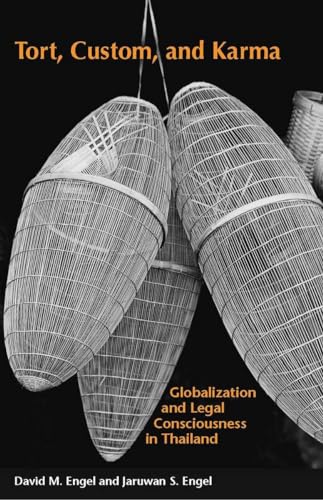
Inhaltsangabe
Diverse societies are now connected by globalization, but how do ordinary people feel about law as they cope day-to-day with a transformed world? Tort, Custom, and Karma examines how rapid societal changes, economic development, and integration into global markets have affected ordinary people's perceptions of law, with a special focus on the narratives of men and women who have suffered serious injuries in the province of Chiangmai, Thailand.
This work embraces neither the conventional view that increasing global connections spread the spirit of liberal legalism, nor its antithesis that backlash to interconnection leads to ideologies such as religious fundamentalism. Instead, it looks specifically at how a person's changing ideas of community, legal justice, and religious belief in turn transform the role of law particularly as a viable form of redress for injury. This revealing look at fundamental shifts in the interconnections between globalization, state law, and customary practices uncovers a pattern of increasing remoteness from law that deserves immediate attention.
Die Inhaltsangabe kann sich auf eine andere Ausgabe dieses Titels beziehen.
Über die Autorinnen und Autoren
David M. Engel is SUNY Distinguished Service Professor at the Law School of the University at Buffalo. His most recent book is Fault Lines: Tort Law and Cultural Practice (Stanford, 2009). Jaruwan S. Engel is an author, Thai language instructor, and translator, and was formerly Lecturer and Coordinator of the Thai Language Program at the University at Buffalo.
David M. Engel is SUNY Distinguished Service Professor at the Law School of the University at Buffalo. His most recent book is Fault Lines: Tort Law and Cultural Practice (Stanford, 2009). Jaruwan S. Engel is an author, Thai language instructor, and translator, and was formerly Lecturer and Coordinator of the Thai Language Program at the University at Buffalo.
Auszug. © Genehmigter Nachdruck. Alle Rechte vorbehalten.
Tort, Custom, and Karma
Globalization and Legal Consciousness in ThailandBy David M. Engel Jaruwan S. EngelStanford University Press
Copyright © 2010 Board of Trustees of the Leland Stanford Junior UniversityAll right reserved.
ISBN: 978-0-8047-6382-0
Contents
Illustrations......................................................ixAcknowledgments....................................................xiNote on Romanization of Thai Words and Phrases.....................xvIntroduction.......................................................11 Buajan's Injury Narrative........................................212 Chiangmai: A History of Globalizations...........................333 State Law and the Law of Sacred Centers..........................474 Injury Practices in a Transformed Society........................775 Litigation.......................................................956 Justice..........................................................1237 Ming's Injury Narrative..........................................140Conclusion.........................................................153Notes..............................................................165Glossary of Thai Words and Phrases.................................173Names of Injury Victims Referenced in Text.........................175Bibliography.......................................................177Index..............................................................185
Chapter One
Buajan's Injury Narrative
A BIRD CHITTERS IN THE TREE at the end of the lane. It is late afternoon, and mosquitoes begin to venture out of the shrubs. Buajan's yard abuts a tall fence with a locked gate. Just beyond the gate we can see the wooded area of a park, formerly the graveyard of a now non-existent temple. Spirits from the graveyard may be listening and could be offended by the things we say, but Buajan must speak honestly with us about her beliefs and experiences: "I wouldn't dare to lie about these things. I'm afraid. I fear sacred things the most."
Buajan was born in a farming village in the neighboring province of Lamphun. She attended primary school in her village and completed the fifth grade before moving to the city of Chiangmai. There she continued her studies through the tenth grade, and there she remained to work as a sales clerk, a cleaner, a launderer, and a cook. She married a native of Chiangmai who is a handyman at a university, and they have two children. Thirty-nine years old at the time of our interview in 1999 and employed on the kitchen staff at a hotel, Buajan struggles to survive Thailand's economic crisis. She earns only 3,000 baht per month, which was about $75 at the time of our interview. Buajan describes a recent past filled with setbacks and crises. Of these, the most vivid is the accident that broke her leg and almost took her life.
The Accident
I had just taken my children to school. I drove past Wat Lampoeng, where there's a roadside stand that sells pork. I decided to stop and buy some pork. After I paid for it ... I was just waiting.... This old man, this "Uncle", had ... parked his car right there, and he began to back up, back, back, back. When he got to the end of the path, he didn't go straight ahead. Instead, he lurched toward me. There was a small child [in a stroller] in his way, and the car was backing into the child, and I went to save him ... Just then the father pulled the boy away by his arm, but I couldn't get out of the way in time. It was a really big car. I was right here. The car ran into the stroller and went on to smash into a longan tree just behind me and then it bounced off it again. He ran into me. One of my legs was bent and the other was sticking out like this. The car ran right over me and came to a stop, and then it ran over me again.
The roof of the pork stand was collapsing. It was made of corrugated zinc. It would have crushed my neck, but luckily I was wearing a crash helmet so I could push it away. I was conscious. I was able to push it off, but I was really shocked. It was a good thing there was no blood at all, even though my leg was so badly hurt. You can imagine what it was like before the surgery. The driver was shocked, too. If he had seen blood, the guy who hit me, he probably would have died. After they brought me to the hospital, he had to be admitted himself at another hospital. He was an old man, you know? I felt sorry for him....
He said he had no feeling, it was as if someone [Buajan is referring to a ghost] was pushing his car. That's what he told me. At the corner of that shop, there had been fatal accidents. Three or four children had been killed.... The pork shop is near a mango tree, which is where I was standing. And near the mango tree, a lot of people had died [indicating the presence of a ghost].
After he hit me he just sat in his car in a state of shock. The villagers took me to the hospital.... They put on a splint for support, because the bones were broken, both of them.... Later the old man came to see me one time. He came and said something like, "You don't have to report this, right? I'll take care of things. I'll pay all your expenses." ... Then he just disappeared. His son came to visit me when I had my surgery. He came, but he didn't say much. He just visited and brought me a gift. He came to see me while I was hurting, and then he disappeared.
Buajan's conversation constantly turns to religious interpretations of everyday experiences and to her own daily efforts to give expression to her beliefs. She articulates her spirituality in several different vocabularies. At times she speaks explicitly of Buddhist-related practices, commenting, for example, that she prays to a Buddha image every day. Buajan's conversation is also dominated by references to spirits and ghosts. It is no exaggeration to say that her everyday perceptions and actions revolve around the spirit world. Whenever she visits her family's home in Lamphun, Buajan propitiates the household spirits and the village guardian spirits. These ceremonies are obligatory on special occasions, such as her wedding, the birth of her children, and when members of her family become ill.
Like many interviewees, she says her beliefs in the supernatural are "fifty-fifty." She still believes in traditional practices related to the spirits of northern Thailand, such as healing rituals-although she acknowledges that there have been important new technological developments, especially in medicine, that can benefit her family. Like her parents' generation, Buajan believes that the ghosts around us may attempt to communicate with us. We cannot see them, but they see us. Contact with ghosts can cause people, especially children, to become startled or ill. When this happens, their khwan, or spiritual essence, may be injured or fly out of the body, causing a fever for which the cause cannot be determined (the khwan and its rituals are discussed in Chapter 3). In such cases, it is necessary to make a promise, lighting incense and telling the ghost that if it is the cause of the child's illness the parents will offer it chicken or sweets when it allows the child to recover.
Injuries, therefore, may originate in efforts by ghosts to communicate with humans, and one appropriate response is to perform rituals to propitiate the khwan. The most dangerous contacts involve ghosts of persons who died abnormal or violent deaths....
„Über diesen Titel“ kann sich auf eine andere Ausgabe dieses Titels beziehen.
Suchergebnisse für Tort, Custom, and Karma: Globalization and Legal Consciousne...

Beispielbild für diese ISBN
Tort, Custom, and Karma: Globalization and Legal Consciousness in Thailand
Verlag:
Stanford University Press, 2010
ISBN 10: 0804763828
ISBN 13: 9780804763820
Gebraucht
Paperback
Anbieter: World of Books (was SecondSale), Montgomery, IL, USA
Verkäuferbewertung 5 von 5 Sternen

Paperback. Zustand: Good. This colorful portrait of law and society during a period of rapid social change reaches a counter-intuitive conclusion about the role of law in injury cases: globalization has led ordinary Thai people to turn away from courts and lawyers and to embrace a form of religious practice that leaves them without any remedy for harms they have suffered. Artikel-Nr. 00104902879
Gebraucht kaufen
EUR 5,98
Versand gratis
Versand innerhalb von USA
Versand innerhalb von USA
Anzahl: 1 verfügbar
Beispielbild für diese ISBN
Tort, Custom, and Karma: Globalization and Legal Consciousness in Thailand
Anbieter: ThriftBooks-Dallas, Dallas, TX, USA
Verkäuferbewertung 5 von 5 Sternen
Paperback. Zustand: Good. No Jacket. Pages can have notes/highlighting. Spine may show signs of wear. ~ ThriftBooks: Read More, Spend Less. Artikel-Nr. G0804763828I3N00
Gebraucht kaufen
EUR 5,99
Versand gratis
Versand innerhalb von USA
Versand innerhalb von USA
Anzahl: 1 verfügbar
Foto des Verkäufers
Tort, Custom, and Karma Globalization and Legal Consciousness in Thailand
Anbieter: True Oak Books, Highland, NY, USA
Verkäuferbewertung 5 von 5 Sternen
Paperback. Zustand: Very Good. The Cultural Lives Of Law; The book is in great overall condition, showing only minor cosmetic wear (small scuffs and sticker residue on back cover).; - We offer free returns for any reason and respond promptly to all inquiries. Your order will be packaged with care and ship on the same or next business day. Buy with confidence. Artikel-Nr. TOB125-10981-A-1.15
Gebraucht kaufen
EUR 15,58
Versand gratis
Versand innerhalb von USA
Versand innerhalb von USA
Anzahl: 1 verfügbar
Beispielbild für diese ISBN
Tort, Custom, and Karma
Anbieter: PBShop.store UK, Fairford, GLOS, Vereinigtes Königreich
Verkäuferbewertung 5 von 5 Sternen
PAP. Zustand: New. New Book. Shipped from UK. Established seller since 2000. Artikel-Nr. FW-9780804763820
Neu kaufen
EUR 26,55
EUR 4,97 Versand
Versand von Vereinigtes Königreich nach USA
Versand von Vereinigtes Königreich nach USA
Anzahl: 15 verfügbar
Beispielbild für diese ISBN
Tort, Custom, and Karma: Globalization and Legal Consciousness in Thailand (The Cultural Lives of Law)
Anbieter: Majestic Books, Hounslow, Vereinigtes Königreich
Verkäuferbewertung 4 von 5 Sternen

Zustand: New. pp. 208. Artikel-Nr. 7990415
Neu kaufen
EUR 31,43
EUR 7,76 Versand
Versand von Vereinigtes Königreich nach USA
Versand von Vereinigtes Königreich nach USA
Anzahl: 3 verfügbar
Beispielbild für diese ISBN
Tort, Custom, and Karma: Globalization and Legal Consciousness in Thailand (The Cultural Lives of Law)
Anbieter: Ria Christie Collections, Uxbridge, Vereinigtes Königreich
Verkäuferbewertung 5 von 5 Sternen
Zustand: New. In English. Artikel-Nr. ria9780804763820_new
Neu kaufen
EUR 30,60
EUR 11,19 Versand
Versand von Vereinigtes Königreich nach USA
Versand von Vereinigtes Königreich nach USA
Anzahl: Mehr als 20 verfügbar
Beispielbild für diese ISBN
Tort, Custom, and Karma Globalization and Legal Consciousness in Thailand
Anbieter: Revaluation Books, Exeter, Vereinigtes Königreich
Verkäuferbewertung 5 von 5 Sternen
Paperback. Zustand: Brand New. 208 pages. 8.50x5.50x0.75 inches. In Stock. Artikel-Nr. x-0804763828
Neu kaufen
EUR 31,40
EUR 11,94 Versand
Versand von Vereinigtes Königreich nach USA
Versand von Vereinigtes Königreich nach USA
Anzahl: 2 verfügbar
Beispielbild für diese ISBN
Tort, Custom, and Karma: Globalization and Legal Consciousness in Thailand
Anbieter: Kennys Bookstore, Olney, MD, USA
Verkäuferbewertung 5 von 5 Sternen
Zustand: New. Examines how rapid societal changes, economic development, and integration into global markets have affected ordinary people's perceptions of law, with a special focus on the narratives of men and women who have suffered serious injuries in the province of Chiangmai, Thailand. Series: The Cultural Lives of Law. Num Pages: 208 pages, 1 table, 3 figures, 14 illustrations. BIC Classification: JHM; LAQ. Category: (P) Professional & Vocational; (U) Tertiary Education (US: College). Dimension: 5487 x 3556 x 18. Weight in Grams: 272. . 2010. 1st Edition. Paperback. . . . . Books ship from the US and Ireland. Artikel-Nr. V9780804763820
Neu kaufen
EUR 37,80
EUR 9,37 Versand
Versand innerhalb von USA
Versand innerhalb von USA
Anzahl: Mehr als 20 verfügbar
Foto des Verkäufers
Tort, Custom, and Karma
Anbieter: moluna, Greven, Deutschland
Verkäuferbewertung 5 von 5 Sternen
Zustand: New. This colorful portrait of law and society during a period of rapid social change reaches a counter-intuitive conclusion about the role of law in injury cases: globalization has led ordinary Thai people to turn away from courts and lawyers and to embrace a f. Artikel-Nr. 699920053
Neu kaufen
EUR 26,77
EUR 48,99 Versand
Versand von Deutschland nach USA
Versand von Deutschland nach USA
Anzahl: Mehr als 20 verfügbar
Foto des Verkäufers
Tort, Custom, and Karma | Globalization and Legal Consciousness in Thailand
Anbieter: preigu, Osnabrück, Deutschland
Verkäuferbewertung 5 von 5 Sternen
Taschenbuch. Zustand: Neu. Tort, Custom, and Karma | Globalization and Legal Consciousness in Thailand | David Engel (u. a.) | Taschenbuch | Einband - flex.(Paperback) | Englisch | 2010 | Stanford University Press | EAN 9780804763820 | Verantwortliche Person für die EU: Mare Nostrum Group B.V., Doelen 72, 4831 GR BREDA, NIEDERLANDE, gpsr[at]mare-nostrum[dot]co[dot]uk | Anbieter: preigu. Artikel-Nr. 107946192
Neu kaufen
EUR 24,45
EUR 70,00 Versand
Versand von Deutschland nach USA
Versand von Deutschland nach USA
Anzahl: 5 verfügbar