
Verwandte Artikel zu Preventing Catastrophe: The Use and Misuse of Intelligence...
Preventing Catastrophe: The Use and Misuse of Intelligence in Efforts to Halt the Proliferation of Weapons of Mass Destruction - Hardcover
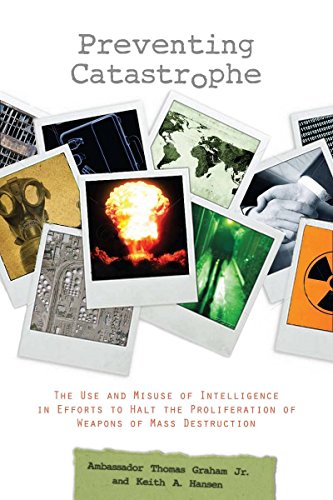
Inhaltsangabe
Preventing Catastrophe is written by two authors who are experienced "Washington hands" and who understand the interplay between intelligence and policymaking. Both have been personally involved, in the United States and overseas, in pursuing national and international measures to stop the proliferation of weapons of mass destruction. Their extensive experience is evident in this book, which puts the Iraqi WMD issue in proper perspective, explains the challenge of monitoring small clandestine programs, and explains how the effort to prevent terrorist acquisition and use of WMD differs from preventing their acquisition and use by nation states. At the same time, the authors are able to make a complex subject understandable to non-technical experts, making this book a useful teaching tool, especially for those who have little or no knowledge or experience in US national security decision making."National intelligence and international inspections are necessary to create confidence that violations of non-proliferation commitments are detected in time to permit appropriate action. Both must be pursued with professionalism and critical minds avoiding poor intelligence or cosmetic inspections. The issues studied thoroughly and with good judgment in this welcome volume by Graham and Hansen were intensely controversial in the case of Iraq but remain central to international counter-proliferation efforts."—Hans Blix, Executive Chairman of the Weapons of Mass Destruction Commission
Die Inhaltsangabe kann sich auf eine andere Ausgabe dieses Titels beziehen.
Über die Autorin bzw. den Autor
Thomas Graham Jr. served for nearly three decades as general counsel as well as acting director of the U.S. Arms Control and Disarmament Agency. He was President Clinton's Special Representative for arms control, nonproliferation, and disarmament, with the rank of ambassador. Keith A. Hansen served in the course of three decades on various strategic arms control delegations (SALT II, INF, and CTBT), where he concentrated on verification issues as an expert on strategic nuclear force issues. He teaches classes on arms control and national security at Stanford University.
Auszug. © Genehmigter Nachdruck. Alle Rechte vorbehalten.
PREVENTING CATASTROPHE
The Use and Misuse of Intelligence in Efforts to Halt the Proliferation of Weapons of Mass Destruction By THOMAS GRAHAM JR. KEITH A. HANSENStanford University Press
Copyright © 2009 Board of Trustees of the Leland Stanford Junior UniversityAll right reserved.
ISBN: 978-0-8047-6360-8
Contents
Preface and Acknowledgments.................................................................................xiForeword by Paul R. Pillar..................................................................................xvIntroduction................................................................................................11 Motivations of Countries and Terrorists to Acquire WMD....................................................72 Detecting and Monitoring Clandestine WMD Programs.........................................................223 The Track Record Against Clandestine Proliferation........................................................434 Intelligence Community-Policymaker Relations: Playing as a Team?..........................................885 Intelligence on Iraqi WMD Programs and Policy Reactions...................................................1066 National and International Efforts to Thwart Proliferation................................................152Conclusion: Is It Possible to Prevent Future Proliferation?.................................................187Postscript: What If the International Community Fails to Prevent Further Proliferation?.....................195Epilogue....................................................................................................201Appendixes..................................................................................................205Notes.......................................................................................................267Bibliography................................................................................................282Index.......................................................................................................293
Chapter One
Motivations of Countries and Terrorists to Acquire WMD
Countries and terrorist groups seek weapons of mass destruction, especially nuclear weapons, for various reasons. According to Sidney Drell and James Goodby (The Gravest Danger), the cases of North Korea, Iran, and Iraq suggest that prestige and national security-through parity or regional dominance-has been the driver behind efforts to acquire nuclear weapon capabilities. To assert that a state is interested in nuclear weapons for security reasons usually means for strategic parity or deterrent purposes; for example, with Pakistan, to offset the superior forces of India, or with Israel, initially to nullify the numerical advantages of its Arab neighbors' conventional military forces. Some states believe that just by possessing nuclear weapons they will be perceived as the dominant state in their region. Iran is a case in point. The possession of nuclear weapons might enable Tehran to dominate at least its part of the Middle East. For purposes of prestige, nuclear weapons also have political value: a state in possession of nuclear weapons can be perceived as a great power. India is a case in point, while Japanese diplomats have complained that Japan is treated like a second-class nation in the international arena and is excluded from important diplomatic meetings because Japan does not have nuclear weapons.
One can argue that it was Saddam's WMD effort that ultimately led to Iran's decision to pursue nuclear weapons, although we believe that Iran probably has had other motives, such as prestige under the Shah, hostility with Israel after the 1979 revolution, and possibly deterrence against US military action. The defense of national sovereignty is a powerful motivation, and both Iran and North Korea appear to have pursued nuclear weapons for that reason.
While the term weapons of mass destruction normally includes chemical, biological, and nuclear weapons, the principal attention should be on nuclear weapons (see Appendix B). Chemical and biological weapons should more properly be considered weapons of mass casualties; they do not have the same destructive power as nuclear weapons. Chemical weapons affect only a limited area when employed, and military forces have defenses against them. Biological weapons are essentially terror weapons (even the party deploying the weapons has little control over them once their use is initiated because of the possibility that infected individuals would travel and spread the disease before knowing they themselves were infected), and in advanced countries public health services may be able to develop defenses against them. However, while a first attack with biological weapons in an advanced country likely could be contained, it nevertheless would draw vast quantities of antidotes to the area where the biological agent was used. A series of attacks could place a heavy toll on the responder community (or country) and cause widespread panic. Moreover, the broad extent of international travel could spread a disease to other countries. No other weapon has a comparable capacity to create catastrophe anonymously. Even so, the use of nuclear weapons could be a potential "game changer": they are overwhelmingly destructive through blast and intense heat; they can change the relationship between states; they can be controlled by the deploying party; and there is little defense against them. Nuclear weapons are truly a thing apart, and terrorist groups, such as al-Qaeda, dream of obtaining such a weapon.
States are also motivated to acquire nuclear weapons for strategic deterrence. The security issues may be regional, such as with India and Pakistan, or more global, as with the United States, the Soviet Union, France, the United Kingdom, and China, especially during the Cold War. For other countries, such as Iran and North Korea, which deeply mistrust the West and fear that the United States will act impulsively and aggressively against their interests, their likely calculation is that nuclear weapons provide at least some deterrent value. After all, they saw how the United States and the Soviet Union used their nuclear arsenals to deter each other from initiating nuclear aggression during the Cold War. However, if unconstrained, the nuclear weapon programs of North Korea and Iran could lead to further nuclear proliferation within their respective regions and might actually decrease their security.
The Political Value of Nuclear Weapons. It became apparent early on that nuclear weapons, with their enormous destructive capacity and indiscriminate effects, could not be used as primary weapons of war; rather they were weapons of deterrence or of last resort. Nevertheless, nuclear weapons took on political value. The possession of nuclear weapons came to be seen as indicative of great-power status for a country, distinguishing it from states that did not have such weapons. For example, the five permanent members of the United Nations Security Council are the five nuclear weapon states recognized by the Nuclear Non-Proliferation Treaty. The political value of nuclear weapons was graphically demonstrated by Britain and France many years ago. In February 1958 British Prime Minister Harold Macmillan, referring in a television interview to the British nuclear weapon program,...
„Über diesen Titel“ kann sich auf eine andere Ausgabe dieses Titels beziehen.
Suchergebnisse für Preventing Catastrophe: The Use and Misuse of Intelligence...

Beispielbild für diese ISBN
Preventing Catastrophe : The Use and Misuse of Intelligence in Efforts to Halt the Proliferation of Weapons of Mass Destruction
Verlag:
Stanford University Press, 2009
ISBN 10: 0804763607
ISBN 13: 9780804763608
Gebraucht
Hardcover
Anbieter: Better World Books, Mishawaka, IN, USA
Verkäuferbewertung 5 von 5 Sternen

Zustand: Very Good. Pages intact with possible writing/highlighting. Binding strong with minor wear. Dust jackets/supplements may not be included. Stock photo provided. Product includes identifying sticker. Better World Books: Buy Books. Do Good. Artikel-Nr. 5631491-6
Gebraucht kaufen
EUR 6,24
Versand gratis
Versand innerhalb von USA
Versand innerhalb von USA
Anzahl: 1 verfügbar
Beispielbild für diese ISBN
Preventing Catastrophe: The Use and Misuse of Intelligence in Efforts to Halt the Proliferation of Weapons of Mass Destruction
Verlag:
Stanford University Press, 2009
ISBN 10: 0804763607
ISBN 13: 9780804763608
Gebraucht
Hardcover
Anbieter: Wonder Book, Frederick, MD, USA
Verkäuferbewertung 5 von 5 Sternen
Zustand: Very Good. Very Good condition. Very Good dust jacket. A copy that may have a few cosmetic defects. May also contain light spine creasing or a few markings such as an owner's name, short gifter's inscription or light stamp. Artikel-Nr. Q10E-01718
Gebraucht kaufen
EUR 6,28
Versand gratis
Versand innerhalb von USA
Versand innerhalb von USA
Anzahl: 1 verfügbar
Beispielbild für diese ISBN
Preventing Catastrophe: The Use and Misuse of Intelligence in Efforts to Halt the Proliferation of Weapons of Mass Destruction
Verlag:
Stanford Security Studies, 2009
ISBN 10: 0804763607
ISBN 13: 9780804763608
Gebraucht
Hardcover
Anbieter: ThriftBooks-Dallas, Dallas, TX, USA
Verkäuferbewertung 5 von 5 Sternen
Hardcover. Zustand: Very Good. No Jacket. Former library book; May have limited writing in cover pages. Pages are unmarked. ~ ThriftBooks: Read More, Spend Less. Artikel-Nr. G0804763607I4N10
Gebraucht kaufen
EUR 6,29
Versand gratis
Versand innerhalb von USA
Versand innerhalb von USA
Anzahl: 1 verfügbar
Beispielbild für diese ISBN
Preventing Catastrophe: The Use and Misuse of Intelligence in Efforts to Halt the Proliferation of Weapons of Mass Destruction
Verlag:
Stanford Security Studies, 2009
ISBN 10: 0804763607
ISBN 13: 9780804763608
Gebraucht
Hardcover
Anbieter: HALCYON BOOKS, LONDON, Vereinigtes Königreich
Verkäuferbewertung 5 von 5 Sternen
hardcover. Zustand: Very Good. NEW EU 3 EURO CHARGE FOR IMPORTS IS INCLUDED IN OUR SHIPPING PRICE. ALL ITEMS ARE DISPATCHED FROM THE UK, ALL OVERSEAS ORDERS SENT BY TRACKABLE AIR MAIL. IF YOU ARE LOCATED OUTSIDE THE UK PLEASE ASK US FOR A POSTAGE QUOTE FOR MULTI VOLUME SETS BEFORE ORDERING. Artikel-Nr. mon0000954424
Gebraucht kaufen
EUR 7,81
EUR 20,99 Versand
Versand von Vereinigtes Königreich nach USA
Versand von Vereinigtes Königreich nach USA
Anzahl: 1 verfügbar
Beispielbild für diese ISBN
Preventing Catastrophe The Use and Misuse of Intelligence in Efforts to Halt the Proliferation of Weapons of Mass Destruction
Anbieter: Revaluation Books, Exeter, Vereinigtes Königreich
Verkäuferbewertung 5 von 5 Sternen
Hardcover. Zustand: Brand New. 320 pages. 9.00x6.30x1.20 inches. In Stock. Artikel-Nr. x-0804763607
Neu kaufen
EUR 32,15
EUR 14,58 Versand
Versand von Vereinigtes Königreich nach USA
Versand von Vereinigtes Königreich nach USA
Anzahl: 2 verfügbar
Beispielbild für diese ISBN
Preventing Catastrophe
Anbieter: Majestic Books, Hounslow, Vereinigtes Königreich
Verkäuferbewertung 4 von 5 Sternen

Zustand: New. pp. xvii + 300. Artikel-Nr. 7990425
Neu kaufen
EUR 39,93
EUR 7,58 Versand
Versand von Vereinigtes Königreich nach USA
Versand von Vereinigtes Königreich nach USA
Anzahl: 1 verfügbar
Foto des Verkäufers
Preventing Catastrophe: The Use and Misuse of Intelligence in Efforts to Halt the Proliferation of Weapons of Mass Destruction
Anbieter: moluna, Greven, Deutschland
Verkäuferbewertung 5 von 5 Sternen
Zustand: New. This book explains the challenge of monitoring small clandestine WMD programs, how the effort to monitor and prevent terrorist acquisition and use of WMD differs from monitoring and preventing the acquisition and use of WMD by nation states, and puts the Ir. Artikel-Nr. 595015800
Neu kaufen
EUR 27,11
EUR 48,99 Versand
Versand von Deutschland nach USA
Versand von Deutschland nach USA
Anzahl: Mehr als 20 verfügbar
Foto des Verkäufers
Preventing Catastrophe : The Use and Misuse of Intelligence in Efforts to Halt the Proliferation of Weapons of Mass Destruction
Verlag:
Stanford University Press Jul 2009, 2009
ISBN 10: 0804763607
ISBN 13: 9780804763608
Neu
Hardcover
Anbieter: AHA-BUCH GmbH, Einbeck, Deutschland
Verkäuferbewertung 5 von 5 Sternen
Buch. Zustand: Neu. Neuware - Preventing Catastrophe is written by two authors who are experienced 'Washington hands' and who understand the interplay between intelligence and policymaking. Both have been personally involved, in the United States and overseas, in pursuing national and international measures to stop the proliferation of weapons of mass destruction. Their extensive experience is evident in this book, which puts the Iraqi WMD issue in proper perspective, explains the challenge of monitoring small clandestine programs, and explains how the effort to prevent terrorist acquisition and use of WMD differs from preventing their acquisition and use by nation states. At the same time, the authors are able to make a complex subject understandable to non-technical experts, making this book a useful teaching tool, especially for those who have little or no knowledge or experience in US national security decision making. 'National intelligence and international inspections are necessary to create confidence that violations of non-proliferation commitments are detected in time to permit appropriate action. Both must be pursued with professionalism and critical minds avoiding poor intelligence or cosmetic inspections. The issues studied thoroughly and with good judgment in this welcome volume by Graham and Hansen were intensely controversial in the case of Iraq but remain central to international counter-proliferation efforts.'-Hans Blix, Executive Chairman of the Weapons of Mass Destruction Commission. Artikel-Nr. 9780804763608
Neu kaufen
EUR 49,45
EUR 30,50 Versand
Versand von Deutschland nach USA
Versand von Deutschland nach USA
Anzahl: 2 verfügbar