
Verwandte Artikel zu In the Self's Place: The Approach of Saint Augustine...
In the Self's Place: The Approach of Saint Augustine (Cultural Memory in the Present) - Softcover
Buch 162 von 213: Cultural Memory in the Present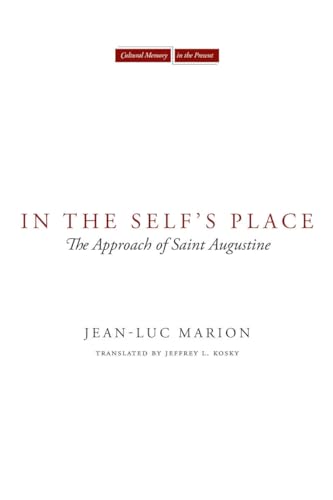
Inhaltsangabe
In the Self's Place is an original phenomenological reading of Augustine that considers his engagement with notions of identity in Confessions. Using the Augustinian experience of confessio, Jean-Luc Marion develops a model of selfhood that examines this experience in light of the whole of the Augustinian corpus. Towards this end, Marion engages with noteworthy modern and postmodern analyses of Augustine's most "experiential" work, including the critical commentaries of Jacques Derrida, Martin Heidegger, and Ludwig Wittgenstein. Marion ultimately concludes that Augustine has preceded postmodernity in exploring an excess of the self over and beyond itself, and in using this alterity of the self to itself, as a driving force for creative relations with God, the world, and others. This reading establishes striking connections between accounts of selfhood across the fields of contemporary philosophy, literary studies, and Augustine's early Christianity.
Die Inhaltsangabe kann sich auf eine andere Ausgabe dieses Titels beziehen.
Über die Autorin bzw. den Autor
Jean-Luc Marion is Greeley Professor of Catholic Studies and Professor of the Philosophy of Religions and Theology at the University of Chicago Divinity School, Professor of Modern Philosophy and Metaphysics at the University of Paris IV (Sorbonne), and a member of the Académie Française. Among his books to have been translated into English are Being Given (Stanford, 2002) and The Crossing of the Visible (Stanford, 2004).
Auszug. © Genehmigter Nachdruck. Alle Rechte vorbehalten.
IN THE SELF'S PLACE
The Approach of Saint AugustineBy Jean-Luc MarionSTANFORD UNIVERSITY PRESS
Copyright © 2008 Presses Universitaires de FranceAll right reserved.
ISBN: 978-0-8047-6291-5
Contents
Foreword........................................................xiiiBibliographic Note..............................................xviiTranslator's Note...............................................xix§1. The aporia of Saint Augustine..........................11 Confessio or Reduction........................................11§2. What praise means......................................11§3. Citation and responsal.................................21§4. Confessio divided and doubled..........................27§5. Coherence by confessio.................................32§6. Unity by confessio.....................................36§7. The model and alterity.................................40§8. The variations of the model............................502 The Ego or the Gifted.........................................56§9. The appearance of a cogito.............................56§10. The anonymity of the ego..............................62§11. The dimensions of memoria.............................69§12. The immemorial........................................74§13. What desire thinks....................................80§14. Vita beata as principle...............................87§15. The gifted, more than the ego.........................933 Truth, or the Saturated Phenomenon............................101§16. The demand of the vita beata..........................101§17. Dual-action truth.....................................108§18. Hatred of truth.......................................113§19. Evidential excess.....................................115§20. Love of truth.........................................120§21. Third-order truth.....................................128§22. The truth loved: pulchritudo..........................1384 Weakness of Will, or Power of Love............................145§23. Temptation and the fact of self.......................145§24. Desire or care........................................152§25. The will or my ownmost................................159§26. To will, not to will..................................164§27. Weakness of will......................................170§28. Vehementer velle......................................175§29. The grace to will.....................................1825 Time, or the Advent...........................................191§30. Time and the origin...................................191§31. Differance............................................197§32. The aporia of the present.............................202§33. The measure of bodily movement........................208§34. Distentio animi.......................................212§35. The event of creation.................................217§36. Conversion of the distentio...........................2236 The Creation of the Self......................................230§37. The opening of the world..............................230§38. The aporia of the place...............................237§39. The site of confessio.................................243§40. Resemblance without definition........................252§41. Pondus meum...........................................260§42. The univocity of love.................................270§43. In the self's place...................................2827 Addition: Idipsum, or the Name of God.........................289§44. The question of the names of God......................289§45. The common response...................................292§46. Translating idipsum by attraction.....................295§47. The silence of idipsum................................299§48. Sum qui sum, or immutability..........................302Conclusion......................................................307§49. Oneself as inclusion..................................307Notes...........................................................313English Translations Cited......................................397Index locorum...................................................403Index nominum...................................................411
Chapter One
Confessio or Reduction
§2. What praise means
The point of departure most often decides the point of arrival, for the target depends on the aim and the aim on the sight and the angle of the shot. The exercise of thought makes no exception to this rule; it even makes it all the more imperative, since, in this case more than in any other, nobody can turn back once out of the gate or take back the shot once fired. And, for that matter, there is no second chance at a first beginning.
Now (as we will see little by little) the Confessiones do not take place in any site known or defined before them. According to the evidence (provided that one sticks to precise terms), they are not inscribed within a metaphysics, still less within a metaphysica even specialis, the definition of which, even just the notion of which, they would know nothing about. But this absence of philosophical determination does not lead them toward a theological determination, if one means by "theology" a speculative discourse about God, as modern usage would have it. For if their text treats of almost everything, and therefore of nothing precisely, it never busies itself with the object of one of the classical treatises of dogmatic theology—neither with the divine unity nor with a trinitarian god, no more with Christology than with the sacraments, the Church than last things. In other places it certainly will fall to Saint Augustine to write as such about the Trinity and the city of God (though it remains to be seen if he treats them as one speaks about and on the subject of the one and the other, or rather by becoming himself the subject submitted to what he evokes). In others it falls to him to comment on the book of Genesis, the Psalms, and the Gospel of John (but commenting is not equivalent to treating a question, for the interpreter must, or should, always first let him- or herself be interpreted by the text, which no longer has anything like an object or a subject). Here, however, in the Confessiones, something else is going on: Saint Augustine does not comment on the text, does not treat any object, for, it could be said, he does not treat anything at all. Even when he comes around to analyzing the will, time, truth, the first verse of Genesis and even the vicissitudes of his turning around to God (what is called a bit too quickly his conversion), he never broaches them for themselves, as autonomous and objectifiable questions, but always inscribes them within a first-person narrative. And this narration itself constitutes the problem: who speaks, about what precisely, and to whom? Confronted with the difficulty of responding to these questions, the most common and (we will see) the most inadequate solution consists in falling back on something apparently obvious, by assigning the Confessiones the status of an autobiography, without worrying anymore about the autos, the self, of the question.
How are we to break free of this aporia? From what place are we to define the point of departure and therefore...
„Über diesen Titel“ kann sich auf eine andere Ausgabe dieses Titels beziehen.
Suchergebnisse für In the Self's Place: The Approach of Saint Augustine...

Beispielbild für diese ISBN
In the Self's Place: The Approach of Saint Augustine
Verlag:
Stanford University Press, 2012
ISBN 10: 0804762910
ISBN 13: 9780804762915
Gebraucht
Paperback
Anbieter: World of Books (was SecondSale), Montgomery, IL, USA
Verkäuferbewertung 5 von 5 Sternen

Paperback. Zustand: Fair. In the Self's Place is a phenomenological reading of Augustine that engages with modern and postmodern analyses of Augustinian philosophy. Artikel-Nr. 00106745568
Gebraucht kaufen
EUR 17,12
Versand gratis
Versand innerhalb von USA
Versand innerhalb von USA
Anzahl: 1 verfügbar
Beispielbild für diese ISBN
In the Self's Place
Anbieter: PBShop.store UK, Fairford, GLOS, Vereinigtes Königreich
Verkäuferbewertung 5 von 5 Sternen
PAP. Zustand: New. New Book. Shipped from UK. Established seller since 2000. Artikel-Nr. FW-9780804762915
Neu kaufen
EUR 27,57
EUR 5,93 Versand
Versand von Vereinigtes Königreich nach USA
Versand von Vereinigtes Königreich nach USA
Anzahl: 1 verfügbar
Beispielbild für diese ISBN
In The Self's Place
Anbieter: Majestic Books, Hounslow, Vereinigtes Königreich
Verkäuferbewertung 4 von 5 Sternen

Zustand: New. pp. 448. Artikel-Nr. 57967025
Neu kaufen
EUR 34,18
EUR 7,68 Versand
Versand von Vereinigtes Königreich nach USA
Versand von Vereinigtes Königreich nach USA
Anzahl: 3 verfügbar
Beispielbild für diese ISBN
In the Self s Place: The Approach of Saint Augustine
Anbieter: Kennys Bookstore, Olney, MD, USA
Verkäuferbewertung 5 von 5 Sternen
Zustand: New. In the Self's Place is a phenomenological reading of Augustine that engages with modern and postmodern analyses of Augustinian philosophy. Translator(s): Kosky, Jeffrey. Series: Cultural Memory in the Present. Num Pages: 448 pages. BIC Classification: HRAB; HRCM. Category: (G) General (US: Trade). Dimension: 228 x 156 x 25. Weight in Grams: 610. . 2012. Paperback. . . . . Books ship from the US and Ireland. Artikel-Nr. V9780804762915
Neu kaufen
EUR 40,50
EUR 9,37 Versand
Versand innerhalb von USA
Versand innerhalb von USA
Anzahl: 1 verfügbar
Beispielbild für diese ISBN
In the Self's Place: The Approach of Saint Augustine (Cultural Memory in the Present)
Anbieter: Ria Christie Collections, Uxbridge, Vereinigtes Königreich
Verkäuferbewertung 5 von 5 Sternen
Zustand: New. In English. Artikel-Nr. ria9780804762915_new
Neu kaufen
EUR 37,47
EUR 13,34 Versand
Versand von Vereinigtes Königreich nach USA
Versand von Vereinigtes Königreich nach USA
Anzahl: 9 verfügbar
Beispielbild für diese ISBN
In the Self`s Place The Approach of Saint Augustine
Anbieter: Revaluation Books, Exeter, Vereinigtes Königreich
Verkäuferbewertung 5 von 5 Sternen
Paperback. Zustand: Brand New. 1st edition. 445 pages. 8.90x1.00x6.00 inches. In Stock. Artikel-Nr. x-0804762910
Neu kaufen
EUR 39,51
EUR 14,77 Versand
Versand von Vereinigtes Königreich nach USA
Versand von Vereinigtes Königreich nach USA
Anzahl: 2 verfügbar
Foto des Verkäufers
In the Self's Place : The Approach of Saint Augustine
Verlag:
Stanford University Press Okt 2012, 2012
ISBN 10: 0804762910
ISBN 13: 9780804762915
Neu
Taschenbuch
Anbieter: AHA-BUCH GmbH, Einbeck, Deutschland
Verkäuferbewertung 5 von 5 Sternen
Taschenbuch. Zustand: Neu. Neuware - In the Self's Place is an original phenomenological reading of Augustine that considers his engagement with notions of identity in Confessions. Using the Augustinian experience of confessio, Jean-Luc Marion develops a model of selfhood that examines this experience in light of the whole of the Augustinian corpus. Towards this end, Marion engages with noteworthy modern and postmodern analyses of Augustine's most 'experiential' work, including the critical commentaries of Jacques Derrida, Martin Heidegger, and Ludwig Wittgenstein. Marion ultimately concludes that Augustine has preceded postmodernity in exploring an excess of the self over and beyond itself, and in using this alterity of the self to itself, as a driving force for creative relations with God, the world, and others. This reading establishes striking connections between accounts of selfhood across the fields of contemporary philosophy, literary studies, and Augustine's early Christianity. Artikel-Nr. 9780804762915
Neu kaufen
EUR 38,30
EUR 35,00 Versand
Versand von Deutschland nach USA
Versand von Deutschland nach USA
Anzahl: 8 verfügbar
Beispielbild für diese ISBN
IN THE SELFS PLACE
Anbieter: Speedyhen, Hertfordshire, Vereinigtes Königreich
Verkäuferbewertung 5 von 5 Sternen
Zustand: NEW. Artikel-Nr. NW9780804762915
Neu kaufen
EUR 27,60
EUR 48,44 Versand
Versand von Vereinigtes Königreich nach USA
Versand von Vereinigtes Königreich nach USA
Anzahl: 6 verfügbar
Foto des Verkäufers
In the Self\ s Place: The Approach of Saint Augustine
Anbieter: moluna, Greven, Deutschland
Verkäuferbewertung 5 von 5 Sternen
Zustand: New. In the Self s Place is a phenomenological reading of Augustine that engages with modern and postmodern analyses of Augustinian philosophy.Über den AutorrnrnJean-Luc Marion is Greeley Professor of Catholic Studies and Professor of the Ph. Artikel-Nr. 595015764
Neu kaufen
EUR 35,40
EUR 48,99 Versand
Versand von Deutschland nach USA
Versand von Deutschland nach USA
Anzahl: 5 verfügbar
Foto des Verkäufers
In the Self's Place | The Approach of Saint Augustine
Anbieter: preigu, Osnabrück, Deutschland
Verkäuferbewertung 5 von 5 Sternen
Taschenbuch. Zustand: Neu. In the Self's Place | The Approach of Saint Augustine | Jean-Luc Marion | Taschenbuch | Einband - flex.(Paperback) | Englisch | 2012 | Stanford University Press | EAN 9780804762915 | Verantwortliche Person für die EU: Libri GmbH, Europaallee 1, 36244 Bad Hersfeld, gpsr[at]libri[dot]de | Anbieter: preigu. Artikel-Nr. 123828677
Neu kaufen
EUR 40,35
EUR 70,00 Versand
Versand von Deutschland nach USA
Versand von Deutschland nach USA
Anzahl: 1 verfügbar