
Verwandte Artikel zu Southeast Asia in Political Science: Theory, Region,...
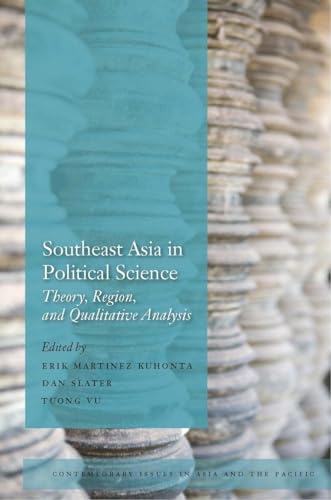
Southeast Asia in Political Science: Theory, Region, and Qualitative Analysis (Contemporary Issues in Asia and the Pacific) - Softcover
Inhaltsangabe
This book argues that Southeast Asian political studies have made important contributions to theory building in comparative politics through a dialogue involving theory, area studies, and qualitative methodology. The book provides a state-of-the-art review of key topics in the field, including: state structures, political regimes, political parties, contentious politics, civil society, ethnicity, religion, rural development, globalization, and political economy. The chapters allow readers to trace the development of Southeast Asian politics and to address central debates in comparative politics. The book will serve as a valuable reference for undergraduate and graduate students, scholars of Southeast Asian politics, and comparativists engaged in theoretical debates at the heart of political science.
Die Inhaltsangabe kann sich auf eine andere Ausgabe dieses Titels beziehen.
Über die Autorinnen und Autoren
Erik Martinez Kuhonta is Assistant Professor in the Department of Political Science at McGill University. Dan Slater is Assistant Professor in the Department of Political Science at the University of Chicago. Tuong Vu is Assistant Professor in the Department of Political Science at the University of Oregon, Eugene.
Erik Martinez Kuhonta is Assistant Professor in the Department of Political Science at McGill University. Dan Slater is Assistant Professor in the Department of Political Science at the University of Chicago. Tuong Vu is Assistant Professor in the Department of Political Science at the University of Oregon, Eugene.
Auszug. © Genehmigter Nachdruck. Alle Rechte vorbehalten.
Southeast Asia in Political Science
Theory, Region, and Qualitative AnalysisStanford University Press
Copyright © 2008 Board of Trustees of the Leland Stanford Junior UniversityAll right reserved.
ISBN: 978-0-8047-6152-9
Contents
Acknowledgments..............................................................................................................................xiiiContributors.................................................................................................................................xv1. Introduction: The Contributions of Southeast Asian Political Studies Erik Martinez Kuhonta, Dan Slater, and Tuong Vu.....................12. Studying States in Southeast Asia Erik Martinez Kuhonta..................................................................................303. Democracy and Dictatorship Do Not Float Freely: Structural Sources of Political Regimes in Southeast Asia Dan Slater.....................554. Developing Democracies in Southeast Asia: Theorizing the Role of Parties and Elections Allen Hicken......................................805. Contentious Mass Politics in Southeast Asia: Knowledge Accumulation and Cycles of Growth and Exhaustion Tuong Vu.........................1026. In-Depth Research and Knowledge Accumulation About Agrarian Politics in Southeast Asia Benedict J. Tria Kerkvliet........................1297. Civil Society and Close Approximations Thereof Meredith L. Weiss.........................................................................1448. Beyond Doctrine and Dogma: Religion and Politics in Southeast Asia Kikue Hamayotsu.......................................................1719. The Study of Political Ethnicity in Southeast Asia Jamie S. Davidson.....................................................................19910. Southeast Asia and the Political Economy of Development Regina Abrami and Richard F. Doner..............................................22711. The Missing Countryside: The Price of Ignoring Rural Political Economy in Southeast Asia Ardeth Maung Thawnghmung.......................25212. Southeast Asia and Globalization: The Political Economy of Illiberal Adaptation Greg Felker.............................................27413. Southeast Asia in Political Science: Terms of Enlistment Donald K. Emmerson.............................................................30214. Concluding Remarks Erik Martinez Kuhonta, Dan Slater, and Tuong Vu......................................................................325Notes........................................................................................................................................333Bibliography.................................................................................................................................361Index........................................................................................................................................423
Chapter One
Introduction The Contributions of Southeast Asian Political StudiesERIK MARTINEZ KUHONTA, DAN SLATER, AND TUONG VU
After a post–Vietnam War hiatus of nearly a quarter-century, Southeast Asia has recaptured the attention of the world. In 1997 the sudden devaluation of Thailand's national currency (the baht) triggered a financial crisis that swept throughout Asia and threatened for a time to engulf the world's richest economies. This "Asian Contagion" had its most devastating economic effects in Indonesia—the world's fourth-most-populous country—where financial implosion helped induce the dramatic collapse of the authoritarian Suharto regime in 1998 amid swelling public demands for democratic reform. The terrorist attacks on the United States in September 2001 brought heightened attention to Southeast Asia for quite different reasons, as the region's large Islamic populations and loosely governed territories led pundits to dub it "the second front in the global war on terror." When the SARS epidemic and bird flu outbreaks struck Southeast Asia starting in 2003, they raised the specter of global pandemics from which no country would be immune. And when Indonesia and Thailand bore the brunt of the most cataclysmic natural disaster in modern history—the Indian Ocean tsunami of December 2004—Southeast Asians' unspeakable suffering not only inspired an unprecedented outpouring of emergency assistance; it also inspired unprecedented calls for international coordination in preventing and limiting the destruction caused by environmental and public-health crises, which respect no boundaries in an increasingly interdependent world.
To be sure, the eleven countries of Southeast Asia—Brunei, Burma, Cambodia, East Timor, Indonesia, Laos, Malaysia, the Philippines, Singapore, Thailand, and Vietnam—may still seem geographically peripheral to Western eyes. No other region is so distant from both North America and Europe, where global institutions are primarily housed and global images are primarily shaped. Yet these dramatic (and mostly tragic) recent events should show beyond a shadow of a doubt that Southeast Asia's diverse political systems are far from peripheral to the most momentous global trends. It is a region that the rest of the world can ill afford to ignore or misunderstand.
Thankfully, scholars of Southeast Asian politics have been accumulating valuable knowledge on this complex and crucial region for decades. Southeast Asia may have been relatively neglected in the study of comparative politics (especially regarding Europe and Latin America), but it has by no means been neglected absolutely. This volume's first mission is to compile and display some of the extensive knowledge that scholars of Southeast Asian politics have produced on pressing global topics such as political Islam, state building, economic globalization, democracy and dictatorship, ethnic conflict, rural development, and civil society. Although students of Southeast Asian politics have produced an impressive range of scholarly works, Southeast Asianists still lack a systematic inventory and synthesis of the wealth of political knowledge that has been accumulated. This book's first goal is to fill this considerable void.
Our second purpose is somewhat broader and bolder. Beyond examining what we have learned about Southeast Asian politics, we also ask this: What can Southeast Asia tell us about the wider political world? This question ineluctably draws us into considerations of how theory, method, and region interact. As political scientists, we wish to consider whether the qualitative analysis of Southeast Asian politics has gone beyond generating particular, fragmented bits of empirical knowledge and whether it has produced more general theoretical insights for our discipline as a whole. We will argue that Southeast Asianists have indeed accumulated theoretical as well as empirical knowledge but that these general, portable insights are often easily missed when scholars refrain from framing their arguments in theoretically self-conscious terms, or from discussing the potential comparative implications of their arguments.
In sum, this book calls for concerted efforts to improve and invigorate the scholarly synergy between region and discipline. We see this endeavor as long overdue. In the last two decades, fresh theoretical perspectives and qualitative methodological approaches have emerged in political science, and there is much room for Southeast Asianists both to contribute to and gain from these new developments. Rather than approaching these theoretical and...
„Über diesen Titel“ kann sich auf eine andere Ausgabe dieses Titels beziehen.
Suchergebnisse für Southeast Asia in Political Science: Theory, Region,...

Beispielbild für diese ISBN
Southeast Asia in Political Science: Theory, Region, and Qualitative Analysis (Contemporary Issues in Asia and the Pacific)
Verlag:
Stanford University Press, 2008
ISBN 10: 0804761523
ISBN 13: 9780804761529
Gebraucht
Softcover
Anbieter: Phatpocket Limited, Waltham Abbey, HERTS, Vereinigtes Königreich
Verkäuferbewertung 5 von 5 Sternen

Zustand: Good. Your purchase helps support Sri Lankan Children's Charity 'The Rainbow Centre'. Ex-library, so some stamps and wear, but in good overall condition. Our donations to The Rainbow Centre have helped provide an education and a safe haven to hundreds of children who live in appalling conditions. Artikel-Nr. Z1-Q-034-02942
Gebraucht kaufen
EUR 25,51
EUR 12,57 Versand
Versand von Vereinigtes Königreich nach USA
Versand von Vereinigtes Königreich nach USA
Anzahl: 2 verfügbar
Beispielbild für diese ISBN
Southeast Asia in Political Science
Anbieter: PBShop.store UK, Fairford, GLOS, Vereinigtes Königreich
Verkäuferbewertung 5 von 5 Sternen
PAP. Zustand: New. New Book. Shipped from UK. Established seller since 2000. Artikel-Nr. FW-9780804761529
Neu kaufen
EUR 35,68
EUR 5,93 Versand
Versand von Vereinigtes Königreich nach USA
Versand von Vereinigtes Königreich nach USA
Anzahl: 15 verfügbar
Beispielbild für diese ISBN
Southeast Asia in Political Science: Theory, Region, and Qualitative Analysis (Contemporary Issues in Asia and Pacific)
Anbieter: Majestic Books, Hounslow, Vereinigtes Königreich
Verkäuferbewertung 4 von 5 Sternen

Zustand: New. pp. 480. Artikel-Nr. 7990281
Neu kaufen
EUR 40,86
EUR 7,68 Versand
Versand von Vereinigtes Königreich nach USA
Versand von Vereinigtes Königreich nach USA
Anzahl: 3 verfügbar
Beispielbild für diese ISBN
Southeast Asia in Political Science: Theory, Region, and Qualitative Analysis (Contemporary Issues in Asia and the Pacific)
Anbieter: Ria Christie Collections, Uxbridge, Vereinigtes Königreich
Verkäuferbewertung 5 von 5 Sternen
Zustand: New. In English. Artikel-Nr. ria9780804761529_new
Neu kaufen
EUR 38,73
EUR 13,34 Versand
Versand von Vereinigtes Königreich nach USA
Versand von Vereinigtes Königreich nach USA
Anzahl: Mehr als 20 verfügbar
Beispielbild für diese ISBN
Southeast Asia in Political Science: Theory, Region, and Qualitative Analysis
Anbieter: Kennys Bookstore, Olney, MD, USA
Verkäuferbewertung 5 von 5 Sternen
Zustand: New. This book provides a state-of-the-art review of Southeast Asian political studies through a dialogue involving theoretical analysis, area studies, and qualitative methodology. Editor(s): Kuhonta, Erik Martinez; Slater, Dan; Vu, Tuong. Series: Contemporary Issues in Asia and Pacific. Num Pages: 480 pages, 2 tables. BIC Classification: 1FM; JPA. Category: (P) Professional & Vocational; (UP) Postgraduate, Research & Scholarly; (UU) Undergraduate. Dimension: 5817 x 3887 x 28. Weight in Grams: 635. . 2008. 1st Edition. Paperback. . . . . Books ship from the US and Ireland. Artikel-Nr. V9780804761529
Neu kaufen
EUR 48,75
EUR 9,37 Versand
Versand innerhalb von USA
Versand innerhalb von USA
Anzahl: Mehr als 20 verfügbar
Beispielbild für diese ISBN
Southeast Asia in Political Science Theory, Region, and Qualitative Analysis
Anbieter: Revaluation Books, Exeter, Vereinigtes Königreich
Verkäuferbewertung 5 von 5 Sternen
Paperback. Zustand: Brand New. 455 pages. 8.75x6.00x1.25 inches. In Stock. Artikel-Nr. x-0804761523
Neu kaufen
EUR 45,46
EUR 14,77 Versand
Versand von Vereinigtes Königreich nach USA
Versand von Vereinigtes Königreich nach USA
Anzahl: 2 verfügbar
Foto des Verkäufers
Southeast Asia in Political Science: Theory, Region, and Qualitative Analysis
Verlag:
STANFORD UNIV PR, 2008
ISBN 10: 0804761523
ISBN 13: 9780804761529
Neu
Kartoniert / Broschiert
Anbieter: moluna, Greven, Deutschland
Verkäuferbewertung 5 von 5 Sternen
Kartoniert / Broschiert. Zustand: New. This book provides a state-of-the-art review of Southeast Asian political studies through a dialogue involving theoretical analysis, area studies, and qualitative methodology.Über den AutorErik Martinez Kuhonta is Assistant Prof. Artikel-Nr. 595015689
Neu kaufen
EUR 36,22
EUR 48,99 Versand
Versand von Deutschland nach USA
Versand von Deutschland nach USA
Anzahl: Mehr als 20 verfügbar
Foto des Verkäufers
Southeast Asia in Political Science | Theory, Region, and Qualitative Analysis
Anbieter: preigu, Osnabrück, Deutschland
Verkäuferbewertung 5 von 5 Sternen
Taschenbuch. Zustand: Neu. Southeast Asia in Political Science | Theory, Region, and Qualitative Analysis | Erik Martinez Kuhonta (u. a.) | Taschenbuch | Einband - flex.(Paperback) | Englisch | 2008 | Stanford University Press | EAN 9780804761529 | Verantwortliche Person für die EU: Mare Nostrum Group B.V., Doelen 72, 4831 GR BREDA, NIEDERLANDE, gpsr[at]mare-nostrum[dot]co[dot]uk | Anbieter: preigu. Artikel-Nr. 124653607
Neu kaufen
EUR 33,80
EUR 70,00 Versand
Versand von Deutschland nach USA
Versand von Deutschland nach USA
Anzahl: 5 verfügbar