
Verwandte Artikel zu Knowledge as Power: Criminal Registration and Community...
Knowledge as Power: Criminal Registration and Community Notification Laws in America (Critical Perspectives on Crime and Law) - Softcover
Buch 4 von 7: Critical Perspectives on Crime and Law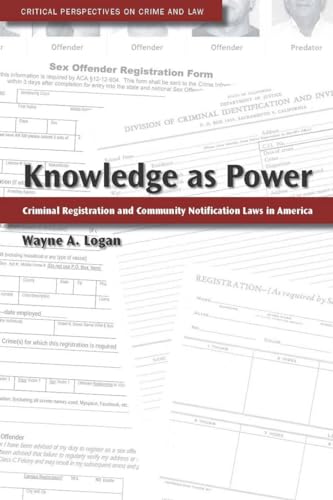
Inhaltsangabe
Societies have long sought security by identifying potentially dangerous individuals in their midst. America is surely no exception. Knowledge as Power traces the evolution of a modern technique that has come to enjoy nationwide popularity-criminal registration laws. Registration, which originated in the 1930s as a means of monitoring gangsters, went largely unused for decades before experiencing a dramatic resurgence in the 1990s. Since then it has been complemented by community notification laws which, like the "Wanted" posters of the Frontier West, publicly disclose registrants' identifying information, involving entire communities in the criminal monitoring process.
Knowledge as Power provides the first in-depth history and analysis of criminal registration and community notification laws, examining the potent forces driving their rapid nationwide proliferation in the 1990s through today, as well as exploring how the laws have affected the nation's law, society, and governance. In doing so, the book provides compelling insights into the manifold ways in which registration and notification reflect and influence life in modern America.
Die Inhaltsangabe kann sich auf eine andere Ausgabe dieses Titels beziehen.
Über die Autorin bzw. den Autor
Wayne A. Logan is Gary & Sallyn Pajcic Professor of Law and Associate Dean for Academic Affairs at Florida State University. In addition to being the nation's preeminent legal scholar on registration and community notification laws, he is a prolific author and commentator on a broad array of other criminal justice-related issues.
Auszug. © Genehmigter Nachdruck. Alle Rechte vorbehalten.
Knowledge as Power
CRIMINAL REGISTRATION AND COMMUNITY NOTIFICATION LAWS IN AMERICABy Wayne A. LoganStanford Law Books
Copyright © 2009 Board of Trustees of the Leland Stanford Junior UniversityAll right reserved.
ISBN: 978-0-8047-6136-9
Contents
Acknowledgments......................................ixIntroduction.........................................xi1 Historical Antecedents.............................12 Early Laws: 1930-1990..............................203 Modern Laws: 1990-Today............................494 Social and Political Catalysts.....................855 Effects and Consequences...........................1096 Law, Privacy, and Governance.......................1347 Prospects for the Future...........................165Conclusion...........................................185Notes................................................189Index................................................287
Chapter One
HISTORICAL ANTECEDENTS
MODERN-DAY CRIMINAL REGISTRATION and community notification laws owe an unmistakable intellectual and technological debt to predecessor efforts. As governments and individuals over time recognized the reality of individualized criminal risk, techniques were devised to render it more knowable, and hence possibly more susceptible to control. This chapter traces the several major developments that laid the foundation for contemporary registration and community notification laws, providing the necessary background for an understanding of the forces propelling their modern proliferation in America.
MEASURING MISCONDUCT
Governments have long valued gathering and storing information on their subjects. Dating back to efforts by ecclesiastics in mid-1500s Finland and Sweden, and later public authorities in seventeenth-century England and Prussia, governments have recognized the importance of population data. By recording events such as births, deaths, and marriages, a "legible people" could be created, and this legibility served the important instrumental purpose of evincing state power itself.
Over time, however, statistical knowledge came to be valued for more particularized reasons, including its capacity to reflect the incidence of criminal deviance, an issue of increasing governmental concern. With improvements in data collection methods, statistical inferences were possible, allowing, as Belgian statistician Adolphe Quetlet put it in 1829, knowledge of the "terrifying exactitude with which crimes reproduce themselves." Governments could "know in advance how many individuals will dirty their hands with the blood of others, how many will be forgers, how many prisoners, nearly as well as one can enumerate in advance the births and deaths that must take place." With such information, one could develop a "kind of budget for the scaffold, the galley and the prisons."
Criminal deviance, nascent social science instructed, was not random. Rather, just as the aggregate occurrence of crime was a social fact, so too was the propensity of certain individuals to repeatedly engage in criminal misconduct. This recognition fueled efforts to amass and maintain records on individual wrongdoers. As early as the late thirteenth century, local governments exchanged names and primitive physical descriptions of wanted outlaws, and over the years such efforts became increasingly routinized. In England, London's court at Bow Street in 1753 initiated a registry containing names and descriptions of all persons suspected of having committed fraud or a felony. In 1844, the French ascribed semantic distinction to the phenomenon, coining the term recidiviste, which itself coincided with a change in governmental perspective. European governments shifted from a preoccupation over dangerous classes to concern over dangerous individuals. Criminal danger, as historian John Pratt has written, became "a quality no longer ... possessed by a class but [rather] by individuals or small groups of criminals." The danger no longer threatened to "tear down the portals of the state in an orgy of blood and destruction," but was instead "targeted at the quality of life of its individual subjects."
PROCESSING THE CRIMINAL ELEMENT
Developing awareness of the individualized nature of criminality had a critically important impact on the administration of justice, which during the late eighteenth and early nineteenth centuries increasingly sought to individualize sanctions. This was especially so in the early American Republic, where two policies, both contingent on the ability to distinguish individual criminal actors, were taking hold. The first was sentence enhancements, which Americans since colonial times imposed on repeat offenders. If such individuals were to be held accountable and singled out for heightened punishment, they had to be reliably identified.
A second policy concerned the goal of offender rehabilitation, which in Jacksonian America emerged as the dominant penal goal and rationale. Under the model, not all convicts were seen as similarly predisposed to recidivism. If prison was to avoid serving as a "school for crime," prior offenders needed to be identified and isolated from perhaps less crime-prone peers. In addition, for reform to be successful, punishments needed to be tailored to the offending histories and backgrounds of individual offenders, which presupposed accurate identification.
Procedures employed in the early 1800s at Philadelphia's Walnut Street Jail highlighted this effort. Upon arrival, officials collected information on each inmate, including name, age, crime of conviction, sentence imposed and date, and adjudicating court. This information was then used to classify individuals in the name of optimizing prospects for rehabilitation, and was augmented by physical descriptions at their time of departure. As a result, future newcomers to Walnut Street could be compared against institutional records, and in the event of a match punishment and reform-related decisions could be made accordingly. Under this regime, "neither change of name or [sic] disguise" would allow reoffenders to escape detection.
Such efforts at individuation, however, were often less than successful. This was so for two chief reasons. First, clerks failed to consistently and comprehensively record available data on convicts (for example, one clerk might note the height of a convict, while another would not). Furthermore, the data points recorded often included vague or relative assessments or descriptors (such as "quick" speech, "sallow" complexion) and focused on too few unalterable features (such as eye color); worse yet, records reflected matters capable of fabrication (such as place or date of birth).
Second, almost as important, the information gathered was not capable of being readily retrieved. Records were typically stored according to sentencing date, with no capacity for cross-referencing, requiring officials to review the entirety of jail records. Although by the mid-1820s the information gathered increased in complexity, and utility was enhanced by storing convict names by means of alphabetization, jail records remained of limited practical use in detecting recidivists.
MONITORING THE CRIMINAL ELEMENT
Concern over recidivists, however, was not limited to government actors; it surely extended to society at large, which in the late eighteenth and early nineteenth centuries was buffeted by broader destabilizing influences....
„Über diesen Titel“ kann sich auf eine andere Ausgabe dieses Titels beziehen.
Suchergebnisse für Knowledge as Power: Criminal Registration and Community...

Beispielbild für diese ISBN
Knowledge As Power
Anbieter: PBShop.store UK, Fairford, GLOS, Vereinigtes Königreich
Verkäuferbewertung 5 von 5 Sternen

PAP. Zustand: New. New Book. Shipped from UK. Established seller since 2000. Artikel-Nr. FW-9780804761369
Neu kaufen
EUR 25,95
EUR 4,85 Versand
Versand von Vereinigtes Königreich nach USA
Versand von Vereinigtes Königreich nach USA
Anzahl: 15 verfügbar
Beispielbild für diese ISBN
Knowledge as Power: Criminal Registration and Community Notification Laws in America (Critical Perspectives on Crime and Law)
Anbieter: Majestic Books, Hounslow, Vereinigtes Königreich
Verkäuferbewertung 4 von 5 Sternen

Zustand: New. pp. 312. Artikel-Nr. 7990292
Neu kaufen
EUR 30,64
EUR 7,58 Versand
Versand von Vereinigtes Königreich nach USA
Versand von Vereinigtes Königreich nach USA
Anzahl: 3 verfügbar
Beispielbild für diese ISBN
Knowledge as Power: Criminal Registration and Community Notification Laws in America (Critical Perspectives on Crime and Law)
Anbieter: Ria Christie Collections, Uxbridge, Vereinigtes Königreich
Verkäuferbewertung 5 von 5 Sternen
Zustand: New. In English. Artikel-Nr. ria9780804761369_new
Neu kaufen
EUR 29,96
EUR 13,17 Versand
Versand von Vereinigtes Königreich nach USA
Versand von Vereinigtes Königreich nach USA
Anzahl: Mehr als 20 verfügbar
Beispielbild für diese ISBN
Knowledge as Power Criminal Registration and Community Notification Laws in America
Anbieter: Revaluation Books, Exeter, Vereinigtes Königreich
Verkäuferbewertung 5 von 5 Sternen
Paperback. Zustand: Brand New. 288 pages. 8.75x6.00x0.75 inches. In Stock. Artikel-Nr. x-0804761361
Neu kaufen
EUR 32,63
EUR 11,67 Versand
Versand von Vereinigtes Königreich nach USA
Versand von Vereinigtes Königreich nach USA
Anzahl: 2 verfügbar
Beispielbild für diese ISBN
Knowledge as Power: Criminal Registration and Community Notification Laws in America
Anbieter: Kennys Bookstore, Olney, MD, USA
Verkäuferbewertung 5 von 5 Sternen
Zustand: New. The first comprehensive examination of U.S. efforts to register and monitor individuals in response to real or perceived criminal threats. Series: Critical Perspectives on Crime and Law. Num Pages: 312 pages. BIC Classification: 1KBB; JKV; LNF. Category: (G) General (US: Trade); (P) Professional & Vocational; (U) Tertiary Education (US: College). Dimension: 5817 x 3887 x 458. Weight in Grams: 408. . 2009. 1st Edition. Paperback. . . . . Books ship from the US and Ireland. Artikel-Nr. V9780804761369
Neu kaufen
EUR 37,34
EUR 9,26 Versand
Versand innerhalb von USA
Versand innerhalb von USA
Anzahl: Mehr als 20 verfügbar
Foto des Verkäufers
Knowledge as Power: Criminal Registration and Community Notification Laws in America
Verlag:
STANFORD LAW BOOKS, 2009
ISBN 10: 0804761361
ISBN 13: 9780804761369
Neu
Kartoniert / Broschiert
Anbieter: moluna, Greven, Deutschland
Verkäuferbewertung 5 von 5 Sternen
Kartoniert / Broschiert. Zustand: New. The first comprehensive examination of U.S. efforts to register and monitor individuals in response to real or perceived criminal threats.Über den AutorWayne A. Logan is Gary & Sallyn Pajcic Professor of Law and Associate Dean f. Artikel-Nr. 595015678
Neu kaufen
EUR 27,54
EUR 48,99 Versand
Versand von Deutschland nach USA
Versand von Deutschland nach USA
Anzahl: Mehr als 20 verfügbar
Foto des Verkäufers
Knowledge as Power | Criminal Registration and Community Notification Laws in America
Anbieter: preigu, Osnabrück, Deutschland
Verkäuferbewertung 5 von 5 Sternen
Taschenbuch. Zustand: Neu. Knowledge as Power | Criminal Registration and Community Notification Laws in America | Wayne A Logan | Taschenbuch | Einband - flex.(Paperback) | Englisch | 2009 | Stanford University Press | EAN 9780804761369 | Verantwortliche Person für die EU: Mare Nostrum Group B.V., Doelen 72, 4831 GR BREDA, NIEDERLANDE, gpsr[at]mare-nostrum[dot]co[dot]uk | Anbieter: preigu. Artikel-Nr. 132520613
Neu kaufen
EUR 24,45
EUR 70,00 Versand
Versand von Deutschland nach USA
Versand von Deutschland nach USA
Anzahl: 5 verfügbar