
Verwandte Artikel zu The Theory and Practice of Statutory Interpretation
Inhaltsangabe
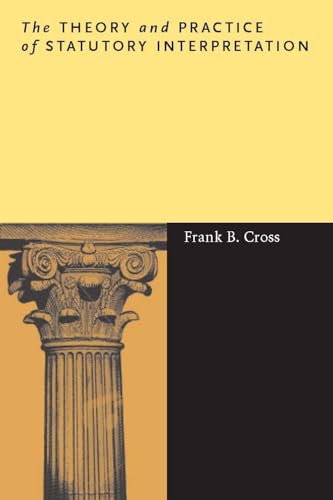
Today, statutes make up the bulk of the relevant law heard in federal courts and arguably represent the most important source of American law. The proper means of judicial interpretation of those statutes have been the subject of great attention and dispute over the years. This book provides new insights into the theory and practice of statutory interpretation by courts.
Cross offers the first comprehensive analysis of statutory interpretation and includes extensive empirical evidence of Supreme Court practice. He offers a thorough review of the active disputes over the appropriate approaches to statutory interpretations, namely whether courts should rely exclusively on the text or also examine the legislative history. The book then considers the use of these approaches by the justices of the recent Rehnquist Court and the degree to which they were applied by the justices, either sincerely or in pursuit of an ideological agenda.
Die Inhaltsangabe kann sich auf eine andere Ausgabe dieses Titels beziehen.
Über die Autorinnen und Autoren
Frank B. Cross is the Herbert D. Kelleher Centennial Professor of Business Law at the University of Texas. He is the author of Decision Making in the U.S. Courts of Appeals (Stanford, 2007), and The Failed Promise of Originalism (Stanford, 2012), among other books.
Frank B. Cross is the Herbert D. Kelleher Centennial Professor of Business Law at the University of Texas. He is the author of Decision Making in the U.S. Courts of Appeals (Stanford, 2007), and The Failed Promise of Originalism (Stanford, 2012), among other books.
Auszug. © Genehmigter Nachdruck. Alle Rechte vorbehalten.
The Theory and Practice of Statutory Interpretation
By FRANK B. CROSSSTANFORD UNIVERSITY PRESS
Copyright © 2009 Board of Trustees of the Leland Stanford Junior UniversityAll right reserved.
ISBN: 978-0-8047-5912-0
Contents
Preface............................................................................vii1. The Goal of Statutory Interpretation............................................12. Textualism and Statutory Interpretation.........................................243. Legislative History and Statutory Interpretation................................584. The Canons of Statutory Interpretation..........................................855. Pragmatism and Dynamic Statutory Interpretation.................................1026. The Justices and Their Practice of Statutory Interpretation.....................1347. Ideology and the Practice of Statutory Interpretation...........................1598. Statutory Interpretation in the Lower Federal Courts............................180Notes..............................................................................201Index..............................................................................225
Chapter One
The Goal of Statutory Interpretation
The goal of statutory interpretation should be central to understanding its theory and practice. Unfortunately, there is no consensus about the proper goal of this interpretive enterprise, either politically or legally. Fortunately, consensus is unnecessary for purposes of this book. However, it remains important to understand the goal of statutory interpretation in order to evaluate the different theories set forth in the book. Practices and consequences cannot be appreciated in the abstract, especially given the concern about unconstrained willful ideological discretion of the judiciary. Consequently, this chapter sets forth, relatively briefly, the theories about the appropriate purpose of judicial interpretation of statutes.
The judicial power, including that of statutory interpretation, derives from the Constitution. The Constitution, however, does not provide much guidance on the relevant question. It simply "leaves statutory interpretation to be resolved by the 'judicial power' without specifying how that interpretation should be conducted." No provision "sets out explicit instructions to judges about the limits of interpretive flexibility." The Constitution leaves us with only the broad principle that statutory interpretation should be a "judicial" exercise, which leaves considerable discretion about the proper nature of judging the application of statutes in individual cases. Various leading scholars have claimed that their proposed interpretive method is constitutionally inspired, or even required, but they have reached this same conclusion in support of different approaches. While some substantive interpretive canons, discussed in Chapter 4, have an apparent constitutional provenance, there is no accepted general thesis of constitutionally directed statutory interpretation.
Historically, the dispute over the goal of statutory interpretation has largely been drawn between those who believe that judges should hew closely to their assessment of what the legislature intended, based upon all available evidence of that intent, and those who think that the purpose is simply to give effect to the statutory language adopted by the legislature and eschew consideration of extrinsic evidence about the legislature's intent. This dispute is closely bound up with the interpretive theories of each school, and it will be explicated further in succeeding chapters. Those who believe that the purpose of the process is to discern intent commonly argue for consideration of legislative history, while those who would limit interpretation to language are of the textualist school. A third purpose has also emerged, which contends that interpretation should be guided by a concern for the best policy consequences under the circumstances. This is generally considered the pragmatic approach to interpretation, which uses its own discretionary standards.
The debate over the proper purpose of statutory interpretation has lasted for many decades. The Supreme Court has cycled among different purposes at different times. While one approach or another has gained ascendancy for a time, it has eventually lost this position. None of the theories have knocked out competing theories. For most of our history, the different theories have coexisted. This book does not purport to resolve the proper theoretical basis for statutory interpretation, but it is important to understand these theories, as their application is examined and evaluated.
This introductory chapter first sets forth the overall theoretical construct for statutory interpretation disputes. The interpretive role of courts should be seen, I contend, as an exercise of power delegated by the legislature. The courts should view themselves as agents who do the bidding of Congress in their interpretations of congressional statutes. Next, I review the major interpretive theories and how they may fit within this delegation scheme. Finally, I summarize the overriding issue of faithless judicial ideological decision making, which pervades the debate over interpretive methods and is discussed throughout the book.
Statutory Interpretation as Delegated Power
Before examining the competing purposes for statutory interpretation, it is important to address its context. Congress passes statutes but does not apply them to individual cases; the judiciary is in charge of that task in our constitutional model. In statutory interpretation cases, judges are applying the legislation passed by Congress. Consequently, judges are often viewed as fiduciaries, or agents, of the legislature. Thus, "[m]ost academic theories of statutory interpretation, and perhaps all judicial ones, see judges as agents of Congress." This is the theory of legislative supremacy in the statutory sphere.
Legally, judges are not true delegatees but have their own independent constitutional interpretive authority that is not derivative of the legislature. The Constitution invests the judicial power in the judiciary, and this serves as its authority to interpret statutes when deciding cases. However, this declaration begs the question of what the "judicial power" means. The judicial power is not that of arbitrary decision making nor that of legislating. The delegation theory suggests that viewing themselves as legislative agents when interpreting statutes is the proper understanding of how judicial power should be exercised.
In this schema, the legislature is the principal and the courts are its agent, analogous to private agency relationships. A corporation, for example, relies on individual officers and employees to carry out its business. The law recognizes the corporation as a principal and the officers as its agents, who are delegated authority to advance the interests of the corporate principal. Because the corporation and its directors are unable themselves to make every day-to-day managerial decision to carry out their broad business policies, they provide this authority to others through delegation. This delegation may provide more or less discretion to an agent. The agent may have broad authority to take action, as in the case of a legal power of attorney, or quite limited authority to take only a given action or actions below a certain monetary threshold. Moreover, there is some residuum of authority that cannot be delegated to officers but must be reserved for the board of directors, under corporate law....
„Über diesen Titel“ kann sich auf eine andere Ausgabe dieses Titels beziehen.
Suchergebnisse für The Theory and Practice of Statutory Interpretation

Beispielbild für diese ISBN
The Theory and Practice of Statutory Interpretation
Anbieter: PBShop.store UK, Fairford, GLOS, Vereinigtes Königreich
Verkäuferbewertung 5 von 5 Sternen

HRD. Zustand: New. New Book. Shipped from UK. Established seller since 2000. Artikel-Nr. FW-9780804759120
Neu kaufen
EUR 113,10
EUR 5,99 Versand
Versand von Vereinigtes Königreich nach USA
Versand von Vereinigtes Königreich nach USA
Anzahl: 15 verfügbar
Beispielbild für diese ISBN
The Theory and Practice of Statutory Interpretation
Anbieter: Majestic Books, Hounslow, Vereinigtes Königreich
Verkäuferbewertung 4 von 5 Sternen

Zustand: New. pp. 248. Artikel-Nr. 7990199
Neu kaufen
EUR 126,66
EUR 7,75 Versand
Versand von Vereinigtes Königreich nach USA
Versand von Vereinigtes Königreich nach USA
Anzahl: 3 verfügbar
Beispielbild für diese ISBN
The Theory and Practice of Statutory Interpretation
Anbieter: Ria Christie Collections, Uxbridge, Vereinigtes Königreich
Verkäuferbewertung 5 von 5 Sternen
Zustand: New. In English. Artikel-Nr. ria9780804759120_new
Neu kaufen
EUR 128,28
EUR 13,46 Versand
Versand von Vereinigtes Königreich nach USA
Versand von Vereinigtes Königreich nach USA
Anzahl: Mehr als 20 verfügbar
Foto des Verkäufers
Cross, F: The Theory and Practice of Statutory Interpretatio
Anbieter: moluna, Greven, Deutschland
Verkäuferbewertung 5 von 5 Sternen
Gebunden. Zustand: New. A comprehensive analysis of theories of statutory interpretation and their use in the Rehnquist Court.Über den AutorFrank B. Cross is the Herbert D. Kelleher Centennial Professor of Business Law at the University of Texas. He is. Artikel-Nr. 595015544
Neu kaufen
EUR 122,66
EUR 48,99 Versand
Versand von Deutschland nach USA
Versand von Deutschland nach USA
Anzahl: Mehr als 20 verfügbar
Beispielbild für diese ISBN
The Theory and Practice of Statutory Interpretation
Anbieter: Kennys Bookstore, Olney, MD, USA
Verkäuferbewertung 5 von 5 Sternen
Zustand: New. A comprehensive analysis of theories of statutory interpretation and their use in the Rehnquist Court. Num Pages: 248 pages, 16 tables, 15 figures. BIC Classification: 1KBB; LNAA; LNZL. Category: (P) Professional & Vocational. Dimension: 232 x 161 x 19. Weight in Grams: 464. . 2008. 1st Edition. Hardcover. . . . . Books ship from the US and Ireland. Artikel-Nr. V9780804759120
Neu kaufen
EUR 166,04
EUR 9,35 Versand
Versand innerhalb von USA
Versand innerhalb von USA
Anzahl: Mehr als 20 verfügbar
Beispielbild für diese ISBN
The Theory and Practice of Statutory Interpretation
Anbieter: Revaluation Books, Exeter, Vereinigtes Königreich
Verkäuferbewertung 5 von 5 Sternen
Hardcover. Zustand: Brand New. illustrated edition. 248 pages. 9.25x6.25x1.00 inches. In Stock. Artikel-Nr. x-080475912X
Neu kaufen
EUR 166,54
EUR 14,90 Versand
Versand von Vereinigtes Königreich nach USA
Versand von Vereinigtes Königreich nach USA
Anzahl: 2 verfügbar