
Verwandte Artikel zu New Directions in the Study of China's Foreign...
Inhaltsangabe
This book brings together several generations of specialists in Chinese foreign policy to present readers with current research on both new and traditional topics. The authors draw on a wide range of new materials—archives, documents, memoirs, opinion polls, and interviews—to examine traditional issues such as China's use of force from 1959 to the present, and new issues such as China's response to globalization, its participation in several international economic institutions, and the role of domestic opinion in its foreign policy.
The book also offers a number of suggestions about the topics, methods, and sources that the Chinese foreign policy field needs to examine and address if it is to grow in richness, rigor, and relevance.
The book also offers a number of suggestions about the topics, methods, and sources that the Chinese foreign policy field needs to examine and address if it is to grow in richness, rigor, and relevance.
Die Inhaltsangabe kann sich auf eine andere Ausgabe dieses Titels beziehen.
Über die Autorinnen und Autoren
Alastair Iain Johnston is the Laine Professor of China and the World at Harvard University. Robert S. Ross is Professor of Political Science at Boston College and Research Associate at Harvard's Fairbank Center for East Asian Research.
Alastair Iain Johnston is the Laine Professor of China and the World at Harvard University. Robert S. Ross is Professor of Political Science at Boston College and Research Associate at Harvard's Fairbank Center for East Asian Research.
Von der hinteren Coverseite
This book brings together several generations of specialists in Chinese foreign policy to present readers with current research on both new and traditional topics. The authors draw on a wide range of new materials—archives, documents, memoirs, opinion polls, and interviews—to examine traditional issues such as China's use of force from 1959 to the present, and new issues such as China's response to globalization, its participation in several international economic institutions, and the role of domestic opinion in its foreign policy.
The book also offers a number of suggestions about the topics, methods, and sources that the Chinese foreign policy field needs to examine and address if it is to grow in richness, rigor, and relevance.
The book also offers a number of suggestions about the topics, methods, and sources that the Chinese foreign policy field needs to examine and address if it is to grow in richness, rigor, and relevance.
Aus dem Klappentext
This book brings together several generations of specialists in Chinese foreign policy to present readers with current research on both new and traditional topics. The authors draw on a wide range of new materialsarchives, documents, memoirs, opinion polls, and interviewsto examine traditional issues such as China's use of force from 1959 to the present, and new issues such as China's response to globalization, its participation in several international economic institutions, and the role of domestic opinion in its foreign policy.
The book also offers a number of suggestions about the topics, methods, and sources that the Chinese foreign policy field needs to examine and address if it is to grow in richness, rigor, and relevance.
The book also offers a number of suggestions about the topics, methods, and sources that the Chinese foreign policy field needs to examine and address if it is to grow in richness, rigor, and relevance.
Auszug. © Genehmigter Nachdruck. Alle Rechte vorbehalten.
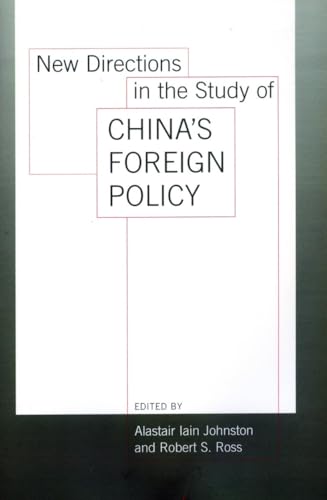
New Directions in the Study of China's Foreign Policy
STANFORD UNIVERSITY PRESS
Copyright © 2006 Board of Trustees of the Leland Stanford Junior UniversityAll right reserved.
ISBN: 978-0-8047-5363-0
Contents
List of Figures and Tables................................................................................................................ixContributors..............................................................................................................................xiEditors' Preface..........................................................................................................................xv1. Introduction ROBERT S. ROSS AND ALASTAIR IAIN JOHNSTON................................................................................1Part I. Security Studies2. Comparative Deterrence: The Taiwan Strait and the Korean Peninsula ROBERT S. ROSS.....................................................133. Windows and War: Trend Analysis and Beijing's Use of Force THOMAS J. CHRISTENSEN......................................................504. China's Decision for War with India in 1962 JOHN W. GARVER............................................................................865. Across the Yalu: China's Interests and the Korean Peninsula in a Changing World AVERY GOLDSTEIN.......................................1316. The Limits of Economic Interdependence: Sino-Japanese Relations MICHAEL YAHUDA........................................................1627. Reputation and the Security Dilemma: China Reacts to the China Threat Theory YONG DENG................................................186Part II. China and Globalization8. More Than Just Saying No: China's Evolving Approach to Sovereignty and Intervention Since Tiananmen ALLEN CARLSON.....................2179. China in Geneva: Lessons from China's Early Years in the World Trade Organization MARGARET M. PEARSON.................................24210. Chinese Foreign Policy Faces Globalization Challenges SAMUEL S. KIM..................................................................276Part III. Domestic Politics11. Identity and Conflict in Sino-American Relations PETER HAYS GRIES....................................................................30912. The Correlates of Beijing Public Opinion Toward the United States, 1998-2004 ALASTAIR IAIN JOHNSTON..................................34013. Conclusions and Future Directions THOMAS J. CHRISTENSEN, ALASTAIR IAIN JOHNSTON, AND ROBERT S. ROSS..................................379Select Bibliography.......................................................................................................................421Index.....................................................................................................................................463
Chapter One
IntroductionRobert S. Ross and Alastair Iain Johnston
This volume reflects an effort to take stock of the field of Chinese foreign policy and to consider potential avenues of new research. It is a collaborative effort by scholars of different generations and many academic perspectives who share an interest in and commitment to explaining Chinese foreign policy and to using systematically gathered and analyzed evidence. It is not intended to be a comprehensive survey of the field of Chinese foreign policy, which is simply too large and diverse for one volume to be able to cover all the topics, draw on all the relevant theories, and include all the first-rate scholars in the field. Rather, scholars were chosen in an attempt to represent current research in Chinese foreign policy from multiple theoretical perspectives and methodologies and multiple academic generations. To some degree, the timing of the volume is also worth noting: it appears at a point in history when the integration of the People's Republic of China (PRC) with regional and global economic and political institutions has never been greater, and when a narrowing range of tropes of unease about "rising China" are coming to dominate policy and pundit discourses both in the United States and elsewhere. Not only is there greater demand today for information about China's foreign policy, but scholars are able, in principle, to supply greater amounts of sophisticated analysis.
The chapters were first presented at a conference held at the John King Fairbank Center at Harvard University in December 2002. The volume is organized into three subfields of Chinese foreign policy. Part I examines Chinese security policy, including Chinese use of force, policy toward conflicts of interests affecting war and peace, and China's strategy as a rising power. Owing to greater access to Chinese analysts, decision-makers, and documents, these chapters draw on a wider range of materials about the sources and effects of Chinese security policy than was available in the earlier days of the field. Part II considers China as an actor in multilateral institutions and China's response to emerging global trends, including evolving conceptions of sovereignty and the emergence of globalization. These topics are relatively new for the field, reflecting the fact that since the late 1980s, China has advanced more rapidly into international institutional life than any other major state moving from a similar position of isolation. Part III presents new research on domestic-foreign linkages, considering the impact of trends in public opinion and of Chinese identity on China's policy toward major powers. This is a very new subfield, because access to public attitudes has been severely restricted in authoritarian China, and the impact of public opinion on foreign policy has never been considered relevant. With rapid urbanization, marketization, and the diversification of political, economic, and foreign policy preferences, this seems to be changing.
The Study of Chinese Security Policy
Robert Ross examines the role of deterrence and use of force in Chinese foreign policy. His Chapter 2, "Comparative Deterrence: The Taiwan Strait and the Korean Peninsula," places these two theaters of deterrence in the context of the theoretical literature on effective deterrence and on the sources of unstable deterrence and unintended war, enabling comparative analysis of the two theaters and estimates of the likelihood of war in East Asia. Regarding Korea, Ross assesses North Korean deterrence of U.S. use of force for either regime change or denuclearization, and U.S.-South Korean deterrence of North Korean use of force for unification. Regarding the Taiwan Strait, he considers Chinese deterrence of a Taiwan declaration of independence, an "act of war," and U.S. deterrence of Chinese initiation of use of force for unification. Using deterrence theory and concepts of credibility, capability, and expected utility, he considers the effectiveness of mutual deterrence dynamics in each region. He also compares these two deterrence theaters regarding incentives for first strikes and the implications for crisis instability and unintended war. Ross argues that although there is effective mutual deterrence on both the Korean peninsula and in the Taiwan Strait so that the status quo is preferred to use of force by all of the otherwise revisionist states, the distinct weapons capabilities of the actors in each theater and the distinct geography of each theater create distinct crisis dynamics. He argues that these differences have made the Korean peninsula a more probable military threat than the Taiwan Strait since the end of the Cold War, and that the Korean peninsula will remain a more likely source of war than the Taiwan Strait.
Thomas Christensen's Chapter 3, "Windows and War: Trend Analysis and Beijing's Use of Force," examines conditions under which China has used force since 1949. Working within international politics theories of preemptive and preventive war, Christensen applies the concept of "closing windows" to provide a comprehensive explanation for all post-1949 cases of Chinese use of force. He argues that Chinese leaders have used force to achieve international political objectives, despite the absence of a clear "red-line" provocation, when they perceive a closing window for China to achieve its strategic objectives, to deter an adversary from becoming more aggressive, or to create favorable long-term strategic trends. Christensen also argues that domestic conditions have consistently contributed to Chinese use of force, not because domestic instability can contribute to Chinese threat perception but because Chinese leaders have seen use of force as an appropriate instrument to achieve their domestic political objectives. Christensen further establishes that Chinese leaders have used force to reverse a deteriorating international situation even when China faced a more powerful and committed adversary, suggesting that China may be an especially difficult state to deter. Christensen's analysis of the patterns in Chinese use of force suggests a relatively pessimistic outlook for relying on deterrence to maintain stability in the Taiwan Strait. Based on past PRC behavior, he warns that although Taiwan might not offer a red-line provocation by declaring de jure independence, mere continued Taiwan movement toward de jure independence could produce sufficient Chinese concern about a closing window to elicit use of force, even should Chinese leaders expect intervention by superior U.S. forces.
John Garver's Chapter 4, "China's Decision for War with India in 1962," presents an analysis of Chinese use of force against India in 1962. This case study integrates many of the issues addressed by Ross and Christensen to explain a major Chinese use of force. Drawing on voluminous new materials, the chapter analyzes the sources of Chinese threat perception, Chinese deterrence strategy, and China's decision to use force. Following the works of Allen Whiting and Neville Maxwell, Garver concurs that India's border policy challenged China's territorial integrity and that the Chinese failure to deter Indian forward deployment across the McMahon Line reflected low Indian assessment of China's resolve to use force and the constraints of Indian domestic politics on Nehru's ability to moderate India's broader policy. But, in contrast to Whiting and Maxwell, Garver argues that China's subsequent use of force against India reflected not simply China's imperative to defend its territorial integrity but rather primarily reflected heightened Chinese threat assessment resulting from Mao Zedong's misperception that Indian border policy reflected Nehru's contribution to the CIA-assisted 1959 uprising in Tibet and his determination to promote Tibetan separatism. Psychologically, Mao was simply unable to grasp Nehru's actual moderate intention to promote Tibetan autonomy within Chinese sovereignty and the domestic situational constraints on Nehru's Tibet and border policies. Mao thus developed a worst-case assessment of Nehru's intentions. Garver concludes that although China's victory over India established Chinese resolve and compelled India to adopt a more cautious China policy, Mao's misperception of Nehru's intentions also inflicted significant costs on China, including long-term hostility with a determined and more modern Indian army and development of anti-China Soviet-Indian cooperation.
Chapters 5 and 6 analyze Chinese policy toward two key issues affecting Chinese security-developments on the Korean peninsula and trends in Sino-Japanese relations. Avery Goldstein's Chapter 5, "Across the Yalu: China's Interests and the Korean Peninsula in a Changing World," examines contemporary Chinese policy toward the Korean conflict. He stresses that during the Cold War, ideology, territorial security, and alignment with Soviet power against U.S. capabilities dominated Chinese policy. In contrast, although in the post-Cold War era, U.S. power remains at the heart of PRC assessments of trends on the peninsula, in the absence of the option of alignment with a great power, Beijing has had to accommodate U.S. power, while seeking gradual development of greater Chinese capabilities and minimization of domestic political instability. These demands require Beijing to seek a peaceful international environment, including peace on the Korean peninsula, even as management of domestic instability and concern about U.S. capabilities require vigilance against U.S. policy and an enduring commitment to the survival of the North Korean government. This analytical indeterminacy requires development of a framework for forecasting the future of China's Korean policy. Goldstein develops four "stylized scenarios" and assesses each in terms of its implications for China's pursuit of its multiple interests on the Korean peninsula, especially vis--vis the United States. He then applies two conceptual frameworks to assess the likely course of Chinese policy among these four futures. First, he builds on Whiting's concepts of Chinese threat perception and deterrence behavior, stressing that linkage between internal instability and heightened PRC threat perception, on the one hand, and the role of force in diplomatic signaling in Chinese deterrence efforts, on the other, may affect crisis outcomes. Second, he considers the impact of China's Korean policy on U.S.-China management of the rise of China, stressing that the very indeterminacy in PRC policy creates space for a negotiated solution, which can facilitate a peaceful power transition.
Michael Yahuda's Chapter 6, "The Limits of Economic Interdependence: Sino-Japanese Relations," also adopts a conceptual approach to the trends in a bilateral Chinese foreign policy. He considers the impact of increasing Sino-Japanese economic interdependence on the trends in the bilateral relationship. Observing that Sino-Japanese relations have become more contentious just as economic cooperation has increased, contrary to the expectations of the international political economy literature, Yahuda considers what factors have been responsible for this countervailing trend. Like Goldstein, he argues that the end of the Cold War in East Asia has transformed the security preferences of each country. In the absence of the constraints imposed by the Soviet Union, each country has developed more assertive and independent security policies. Simultaneously, each country has also been increasingly intolerant of the changes in the other's policies. Yahuda explains this development and the resulting tension in relations by observing each country's inability to appreciate the impact of its changing security policies, especially the growth in respective military capabilities, on the other's security, that is, its inability to appreciate the impact of the security dilemma in international politics, so that each develops a worst-case perspective on the other's intentions. He explains these mutual worst-case analyses by developments in domestic politics. Following Whiting's analysis of Sino-Japanese relations in the 1980s, he finds that anti-Japanese nationalism in Chinese education has fostered widespread Chinese misperceptions about Japanese behavior. Moreover, generational change in China and Japan has given rise to leaders with limited knowledge of the other's culture and society. The result is that security perspectives, informed by domestically informed misperceptions, have offset the potentially positive effects of increased economic interdependence.
Part I concludes with Deng Yong's Chapter 7, "Reputation and the Security Dilemma: China Reacts to the China Threat Theory," which discusses China's management of its rising power status, considered in the context of Beijing's implicit appreciation of the impact of the security dilemma in international politics. Whereas Yahuda suggests that Chinese leaders are insensitive to the impact of Chinese policy on Japanese security, Deng argues that the Chinese leadership is aware that China's reputation in other countries can be a major factor in their assessments of Chinese intentions and in their corresponding response to China's rising capabilities. In particular, perceptions of a "China threat" can lead other countries to adopt belligerent policies toward China that might disrupt Beijing's ability to focus on economic development and to enhance Chinese security in a peaceful international environment. Thus, Chinese diplomacy has actively tried to neutralize China threat arguments. First, it accuses proponents of the China threat of having a Cold War mentality of containment, seeking to delegitimate China's critics. Second, it has tried to foster a benign image of itself. One aspect of this is China's public diplomacy to define its own reputation in world affairs. Deng explains that China's development of its "peaceful rise" diplomacy aims to undermine China threat arguments. Another aspect of its rising power diplomacy is its extensive participation in multilateral institutions, including in arms control and nonproliferation institutions. Deng concludes with the observation that China's recognition of the importance of reputation for security dilemma dynamics is indicative of the fundamental changes in Chinese foreign policy that have taken place since the Maoist era, when China primarily depended on a reputation for military resolve to influence the behavior of potential adversaries.
China and Globalization
Part I of this volume thus considers the impact of China's international strategic environment on Chinese policy. Part II is also concerned with China's response to its international environment, but the focus is on China's response to globalization, including the globalization of norms of limited sovereignty, humanitarian intervention, and economic cooperation.
Allen Carlson's Chapter 8, "More Than Just Saying No: China's Evolving Approach to Sovereignty and Intervention Since Tiananmen," examines in depth perhaps the most sensitive challenge of globalization-China's gradual compromise of its long-term commitment to absolute sovereignty in response to its determined exposure to the deepening and increasingly global norm of humanitarian intervention. Although Carlson acknowledges the role of material interests in Chinese behavior, he explains the evolution in Chinese thinking on sovereignty by focusing on the susceptibility of Chinese foreign policy elites to international norms through "social learning." He argues that Chinese participation in international society has led to internalization of hitherto unacceptable ideas. His empirical work examines changes in Chinese attitudes toward sovereignty as they relate to the legitimacy of security and humanitarian international intervention in a state's domestic affairs. Carlson argues that even as interest calculations clearly drove China's initial moderation of its stand on absolute sovereignty in the early 1990s, China's changing policy also encouraged underlying ideational change among Chinese foreign policy elites that sustained and even deepened the trend in China toward acceptance of the concept of limited sovereignty well into the decade. By the first decade of the twenty-first century, despite enduring Chinese concern that Western democracies, in particular the United States, have used the concept of limited sovereignty to suit their narrow national interests, the global norm of humanitarian multilateral intervention in protection of human rights, expressed in the very language used by Western foreign policy elites, had become widespread in Chinese foreign policy circles, and Chinese government attitudes toward multilateral intervention had become increasingly flexible.
(Continues...)
Excerpted from New Directions in the Study of China's Foreign Policy Copyright © 2006 by Board of Trustees of the Leland Stanford Junior University. Excerpted by permission.
All rights reserved. No part of this excerpt may be reproduced or reprinted without permission in writing from the publisher.
Excerpts are provided by Dial-A-Book Inc. solely for the personal use of visitors to this web site.
„Über diesen Titel“ kann sich auf eine andere Ausgabe dieses Titels beziehen.
Suchergebnisse für New Directions in the Study of China's Foreign...

Beispielbild für diese ISBN
New Directions in the Study of China's Foreign Policy
Verlag:
Stanford University Press, 2006
ISBN 10: 0804753636
ISBN 13: 9780804753630
Gebraucht
Paperback
Anbieter: World of Books (was SecondSale), Montgomery, IL, USA
Verkäuferbewertung 5 von 5 Sternen

Paperback. Zustand: Good. Ten outstanding specialists in Chinese foreign policy draw on new theories, methods, and sources to examine China's use of force, its response to globalization, and the role of domestic politics in its foreign policy. Artikel-Nr. 00098841085
Gebraucht kaufen
EUR 6,49
Versand gratis
Versand innerhalb von USA
Versand innerhalb von USA
Anzahl: 1 verfügbar
Beispielbild für diese ISBN
New Directions in the Study of China's Foreign Policy
Verlag:
Stanford University Press, 2006
ISBN 10: 0804753636
ISBN 13: 9780804753630
Gebraucht
Softcover
Anbieter: Better World Books, Mishawaka, IN, USA
Verkäuferbewertung 5 von 5 Sternen
Zustand: Good. Pages intact with minimal writing/highlighting. The binding may be loose and creased. Dust jackets/supplements are not included. Stock photo provided. Product includes identifying sticker. Better World Books: Buy Books. Do Good. Artikel-Nr. 9516724-6
Gebraucht kaufen
EUR 6,50
Versand gratis
Versand innerhalb von USA
Versand innerhalb von USA
Anzahl: 1 verfügbar
Beispielbild für diese ISBN
New Directions in the Study of China's Foreign Policy
Verlag:
Stanford University Press, 2006
ISBN 10: 0804753636
ISBN 13: 9780804753630
Gebraucht
Softcover
Anbieter: Better World Books, Mishawaka, IN, USA
Verkäuferbewertung 5 von 5 Sternen
Zustand: Very Good. Pages intact with possible writing/highlighting. Binding strong with minor wear. Dust jackets/supplements may not be included. Stock photo provided. Product includes identifying sticker. Better World Books: Buy Books. Do Good. Artikel-Nr. 7548000-6
Gebraucht kaufen
EUR 6,50
Versand gratis
Versand innerhalb von USA
Versand innerhalb von USA
Anzahl: 1 verfügbar
Beispielbild für diese ISBN
New Directions in the Study of China's Foreign Policy
Verlag:
Stanford University Press, 2006
ISBN 10: 0804753636
ISBN 13: 9780804753630
Gebraucht
Softcover
Anbieter: Wonder Book, Frederick, MD, USA
Verkäuferbewertung 5 von 5 Sternen
Zustand: Very Good. Very Good condition. A copy that may have a few cosmetic defects. May also contain light spine creasing or a few markings such as an owner's name, short gifter's inscription or light stamp. Artikel-Nr. I18J-01508
Gebraucht kaufen
EUR 6,86
Versand gratis
Versand innerhalb von USA
Versand innerhalb von USA
Anzahl: 1 verfügbar
Beispielbild für diese ISBN
New Directions in the Study of China's Foreign Policy
Verlag:
Stanford University Press, 2006
ISBN 10: 0804753636
ISBN 13: 9780804753630
Gebraucht
Paperback
Anbieter: WorldofBooks, Goring-By-Sea, WS, Vereinigtes Königreich
Verkäuferbewertung 5 von 5 Sternen
Paperback. Zustand: Very Good. The book has been read, but is in excellent condition. Pages are intact and not marred by notes or highlighting. The spine remains undamaged. Artikel-Nr. GOR007546984
Gebraucht kaufen
EUR 8,76
EUR 6,69 Versand
Versand von Vereinigtes Königreich nach USA
Versand von Vereinigtes Königreich nach USA
Anzahl: 1 verfügbar
Beispielbild für diese ISBN
New Directions in the Study of China's Foreign Policy
Verlag:
Stanford University Press, 2006
ISBN 10: 0804753636
ISBN 13: 9780804753630
Gebraucht
Softcover
Anbieter: medimops, Berlin, Deutschland
Verkäuferbewertung 5 von 5 Sternen
Zustand: acceptable. Ausreichend/Acceptable: Exemplar mit vollständigem Text und sämtlichen Abbildungen oder Karten. Schmutztitel oder Vorsatz können fehlen. Einband bzw. Schutzumschlag weisen unter Umständen starke Gebrauchsspuren auf. / Describes a book or dust jacket that has the complete text pages (including those with maps or plates) but may lack endpapers, half-title, etc. (which must be noted). Binding, dust jacket (if any), etc may also be worn. Artikel-Nr. M00804753636-B
Gebraucht kaufen
EUR 5,51
EUR 10,00 Versand
Versand von Deutschland nach USA
Versand von Deutschland nach USA
Anzahl: 1 verfügbar
Beispielbild für diese ISBN
New Directions in the Study of China's Foreign Policy
Verlag:
Stanford University Press, 2006
ISBN 10: 0804753636
ISBN 13: 9780804753630
Gebraucht
paperback
Anbieter: Sell Books, Elland, YORKS, Vereinigtes Königreich
Verkäuferbewertung 5 von 5 Sternen
paperback. Zustand: Good. Our good condition books are generally good for reading but not for gifting or collecting. They could have imperfections such as creasing, fanning, inscriptions, margin notes, yellowing, staining on edge or cover or pages, bumps, scuffs, etc etc (sometimes multiple of these). It's a wide category that encompasses anything that isn't almost-new down to anything that is slightly better than poor. We would NOT recommend gifting Good books - these should be considered reading copies. Our books are dispatched from a Yorkshire former cotton mill. We list via barcode/ISBN so please note that the images are stock images and may not be the exact copy you receive, furthermore the details about edition and year might not be accurate as many publishers reuse the same ISBN for multiple editions and as we simply scan a barcode or enter an ISBN we do not check the validity of the edition data when listing. If you're looking for an exact edition please don't order (at least not without checking with us first, although we don't always have time to check). We aim to dispatch prompty, the service used will depend on order value and book size. We can ship to most countries, see our shipping policies. Payment is via Abe only. Artikel-Nr. SBAB-P-BRL00021-MIX-20250306-G
Gebraucht kaufen
EUR 6,67
EUR 13,63 Versand
Versand von Vereinigtes Königreich nach USA
Versand von Vereinigtes Königreich nach USA
Anzahl: 1 verfügbar
Beispielbild für diese ISBN
New Directions in the Study of China's Foreign Policy
Verlag:
Stanford University Press, 2006
ISBN 10: 0804753636
ISBN 13: 9780804753630
Gebraucht
Softcover
Anbieter: Anybook.com, Lincoln, Vereinigtes Königreich
Verkäuferbewertung 5 von 5 Sternen
Zustand: Good. This is an ex-library book and may have the usual library/used-book markings inside.This book has soft covers. Clean from markings. In good all round condition. Please note the Image in this listing is a stock photo and may not match the covers of the actual item,800grams, ISBN:9780804753630. Artikel-Nr. 9901981
Gebraucht kaufen
EUR 15,53
EUR 15,58 Versand
Versand von Vereinigtes Königreich nach USA
Versand von Vereinigtes Königreich nach USA
Anzahl: 1 verfügbar
Beispielbild für diese ISBN
New Directions in the Study of China's Foreign Policy
Verlag:
Stanford University Press, 2006
ISBN 10: 0804753636
ISBN 13: 9780804753630
Gebraucht
Softcover
Anbieter: Anybook.com, Lincoln, Vereinigtes Königreich
Verkäuferbewertung 5 von 5 Sternen
Zustand: Good. This is an ex-library book and may have the usual library/used-book markings inside.This book has soft covers. Clean from markings. In good all round condition. Please note the Image in this listing is a stock photo and may not match the covers of the actual item,800grams, ISBN:9780804753630. Artikel-Nr. 9901983
Gebraucht kaufen
EUR 15,68
EUR 15,58 Versand
Versand von Vereinigtes Königreich nach USA
Versand von Vereinigtes Königreich nach USA
Anzahl: 1 verfügbar
Beispielbild für diese ISBN
New Directions in the Study of China's Foreign Policy
Anbieter: PBShop.store UK, Fairford, GLOS, Vereinigtes Königreich
Verkäuferbewertung 5 von 5 Sternen
PAP. Zustand: New. New Book. Shipped from UK. Established seller since 2000. Artikel-Nr. FW-9780804753630
Neu kaufen
EUR 34,09
EUR 7,01 Versand
Versand von Vereinigtes Königreich nach USA
Versand von Vereinigtes Königreich nach USA
Anzahl: 15 verfügbar