
Verwandte Artikel zu Before Internment: Essays in Prewar Japanese American...
Inhaltsangabe
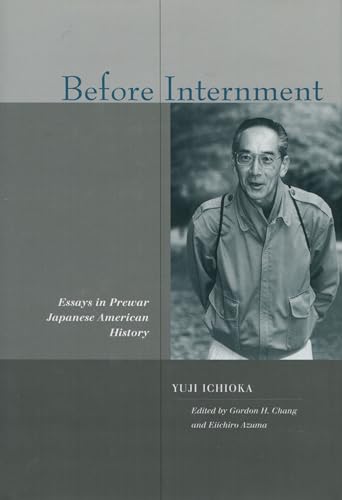
This is a collection of the last essays by Yuji Ichioka, the foremost authority on Japanese-American history, who passed away two years ago. The essays focus on Japanese Americans during the interwar years and explore issues such as the nisei (American-born generation) relationship toward Japan, Japanese-American attitudes toward Japan's prewar expansionism in Asia, and the meaning of "loyalty" in a racist society-all controversial but central issues in Japanese-American history.
Ichioka draws from original sources in Japanese and English to offer an unrivaled picture of Japanese Americans in these years. Also included in this volume are an introductory essay by editor Eiichiro Azuma that places Ichioka's work in Japanese-American historiography, and a postscript by editor Chang reflecting on Ichioka's life-work.
Die Inhaltsangabe kann sich auf eine andere Ausgabe dieses Titels beziehen.
Über die Autorinnen und Autoren
The late Yuji Ichioka was the founding father of the scholarly study of Japanese-American history. His book on the immigrant generation in America, The Issei: The World of the First-Generation Japanese Immigrants, 1885-1924 (1988), is considered a classic. He invented the term Asian American, and trained many of the scholars now teaching Asian American history at colleges and universities.
The late Yuji Ichioka was the founding father of the scholarly study of Japanese-American history. His book on the immigrant generation in America, The Issei: The World of the First-Generation Japanese Immigrants, 1885-1924 (1988), is considered a classic. He invented the term Asian American, and trained many of the scholars now teaching Asian American history at colleges and universities.
Von der hinteren Coverseite
This is a collection of the last essays by Yuji Ichioka, the foremost authority on Japanese-American history, who passed away two years ago. The essays focus on Japanese Americans during the interwar years and explore issues such as the nisei (American-born generation) relationship toward Japan, Japanese-American attitudes toward Japan's prewar expansionism in Asia, and the meaning of “loyalty” in a racist society—all controversial but central issues in Japanese-American history.
Ichioka draws from original sources in Japanese and English to offer an unrivaled picture of Japanese Americans in these years. Also included in this volume are an introductory essay by editor Eiichiro Azuma that places Ichioka's work in Japanese-American historiography, and a postscript by editor Chang reflecting on Ichioka’s life-work.
Ichioka draws from original sources in Japanese and English to offer an unrivaled picture of Japanese Americans in these years. Also included in this volume are an introductory essay by editor Eiichiro Azuma that places Ichioka's work in Japanese-American historiography, and a postscript by editor Chang reflecting on Ichioka’s life-work.
Aus dem Klappentext
This is a collection of the last essays by Yuji Ichioka, the foremost authority on Japanese-American history, who passed away two years ago. The essays focus on Japanese Americans during the interwar years and explore issues such as the nisei (American-born generation) relationship toward Japan, Japanese-American attitudes toward Japan's prewar expansionism in Asia, and the meaning of loyalty in a racist society all controversial but central issues in Japanese-American history.
Ichioka draws from original sources in Japanese and English to offer an unrivaled picture of Japanese Americans in these years. Also included in this volume are an introductory essay by editor Eiichiro Azuma that places Ichioka's work in Japanese-American historiography, and a postscript by editor Chang reflecting on Ichioka s life-work.
Ichioka draws from original sources in Japanese and English to offer an unrivaled picture of Japanese Americans in these years. Also included in this volume are an introductory essay by editor Eiichiro Azuma that places Ichioka's work in Japanese-American historiography, and a postscript by editor Chang reflecting on Ichioka s life-work.
Auszug. © Genehmigter Nachdruck. Alle Rechte vorbehalten.
Before Internment
ESSAYS IN PREWAR JAPANESE AMERICAN HISTORYBy Yuji IchiokaSTANFORD UNIVERSITY PRESS
Copyright © 2006 Board of Trustees of the Leland Stanford Junior UniversityAll right reserved.
ISBN: 978-0-8047-5147-6
Contents
Note on the Translation and Transliteration of Japanese Names and Words...............................................................................xiPreface...............................................................................................................................................xiiiEditor's Introduction: Yuji Ichioka and New Paradigms in Japanese American History EIICHIRO AZUMA....................................................xviPART ONE1. Introduction......................................................................................................................................12. Dai Nisei Mondai: Changing Japanese Immigrant Conceptions of the Second-Generation Problem, 1902-1941.............................................103. Kengakudan: The Origin of Nisei Study Tours of Japan..............................................................................................534. Kokugo Gakko: The Debate over the Role of Japanese-Language Schools...............................................................................755. A Study in Dualism: James Yoshinori Sakamoto and the Japanese American Courier, 1928-1942.........................................................92PART TWO6. "Unity Within Diversity": Louis Adamic and Japanese Americans.....................................................................................1277. The Meaning of Loyalty: The Case of Kazumaro Buddy Uno............................................................................................1538. Japanese Immigrant Nationalism: The Issei and the Sino-Japanese War, 1937-1941....................................................................1809. National Security on the Eve of Pearl Harbor: The 1941 Tachibana Espionage Case and Implicated Issei Leaders......................................20410. "Attorney for the Defense": Yamato Ichihashi and Japanese Immigration.............................................................................22711. The Death of Dr. Honda Rikita: A Tragic Wartime Story.............................................................................................258PART THREE12. The Future of Japanese American Studies: Prospect of Comparative Historical Perspectives on Nikkei in North and South America.....................27313. A Historian by Happenstance.......................................................................................................................280Epilogue: Remembering Yuji GORDON H. CHANG...........................................................................................................301Select Bibliography of Japanese Americans During World War II.........................................................................................309Index.................................................................................................................................................347
Chapter One
Introduction
Yuji Ichioka died before finishing his introduction. Although it is incomplete, the editors have included the author's draft, including the endnotes, with some minor stylistic revisions. Editorial additions are in brackets.
Until recently studies of Japanese American history have paid very little attention to the decades before World War II. As a general rule, they have treated the interwar period as an interlude between the Japanese exclusion movement, which culminated in the enactment of the 1924 Immigration Act, terminating all Japanese immigration, and the outbreak of World War II and the ensuing dramatic wartime mass internment of Japanese Americans. Historians understandably have been preoccupied with the internment of Japanese Americans and, consequently, have paid and continue to pay extraordinary attention to this topic. If they examine the interwar years at all, they tend to look at the period simply as an incidental backdrop to mass internment.
The result has been to obscure significant continuities and discontinuities between the 1930s and 1940s. What happened in the interwar period had a definite influence on events during the internment period, so much so, indeed, that the latter cannot, in my judgment, be properly understood without taking into account the former. In other words, the mass internment of Japanese Americans cannot be fully comprehended without an understanding of the historical continuities and discontinuities between the 1930s and 1940s.
Clearly not comprehensive, this anthology of essays covers selected topics in prewar Japanese American history. Of the eight essays, six have been previously published, and two are new, unpublished pieces, "Kokugo Gakko" [Chapter 4] and "National Security on the Eve of Pearl Harbor" [Chapter 9]. The published essays are reprinted here with minor changes and additions. All of the essays here are a sequel to my book The Issei: The World of the First Generation Japanese Immigrants, 1885-1924. I hope that these essays will stimulate future researchers to link the interwar period to studies of wartime years.
Several noteworthy studies devoted to the prewar period have been recently published. Eileen Tamura examines the Nisei [U.S.-born, second generation] in Hawaii and their acculturation under pressures to Americanize while forging a distinctive ethnic identity during the 1920s and 1930s. Jere Takahashi analyzes the shifting political perspective of the Nisei and Sansei [third] generations during the prewar, wartime, and postwar periods. David Yoo looks at the complex social, cultural, and religious milieu in which the Nisei came of age in the 1930s. Valerie Matsumoto probes into the prewar lives of young Nisei women. Lon Kurashige studies the history of the Nisei Week Festival in Los Angeles in terms of changing Japanese American ethnic identity. In all of these studies, however, notwithstanding the Issei generation's relationship to and influences on the Nisei generation, the Issei are conspicuously absent.
To broaden and deepen our historical understanding of the wartime years, the Issei generation should be studied in much greater depth. Many research topics remain untouched. Here the problem of language presents itself. Past and present researchers, with few exceptions, have failed to examine available Japanese language sources. To redress the imbalance caused by the almost exclusive reliance on English-language sources, future researchers must equip themselves with the necessary language skills to conduct research in Japanese-language sources. The best collection of such sources is the Japanese American Research Project Collection (JARP) at UCLA, which affords an unrivalled opportunity to explore almost every aspect of prewar, wartime, and postwar Issei life.
Five of the essays in this collection cover one aspect or another of the Issei generation during the prewar period. Taken together, they mark a small beginning in highlighting some of the significant continuities and discontinuities between the 1930s and 1940s. The essay "Kengakudan" [Chapter 3] examines the origin of organized Nisei tours of Japan and the Issei concept of the Nisei as a so-called bridge of understanding between Japan and the United States. Nisei tours began with the first two sponsored by the Nichibei Shimbun in 1925 and 1926 and continued through the 1930s under...
„Über diesen Titel“ kann sich auf eine andere Ausgabe dieses Titels beziehen.
Suchergebnisse für Before Internment: Essays in Prewar Japanese American...

Beispielbild für diese ISBN
Before Internment
Verlag:
MK - Stanford University Press, 2006
ISBN 10: 0804751471
ISBN 13: 9780804751476
Neu
Hardcover
Anbieter: PBShop.store UK, Fairford, GLOS, Vereinigtes Königreich
Verkäuferbewertung 5 von 5 Sternen

HRD. Zustand: New. New Book. Shipped from UK. Established seller since 2000. Artikel-Nr. FW-9780804751476
Neu kaufen
EUR 66,27
EUR 6,87 Versand
Versand von Vereinigtes Königreich nach USA
Versand von Vereinigtes Königreich nach USA
Anzahl: 15 verfügbar
Beispielbild für diese ISBN
Before Internment: Essays in Prewar Japanese American History
Verlag:
Stanford University Press, 2006
ISBN 10: 0804751471
ISBN 13: 9780804751476
Gebraucht
Hardcover
Anbieter: Anybook.com, Lincoln, Vereinigtes Königreich
Verkäuferbewertung 5 von 5 Sternen
Zustand: Fair. This is an ex-library book and may have the usual library/used-book markings inside.This book has hardback covers. Book contains pencil markings. In fair condition, suitable as a study copy. No dust jacket. Please note the Image in this listing is a stock photo and may not match the covers of the actual item,700grams, ISBN:0804751471. Artikel-Nr. 4929946
Gebraucht kaufen
EUR 63,33
EUR 15,27 Versand
Versand von Vereinigtes Königreich nach USA
Versand von Vereinigtes Königreich nach USA
Anzahl: 1 verfügbar
Beispielbild für diese ISBN
Before Internment
Anbieter: Majestic Books, Hounslow, Vereinigtes Königreich
Verkäuferbewertung 4 von 5 Sternen

Zustand: New. pp. xxviii + 360 Illus. Artikel-Nr. 7989781
Neu kaufen
EUR 81,80
EUR 7,61 Versand
Versand von Vereinigtes Königreich nach USA
Versand von Vereinigtes Königreich nach USA
Anzahl: 3 verfügbar
Beispielbild für diese ISBN
Before Internment: Essays in Prewar Japanese American History
Anbieter: Ria Christie Collections, Uxbridge, Vereinigtes Königreich
Verkäuferbewertung 5 von 5 Sternen
Zustand: New. In English. Artikel-Nr. ria9780804751476_new
Neu kaufen
EUR 82,47
EUR 13,22 Versand
Versand von Vereinigtes Königreich nach USA
Versand von Vereinigtes Königreich nach USA
Anzahl: Mehr als 20 verfügbar
Beispielbild für diese ISBN
Before Internment
Anbieter: Kennys Bookstore, Olney, MD, USA
Verkäuferbewertung 5 von 5 Sternen
Zustand: New. This book is an anthology of essays by Yuji Ichioka, the foremost authority on Japanese American history, which studies Japanese American life and politics in the interwar years. Editor(s): Chang, Gordon G.; Azuma, Eiichiro; Dirlik, Arif. Series: Asian America. Num Pages: 392 pages, 10 illustrations. BIC Classification: 1KBB; 3JJG; HBJK; HBLW; HBTB; JFSL. Category: (P) Professional & Vocational; (UP) Postgraduate, Research & Scholarly; (UU) Undergraduate. Dimension: 5817 x 3887 x 28. Weight in Grams: 653. . 2006. 1st Edition. hardcover. . . . . Books ship from the US and Ireland. Artikel-Nr. V9780804751476
Neu kaufen
EUR 105,96
EUR 9,27 Versand
Versand innerhalb von USA
Versand innerhalb von USA
Anzahl: Mehr als 20 verfügbar
Beispielbild für diese ISBN
Before Internment Essays in Prewar Japanese American History
Anbieter: Revaluation Books, Exeter, Vereinigtes Königreich
Verkäuferbewertung 5 von 5 Sternen
Hardcover. Zustand: Brand New. 1st edition. 360 pages. 9.00x6.25x1.00 inches. In Stock. Artikel-Nr. x-0804751471
Neu kaufen
EUR 109,16
EUR 14,64 Versand
Versand von Vereinigtes Königreich nach USA
Versand von Vereinigtes Königreich nach USA
Anzahl: 2 verfügbar
Foto des Verkäufers
Before Internment: Essays in Prewar Japanese American History
Anbieter: moluna, Greven, Deutschland
Verkäuferbewertung 5 von 5 Sternen
Zustand: New. This book is an anthology of essays by Yuji Ichioka, the foremost authority on Japanese American history, which studies Japanese American life and politics in the interwar years.Über den AutorThe late Yuji Ichioka was the foundi. Artikel-Nr. 867670167
Neu kaufen
EUR 82,43
EUR 48,99 Versand
Versand von Deutschland nach USA
Versand von Deutschland nach USA
Anzahl: Mehr als 20 verfügbar