
Verwandte Artikel zu Kinship, Contract, Community, and State: Anthropological...
Kinship, Contract, Community, and State: Anthropological Perspectives on China (Studies of the Weatherhead East Asian Institute, Columbia Un) - Softcover
Buch 5 von 12: Studies of the Weatherhead East Asian Institute, Columbia University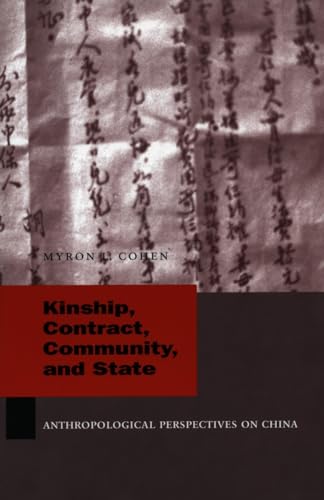
Inhaltsangabe
This book examines major areas of late imperial Chinese culture, and their relation to Chinese culture today, focusing on the competence and sophistication of ordinary people.
The work provides an overview of late imperial society and its responses to forces for change. Its ethnographically rich treatment of changes in family life under Communist rule is based on the author's fieldwork. Kinship beyond the family is treated through comparisons of the author's fieldwork sites in China and Taiwan. In dealing with the use of contracts and commodification within one community setting, it illuminates the broader economic culture of late imperial China. This book powerfully confirms that China's modernity has deep roots in its own tradition, and in doing so offers an excellent introduction to the anthropological view of China.
The work provides an overview of late imperial society and its responses to forces for change. Its ethnographically rich treatment of changes in family life under Communist rule is based on the author's fieldwork. Kinship beyond the family is treated through comparisons of the author's fieldwork sites in China and Taiwan. In dealing with the use of contracts and commodification within one community setting, it illuminates the broader economic culture of late imperial China. This book powerfully confirms that China's modernity has deep roots in its own tradition, and in doing so offers an excellent introduction to the anthropological view of China.
Die Inhaltsangabe kann sich auf eine andere Ausgabe dieses Titels beziehen.
Über die Autorinnen und Autoren
Myron L. Cohen is Professor of Anthropology at Columbia University and an affiliate of the Weatherhead East Asian Institute. He is the author of House United, House Divided: The Chinese Family in Taiwan, and Asia Case Studies in the Social Sciences: A Guide for Teaching.
Myron L. Cohen is Professor of Anthropology at Columbia University and an affiliate of the Weatherhead East Asian Institute. He is the author of House United, House Divided: The Chinese Family in Taiwan, and Asia Case Studies in the Social Sciences: A Guide for Teaching.
Von der hinteren Coverseite
This book examines major areas of late imperial Chinese culture, and their relation to Chinese culture today, focusing on the competence and sophistication of ordinary people.
The work provides an overview of late imperial society and its responses to forces for change. Its ethnographically rich treatment of changes in family life under Communist rule is based on the author's fieldwork. Kinship beyond the family is treated through comparisons of the author's fieldwork sites in China and Taiwan. In dealing with the use of contracts and commodification within one community setting, it illuminates the broader economic culture of late imperial China. This book powerfully confirms that China's modernity has deep roots in its own tradition, and in doing so offers an excellent introduction to the anthropological view of China.
The work provides an overview of late imperial society and its responses to forces for change. Its ethnographically rich treatment of changes in family life under Communist rule is based on the author's fieldwork. Kinship beyond the family is treated through comparisons of the author's fieldwork sites in China and Taiwan. In dealing with the use of contracts and commodification within one community setting, it illuminates the broader economic culture of late imperial China. This book powerfully confirms that China's modernity has deep roots in its own tradition, and in doing so offers an excellent introduction to the anthropological view of China.
Aus dem Klappentext
This book examines major areas of late imperial Chinese culture, and their relation to Chinese culture today, focusing on the competence and sophistication of ordinary people.
The work provides an overview of late imperial society and its responses to forces for change. Its ethnographically rich treatment of changes in family life under Communist rule is based on the author's fieldwork. Kinship beyond the family is treated through comparisons of the author's fieldwork sites in China and Taiwan. In dealing with the use of contracts and commodification within one community setting, it illuminates the broader economic culture of late imperial China. This book powerfully confirms that China's modernity has deep roots in its own tradition, and in doing so offers an excellent introduction to the anthropological view of China.
The work provides an overview of late imperial society and its responses to forces for change. Its ethnographically rich treatment of changes in family life under Communist rule is based on the author's fieldwork. Kinship beyond the family is treated through comparisons of the author's fieldwork sites in China and Taiwan. In dealing with the use of contracts and commodification within one community setting, it illuminates the broader economic culture of late imperial China. This book powerfully confirms that China's modernity has deep roots in its own tradition, and in doing so offers an excellent introduction to the anthropological view of China.
Auszug. © Genehmigter Nachdruck. Alle Rechte vorbehalten.
Kinship, Contract, Community, and State
Anthropological Perspectives on ChinaBy MYRON L. COHENSTANFORD UNIVERSITY PRESS
Copyright © 2005 Board of Trustees of the Leland Stanford Junior UniversityAll right reserved.
ISBN: 978-0-8047-5067-7
Contents
Introduction.................................................................................................................................1SECTION I: Late Imperial China and Its Legacies1 Introduction to Arthur H. Smith's Village Life in China....................................................................................192 Being Chinese: The Peripheralization of Traditional Identity...............................................................................393 Cultural and Political Inventions in Modern China: The Case of the Chinese "Peasant".......................................................60SECTION II: The Family4 North China Rural Families: Changes During the Communist Era...............................................................................77SECTION III: Lineage Studies5 Lineage Development and the Family in China................................................................................................1536 Lineage Organization in North China........................................................................................................1657 Lineage Organization in East China.........................................................................................................195SECTION IV: Historical Anthropology: The Minong Community During Qing8 Commodity Creation in Late Imperial China..................................................................................................2239 Writs of Passage in Late Imperial China: Contracts and the Documentation of Practical Understandings in Minong, Taiwan.....................252Notes........................................................................................................................................307Bibliography.................................................................................................................................331Character List...............................................................................................................................347Index........................................................................................................................................351
Chapter One
Introduction to Arthur H. Smith'sVillage Life in China
Village Life in China is one of the vital sources for data on Chinese society during the late nineteenth century; the book deals with rural life at a time when the growing impact of the West was still only minimally felt over most of China's countryside. When Arthur H. Smith lived and traveled in China, the Qing dynasty still held sway, although it was to topple only a few decades later, in 1911. Most of what Smith observed was "traditional" Chinese behavior and social organization, the product of over two millennia of development during which the Chinese subcontinent attained a degree of political, economic, and social integration perhaps unparalleled among preindustrial civilizations. Smith's work, then, is valuable reading for anyone concerned with China, including the present-day Chinese People's Republic, for he deals with the culture and society from which much of life in China to this day derives.
Smith's book is not what anthropologists and sociologists would call a "community study." Rather than comprehensively describing a single village, Smith deals with rural society in general, as he observed it mainly in the northern province of Shandong. Nevertheless, much of what he observed pertains to basic patterns of organization in Chinese society: the ways in which social, economic, and political relationships crosscut village boundaries and fixed villages within larger social arrangements.
The book's first chapters deal with the physical appearance of the countryside and its villages. In most of China the population lived in concentrated settlements: hamlets, villages, towns, and cities. The spatial dimension provided a crucial framework for social organization. Territorially defined social units were arranged hierarchically such that they were integrated into the nation as a whole. As spatial and settlement units, local areas were organized roughly as follows: in a larger village or in a town or city, the basic unit would be a ward or a neighborhood, and in a smaller village or hamlet the unit would be the entire settlement itself. Such basic-level units were formally organized community entities; in its simplest form, the organization might be expressed by nothing more than a common ritual or religious focus on a shrine representing Tudi, the "earth god" or the "local god" (see Smith, pp. 99-100), with such a focus defining the territorial community as a religious congregation. In communities that were more prosperous, advantageously located, or with especially influential members, religious organizations might be much more complex, boasting large temples with a clearly defined group of managers; secular organizations could also be more clearly defined and undertake a variety of activities.
Such basic community units usually were components of larger territorial entities, with several small hamlets or village neighborhoods forming a larger village organization. It seems safe to say that in the case of larger villages subdivided into neighborhoods, the major organizations, with functions most vital to village life, were those that encompassed the village as a whole. But even in a concentrated village settlement the organizational importance of the component segments might, in what was probably a minority of cases, outweigh that of the higher-level unit. Smith refers to this in passing: "If the village is a large one, divided into several sections transacting their public business independently of one another, there may be several temples to the same divinity" (pp. 99-100). The hierarchy of local units usually involved more than two levels: in the countryside regional communities comprising several villages were important in rural life, with a shared temple often serving to identify such a multivillage community; and it was commonly the region occupied by such a community that people identified as their "homeland" or "ancestral home" (xiang, guxiang). Multiple levels of community and regional organization were especially characteristic of larger towns and cities. While there also must have been cases where the small size and isolated location of a settlement precluded its involvement in such local hierarchies, such circumstances almost by definition had to pertain to only a very small minority of China's population.
Local settlements, irrespective of the degree of their internal complexity, were fitted into hierarchical structures of yet larger scope; these centered on towns and cities that supported larger populations and were the sites of markets, commercial and manufacturing establishments, and other specialized economic activities. Thus, since the surrounding villages were dependent upon such a town, it formed a central point for intervillage activities of many sorts. A market town, therefore, usually served as the focal point of a region composed of many villages. Just as there was variation in the number of organizations and their functions at the village segment, village, and village cluster levels, so were there differences in the extent to which there emerged important organizations encompassing a region centering on a market town. There might be nothing more than a town-based temple serving to define the entire region ritually, or there might be comprehensive region-wide organizations with important economic and political functions. Although the strategic economic significance of a market town frequently meant that the villages in its hinterland maintained social and economic links with each other via their common access to this town, it was sometimes the case that such a town rather was seen as a desired economic asset by competing village cluster communities who might at times even confront each other violently so as to gain control over it.
Towns and cities can be ordered into yet another hierarchy, using certain economic and social functions. In an ascending scale, larger towns and cities served as marketing and distribution centers not only for the farming villages surrounding them, but also for smaller market towns. There was a hierarchy of marketing areas of ever-increasing size, then, and the central towns or cities exhibited economic complexity and diversification on a scale commensurate with their marketing functions. Such towns and cities were also the locales for the activities of those powerful men with economic and social interests over wide areas of the country. A region consisting of a market town and its surrounding villages, or simply one of several village clusters within a larger marketing area, however, seems to have been the largest region whose population could form a discrete and organized social unit that recognized itself as a community and where there was common participation of the general population in a wide variety of activities, and therefore "face-to-face" familiarity among the community's members.
At each level in a local spatial hierarchy, the inhabitants were themselves fitted into what might be called a sociological hierarchy. There were a variety of attributes that tended to position an individual and his family at or near the apex of such an arrangement. Wealth, especially in the form of land, was surely one; literacy, recognized managerial ability, and spare time to devote to public affairs were other attributes. In addition to its more mundane manifestations, one's high position within a local hierarchy was expressed by a greater approximation to the standards of li, often translated as "ritual," or "propriety." In the elite literary tradition, li denotes concepts developed by Confucian thinkers concerned with the ethics of human relationships, society, and government. Ethnographically, li designates the elite style of life, compounded of many elements: patterns of behavior and belief; education; material possessions; and the full elaboration of funerals, ancestral worship, and other ceremonial or ritual expressions of ethical ideas such as filial loyalty, obedience, and others.
It is not surprising that among the Han Chinese, settled across an area of subcontinental proportions, there were local variations in customs, attire, and even in aspects of social organization; what is remarkable is the near uniformity of the usages of li, although there was some variation in this respect also. Nevertheless, an elite style of life of basically one pattern was practiced over wide areas of China by the men (and their families) who were near or at the apex of their local hierarchies. During the Qing dynasty, and doubtless much earlier, the close connections between the practice of li and wealth, power, and prestige were as much incorporated into local custom as were those patterns that might vary from one local region to another. Added to the role of li in local hierarchies was that of the examination system itself. Success in the examinations-the achievement of a government degree-had the effect of raising one's position in a local context, while at the same time it gave a person a new status with respect to the government. Degree holders, the "literati," were thus members of the upper strata of local elites at the same time that they comprised a nationwide class.
The system of social stratification was manifested at all levels of the hierarchy of social and spatial units. Within each neighborhood of a village, for example, some men were more influential and powerful than others, and to a greater extent tended to partake of an elite style of life. These men-the elite components of each village neighborhood-as a group formed the villagewide elite. It is true, of course, that not every part of a village boasted men of equal wealth, learning, and power, so that two persons, for example, occupying apical positions in their respective hierarchies might not be social equals in terms of the village as a whole. Thus, while the men with the greatest social status within each village section dealt with each other and jointly managed village affairs, within this group there was a further hierarchical ordering of relationships. The same situation was present with respect to village clusters or to the market town and its surrounding villages; the various component communities contributed men who formed a regionwide elite, within which there were those men who had the highest social status and the greatest influence on the affairs of the region as a whole. It was at this level that local elites interlocked to form a nationwide elite stratum. Membership in this group was on the basis of different combinations of attributes such as great wealth, academic rank, and a past or present position of importance in the government bureaucracy. Persons in this group were powerful in their local regions, but their power was fed by the potential or actual nationwide scope of their personal, commercial, and political interests and contacts.
In the integration of society at the national level, the bureaucracy and the administration it manned played a crucial role. The many references in Smith's book to yamens, yamen runners, magistrates, and lawsuits give powerful testimony to the ongoing impact of government administration on rural life. It is of some interest, therefore, that in most of China the xian (county or district) was the smallest administrative unit for which a yamen was established. Xian varied greatly in area and population, some including only a score or so villages, while others encompassed hundreds of villages and many market towns. In general, however, a xian magistrate had under his jurisdiction a very large number of people indeed. According to official statistics, cited by Hsiao (1960: 5), there was an average of 100,000 people for each magistrate in 1749 and 250,000 in 1819. The ability of the complex and highly centralized Qing bureaucracy to function with such a minimal administrative establishment at the local level was due precisely to its close interconnections with the local social hierarchies described earlier. Magistrates, forbidden to serve in their home districts, would carry out their administrative duties with the cooperation of the local elites in the region to which they had been assigned. Through its intimacy and social equality with the district magistrate, including a similar or identical style of life, the local elite was plugged into the national political system (see Smith, p. 95). The district magistrate, from his point of view, required the cooperation of the local elite in order to fulfill his administrative responsibilities. In this fashion local social hierarchies, national elites, and the imperial administrative system combined and interlocked to provide a framework for Chinese society as a whole. There were persons with positions of power and influence at many points within this system; they would deal with their equals and superiors as representatives of the units within which they occupied superordinate positions; at the same time, they would have to reconcile the interests of their own groups with those of equivalent or higher-level units, and with their own personal ambitions.
What the operation of this system meant from the point of view of the individual is aptly summarized by Smith: "In China the power is in the hands of the learned and of the rich" (p. 94). China was unlike many other preindustrial agrarian societies in that, with very few exceptions, the highest positions in society were, in theory at least, open to anyone (to any man, that is) who might achieve them. Only at the very bottom and at the pinnacle of the nationwide arrangement of social classes was membership hereditary. There were, then, a small number of "mean people" (jian min) who held "despised" occupations and were ineligible for participation in the government examinations. Within the very top social strata was the nobility, including the emperor, his family, and the imperial clan. The vast majority of the population belonged to neither of these social categories: ordinary villagers and elite alike were in a situation where a person's social and economic status could change. There was a definite pattern of upward mobility involving the accumulation of wealth and scholarship; a family's movement up into the elite would be followed by movement, down again, unless circumvented by continuing fiscal and scholastic successes on the part of subsequent generations. To be sure, a Chinese who would fit into a Horatio Alger story was a rare person indeed; nevertheless, families were always going up or down. Those not eliminated by poverty would manage eventually to improve their position, and for those on top, the constant struggle to maintain their status eventually met with defeat.
A good portion of Village Life in China in fact deals with the way rural life was involved in this fluid social situation. Chapters 9 and 10 provide an excellent description of the arduous program that had to be followed by all desiring a coveted academic degree. One's own native village, if it supported its own school-and quite a few villages did-could be the starting point of a career that, if one succeeded at each juncture, could result in attainment of the highest academic honors, and in entrance into the imperial bureaucracy. A careful reading of Smith's description of the village school curriculum shows the very same texts were studied, and by some students mastered, in villages, towns, and cities throughout China.
The successful operation of a uniform system of education at the immediately local level throughout the Chinese empire, which by mid-Qing contained about 400 million people, was an achievement unmatched by any other preindustrial agrarian society, and it is safe to say that even today there is no comparably standardized educational system extending over such a wide area and involving such a large population-except, perhaps, in China itself. This is not to say that all the Chinese received even the first few years of a "classical" education. The facts emphatically were otherwise. Within the population at large, girls and women were largely excluded from formal education, precisely because they were not eligible to enjoy the advantages it afforded. Even for boys, education required money and time, both of which were in short supply in a nation fed by small-scale intensive agriculturalists. In wealthier literati households, however, many girls were schooled in reading and writing, some even to levels equivalent to those attained by accomplished male degree holders. But such education for women represented not so much a family's effort to improve its social standing but rather a statement of its achieved social position, and for such achievement high levels of male literacy were required.
(Continues...)
Excerpted from Kinship, Contract, Community, and Stateby MYRON L. COHEN Copyright © 2005 by Board of Trustees of the Leland Stanford Junior University. Excerpted by permission.
All rights reserved. No part of this excerpt may be reproduced or reprinted without permission in writing from the publisher.
Excerpts are provided by Dial-A-Book Inc. solely for the personal use of visitors to this web site.
„Über diesen Titel“ kann sich auf eine andere Ausgabe dieses Titels beziehen.
Suchergebnisse für Kinship, Contract, Community, and State: Anthropological...

Beispielbild für diese ISBN
Kinship, Contract, Community, and State
Anbieter: PBShop.store UK, Fairford, GLOS, Vereinigtes Königreich
Verkäuferbewertung 5 von 5 Sternen

PAP. Zustand: New. New Book. Shipped from UK. Established seller since 2000. Artikel-Nr. FW-9780804750677
Neu kaufen
EUR 30,82
EUR 5,99 Versand
Versand von Vereinigtes Königreich nach USA
Versand von Vereinigtes Königreich nach USA
Anzahl: 15 verfügbar
Beispielbild für diese ISBN
Kinship, Contract, Community, and State: Anthropological Perspectives on China (Studies of the Weatherhead East Asian In)
Anbieter: Majestic Books, Hounslow, Vereinigtes Königreich
Verkäuferbewertung 4 von 5 Sternen

Zustand: New. pp. 376. Artikel-Nr. 7989801
Neu kaufen
EUR 37,01
EUR 7,75 Versand
Versand von Vereinigtes Königreich nach USA
Versand von Vereinigtes Königreich nach USA
Anzahl: 3 verfügbar
Beispielbild für diese ISBN
Kinship, Contract, Community, and State: Anthropological Perspectives on China (Studies of the Weatherhead East Asian Institute, Columbia University)
Anbieter: Ria Christie Collections, Uxbridge, Vereinigtes Königreich
Verkäuferbewertung 5 von 5 Sternen
Zustand: New. In English. Artikel-Nr. ria9780804750677_new
Neu kaufen
EUR 35,47
EUR 13,46 Versand
Versand von Vereinigtes Königreich nach USA
Versand von Vereinigtes Königreich nach USA
Anzahl: Mehr als 20 verfügbar
Beispielbild für diese ISBN
Kinship, Contract, Community, and State: Anthropological Perspectives on China
Anbieter: Kennys Bookstore, Olney, MD, USA
Verkäuferbewertung 5 von 5 Sternen
Zustand: New. This is an anthropological exploration of the roots of China's modernity in the country's own tradition, as seen especially in economic and kinship patterns. Series: Studies of the Weatherhead East Asian Institute. Num Pages: 376 pages, 10 tables, 1 map. BIC Classification: 1FPC; JHMC. Category: (P) Professional & Vocational; (UP) Postgraduate, Research & Scholarly; (UU) Undergraduate. Dimension: 5817 x 3887 x 21. Weight in Grams: 485. . 2005. Paperback. . . . . Books ship from the US and Ireland. Artikel-Nr. V9780804750677
Neu kaufen
EUR 43,95
EUR 9,36 Versand
Versand innerhalb von USA
Versand innerhalb von USA
Anzahl: Mehr als 20 verfügbar
Beispielbild für diese ISBN
Kinship, Contract, Community, and State Anthropological Perspectives on China
Anbieter: Revaluation Books, Exeter, Vereinigtes Königreich
Verkäuferbewertung 5 von 5 Sternen
Paperback. Zustand: Brand New. 1st edition. 359 pages. 8.75x6.00x0.75 inches. In Stock. Artikel-Nr. x-080475067X
Neu kaufen
EUR 40,40
EUR 14,91 Versand
Versand von Vereinigtes Königreich nach USA
Versand von Vereinigtes Königreich nach USA
Anzahl: 2 verfügbar
Foto des Verkäufers
Kinship, Contract, Community, and State: Anthropological Perspectives on China
Anbieter: moluna, Greven, Deutschland
Verkäuferbewertung 5 von 5 Sternen
Zustand: New. This is an anthropological exploration of the roots of China s modernity in the country s own tradition, as seen especially in economic and kinship patterns.Über den AutorMyron L. Cohen is Professor of Anthropology at Columbia U. Artikel-Nr. 595015067
Neu kaufen
EUR 33,12
EUR 48,99 Versand
Versand von Deutschland nach USA
Versand von Deutschland nach USA
Anzahl: Mehr als 20 verfügbar
Foto des Verkäufers
Kinship, Contract, Community, and State | Anthropological Perspectives on China
Anbieter: preigu, Osnabrück, Deutschland
Verkäuferbewertung 5 von 5 Sternen
Taschenbuch. Zustand: Neu. Kinship, Contract, Community, and State | Anthropological Perspectives on China | Myron L Cohen | Taschenbuch | Einband - flex.(Paperback) | Englisch | 2005 | Stanford University Press | EAN 9780804750677 | Verantwortliche Person für die EU: Mare Nostrum Group B.V., Doelen 72, 4831 GR BREDA, NIEDERLANDE, gpsr[at]mare-nostrum[dot]co[dot]uk | Anbieter: preigu. Artikel-Nr. 108504873
Neu kaufen
EUR 29,75
EUR 70,00 Versand
Versand von Deutschland nach USA
Versand von Deutschland nach USA
Anzahl: 5 verfügbar