
Verwandte Artikel zu National Differences, Global Similarities: World Culture...
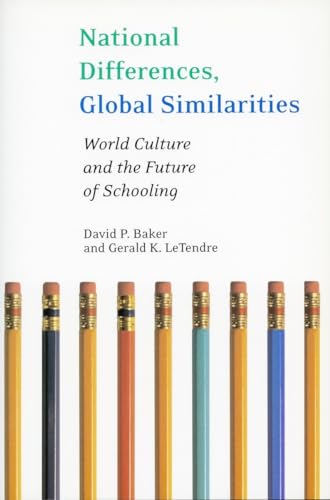
National Differences, Global Similarities: World Culture And The Future Of Schooling (Stanford Social Sciences) - Softcover
Inhaltsangabe
Using American schools as a reference point, this book provides a comprehensive, comparative description of schooling as a global institution. Each chapter develops a story about a particular global trend: continuing gender differences in achievement, new methods nations employ to govern their schools, the rapidly increasing use of private tutoring, school violence, the development of effective curriculums, and the everyday work of teachers, among other topics.
The authors draw on a four-year investigation conducted in forty-seven countries that examined many aspects of K-12 schooling, such as how schools are run, what teachers teach, and what students learn in mathematics and science. Baker and LeTendre present the results of the study in a non-technical and accessible fashion, outlining the implications of current trends for both education policy discussions and theoretical explorations of the role of education in society. Running throughout the book is a discussion of how world educational trends and the forces behind them will work to change and shape the possible directions education may take in the future.
The authors draw on a four-year investigation conducted in forty-seven countries that examined many aspects of K-12 schooling, such as how schools are run, what teachers teach, and what students learn in mathematics and science. Baker and LeTendre present the results of the study in a non-technical and accessible fashion, outlining the implications of current trends for both education policy discussions and theoretical explorations of the role of education in society. Running throughout the book is a discussion of how world educational trends and the forces behind them will work to change and shape the possible directions education may take in the future.
Die Inhaltsangabe kann sich auf eine andere Ausgabe dieses Titels beziehen.
Über die Autorinnen und Autoren
David Baker is Professor of Education and Sociology at Pennsylvania State University, and publishes widely on comparative education, the organization of schools, and sociology. Gerald LeTendre is Associate Professor of Education Policy Studies at Pennsylvania State University, and is the author of Learning to Be Adolescent.
David Baker is Professor of Education and Sociology at Pennsylvania State University, and publishes widely on comparative education, the organization of schools, and sociology. Gerald LeTendre is Associate Professor of Education Policy Studies at Pennsylvania State University, and is the author of Learning to Be Adolescent.
Von der hinteren Coverseite
Using American schools as a reference point, this book provides a comprehensive, comparative description of schooling as a global institution. Each chapter develops a story about a particular global trend: continuing gender differences in achievement, new methods nations employ to govern their schools, the rapidly increasing use of private tutoring, school violence, the development of effective curriculums, and the everyday work of teachers, among other topics.
The authors draw on a four-year investigation conducted in forty-seven countries that examined many aspects of K-12 schooling, such as how schools are run, what teachers teach, and what students learn in mathematics and science. Baker and LeTendre present the results of the study in a non-technical and accessible fashion, outlining the implications of current trends for both education policy discussions and theoretical explorations of the role of education in society. Running throughout the book is a discussion of how world educational trends and the forces behind them will work to change and shape the possible directions education may take in the future.
The authors draw on a four-year investigation conducted in forty-seven countries that examined many aspects of K-12 schooling, such as how schools are run, what teachers teach, and what students learn in mathematics and science. Baker and LeTendre present the results of the study in a non-technical and accessible fashion, outlining the implications of current trends for both education policy discussions and theoretical explorations of the role of education in society. Running throughout the book is a discussion of how world educational trends and the forces behind them will work to change and shape the possible directions education may take in the future.
Aus dem Klappentext
Using American schools as a reference point, this book provides a comprehensive, comparative description of schooling as a global institution. Each chapter develops a story about a particular global trend: continuing gender differences in achievement, new methods nations employ to govern their schools, the rapidly increasing use of private tutoring, school violence, the development of effective curriculums, and the everyday work of teachers, among other topics.
The authors draw on a four-year investigation conducted in forty-seven countries that examined many aspects of K-12 schooling, such as how schools are run, what teachers teach, and what students learn in mathematics and science. Baker and LeTendre present the results of the study in a non-technical and accessible fashion, outlining the implications of current trends for both education policy discussions and theoretical explorations of the role of education in society. Running throughout the book is a discussion of how world educational trends and the forces behind them will work to change and shape the possible directions education may take in the future.
The authors draw on a four-year investigation conducted in forty-seven countries that examined many aspects of K-12 schooling, such as how schools are run, what teachers teach, and what students learn in mathematics and science. Baker and LeTendre present the results of the study in a non-technical and accessible fashion, outlining the implications of current trends for both education policy discussions and theoretical explorations of the role of education in society. Running throughout the book is a discussion of how world educational trends and the forces behind them will work to change and shape the possible directions education may take in the future.
Auszug. © Genehmigter Nachdruck. Alle Rechte vorbehalten.
National Differences, Global Similarities
World Culture and the Future of SchoolingBy DAVID P. BAKER GERALD K. LETENDREStanford University Press
Copyright © 2005 Board of Trustees of the Leland Stanford Junior UniversityAll right reserved.
ISBN: 978-0-8047-5021-9
Contents
List of Tables and Figures.............................................................................................................ixPreface................................................................................................................................xi1. The Global Environment of National School Systems...................................................................................12. The Declining Significance of Gender and the Rise of Egalitarian Mathematics Education..............................................163. Symbiotic Institutions: Changing Global Dynamics Between Family and Schooling.......................................................344. Demand for Achievement: The Worldwide Growth of Shadow Education Systems............................................................545. Rich Land, Poor Schools: Inequality of National Educational Resources and Achievement of Disadvantaged Students.....................716. Safe Schools, Dangerous Nations: The Paradox of School Violence.....................................................................867. The Universal Math Teacher? International Beliefs, National Work Roles, and Local Practice..........................................1048. Schoolwork at Home? Low-Quality Schooling and Homework..............................................................................1179. Slouching Toward a Global Ideology: The Devolution Revolution in Education Governance...............................................13410. Nation Versus Nation: The Race to Be the First in the World........................................................................15011. Conclusion: Observing Modern Schooling as an Institution...........................................................................169Bibliography...........................................................................................................................179Index..................................................................................................................................191
Chapter One
The Global Environment of National School Systems WHATEVER SUCCESS human society has mustered over the past hundred years is in large measure a result of widespread educational investment by nations in the skills, attitudes, and behaviors of all children. Schools are part of the essential fabric of life in a modern society. Although schools are so commonplace we often overlook them, they play a crucial role in the making of our social world. In the global community, a high-quality public system of education is the sine qua non of a modern democratic society. Many economists and others who study how nations develop stress that high-quality schools are essential for the human capital development and economic growth of nations (OECD, 2001). Beyond economic development, a nation would be hard-pressed to consider itself a functioning country without a national system of education.With all the importance attached to schools, it is no wonder that politicians and policy makers around the world place much emphasis on providing quality public education to their constituents. Operating and regulating a nation's schools-public or private-is of extreme importance to national leaders, and governments everywhere guide and direct the kind of education that children receive. In a very short time, public schooling has become the major means by which governments try to promote positive economic change, strengthen national identity, and inculcate citizenship values and behavior in entire populations of people. Consequently there is incessant public discussion about schooling, and political campaigns in all sorts of nations make educational policy and the performance of schools a central point.
By and large, most people most of the time think about education as solely a national undertaking. The trends we examine here, however, lead to quite a different vision, one where there is a considerable global process at work. To make sense of this contrasting globalized world of education, it is helpful first to describe the common image of schooling as a national enterprise. It is a vision with several components.
The everyday vision of schooling as a national enterprise sees it as chiefly a unique product of a nation's culture and governmental effort to foster prosperity for its citizens. This is thought to be true regardless of the particular level of governance of schools within the nation. It is common, then, to refer to French, Chilean, Japanese, American, and South African (or any nation's) schools as separate national entities. After all, what could be more deeply embedded in a nation's society than its schools preparing children for future adult lives in that country? The reigning image of education today is that schools are designed and managed within a national context for the specific needs and goals of a particular nation.
This vision also assumes that schooling is organized to educate and socialize children in a specific way that is directly linked to the future welfare of a particular nation. For example, German schools are thought to produce German adults with the technical skills, linguistic capabilities, and cultural awareness necessary to carry forth the entity of Germany into the future. A national product of educated citizens issuing forth from the school system is the main image of what schooling does in every nation. Educators may be aware of the larger global world, but their predominant image of a nation's schools is as a means to pass on a sense of national uniqueness and heritage, as well as meet the technical needs of its particular labor market. This image implies that schooling is limited to the specific needs of a nation, therefore schooling would not expand except as is needed for national reasons. Nor would schools engage in education that is separable from traditional values of the nation. Additionally, this image of schooling holds that because labor markets are hierarchical, so should schooling be hierarchical. For efficiency, the argument continues, the best and the brightest of a nation deserve the best educational opportunities for the best national outcomes, and those with lesser endowments should receive less. All of this is wrapped up in the picture of a national system of education operating uniquely to produce efficiently adults with the kind of skill necessary for a range of tasks in the labor market and adult life within a national context.
This common image of schooling bound up in a national context is further reinforced by the rhetoric of official comparisons of education across nations (Schmer, 2004). Observing schooling across nations is thought to reveal significant differences in specific and unique national features causing relative differences in academic outcomes, such as national achievement among nations. A common extension of this idea is that the specific characteristics of a nation's schools are partly responsible for its relative position in the world's economy, and that nations are different enough from one another in their...
„Über diesen Titel“ kann sich auf eine andere Ausgabe dieses Titels beziehen.
Suchergebnisse für National Differences, Global Similarities: World Culture...

Beispielbild für diese ISBN
National Differences, Global Similarities: World Culture and the Future of Schooling
Verlag:
Stanford University Press, 2005
ISBN 10: 0804750211
ISBN 13: 9780804750219
Gebraucht
Paperback
Anbieter: World of Books (was SecondSale), Montgomery, IL, USA
Verkäuferbewertung 5 von 5 Sternen

Paperback. Zustand: Good. Using American schools as a reference point, this book provides a comprehensive, comparative description of schooling as a global institution. Artikel-Nr. 00083641055
Gebraucht kaufen
EUR 4,65
Versand gratis
Versand innerhalb von USA
Versand innerhalb von USA
Anzahl: 3 verfügbar
Beispielbild für diese ISBN
National Differences, Global Similarities: World Culture and the Future of Schooling (Stanford Social Sciences)
Verlag:
Stanford University Press (edition 1), 2005
ISBN 10: 0804750211
ISBN 13: 9780804750219
Gebraucht
Paperback
Anbieter: BooksRun, Philadelphia, PA, USA
Verkäuferbewertung 5 von 5 Sternen
Paperback. Zustand: Very Good. 1. It's a well-cared-for item that has seen limited use. The item may show minor signs of wear. All the text is legible, with all pages included. It may have slight markings and/or highlighting. Artikel-Nr. 0804750211-11-1
Gebraucht kaufen
EUR 4,66
Versand gratis
Versand innerhalb von USA
Versand innerhalb von USA
Anzahl: 1 verfügbar
Beispielbild für diese ISBN
National Differences, Global Similarities: World Culture and the Future of Schooling (Stanford Social Sciences)
Verlag:
Stanford University Press, 2005
ISBN 10: 0804750211
ISBN 13: 9780804750219
Gebraucht
Softcover
Anbieter: Wonder Book, Frederick, MD, USA
Verkäuferbewertung 5 von 5 Sternen
Zustand: Good. Good condition. A copy that has been read but remains intact. May contain markings such as bookplates, stamps, limited notes and highlighting, or a few light stains. Artikel-Nr. R09R-01314
Gebraucht kaufen
EUR 6,43
Versand gratis
Versand innerhalb von USA
Versand innerhalb von USA
Anzahl: 2 verfügbar
Beispielbild für diese ISBN
National Differences, Global Similarities: World Culture and the Future of Schooling (Stanford Social Sciences)
Verlag:
Stanford University Press, 2005
ISBN 10: 0804750211
ISBN 13: 9780804750219
Gebraucht
Softcover
Anbieter: Wonder Book, Frederick, MD, USA
Verkäuferbewertung 5 von 5 Sternen
Zustand: Very Good. Very Good condition. A copy that may have a few cosmetic defects. May also contain a few markings such as an owner's name, short gifter's inscription or light stamp. Artikel-Nr. O10N-00532
Gebraucht kaufen
EUR 6,43
Versand gratis
Versand innerhalb von USA
Versand innerhalb von USA
Anzahl: 1 verfügbar
Beispielbild für diese ISBN
National Differences, Global Similarities : World Culture and the Future of Schooling
Verlag:
Stanford University Press, 2005
ISBN 10: 0804750211
ISBN 13: 9780804750219
Gebraucht
Softcover
Erstausgabe
Anbieter: Better World Books, Mishawaka, IN, USA
Verkäuferbewertung 5 von 5 Sternen
Zustand: Good. 1st Edition. Pages intact with minimal writing/highlighting. The binding may be loose and creased. Dust jackets/supplements are not included. Stock photo provided. Product includes identifying sticker. Better World Books: Buy Books. Do Good. Artikel-Nr. 4278522-6
Gebraucht kaufen
EUR 6,57
Versand gratis
Versand innerhalb von USA
Versand innerhalb von USA
Anzahl: 1 verfügbar
Beispielbild für diese ISBN
National Differences, Global Similarities: World Culture and the Future of Schooling
Verlag:
Stanford Social Sciences, 2005
ISBN 10: 0804750211
ISBN 13: 9780804750219
Gebraucht
Paperback
Anbieter: ThriftBooks-Dallas, Dallas, TX, USA
Verkäuferbewertung 5 von 5 Sternen
Paperback. Zustand: Very Good. No Jacket. May have limited writing in cover pages. Pages are unmarked. ~ ThriftBooks: Read More, Spend Less. Artikel-Nr. G0804750211I4N00
Gebraucht kaufen
EUR 9,18
Versand gratis
Versand innerhalb von USA
Versand innerhalb von USA
Anzahl: 1 verfügbar
Beispielbild für diese ISBN
National Differences, Global Similarities: World Culture and the Future of Schooling (Stanford Social Sciences)
Anbieter: AwesomeBooks, Wallingford, Vereinigtes Königreich
Verkäuferbewertung 5 von 5 Sternen
Paperback. Zustand: Very Good. National Differences, Global Similarities: World Culture and the Future of Schooling (Stanford Social Sciences) This book is in very good condition and will be shipped within 24 hours of ordering. The cover may have some limited signs of wear but the pages are clean, intact and the spine remains undamaged. This book has clearly been well maintained and looked after thus far. Money back guarantee if you are not satisfied. See all our books here, order more than 1 book and get discounted shipping. Artikel-Nr. 7719-9780804750219
Gebraucht kaufen
EUR 4,90
EUR 4,92 Versand
Versand von Vereinigtes Königreich nach USA
Versand von Vereinigtes Königreich nach USA
Anzahl: 2 verfügbar
Beispielbild für diese ISBN
National Differences, Global Similarities : World Culture and the Future of Schooling
Verlag:
Stanford University Press, 2005
ISBN 10: 0804750211
ISBN 13: 9780804750219
Gebraucht
Softcover
Erstausgabe
Anbieter: Better World Books Ltd, Dunfermline, Vereinigtes Königreich
Verkäuferbewertung 5 von 5 Sternen
Zustand: Good. 1st Edition. Pages intact with minimal writing/highlighting. The binding may be loose and creased. Dust jackets/supplements are not included. Stock photo provided. Product includes identifying sticker. Better World Books: Buy Books. Do Good. Artikel-Nr. 4278522-6
Gebraucht kaufen
EUR 5,77
EUR 5,97 Versand
Versand von Vereinigtes Königreich nach USA
Versand von Vereinigtes Königreich nach USA
Anzahl: 2 verfügbar
Beispielbild für diese ISBN
National Differences, Global Similarities: World Culture and the Future of Schooling (Stanford Social Sciences)
Anbieter: Bahamut Media, Reading, Vereinigtes Königreich
Verkäuferbewertung 4 von 5 Sternen

Paperback. Zustand: Very Good. This book is in very good condition and will be shipped within 24 hours of ordering. The cover may have some limited signs of wear but the pages are clean, intact and the spine remains undamaged. This book has clearly been well maintained and looked after thus far. Money back guarantee if you are not satisfied. See all our books here, order more than 1 book and get discounted shipping. Artikel-Nr. 6545-9780804750219
Gebraucht kaufen
EUR 5,79
EUR 8,33 Versand
Versand von Vereinigtes Königreich nach USA
Versand von Vereinigtes Königreich nach USA
Anzahl: 2 verfügbar
Foto des Verkäufers
National Differences, Global Similarities World Culture and the Future of Schooling
Verlag:
Stanford University Press, Stanford, CA, 2005
ISBN 10: 0804750211
ISBN 13: 9780804750219
Gebraucht
Paperback
Erstausgabe
Anbieter: True Oak Books, Highland, NY, USA
Verkäuferbewertung 5 von 5 Sternen
Paperback. Zustand: Good+. First Edition; Early Printing. Stanford Social Sciences; 6 X 0.53 X 9 inches; 194 pages; minor pencil markings in the margins on a few pages. Very Good condition otherwise. No other noteworthy defects. ; Your satisfaction is our priority. We offer free returns and respond promptly to all inquiries. Your item will be packaged with care and ship on the same or next business day. Buy with confidence. Artikel-Nr. HVD-65830-A-0
Gebraucht kaufen
EUR 18,38
Versand gratis
Versand innerhalb von USA
Versand innerhalb von USA
Anzahl: 1 verfügbar