
Verwandte Artikel zu Making Indigenous Citizens: Identities, Education,...
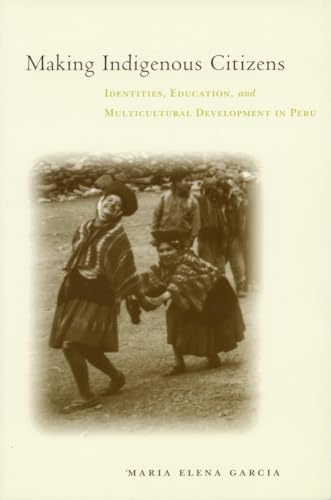
Making Indigenous Citizens: Identities, Education, and Multicultural Development in Peru - Softcover
Inhaltsangabe
Set against conventional views of Peru as a place where indigenous mobilization has been absent, this book examines the complex, contentious politics between intercultural activists, local Andean indigenous community members, state officials, non-governmental organizations, and transnationally-educated indigenous intellectuals. It examines the paradoxes and possibilities of Quechua community protests against intercultural bilingual education, official multicultural policies implemented by state and non-state actors, and the training of "authentic" indigenous leaders far from their home communities.
Focusing on important local sites of transnational connections, especially in the highland communities of Cuzco, and on an international academic institute for the study of intercultural bilingual education, this book shows how contemporary indigenous politics are inextricably and simultaneously local and global. In exploring some of the seeming contradictions of Peruvian indigenous politics, Making Indigenous Citizens suggests that indigenous movements and citizenship are articulated in extraordinary but under-explored ways in Latin America and beyond.
Die Inhaltsangabe kann sich auf eine andere Ausgabe dieses Titels beziehen.
Über die Autorin bzw. den Autor
María Elena García is Assistant Professor of Anthropology at Sarah Lawrence College.
Von der hinteren Coverseite
Set against conventional views of Peru as a place where indigenous mobilization has been absent, this book examines the complex, contentious politics between intercultural activists, local Andean indigenous community members, state officials, non-governmental organizations, and transnationally-educated indigenous intellectuals. It examines the paradoxes and possibilities of Quechua community protests against intercultural bilingual education, official multicultural policies implemented by state and non-state actors, and the training of “authentic” indigenous leaders far from their home communities.
Focusing on important local sites of transnational connections, especially in the highland communities of Cuzco, and on an international academic institute for the study of intercultural bilingual education, this book shows how contemporary indigenous politics are inextricably and simultaneously local and global. In exploring some of the seeming contradictions of Peruvian indigenous politics, Making Indigenous Citizens suggests that indigenous movements and citizenship are articulated in extraordinary but under-explored ways in Latin America and beyond.
Focusing on important local sites of transnational connections, especially in the highland communities of Cuzco, and on an international academic institute for the study of intercultural bilingual education, this book shows how contemporary indigenous politics are inextricably and simultaneously local and global. In exploring some of the seeming contradictions of Peruvian indigenous politics, Making Indigenous Citizens suggests that indigenous movements and citizenship are articulated in extraordinary but under-explored ways in Latin America and beyond.
Aus dem Klappentext
Set against conventional views of Peru as a place where indigenous mobilization has been absent, this book examines the complex, contentious politics between intercultural activists, local Andean indigenous community members, state officials, non-governmental organizations, and transnationally-educated indigenous intellectuals. It examines the paradoxes and possibilities of Quechua community protests against intercultural bilingual education, official multicultural policies implemented by state and non-state actors, and the training of authentic indigenous leaders far from their home communities.
Focusing on important local sites of transnational connections, especially in the highland communities of Cuzco, and on an international academic institute for the study of intercultural bilingual education, this book shows how contemporary indigenous politics are inextricably and simultaneously local and global. In exploring some of the seeming contradictions of Peruvian indigenous politics, Making Indigenous Citizens suggests that indigenous movements and citizenship are articulated in extraordinary but under-explored ways in Latin America and beyond.
Focusing on important local sites of transnational connections, especially in the highland communities of Cuzco, and on an international academic institute for the study of intercultural bilingual education, this book shows how contemporary indigenous politics are inextricably and simultaneously local and global. In exploring some of the seeming contradictions of Peruvian indigenous politics, Making Indigenous Citizens suggests that indigenous movements and citizenship are articulated in extraordinary but under-explored ways in Latin America and beyond.
Auszug. © Genehmigter Nachdruck. Alle Rechte vorbehalten.
Making Indigenous Citizens
IDENTITIES, EDUCATION, AND MULTICULTURAL DEVELOPMENT IN PERUBy Mara Elena GarcaStanford University Press
Copyright © 2005 Board of Trustees of the Leland Stanford Junior UniversityAll right reserved.
ISBN: 978-0-8047-5015-8
Contents
Acknowledgments.................................................................................................ixIntroduction: Reconsidering Ethnicity and Multicultural Development in the Peruvian Andes.......................1Part I. Politics and Histories1. In the Shadow of Terror: Indigenous Peoples and the State, 1980-2002.........................................352. Race, Education, and Citizenship: From Indigenismo to Interculturalidad, 1920s-1990s.........................63Part II. Ethnographies3. Community Politics and Resistance: Challenging Representation................................................874. Conflicted Multiculturalisms: NGOs, the State, and the Contradictions of Rights Activism.....................1105. Developing Indigenous Spaces: Intellectuals and Transnational Networks.......................................133Part III. Conclusions6. Articulating Indigenous Citizenship: Intercultural Identities and Politics...................................163Notes...........................................................................................................179Works Cited.....................................................................................................189Index...........................................................................................................207
Chapter One
In the Shadow of Terror INDIGENOUS PEOPLES AND THE STATE, 1980-2002 35
During my seventeen months in Cuzco, I spent many weeks in Intipacha, a monolingual Quechua community at the foot of the snowcapped Ausangate mountains. At the end of one stay in the community, while I packed my few belongings in preparation for my return to the city, Carmen, my comadre, called me into her family's eating area. They had prepared pachamanca, a special meal (in this case, potatoes, lamb, and alpaca meat) cooked in a makeshift oven underground. There was a large pail of chicha (fermented corn beer) on the ground, and I suspected that several bottles of beer, though hidden from me then, would appear later.
Huddling close to each other against the cold night air, we began eating and drinking, and gradually many in the community joined us. One man brought his guitar, another his charango, and before I knew it I was asked to change into the traditional polleras (skirts) allinta tusunaypaq (for a prettier dance). The dancing began and the drinking continued until Ral, an unusually tall and serious man whom I had seen little during my time in Intipacha, walked in. I noticed glances toward my compadres Carmen and Ignacio from most people, and an uncomfortable pause in the music confirmed the uneasiness that had suddenly enveloped the room. But, charming and proper as ever, Ignacio recovered the one glass passing around the room, rinsed it out with water, filled it to the brim with chicha, and handed it to Ral in a welcoming gesture.
Visibly pleased, Ral took the glass. After slowly and carefully scrutinizing everyone in the room, he offered some drops to the Pachamama (Earth Mother) and gulped down the cold drink. With that the music began again and we continued to dance, though I was now nervous about this man's presence. Everyone in the room seemed to understand something that had escaped me, and although I tried to ignore my nervousness, I was still uncomfortable and my gaze constantly shifted toward Ral. At the end of a song, as I took the opportunity to rest and have a beer, Ral approached me. Again there were glances, though this time first toward me and then quickly toward Ignacio. But with a sign from Ignacio, the music continued and people attempted to converse naturally. As Ral began to speak with me, however, those closest to us stopped talking and listened.
We did not exchange many words, and his comments were short and direct. He said he had come to say goodbye, although he had never said hello. And he said he had come to apologize. I was confused, and when I asked him why, it was he who became confused. He had obviously been certain I would understand. He looked to Ignacio for the answer, and I looked to Carmen. Suddenly Ignacio's cousin Mario, a short, thin, very funny (and by this time very drunk) man, blurted out: "He thought you were a terrorist and that we were all going to be blown up!"
I was in shock. All around me, though, people were laughing. The entire room found this hilarious, but even funnier was the fact that I was entirely unaware that heated debates had gone on during my first week in Intipacha (in June 1998) between Ral and Ignacio. Some members of the community had been unsure whether I was a threat to the community or simply a well-intentioned anthropologist trying to learn Quechua. While at that time the Peruvian government maintained that the years of political violence were over, for many highland and lowland communities the threat of violence was still real. Ral and several others in the community were certain that Sendero Luminoso, a Maoist guerrilla movement, had sent me to determine whether any children in the community were strong enough and smart enough to recruit into the organization. As an anthropologist, I was immediately associated with the political left, and because I spent much of my time in the school observing and working with children, my intentions became suspect.
In contemporary Peru, the official years of terror (1980-95) continue to cast a shadow over the country (Basombro Iglesias 1998). These shadows have come to seem even more menacing as reports appear in the media about the resurgence of Sendero Luminoso. Moreover, the release of the national Truth and Reconciliation Commission's report in August 2003 sparked new debates over indigenous rights, reparations, state accountability, and impunity. Clearly the politics of culture and development in the Peruvian Andes cannot be separated from the lingering effects of more than a decade of violence-much of it aimed at indigenous peoples.
While the present moment is full of uncertainties, I would like to note that the period during which I conducted most of my fieldwork (1996-99) was also characterized by a particular set of ambiguities, hopes, and fears. Intercultural education was being debated and implemented in the context of a tenuous transition away from authoritarianism. Though in a sense activists were continuing work that had been ongoing since the 1960s and 1970s (Burns 1968, 1971), they were also breaking new ground as they sought to broaden their linguistic and cultural work toward more explicitly political activism. Indigenous and peasant political mobilization in Cuzco, in their view, had last erupted over questions of land tenure and agrarian reform (Blanco 1972). While the 1990s bore the marks of these earlier mobilizations, for activists this decade was about a new set of concerns about culture, language, and education (Andrs Chirinos, personal communication).
When I first arrived in Cuzco in 1996, Peruvian indigenous rights activists were hesitant to discuss indigenous rights overtly. Although the war had officially ended in 1995, the political climate was still such that simply discussing politics or raising questions about human rights abuses could be (and had been) labeled subversive by Alberto Fujimori's government forces. In the place of more overtly...
„Über diesen Titel“ kann sich auf eine andere Ausgabe dieses Titels beziehen.
Suchergebnisse für Making Indigenous Citizens: Identities, Education,...

Beispielbild für diese ISBN
Making Indigenous Citizens : Identities, Education, and Multicultural Development in Peru
Verlag:
Stanford University Press, 2005
ISBN 10: 0804750157
ISBN 13: 9780804750158
Gebraucht
Softcover
Erstausgabe
Anbieter: Better World Books, Mishawaka, IN, USA
Verkäuferbewertung 5 von 5 Sternen

Zustand: Good. 1st Edition. Pages intact with minimal writing/highlighting. The binding may be loose and creased. Dust jackets/supplements are not included. Stock photo provided. Product includes identifying sticker. Better World Books: Buy Books. Do Good. Artikel-Nr. 7975870-6
Gebraucht kaufen
EUR 8,35
Versand gratis
Versand innerhalb von USA
Versand innerhalb von USA
Anzahl: 1 verfügbar
Beispielbild für diese ISBN
Making Indigenous Citizens
Anbieter: PBShop.store UK, Fairford, GLOS, Vereinigtes Königreich
Verkäuferbewertung 5 von 5 Sternen
PAP. Zustand: New. New Book. Shipped from UK. Established seller since 2000. Artikel-Nr. FW-9780804750158
Neu kaufen
EUR 24,47
EUR 4,91 Versand
Versand von Vereinigtes Königreich nach USA
Versand von Vereinigtes Königreich nach USA
Anzahl: 15 verfügbar
Beispielbild für diese ISBN
Making Indigenous Citizens: Identities, Education, and Multicultural Development in Peru
Anbieter: Majestic Books, Hounslow, Vereinigtes Königreich
Verkäuferbewertung 4 von 5 Sternen

Zustand: New. pp. 232. Artikel-Nr. 7989818
Neu kaufen
EUR 31,02
EUR 7,68 Versand
Versand von Vereinigtes Königreich nach USA
Versand von Vereinigtes Königreich nach USA
Anzahl: 3 verfügbar
Beispielbild für diese ISBN
Making Indigenous Citizens: Identities, Education, and Multicultural Development in Peru
Anbieter: Ria Christie Collections, Uxbridge, Vereinigtes Königreich
Verkäuferbewertung 5 von 5 Sternen
Zustand: New. In English. Artikel-Nr. ria9780804750158_new
Neu kaufen
EUR 30,34
EUR 11,07 Versand
Versand von Vereinigtes Königreich nach USA
Versand von Vereinigtes Königreich nach USA
Anzahl: Mehr als 20 verfügbar
Beispielbild für diese ISBN
Making Indigenous Citizens Identities, Education, and Multicultural Development in Peru
Anbieter: Revaluation Books, Exeter, Vereinigtes Königreich
Verkäuferbewertung 5 von 5 Sternen
Paperback. Zustand: Brand New. 1st edition. 213 pages. 9.00x5.75x0.25 inches. In Stock. Artikel-Nr. x-0804750157
Neu kaufen
EUR 32,05
EUR 11,81 Versand
Versand von Vereinigtes Königreich nach USA
Versand von Vereinigtes Königreich nach USA
Anzahl: 2 verfügbar
Beispielbild für diese ISBN
Making Indigenous Citizens: Identities, Education, and Multicultural Development in Peru
Anbieter: Kennys Bookstore, Olney, MD, USA
Verkäuferbewertung 5 von 5 Sternen
Zustand: New. 2005. 1st Edition. Paperback. . . . . . Books ship from the US and Ireland. Artikel-Nr. V9780804750158
Neu kaufen
EUR 37,90
EUR 9,37 Versand
Versand innerhalb von USA
Versand innerhalb von USA
Anzahl: Mehr als 20 verfügbar
Foto des Verkäufers
Making Indigenous Citizens: Identities, Education, and Multicultural Development in Peru
Anbieter: moluna, Greven, Deutschland
Verkäuferbewertung 5 von 5 Sternen
Zustand: New. Taking on existing interpretations of Peruvian exceptionalism, this book presents a multi-sited ethnographic exploration of the local and transnational articulations of indigenous movements, multicultural development policies, and indigenous citizenship i. Artikel-Nr. 595015038
Neu kaufen
EUR 26,94
EUR 48,99 Versand
Versand von Deutschland nach USA
Versand von Deutschland nach USA
Anzahl: Mehr als 20 verfügbar
Foto des Verkäufers
Making Indigenous Citizens | Identities, Education, and Multicultural Development in Peru
Anbieter: preigu, Osnabrück, Deutschland
Verkäuferbewertung 5 von 5 Sternen
Taschenbuch. Zustand: Neu. Making Indigenous Citizens | Identities, Education, and Multicultural Development in Peru | Maria Elena García | Taschenbuch | Einband - flex.(Paperback) | Englisch | 2005 | Stanford University Press | EAN 9780804750158 | Verantwortliche Person für die EU: Mare Nostrum Group B.V., Doelen 72, 4831 GR BREDA, NIEDERLANDE, gpsr[at]mare-nostrum[dot]co[dot]uk | Anbieter: preigu. Artikel-Nr. 108545350
Neu kaufen
EUR 24,45
EUR 70,00 Versand
Versand von Deutschland nach USA
Versand von Deutschland nach USA
Anzahl: 5 verfügbar