
Verwandte Artikel zu Frontier Passages: Ethnopolitics and the Rise of Chinese...
Inhaltsangabe
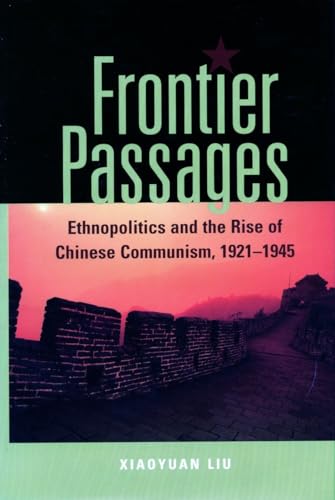
In this pathbreaking book, Xiaoyuan Liu establishes the ways in which the history of the Chinese Communist Party was, from the Yan’an period onward, intertwined with the ethnopolitics of the Chinese “periphery.” As a Han-dominated party, the CCP had to adapt to an inhospitable political environment, particularly among the Hui (Muslims) of northwest China and the Mongols of Inner Mongolia. Based on a careful examination of CCP and Soviet Comintern documents only recently available, Liu’s study shows why the CCP found itself unable to follow the Russian Bolshevik precedent by inciting separatism among the non-Han peoples as a stratagem for gaining national power. Rather than swallowing Marxist-Leninist dogma on “the nationalities question,” the CCP took a position closer to that of the Kuomintang, stressing the inclusiveness of the Han-dominated Chinese nation, “Zhongua Minzu.”
Die Inhaltsangabe kann sich auf eine andere Ausgabe dieses Titels beziehen.
Über die Autorinnen und Autoren
Xiaoyuan Liu is an Associate Professor of History at Iowa State University and a recent Fellow at the Woodrow Wilson Center in Washington.
Xiaoyuan Liu is an Associate Professor of History at Iowa State University and a recent Fellow at the Woodrow Wilson Center in Washington.
Von der hinteren Coverseite
“This spare and elegant study is a singular contribution to the history of the Chinese Communist Party in particular and modern Chinese history more broadly speaking, in an area that has been relatively neglected by Western historical scholarship. Using an impressive array of Chinese documentary evidence, and grounding his work in the best recent scholarship on nationalism and ethnopolitics, Liu has focused on a dimension of Chinese Communist history that is too often overlooked, namely, the ethnopolitical dimension of the CCP's rise to power.” —Steven I. Levine, University of North Carolina-Chapel Hill
“This spare and elegant study is a singular contribution to the history of the Chinese Communist Party in particular and modern Chinese history more broadly speaking. . . . Liu has focused on a dimension of Chinese Communist history that is too often overlooked, namely, the ethnopolitical dimension of the CCP's rise to power.” —Steven I. Levine, University of North Carolina-Chapel Hill
“This spare and elegant study is a singular contribution to the history of the Chinese Communist Party in particular and modern Chinese history more broadly speaking. . . . Liu has focused on a dimension of Chinese Communist history that is too often overlooked, namely, the ethnopolitical dimension of the CCP's rise to power.” —Steven I. Levine, University of North Carolina-Chapel Hill
Aus dem Klappentext
In this pathbreaking book, Xiaoyuan Liu establishes the ways in which the history of the Chinese Communist Party was, from the Yan an period onward, intertwined with the ethnopolitics of the Chinese periphery. As a Han-dominated party, the CCP had to adapt to an inhospitable political environment, particularly among the Hui (Muslims) of northwest China and the Mongols of Inner Mongolia. Based on a careful examination of CCP and Soviet Comintern documents only recently available, Liu s study shows why the CCP found itself unable to follow the Russian Bolshevik precedent by inciting separatism among the non-Han peoples as a stratagem for gaining national power. Rather than swallowing Marxist-Leninist dogma on the nationalities question, the CCP took a position closer to that of the Kuomintang, stressing the inclusiveness of the Han-dominated Chinese nation, Zhongua Minzu.
„Über diesen Titel“ kann sich auf eine andere Ausgabe dieses Titels beziehen.
Suchergebnisse für Frontier Passages: Ethnopolitics and the Rise of Chinese...

Beispielbild für diese ISBN
Frontier Passages : Ethnopolitics and the Rise of Chinese Communism, 1921-1945
Verlag:
Stanford University Press, 2003
ISBN 10: 0804749604
ISBN 13: 9780804749602
Gebraucht
Hardcover
Erstausgabe
Anbieter: Better World Books, Mishawaka, IN, USA
Verkäuferbewertung 5 von 5 Sternen

Zustand: Good. 1st Edition. Pages intact with minimal writing/highlighting. The binding may be loose and creased. Dust jackets/supplements are not included. Stock photo provided. Product includes identifying sticker. Better World Books: Buy Books. Do Good. Artikel-Nr. 39783546-6
Gebraucht kaufen
EUR 38,02
Versand gratis
Versand innerhalb von USA
Versand innerhalb von USA
Anzahl: 1 verfügbar
Beispielbild für diese ISBN
Frontier Passages
Anbieter: PBShop.store UK, Fairford, GLOS, Vereinigtes Königreich
Verkäuferbewertung 5 von 5 Sternen
HRD. Zustand: New. New Book. Shipped from UK. Established seller since 2000. Artikel-Nr. FW-9780804749602
Neu kaufen
EUR 78,61
EUR 5,96 Versand
Versand von Vereinigtes Königreich nach USA
Versand von Vereinigtes Königreich nach USA
Anzahl: 1 verfügbar
Beispielbild für diese ISBN
Frontier Passages: Ethnopolitics and the Rise of Chinese Communism, 1921-1945
Anbieter: Ria Christie Collections, Uxbridge, Vereinigtes Königreich
Verkäuferbewertung 5 von 5 Sternen
Zustand: New. In English. Artikel-Nr. ria9780804749602_new
Neu kaufen
EUR 83,58
EUR 13,40 Versand
Versand von Vereinigtes Königreich nach USA
Versand von Vereinigtes Königreich nach USA
Anzahl: 1 verfügbar
Beispielbild für diese ISBN
Frontier Passages: Ethnopolitics and the Rise of Chinese Communism, 1921-1945
Anbieter: Majestic Books, Hounslow, Vereinigtes Königreich
Verkäuferbewertung 4 von 5 Sternen

Zustand: New. pp. 256. Artikel-Nr. 7989697
Neu kaufen
EUR 101,46
EUR 7,71 Versand
Versand von Vereinigtes Königreich nach USA
Versand von Vereinigtes Königreich nach USA
Anzahl: 1 verfügbar
Beispielbild für diese ISBN
Frontier Passages
Anbieter: Kennys Bookstore, Olney, MD, USA
Verkäuferbewertung 5 von 5 Sternen
Zustand: New. Xiaoyuan Liu shows how the history of the Chinese Communist Party was, from the Yan'an period onward, intertwined with the ethnopolitics of the Chinese "periphery." As a Han-dominated party, the CCP had to adapt to an inhospitable political environment, particularly among the Hui (Muslims) of northwest China and the Mongols of Inner Mongolia. Num Pages: 256 pages, 7 maps. BIC Classification: 1FPC; 3JJG; 3JJH; HBJF; HBLW; HBT; JPFC; JPL. Category: (G) General (US: Trade); (P) Professional & Vocational; (U) Tertiary Education (US: College). Dimension: 5817 x 3887 x 23. Weight in Grams: 549. . 2003. 1st Edition. hardcover. . . . . Books ship from the US and Ireland. Artikel-Nr. V9780804749602
Neu kaufen
EUR 107,03
EUR 9,36 Versand
Versand innerhalb von USA
Versand innerhalb von USA
Anzahl: 1 verfügbar
Beispielbild für diese ISBN
Frontier Passages Ethnopolitics and the Rise of Chinese Communism, 19211945
Anbieter: Revaluation Books, Exeter, Vereinigtes Königreich
Verkäuferbewertung 5 von 5 Sternen
Hardcover. Zustand: Brand New. 1st edition. 256 pages. 9.00x6.25x0.75 inches. In Stock. Artikel-Nr. x-0804749604
Neu kaufen
EUR 109,15
EUR 14,84 Versand
Versand von Vereinigtes Königreich nach USA
Versand von Vereinigtes Königreich nach USA
Anzahl: 2 verfügbar
Foto des Verkäufers
Liu, X: Frontier Passages
Anbieter: moluna, Greven, Deutschland
Verkäuferbewertung 5 von 5 Sternen
Gebunden. Zustand: New. Xiaoyuan Liu shows how the history of the Chinese Communist Party was, from the Yan an period onward, intertwined with the ethnopolitics of the Chinese periphery. As a Han-dominated party, the CCP had to adapt to an inhospitable political environment, par. Artikel-Nr. 867670099
Neu kaufen
EUR 80,86
EUR 48,99 Versand
Versand von Deutschland nach USA
Versand von Deutschland nach USA
Anzahl: Mehr als 20 verfügbar
Foto des Verkäufers
Frontier Passages : Ethnopolitics and the Rise of Chinese Communism, 1921-1945
Verlag:
Stanford University Press Nov 2003, 2003
ISBN 10: 0804749604
ISBN 13: 9780804749602
Neu
Hardcover
Anbieter: AHA-BUCH GmbH, Einbeck, Deutschland
Verkäuferbewertung 5 von 5 Sternen
Buch. Zustand: Neu. Neuware - In this pathbreaking book, Xiaoyuan Liu establishes the ways in which the history of the Chinese Communist Party was, from the Yan'an period onward, intertwined with the ethnopolitics of the Chinese 'periphery.' As a Han-dominated party, the CCP had to adapt to an inhospitable political environment, particularly among the Hui (Muslims) of northwest China and the Mongols of Inner Mongolia. Based on a careful examination of CCP and Soviet Comintern documents only recently available, Liu's study shows why the CCP found itself unable to follow the Russian Bolshevik precedent by inciting separatism among the non-Han peoples as a stratagem for gaining national power. Rather than swallowing Marxist-Leninist dogma on 'the nationalities question,' the CCP took a position closer to that of the Kuomintang, stressing the inclusiveness of the Han-dominated Chinese nation, 'Zhongua Minzu.'. Artikel-Nr. 9780804749602
Neu kaufen
EUR 109,40
EUR 35,00 Versand
Versand von Deutschland nach USA
Versand von Deutschland nach USA
Anzahl: 1 verfügbar