
Verwandte Artikel zu Another Such Victory: President Truman and the Cold...
Another Such Victory: President Truman and the Cold War, 1945-1953 (Stanford Nuclear Age Series) - Softcover
Buch 8 von 22: Stanford Nuclear Age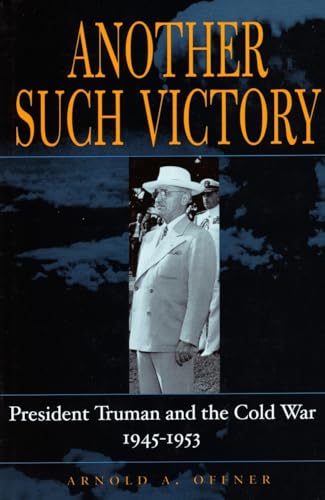
Inhaltsangabe
This book is a provocative and thoroughly documented reassessment of President Truman's profound influence on U.S. foreign policy and the Cold War. The author contends that Truman remained a parochial nationalist who lacked the vision and leadership to move the United States away from conflict and toward détente. Instead, he promoted an ideology and politics of Cold War confrontation that set the pattern for successor administrations.
Die Inhaltsangabe kann sich auf eine andere Ausgabe dieses Titels beziehen.
Über die Autorin bzw. den Autor
Arnold A. Offner is Cornelia F. Hugel Professor of History at Lafayette College. He is the author of American Appeasement: United States Foreign Policy and Germany, 1933-1938 and The Origins of the Second World War: American Foreign Policy and World Politics, 1917-1941, and co-editor of Victory in Europe, 1945: From World War to Cold War.
Von der hinteren Coverseite
"This major book is a critical revisionist portrait of Truman's personal role in shaping U.S. foreign policy toward the Soviet Union and the People's Republic of China. . . . The importance of the scholarship, the author's careful voice of reasonable criticism, the lucid writing style--all should give the book a popular readership that reaches beyond the university and foreign policy publics."--J. Garry Clifford, University of Connecticut
"At a moment in the early 2lst century when the choices in a new crisis seem simply black and white, this is precisely the kind of historical perspective we should have. Professor Offner has reopened a long overdue debate on Harry Truman--both on the man and his role in the origins of the Cold War. . . . [I]t certainly demands to be read and widely discussed."--Walter LaFeber, Cornell University and author of America, Russia and the Cold War
Aus dem Klappentext
This book is a provocative, forcefully argued, and thoroughly documented reassessment of President Truman's profound influence on U.S. foreign policy and the Cold War. The author contends that throughout his presidency, Truman remained a parochial nationalist who lacked the vision and leadership to move the United States away from conflict and toward detente. Instead, he promoted an ideology and politics of Cold War confrontation that set the pattern for successor administrations.
This study sharply challenges the prevailing view of historians who have uncritically praised Truman for repulsing the Soviet Union. Based on exhaustive research and including many documents that have come to light since the end of the Cold War, the book demonstrates how Truman's simplistic analogies, exaggerated beliefs in U.S. supremacy, and limited grasp of world affairs exacerbated conflicts with the Soviet Union and the People's Republic of China. For example, Truman's decision at the Potsdam Conference to engage in "atomic poker" and outmaneuver the Soviets in Europe and Asia led him to brush aside all proposals to forgo the use of atomic bombs on Japan.
Truman's insecurity also reinforced his penchant to view conflict in black-and-white terms, to categorize all nations as either free or totalitarian, to demonize his opponents, and to ignore the complexities of historic national conflicts. Truman was unable to view China's civil war apart from the U.S.-Soviet Cold War. Belittling critics of his support for the corrupt Guomindang government, he refused to negotiate with the emergent PRC. Though he did preserve South Korea's independence after North Korea's attack, he blamed the conflict solely on Soviet-inspired aggression, instead of a bitter dispute between two rival regimes. Truman's decision to send troops across the 38th parallel to destroy the North Korean regime, combined with his disdain for PRC security concerns, brought about a tragic wider war.
In sum, despite Truman's claim to have "knocked the socks off the communists," he left the White House with his presidency in tatters, military spending at a record high, McCarthyism rampant, and the United States on Cold War footing at home and abroad.
„Über diesen Titel“ kann sich auf eine andere Ausgabe dieses Titels beziehen.
Suchergebnisse für Another Such Victory: President Truman and the Cold...

Beispielbild für diese ISBN
Another Such Victory: President Truman and the Cold War, 1945-1953
Verlag:
Stanford University Press, 2002
ISBN 10: 0804747741
ISBN 13: 9780804747745
Gebraucht
Paperback
Anbieter: World of Books (was SecondSale), Montgomery, IL, USA
Verkäuferbewertung 5 von 5 Sternen

Paperback. Zustand: Good. A provocative reassessment of President Truman's profound influence on US foreign policy and the Cold War. The author contends that throughout his presidency, Truman remained a parochial nationalist who lacked the vision and leadership to move the United States away from conflict. Artikel-Nr. CIN0804747741G
Gebraucht kaufen
EUR 12,42
Versand gratis
Versand innerhalb von USA
Versand innerhalb von USA
Anzahl: 1 verfügbar
Beispielbild für diese ISBN
Another Such Victory : President Truman and the Cold War, 1945-1953
Verlag:
Stanford University Press, 2002
ISBN 10: 0804747741
ISBN 13: 9780804747745
Gebraucht
Softcover
Anbieter: Better World Books Ltd, Dunfermline, Vereinigtes Königreich
Verkäuferbewertung 5 von 5 Sternen
Zustand: Good. Former library copy. Pages intact with minimal writing/highlighting. The binding may be loose and creased. Dust jackets/supplements are not included. Includes library markings. Stock photo provided. Product includes identifying sticker. Better World Books: Buy Books. Do Good. Artikel-Nr. GRP12456380
Gebraucht kaufen
EUR 10,17
EUR 5,98 Versand
Versand von Vereinigtes Königreich nach USA
Versand von Vereinigtes Königreich nach USA
Anzahl: 1 verfügbar
Beispielbild für diese ISBN
Another Such Victory: President Truman and the Cold War, 1945-1953 (Stanford Nuclear Age Series)
Verlag:
Stanford University Press, 2002
ISBN 10: 0804747741
ISBN 13: 9780804747745
Gebraucht
Paperback
Anbieter: WorldofBooks, Goring-By-Sea, WS, Vereinigtes Königreich
Verkäuferbewertung 5 von 5 Sternen
Paperback. Zustand: Very Good. The book has been read, but is in excellent condition. Pages are intact and not marred by notes or highlighting. The spine remains undamaged. Artikel-Nr. GOR015160269
Gebraucht kaufen
EUR 16,56
EUR 6,70 Versand
Versand von Vereinigtes Königreich nach USA
Versand von Vereinigtes Königreich nach USA
Anzahl: 1 verfügbar
Beispielbild für diese ISBN
Another Such Victory: President Truman and the Cold War, 1945-1953 (Stanford Nuclear Age Series)
Verlag:
Stanford University Press, 2002
ISBN 10: 0804747741
ISBN 13: 9780804747745
Gebraucht
Softcover
Anbieter: Phatpocket Limited, Waltham Abbey, HERTS, Vereinigtes Königreich
Verkäuferbewertung 5 von 5 Sternen
Zustand: Good. Your purchase helps support Sri Lankan Children's Charity 'The Rainbow Centre'. Ex-library, so some stamps and wear, but in good overall condition. Our donations to The Rainbow Centre have helped provide an education and a safe haven to hundreds of children who live in appalling conditions. Artikel-Nr. Z1-K-001-02610
Gebraucht kaufen
EUR 15,44
EUR 12,73 Versand
Versand von Vereinigtes Königreich nach USA
Versand von Vereinigtes Königreich nach USA
Anzahl: 1 verfügbar
Beispielbild für diese ISBN
Another Such Victory: President Truman and the Cold War, 1945-1953 (Stanford Nuclear Age Series)
Verlag:
Stanford University Press, 2002
ISBN 10: 0804747741
ISBN 13: 9780804747745
Gebraucht
Softcover
Anbieter: Anybook.com, Lincoln, Vereinigtes Königreich
Verkäuferbewertung 5 von 5 Sternen
Zustand: Good. This is an ex-library book and may have the usual library/used-book markings inside.This book has soft covers. In good all round condition. Please note the Image in this listing is a stock photo and may not match the covers of the actual item,1000grams, ISBN:9780804747745. Artikel-Nr. 5812973
Gebraucht kaufen
EUR 22,70
EUR 15,60 Versand
Versand von Vereinigtes Königreich nach USA
Versand von Vereinigtes Königreich nach USA
Anzahl: 1 verfügbar
Beispielbild für diese ISBN
Another Such Victory President Truman and the Cold War, 19451953
Anbieter: Revaluation Books, Exeter, Vereinigtes Königreich
Verkäuferbewertung 5 von 5 Sternen
Paperback. Zustand: Brand New. 656 pages. 9.25x6.00x1.50 inches. In Stock. Artikel-Nr. x-0804747741
Neu kaufen
EUR 91,51
EUR 17,95 Versand
Versand von Vereinigtes Königreich nach USA
Versand von Vereinigtes Königreich nach USA
Anzahl: 2 verfügbar
Foto des Verkäufers
Another Such Victory
Verlag:
Stanford University Press, US, 2002
ISBN 10: 0804747741
ISBN 13: 9780804747745
Neu
Paperback
Anbieter: Rarewaves USA, HEBRON, KY, USA
Verkäuferbewertung 5 von 5 Sternen
Paperback. Zustand: New. This book is a provocative, forcefully argued, and thoroughly documented reassessment of President Truman's profound influence on U.S. foreign policy and the Cold War. The author contends that throughout his presidency, Truman remained a parochial nationalist who lacked the vision and leadership to move the United States away from conflict and toward détente. Instead, he promoted an ideology and politics of Cold War confrontation that set the pattern for successor administrations. This study sharply challenges the prevailing view of historians who have uncritically praised Truman for repulsing the Soviet Union. Based on exhaustive research and including many documents that have come to light since the end of the Cold War, the book demonstrates how Truman's simplistic analogies, exaggerated beliefs in U.S. supremacy, and limited grasp of world affairs exacerbated conflicts with the Soviet Union and the People's Republic of China. For example, Truman's decision at the Potsdam Conference to engage in "atomic poker" and outmaneuver the Soviets in Europe and Asia led him to brush aside all proposals to forgo the use of atomic bombs on Japan. Truman's insecurity also reinforced his penchant to view conflict in black-and-white terms, to categorize all nations as either free or totalitarian, to demonize his opponents, and to ignore the complexities of historic national conflicts. Truman was unable to view China's civil war apart from the U.S.-Soviet Cold War. Belittling critics of his support for the corrupt Guomindang government, he refused to negotiate with the emergent PRC. Though he did preserve South Korea's independence after North Korea's attack, he blamed the conflict solely on Soviet-inspired aggression, instead of a bitter dispute between two rival regimes. Truman's decision to send troops across the 38th parallel to destroy the North Korean regime, combined with his disdain for PRC security concerns, brought about a tragic wider war. In sum, despite Truman's claim to have "knocked the socks off the communists," he left the White House with his presidency in tatters, military spending at a record high, McCarthyism rampant, and the United States on Cold War footing at home and abroad. Artikel-Nr. LU-9780804747745
Neu kaufen
EUR 113,75
Versand gratis
Versand innerhalb von USA
Versand innerhalb von USA
Anzahl: Mehr als 20 verfügbar
Foto des Verkäufers
Another Such Victory: President Truman and the Cold War, 1945-1953
Anbieter: moluna, Greven, Deutschland
Verkäuferbewertung 5 von 5 Sternen
Zustand: New. A provocative reassessment of President Truman s profound influence on US foreign policy and the Cold War. The author contends that throughout his presidency, Truman remained a parochial nationalist who lacked the vision and leadership to move the United St. Artikel-Nr. 595014895
Neu kaufen
EUR 67,58
EUR 48,99 Versand
Versand von Deutschland nach USA
Versand von Deutschland nach USA
Anzahl: Mehr als 20 verfügbar
Foto des Verkäufers
Another Such Victory : President Truman and the Cold War, 1945-1953
Verlag:
Stanford University Press Jan 2002, 2002
ISBN 10: 0804747741
ISBN 13: 9780804747745
Neu
Taschenbuch
Anbieter: AHA-BUCH GmbH, Einbeck, Deutschland
Verkäuferbewertung 5 von 5 Sternen
Taschenbuch. Zustand: Neu. Neuware - This book is a provocative, forcefully argued, and thoroughly documented reassessment of President Truman's profound influence on U.S. foreign policy and the Cold War. The author contends that throughout his presidency, Truman remained a parochial nationalist who lacked the vision and leadership to move the United States away from conflict and toward détente. Instead, he promoted an ideology and politics of Cold War confrontation that set the pattern for successor administrations. This study sharply challenges the prevailing view of historians who have uncritically praised Truman for repulsing the Soviet Union. Based on exhaustive research and including many documents that have come to light since the end of the Cold War, the book demonstrates how Truman's simplistic analogies, exaggerated beliefs in U.S. supremacy, and limited grasp of world affairs exacerbated conflicts with the Soviet Union and the People's Republic of China. For example, Truman's decision at the Potsdam Conference to engage in 'atomic poker' and outmaneuver the Soviets in Europe and Asia led him to brush aside all proposals to forgo the use of atomic bombs on Japan. Truman's insecurity also reinforced his penchant to view conflict in black-and-white terms, to categorize all nations as either free or totalitarian, to demonize his opponents, and to ignore the complexities of historic national conflicts. Truman was unable to view China's civil war apart from the U.S.-Soviet Cold War. Belittling critics of his support for the corrupt Guomindang government, he refused to negotiate with the emergent PRC. Though he did preserve South Korea's independence after North Korea's attack, he blamed the conflict solely on Soviet-inspired aggression, instead of a bitter dispute between two rival regimes. Truman's decision to send troops across the 38th parallel to destroy the North Korean regime, combined with his disdain for PRC security concerns, brought about a tragic wider war. In sum, despite Truman's claim to have 'knocked the socks off the communists,' he left the White House with his presidency in tatters, military spending at a record high, McCarthyism rampant, and the United States on Cold War footing at home and abroad. Artikel-Nr. 9780804747745
Neu kaufen
EUR 91,82
EUR 35,00 Versand
Versand von Deutschland nach USA
Versand von Deutschland nach USA
Anzahl: 2 verfügbar
Foto des Verkäufers
Another Such Victory
Verlag:
Stanford University Press, US, 2002
ISBN 10: 0804747741
ISBN 13: 9780804747745
Neu
Paperback
Anbieter: Rarewaves USA United, HEBRON, KY, USA
Verkäuferbewertung 5 von 5 Sternen
Paperback. Zustand: New. This book is a provocative, forcefully argued, and thoroughly documented reassessment of President Truman's profound influence on U.S. foreign policy and the Cold War. The author contends that throughout his presidency, Truman remained a parochial nationalist who lacked the vision and leadership to move the United States away from conflict and toward détente. Instead, he promoted an ideology and politics of Cold War confrontation that set the pattern for successor administrations. This study sharply challenges the prevailing view of historians who have uncritically praised Truman for repulsing the Soviet Union. Based on exhaustive research and including many documents that have come to light since the end of the Cold War, the book demonstrates how Truman's simplistic analogies, exaggerated beliefs in U.S. supremacy, and limited grasp of world affairs exacerbated conflicts with the Soviet Union and the People's Republic of China. For example, Truman's decision at the Potsdam Conference to engage in "atomic poker" and outmaneuver the Soviets in Europe and Asia led him to brush aside all proposals to forgo the use of atomic bombs on Japan. Truman's insecurity also reinforced his penchant to view conflict in black-and-white terms, to categorize all nations as either free or totalitarian, to demonize his opponents, and to ignore the complexities of historic national conflicts. Truman was unable to view China's civil war apart from the U.S.-Soviet Cold War. Belittling critics of his support for the corrupt Guomindang government, he refused to negotiate with the emergent PRC. Though he did preserve South Korea's independence after North Korea's attack, he blamed the conflict solely on Soviet-inspired aggression, instead of a bitter dispute between two rival regimes. Truman's decision to send troops across the 38th parallel to destroy the North Korean regime, combined with his disdain for PRC security concerns, brought about a tragic wider war. In sum, despite Truman's claim to have "knocked the socks off the communists," he left the White House with his presidency in tatters, military spending at a record high, McCarthyism rampant, and the United States on Cold War footing at home and abroad. Artikel-Nr. LU-9780804747745
Neu kaufen
EUR 98,20
EUR 45,07 Versand
Versand innerhalb von USA
Versand innerhalb von USA
Anzahl: Mehr als 20 verfügbar