
Verwandte Artikel zu Just Being Difficult?: Academic Writing in the Public...
Just Being Difficult?: Academic Writing in the Public Arena (Cultural Memory in the Present) - Softcover
Buch 55 von 213: Cultural Memory in the Present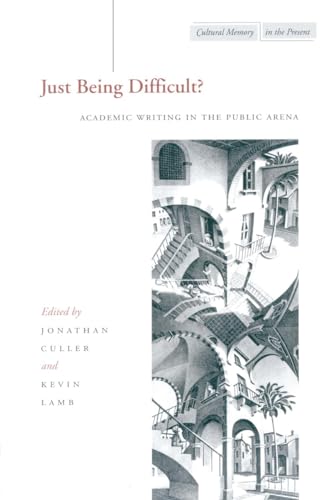
Inhaltsangabe
Is academic writing, particularly in the disciplines of literary theory and cultural studies, needlessly obscure? The claim has been widely circulated in the media and subject to passionate debate, but it has not been the subject of serious discussion. Just Being Difficult? provides learned and thoughtful analyses of the claim, of those it targets, and of the entire question of how critical writing relates to its intended publics and to audiences beyond them.
In this book, a range of distinguished scholars, including some who have been charged with willful obscurity, argue for the interest and importance of some of the procedures that critics have preferred to charge with obscurity rather than confront in another way. The debate on difficult writing hovers on the edges of all academic writing that seeks to play a role in the public arena. This collection is a much-needed contribution to the discussion.
Die Inhaltsangabe kann sich auf eine andere Ausgabe dieses Titels beziehen.
Über die Autorin bzw. den Autor
Jonathan Culler is Senior Associate Dean of the College of Arts and Sciences and Class of 1916 Professor of English and Comparative Literature at Cornell University. Kevin Lamb is a graduate student in the English Department at Cornell University.
Von der hinteren Coverseite
Is academic writing, particularly in the disciplines of literary theory and cultural studies, needlessly obscure? The claim has been widely circulated in the media and subject to passionate debate, but it has not been the subject of serious discussion. Just Being Difficult? provides learned and thoughtful analyses of the claim, of those it targets, and of the entire question of how critical writing relates to its intended publics and to audiences beyond them.
In this book, a range of distinguished scholars, including some who have been charged with willful obscurity, argue for the interest and importance of some of the procedures that critics have preferred to charge with obscurity rather than confront in another way. The debate on difficult writing hovers on the edges of all academic writing that seeks to play a role in the public arena. This collection is a much-needed contribution to the discussion.
In this book, a range of distinguished scholars, including some who have been charged with willful obscurity, argue for the interest and importance of some of the procedures that critics have preferred to charge with obscurity rather than confront in another way. The debate on difficult writing hovers on the edges of all academic writing that seeks to play a role in the public arena. This collection is a much-needed contribution to the discussion.
Aus dem Klappentext
Is academic writing, particularly in the disciplines of literary theory and cultural studies, needlessly obscure? The claim has been widely circulated in the media and subject to passionate debate, but it has not been the subject of serious discussion. Just Being Difficult? provides learned and thoughtful analyses of the claim, of those it targets, and of the entire question of how critical writing relates to its intended publics and to audiences beyond them.
In this book, a range of distinguished scholars, including some who have been charged with willful obscurity, argue for the interest and importance of some of the procedures that critics have preferred to charge with obscurity rather than confront in another way. The debate on difficult writing hovers on the edges of all academic writing that seeks to play a role in the public arena. This collection is a much-needed contribution to the discussion.
In this book, a range of distinguished scholars, including some who have been charged with willful obscurity, argue for the interest and importance of some of the procedures that critics have preferred to charge with obscurity rather than confront in another way. The debate on difficult writing hovers on the edges of all academic writing that seeks to play a role in the public arena. This collection is a much-needed contribution to the discussion.
Auszug. © Genehmigter Nachdruck. Alle Rechte vorbehalten.
Just Being Difficult?
Academic Writing in the Public ArenaStanford University Press
Copyright © 2003 Board of Trustees of the Leland Stanford Junior UniversityAll right reserved.
ISBN: 978-0-8047-4710-3
Contents
Introduction: Dressing Up, Dressing Down JONATHAN CULLER AND KEVIN LAMB............................................................1Part 1. In Search of a Common Language; or, Language Debates and the History of Philosophy1. Difficult Style and "Illustrious" Vernaculars: A Historical Perspective MARGARET FERGUSON.......................................152. Hume's Learned and Conversable Worlds ROBIN VALENZA AND JOHN BENDER.............................................................293. Bad Writing and Good Philosophy JONATHAN CULLER.................................................................................434. The Metaphysics of Clarity and the Freedom of Meaning JOHN MCCUMBER.............................................................58Part 2. Institutions, Publics, Intellectual Labor5. Feminism's Broken English ROBYN WIEGMAN.........................................................................................756. The Resistance of Theory; or, The Worth of Agony REY CHOW.......................................................................957. Styles of Intellectual Publics MICHAEL WARNER...................................................................................106Part 3. Modernist Poetics and Critical Badness8. On Difficulty, the Avant-Garde, and Critical Moribundity PETER BROOKS...........................................................1299. Difficulty in Modern Poetry and Aesthetics ROBERT KAUFMAN.......................................................................13910. Bad Writing BARBARA JOHNSON....................................................................................................157Part 4. Address to the Other: Ethics and Acknowledgment11. The Morality of Form; or, What's "Bad" about "Bad Writing"? DAVID PALUMBO-LIU..................................................17112. The Politics of the Production of Knowledge: An Interview with Gayatri Chakravorty Spivak STUART J. MURRAY.....................18113. Values of Difficulty JUDITH BUTLER.............................................................................................199Contributors........................................................................................................................217Index...............................................................................................................................221
Chapter One
MARGARET FERGUSON
Difficult Style and "Illustrious" Vernaculars
A Historical Perspective
Ever since Socrates distinguished philosophy from what the sophists and the rhetoricians were doing, it has been a discourse of equals who trade arguments and counter-arguments without any obscurantist sleight of hand. In that way, he claimed, philosophy showed respect for the soul, while the others' manipulative methods showed only disrespect. -Martha Nussbaum, "The Professor of Parody" The Sophists were disliked for different reasons both by philosophers like Socrates and Plato and by leading citizens. The odium which they incurred in the eyes of the establishment was not only due to the subjects they professed; their own status [as "foreigners" to Athens] was against them. -W. K. C. Guthrie, The Sophists
PHILOSOPHERS, Martha Nussbaum suggests, demonstrate their moral goodness by using good language. Good language is clear language; it avoids any "obscurantist sleight of hand" and conducts its arguments without any trace of those "manipulative methods" that Plato's Socrates associated with the Sophists. That group of language users and teachers, whose name allies them with sophia, wisdom, have nonetheless come, in Western history, to be vilified as false claimants to philosophy's goods. Those who possess some cultural literacy of the kind defined by E.D. Hirsch know that a sophistical argument is a specious one; and those who read and allowed themselves to be persuaded by Nussbaum's denunciation of Judith Butler's writing style (and ideas) in a 1999 issue of the New Republic know that those associated with Sophists, even at the turn of the millennium in a country far from Greece, are rhetoricians who seek to manipulate their readers' minds rather than respecting their souls. When they assessed Nussbaum's highly manipulative rhetorical gesture of associating Judith Butler with the Sophists, however, did the readers of the New Republic know that the Sophists were foreigners, "provincials" (in the eyes of Athenians) who lacked legal standing in Athens and whose habit, as Plato describes it, was to wander "from city to city ... having no settled home of their own" (Timaeus, 19e)?
The Sophists' status as foreigners is less likely to figure in a Hirschean conception of modern American cultural literacy, I suspect, than is their reputation as amoral, or even immoral, rhetoricians. In truth (but beware such a phrase: it may be attempting to manipulate you), the question of what constitutes foreignness in language use and among language users is intricately bound up with debates (past and present) about what constitutes "good" writing (or speaking) in English. By English I mean, in the context of this essay and this volume, that standardized form of the language that some sociolinguists call a "high prestige dialect" and see emerging, as a concept and a set of prescribed practices, over the course of many centuries starting in the early Renaissance era. What counts as "bad" English has often been defined as a function of what the Athenians called barbarism or, more precisely, solecism. This term, which I vividly remember first seeing in the margin of one of my graduate school essays, where it accompanied a circled phrase the professorial reader regarded as extremely infelicitous and as a mark of my gross ignorance, denotes, according to the Oxford English Dictionary, "speaking incorrectly," a "violation of the rules of grammar or syntax." Ancient writers used the word to refer to "the corruption of the Attic dialect among the Athenian colonists at Soloi in Cilicia." Solecisms are thus usages judged to be improper or (later) "nonstandard" by those who know the rules of the prestige dialect, which is often, historically, the dialect spoken at the court and/or in the dominant city of a region or (later) of a nation-state.
By looking at a few moments in the history of the concept of a standard language or, as Dante called it, an "illustrious" vernacular, I hope in this essay to question a tendency I see not only in Martha Nussbaum's approach to the problem of Butler's "difficult" style but also in that of many well-educated persons who have written more generally, and in various fora, against the "obscure" language, often called "jargon," of recent literary and cultural theory. The tendency against which I'm writing here-and which I've certainly exhibited myself, at moments of irritation when I've felt that life is just too short to wade through one more convoluted sentence by (for instance) Luce Irigaray, or Jacques Derrida, or Theodor Adorno, or Cicero, or Milton-is to project one's irritation with stylistic difficulty as a negative moral judgment on the author of the text in question. It may of course be the case that the author is...
„Über diesen Titel“ kann sich auf eine andere Ausgabe dieses Titels beziehen.
Suchergebnisse für Just Being Difficult?: Academic Writing in the Public...

Beispielbild für diese ISBN
Just Being Difficult? : Academic Writing in the Public Arena
Verlag:
Stanford University Press, 2003
ISBN 10: 0804747105
ISBN 13: 9780804747103
Gebraucht
Softcover
Anbieter: Better World Books, Mishawaka, IN, USA
Verkäuferbewertung 5 von 5 Sternen

Zustand: Good. Former library copy. Pages intact with minimal writing/highlighting. The binding may be loose and creased. Dust jackets/supplements are not included. Includes library markings. Stock photo provided. Product includes identifying sticker. Better World Books: Buy Books. Do Good. Artikel-Nr. 18265990-6
Gebraucht kaufen
EUR 8,16
Versand gratis
Versand innerhalb von USA
Versand innerhalb von USA
Anzahl: 1 verfügbar
Beispielbild für diese ISBN
Just Being Difficult?: Academic Writing in the Public Arena (Cultural Memory in the Present)
Verlag:
Stanford University Press, 2003
ISBN 10: 0804747105
ISBN 13: 9780804747103
Gebraucht
Softcover
Anbieter: Wonder Book, Frederick, MD, USA
Verkäuferbewertung 5 von 5 Sternen
Zustand: Very Good. Very Good condition. A copy that may have a few cosmetic defects. May also contain light spine creasing or a few markings such as an owner's name, short gifter's inscription or light stamp. Artikel-Nr. O09B-04036
Gebraucht kaufen
EUR 9,57
Versand gratis
Versand innerhalb von USA
Versand innerhalb von USA
Anzahl: 1 verfügbar
Beispielbild für diese ISBN
Just Being Difficult?
Anbieter: PBShop.store UK, Fairford, GLOS, Vereinigtes Königreich
Verkäuferbewertung 5 von 5 Sternen
PAP. Zustand: New. New Book. Shipped from UK. Established seller since 2000. Artikel-Nr. FW-9780804747103
Neu kaufen
EUR 24,73
EUR 4,97 Versand
Versand von Vereinigtes Königreich nach USA
Versand von Vereinigtes Königreich nach USA
Anzahl: 15 verfügbar
Beispielbild für diese ISBN
Just Being Difficult?: Academic Writing in the Public Arena
Verlag:
Stanford University Press, 2003
ISBN 10: 0804747105
ISBN 13: 9780804747103
Gebraucht
Softcover
Anbieter: Anybook.com, Lincoln, Vereinigtes Königreich
Verkäuferbewertung 5 von 5 Sternen
Zustand: Poor. This is an ex-library book and may have the usual library/used-book markings inside.This book has soft covers. In poor condition, suitable as a reading copy. Please note the Image in this listing is a stock photo and may not match the covers of the actual item,450grams, ISBN:9780804747103. Artikel-Nr. 9965994
Gebraucht kaufen
EUR 17,51
EUR 15,57 Versand
Versand von Vereinigtes Königreich nach USA
Versand von Vereinigtes Königreich nach USA
Anzahl: 1 verfügbar
Beispielbild für diese ISBN
Just Being Difficult?
Anbieter: Majestic Books, Hounslow, Vereinigtes Königreich
Verkäuferbewertung 4 von 5 Sternen

Zustand: New. pp. 240. Artikel-Nr. 5652065
Neu kaufen
EUR 32,92
EUR 7,76 Versand
Versand von Vereinigtes Königreich nach USA
Versand von Vereinigtes Königreich nach USA
Anzahl: 3 verfügbar
Beispielbild für diese ISBN
Just Being Difficult?: Academic Writing in the Public Arena (Cultural Memory in the Present)
Anbieter: Ria Christie Collections, Uxbridge, Vereinigtes Königreich
Verkäuferbewertung 5 von 5 Sternen
Zustand: New. In English. Artikel-Nr. ria9780804747103_new
Neu kaufen
EUR 31,88
EUR 11,19 Versand
Versand von Vereinigtes Königreich nach USA
Versand von Vereinigtes Königreich nach USA
Anzahl: Mehr als 20 verfügbar
Beispielbild für diese ISBN
Just Being Difficult? Academic Writing in the Public Arena
Anbieter: Revaluation Books, Exeter, Vereinigtes Königreich
Verkäuferbewertung 5 von 5 Sternen
Paperback. Zustand: Brand New. 1st edition. 224 pages. 8.75x6.00x0.75 inches. In Stock. Artikel-Nr. x-0804747105
Neu kaufen
EUR 34,54
EUR 11,94 Versand
Versand von Vereinigtes Königreich nach USA
Versand von Vereinigtes Königreich nach USA
Anzahl: 2 verfügbar
Beispielbild für diese ISBN
Just Being Difficult?: Academic Writing in the Public Arena
Anbieter: Kennys Bookstore, Olney, MD, USA
Verkäuferbewertung 5 von 5 Sternen
Zustand: New. Is academic writing, particularly in the disciplines of literary theory and cultural studies, needlessly obscure? "Just Being Difficult?" provides learned and thoughtful analyses of the entire question of how critical writing relates to its intended publics and to audiences beyond them. Series: Cultural Memory in the Present. Num Pages: 240 pages, bibliog references, index. BIC Classification: DSA; JFC. Category: (G) General (US: Trade); (P) Professional & Vocational; (U) Tertiary Education (US: College). Dimension: 154 x 229 x 20. Weight in Grams: 364. . 2003. 1st Edition. Paperback. . . . . Books ship from the US and Ireland. Artikel-Nr. V9780804747103
Neu kaufen
EUR 39,52
EUR 9,40 Versand
Versand innerhalb von USA
Versand innerhalb von USA
Anzahl: Mehr als 20 verfügbar
Foto des Verkäufers
Just Being Difficult?: Academic Writing in the Public Arena
Verlag:
STANFORD UNIV PR, 2003
ISBN 10: 0804747105
ISBN 13: 9780804747103
Neu
Kartoniert / Broschiert
Anbieter: moluna, Greven, Deutschland
Verkäuferbewertung 5 von 5 Sternen
Kartoniert / Broschiert. Zustand: New. Is academic writing, particularly in the disciplines of literary theory and cultural studies, needlessly obscure? Just Being Difficult? provides learned and thoughtful analyses of the entire question of how critical writing relates to its intended publics. Artikel-Nr. 595014868
Neu kaufen
EUR 28,61
EUR 48,99 Versand
Versand von Deutschland nach USA
Versand von Deutschland nach USA
Anzahl: Mehr als 20 verfügbar
Foto des Verkäufers
Just Being Difficult? | Academic Writing in the Public Arena
Anbieter: preigu, Osnabrück, Deutschland
Verkäuferbewertung 5 von 5 Sternen
Taschenbuch. Zustand: Neu. Just Being Difficult? | Academic Writing in the Public Arena | Jonathan Culler (u. a.) | Taschenbuch | Einband - flex.(Paperback) | Englisch | 2003 | Stanford University Press | EAN 9780804747103 | Verantwortliche Person für die EU: Mare Nostrum Group B.V., Doelen 72, 4831 GR BREDA, NIEDERLANDE, gpsr[at]mare-nostrum[dot]co[dot]uk | Anbieter: preigu. Artikel-Nr. 121006042
Neu kaufen
EUR 26,20
EUR 70,00 Versand
Versand von Deutschland nach USA
Versand von Deutschland nach USA
Anzahl: 5 verfügbar