
Verwandte Artikel zu The Reality of the Mass Media (Cultural Memory in the...
Inhaltsangabe
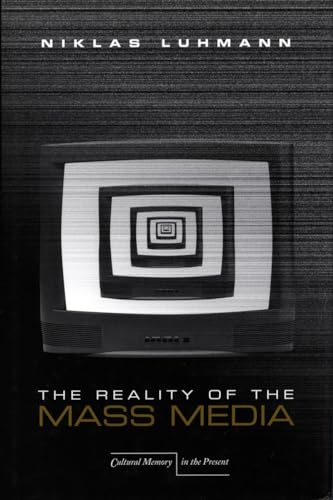
In The Reality of the Mass Media, Luhmann extends his theory of social systems—applied in his earlier works to the economy, the political system, art, religion, the sciences, and law—to an examination of the role of mass media in the construction of social reality.
Luhmann argues that the system of mass media is a set of recursive, self-referential programs of communication, whose functions are not determined by the external values of truthfulness, objectivity, or knowledge, nor by specific social interests or political directives. Rather, he contends that the system of mass media is regulated by the internal code information/noninformation, which enables the system to select its information (news) from its own environment and to communicate this information in accordance with its own reflexive criteria.
Despite its self-referential quality, Luhmann describes the mass media as one of the key cognitive systems of modern society, by means of which society constructs the illusion of its own reality. The reality of mass media, he argues, allows societies to process information without destabilizing social roles or overburdening social actors. It forms a broad reservoir (memory) of options for the future coordination of action, and it provides parameters for the stabilization of political reproduction of society, as it produces a continuous self-description of the world around which modern society can orient itself.
In his discussion of mass media, Luhmann elaborates a theory of communication in which communication is seen not as the act of a particular consciousness, nor the medium of integrative social norms, but merely the technical codes through which systemic operations arrange and perpetuate themselves.
Die Inhaltsangabe kann sich auf eine andere Ausgabe dieses Titels beziehen.
Über die Autorin bzw. den Autor
Niklas Luhmann was Professor Emeritus of Sociology at the University of Bielefeld.
Auszug. © Genehmigter Nachdruck. Alle Rechte vorbehalten.
The Reality of the Mass Media
By Niklas LuhmannStanford University Press
Copyright © 1996 Westdeutscher VerlagAll right reserved.
ISBN: 978-0-8047-4077-7
Contents
Foreword.......................................................vi1 Differentiation as a Doubling of Reality.....................12 Self-reference and Other-reference...........................103 Coding.......................................................154 System-specific Universalism.................................235 News and In-depth Reporting..................................256 Ricpero.....................................................427 Advertising..................................................448 Entertainment................................................519 Unity and Structural Couplings...............................6310 Individuals.................................................7111 The Construction of Reality.................................7612 The Reality of Construction.................................8813 The Function of the Mass Media..............................9514 The Public..................................................10315 Schema Formation............................................10716 Second-order Cybernetics as Paradox.........................117Notes..........................................................123Index..........................................................151
Chapter One
Differentiation as a Doubling of Reality
Whatever we know about our society, or indeed about the world in which we live, we know through the mass media. This is true not only of our knowledge of society and history but also of our knowledge of nature. What we know about the stratosphere is the same as what Plato knows about Atlantis: we've heard tell of it. Or, as Horatio puts it: 'So have I heard, and do in part believe it.' On the other hand, we know so much about the mass media that we are not able to trust these sources. Our way of dealing with this is to suspect that there is manipulation at work, and yet no consequences of any import ensue because knowledge acquired from the mass media merges together as if of its own accord into a self-reinforcing structure. Even if all knowledge were to carry a warning that it was open to doubt, it would still have to be used as a foundation, as a starting point. Unlike in the gothic novels of the eighteenth century, the solution to the problem cannot be found in someone secretly pulling strings behind the scenes, however much even sociologists themselves would like to believe this to be the case. What we are dealing with - and this is the theory to be elaborated in what follows - is an effect of the functional differentiation of modern society. This effect can be comprehended, it can be the subject of theoretical reflection. But we are not talking about a mystery that would be solved once it is made known. Rather, one could say that modern society has an 'Eigenvalue' or an 'Eigenbehaviour' - in other words, recursively stabilized functional mechanisms, which remain stable even when their genesis and their mode of functioning have been revealed.
In what follows, the term 'mass media' includes all those institutions of society which make use of copying technologies to disseminate communication. This means principally books, magazines and newspapers manufactured by the printing press, but also all kinds of photographic or electronic copying procedures, provided that they generate large quantities of products whose target groups are as yet undetermined. Also included in the term is the dissemination of communication via broadcasting, provided that it is generally accessible and does not merely serve to maintain a telephone connection between individual participants. The mass production of manuscripts from dictation, as in medieval writing rooms, does not qualify for inclusion, nor does the public accessibility of the room in which the communication takes place - in other words, not public lectures, theatrical productions, exhibitions, or concerts, though the term does include the circulation of such performances via film or diskette. This delimitation may appear somewhat arbitrary, but the basic idea is that it is the mechanical manufacture of a product as the bearer of communication - but not writing itself - which has led to the differentiation of a particular system of the mass media. Thus, the technology of dissemination plays the same kind of role as that played by the medium of money in the differentiation of the economy: it merely constitutes a medium which makes formations of forms possible. These formations in turn, unlike the medium itself, constitute the communicative operations which enable the differentiation and operational closure of the system.
The crucial point at any rate is that no interaction among those co-present can take place between sender and receivers. Interaction is ruled out by the interposition of technology, and this has far-reaching consequences which define for us the concept of mass media. Exceptions are possible (though never with all participants); however, they come across as staged and are indeed handled as such in broadcasting studios. They do not alter in the slightest the technologically conditioned necessity for interruption of contact. The interruption of direct contact, on the one hand, ensures high levels of freedom of communication. A surplus of possibilities for communication thus arises which can only be regulated within the system, by means of self-organization and the system's own constructions of reality. On the other hand, two selecting factors are at work: the extent of willingness to transmit and the amount of interest in tuning in, which cannot be coordinated centrally. The organizations which produce mass media communication are dependent upon assumptions concerning acceptability. This leads not only to the standardization but also to the differentiation of their programmes, or at any rate to a standardization not tailored to individuals. This, however, is precisely how individual participants have the chance to get what they want, or what they believe they need to know in their own milieu (for example, as politicians or teachers), from the range of programmes on offer. The mode of operation of the mass media is thus subject to external structural conditions which place limits on what they are able to realize.
We can speak of the reality of the mass media in a dual sense. Our title is intended to mark this dual meaning and is therefore to be understood as ambivalent. The unity of this twofold meaning is the point which is to be elaborated in the following discussion.
The reality of the mass media, their real reality, as we might say, consists in their own operations. Things are printed and broadcast. Things are read. Programmes are received. Numerous communications involving preparation and subsequent discussion closely surround this activity. However, the process of dissemination is only possible on the basis of technologies. The way in which these technologies work structures and limits what is possible as mass communication. This has to be taken into account in any theory of the mass media. Nonetheless, we do not want to regard the work of these machines, nor indeed their mechanical or electronic internal workings, as an operation within the system of the mass media. Not everything which is a condition of possibility of systems operations can be a part of the operational sequences of the system itself. (This is also true, of course, of living beings and indeed of any autopoietic...
„Über diesen Titel“ kann sich auf eine andere Ausgabe dieses Titels beziehen.
Suchergebnisse für The Reality of the Mass Media (Cultural Memory in the...

Beispielbild für diese ISBN
The Reality of the Mass Media (Cultural Memory in the Present)
Anbieter: Revaluation Books, Exeter, Vereinigtes Königreich
Verkäuferbewertung 5 von 5 Sternen

Paperback. Zustand: Brand New. 1st edition. 160 pages. 8.75x6.00x0.50 inches. In Stock. Artikel-Nr. x-0804740771
Neu kaufen
EUR 25,97
EUR 11,66 Versand
Versand von Vereinigtes Königreich nach USA
Versand von Vereinigtes Königreich nach USA
Anzahl: 2 verfügbar
Foto des Verkäufers
The Reality of the Mass Media
Anbieter: moluna, Greven, Deutschland
Verkäuferbewertung 5 von 5 Sternen
Zustand: New. Über den AutorrnrnNiklas Luhmann was Professor Emeritus of Sociology at the University of Bielefeld.KlappentextIn The Reality of the Mass Media, Luhmann extends his theory of social systems--applied in his earl. Artikel-Nr. 898738541
Neu kaufen
EUR 24,88
EUR 48,99 Versand
Versand von Deutschland nach USA
Versand von Deutschland nach USA
Anzahl: Mehr als 20 verfügbar
Foto des Verkäufers
The Reality of the Mass Media
Verlag:
Stanford University Press Jul 2000, 2000
ISBN 10: 0804740771
ISBN 13: 9780804740777
Neu
Taschenbuch
Anbieter: AHA-BUCH GmbH, Einbeck, Deutschland
Verkäuferbewertung 5 von 5 Sternen
Taschenbuch. Zustand: Neu. Neuware - In The Reality of the Mass Media, Luhmann extends his theory of social systems-applied in his earlier works to the economy, the political system, art, religion, the sciences, and law-to an examination of the role of mass media in the construction of social reality.Luhmann argues that the system of mass media is a set of recursive, self-referential programs of communication, whose functions are not determined by the external values of truthfulness, objectivity, or knowledge, nor by specific social interests or political directives. Rather, he contends that the system of mass media is regulated by the internal code information/noninformation, which enables the system to select its information (news) from its own environment and to communicate this information in accordance with its own reflexive criteria.Despite its self-referential quality, Luhmann describes the mass media as one of the key cognitive systems of modern society, by means of which society constructs the illusion of its own reality. The reality of mass media, he argues, allows societies to process information without destabilizing social roles or overburdening social actors. It forms a broad reservoir (memory) of options for the future coordination of action, and it provides parameters for the stabilization of political reproduction of society, as it produces a continuous self-description of the world around which modern society can orient itself.In his discussion of mass media, Luhmann elaborates a theory of communication in which communication is seen not as the act of a particular consciousness, nor the medium of integrative social norms, but merely the technical codes through which systemic operations arrange and perpetuate themselves. Artikel-Nr. 9780804740777
Neu kaufen
EUR 43,71
EUR 30,50 Versand
Versand von Deutschland nach USA
Versand von Deutschland nach USA
Anzahl: 2 verfügbar
Beispielbild für diese ISBN
The Reality of the Mass Media (Cultural Memory in the Present)
Anbieter: Studibuch, Stuttgart, Deutschland
Verkäuferbewertung 5 von 5 Sternen
paperback. Zustand: Gut. 160 Seiten; 9780804740777.3 Gewicht in Gramm: 500. Artikel-Nr. 1013980
Gebraucht kaufen
EUR 6,99
EUR 80,70 Versand
Versand von Deutschland nach USA
Versand von Deutschland nach USA
Anzahl: 1 verfügbar