
Verwandte Artikel zu Historical Representation: F.R. Ankersmit (Cultural...
Inhaltsangabe
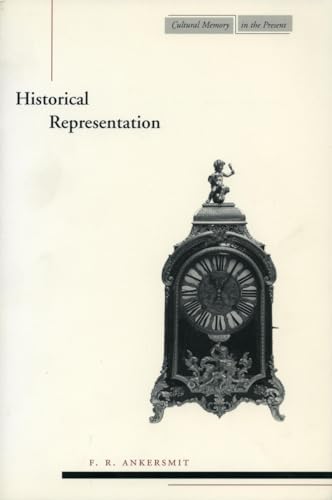
This book fully recognizes the aestheticism inherent in historical writing while acknowledging its claim to satisfy the demands of rational and scientific inquiry. Focusing on the notion of representation and on the necessity of distinguishing between representation and description, it argues that the traditional semantic apparatus of meaning, truth, and reference that we use for description must be redefined if we are to understand properly the nature of historical writing.
The author shows that historical representation is essentially aesthetic, though its adequacy can be discussed rationally. He defines the criteria for representational adequacy, and examines the relationship between these criteria and value judgments. He also investigates the historicist conception of historical writing and the notions of identity and narrativity. This investigation takes place against the backdrop of the ideas of four of the most influential contemporary historical theorists: Erich Auerbach, Arthur Danto, Hayden White, and Jörn Rüsen.
The book aims to identify and to explore for historical theory the juste milieu between the extravagances of the literary approach to historical writing and the narrow-mindedness of empiricists. The search for this juste milieu leads to a rationalist aesthetics of historical writing, a position that repeats both the aesthetic dimension of all historical writing and the criteria defining the rationality of the discipline of history.
Die Inhaltsangabe kann sich auf eine andere Ausgabe dieses Titels beziehen.
Über die Autorin bzw. den Autor
Frank Ankersmit is Professor of History at the University of Groningen, The Netherlands. Among his many books are Political Representation (Stanford, 2001) and Aesthetic Politics: Political Philosophy Beyond Fact and Value (Stanford, 1997)
Von der hinteren Coverseite
This book fully recognizes the aestheticism inherent in historical writing while acknowledging its claim to satisfy the demands of rational and scientific inquiry. Focusing on the notion of representation and on the necessity of distinguishing between representation and description, it argues that the traditional semantic apparatus of meaning, truth, and reference that we use for description must be redefined if we are to understand properly the nature of historical writing.
The author shows that historical representation is essentially aesthetic, though its adequacy can be discussed rationally. He defines the criteria for representational adequacy, and examines the relationship between these criteria and value judgments. He also investigates the historicist conception of historical writing and the notions of identity and narrativity. This investigation takes place against the backdrop of the ideas of four of the most influential contemporary historical theorists: Erich Auerbach, Arthur Danto, Hayden White, and Jörn Rüsen.
The book aims to identify and to explore for historical theory the juste milieu between the extravagances of the literary approach to historical writing and the narrow-mindedness of empiricists. The search for this juste milieu leads to a rationalist aesthetics of historical writing, a position that repeats both the aesthetic dimension of all historical writing and the criteria defining the rationality of the discipline of history.
The author shows that historical representation is essentially aesthetic, though its adequacy can be discussed rationally. He defines the criteria for representational adequacy, and examines the relationship between these criteria and value judgments. He also investigates the historicist conception of historical writing and the notions of identity and narrativity. This investigation takes place against the backdrop of the ideas of four of the most influential contemporary historical theorists: Erich Auerbach, Arthur Danto, Hayden White, and Jörn Rüsen.
The book aims to identify and to explore for historical theory the juste milieu between the extravagances of the literary approach to historical writing and the narrow-mindedness of empiricists. The search for this juste milieu leads to a rationalist aesthetics of historical writing, a position that repeats both the aesthetic dimension of all historical writing and the criteria defining the rationality of the discipline of history.
Aus dem Klappentext
This book fully recognizes the aestheticism inherent in historical writing while acknowledging its claim to satisfy the demands of rational and scientific inquiry. Focusing on the notion of representation and on the necessity of distinguishing between representation and description, it argues that the traditional semantic apparatus of meaning, truth, and reference that we use for description must be redefined if we are to understand properly the nature of historical writing.
The author shows that historical representation is essentially aesthetic, though its adequacy can be discussed rationally. He defines the criteria for representational adequacy, and examines the relationship between these criteria and value judgments. He also investigates the historicist conception of historical writing and the notions of identity and narrativity. This investigation takes place against the backdrop of the ideas of four of the most influential contemporary historical theorists: Erich Auerbach, Arthur Danto, Hayden White, and Jörn Rüsen.
The book aims to identify and to explore for historical theory the juste milieu between the extravagances of the literary approach to historical writing and the narrow-mindedness of empiricists. The search for this juste milieu leads to a rationalist aesthetics of historical writing, a position that repeats both the aesthetic dimension of all historical writing and the criteria defining the rationality of the discipline of history.
The author shows that historical representation is essentially aesthetic, though its adequacy can be discussed rationally. He defines the criteria for representational adequacy, and examines the relationship between these criteria and value judgments. He also investigates the historicist conception of historical writing and the notions of identity and narrativity. This investigation takes place against the backdrop of the ideas of four of the most influential contemporary historical theorists: Erich Auerbach, Arthur Danto, Hayden White, and Jörn Rüsen.
The book aims to identify and to explore for historical theory the juste milieu between the extravagances of the literary approach to historical writing and the narrow-mindedness of empiricists. The search for this juste milieu leads to a rationalist aesthetics of historical writing, a position that repeats both the aesthetic dimension of all historical writing and the criteria defining the rationality of the discipline of history.
Auszug. © Genehmigter Nachdruck. Alle Rechte vorbehalten.
HISTORICAL REPRESENTATION
Cultural Memory in the PresentBy F. R. AnkersmitSTANFORD UNIVERSITY PRESS
Copyright © 2001 Board of Trustees of the Leland Stanford Junior UniversityAll right reserved.
ISBN: 978-0-8047-3980-1
Contents
Acknowledgments..................................................................ixIntroduction.....................................................................1PART I HISTORICAL THEORY1 The Linguistic Turn: Literary Theory and Historical Theory.....................292 In Praise of Subjectivity......................................................75PART II HISTORICAL CONSCIOUSNESS3 Gibbon and Ovid: History as Metamorphosis......................................1074 The Dialectics of Narrativist Historism........................................1235 The Postmodernist "Privatization" of the Past..................................1496 Remembering the Holocaust: Mourning and Melancholia............................176PART III THEORISTS7 Why Realism? Auerbach on the Representation of Reality.........................1978 Danto on Representation, Identity, and Indiscernibles..........................2189 Hayden White's Appeal to the Historians........................................24910 Rsen on History and Politics.................................................262Epilogue.........................................................................281Notes............................................................................289Index............................................................................317
Chapter One
THE LINGUISTIC TURN: LITERARY THEORY AND HISTORICAL THEORY
In 1973 Hayden White published his by now famous Metahistory, a book that is generally regarded as a turning point-as is most suitable for a theory on tropology-in the history of historical theory. And, surely, one need only be superficially aware of the evolution of historical theory since World War II in order to recognize that historical theory has become a fundamentally different discipline since the publication of White's magnum opus. Different questions are now being asked, different aspects of historical writing are now being investigated, and it would be no exaggeration to say that thanks to White the kind of historical writing that now is the object of theoretical studies is much different from the kind of history that a previous generation of historical theorists believed to be exemplary of historical writing.
Three decades later now, at the beginning of the new century, it is arguable that this is an appropriate moment in which to assess what has and has not been achieved. In order to do so, I will address mainly the question of the relationship between the so-called linguistic turn and the introduction of literary theory as an instrument for understanding historical writing. My conclusion will be (1) that there is an asymmetry between the claims of the linguistic turn and those of literary theory; (2) that confusion between these two sets of claims has been most unfortunate from the perspective of historical theory; and (3) that literary theory has a lot to teach to the historian of historical writing but has no bearing on the kind of problems that is traditionally investigated by the historical theorist.
THE LINGUISTIC TURN AND HISTORICAL THEORY
The revolution effected by White in contemporary historical theory has often been related to the so-called linguistic turn. And quite rightly so, since White's main thesis has been that our understanding of the past is determined not only by what the past has been like but also by the language used by the historian for speaking about it-or, as he liked to put it himself, that historical knowledge is as much "made" (by the historian's language) as it is "found" (in the archives). Nonetheless, when White makes this claim he sometimes has things in mind different from the philosophers who argue for the linguistic turn. For a satisfactory appraisal of what White's revolution has done to historical theory, it will be worthwhile to identify these differences and to consider their implications.
"I shall mean by `linguistic philosophy' the view that philosophical problems are problems which may be solved (or dissolved) either by reforming language, or by understanding more about the language we presently use": thus Rorty in the introduction to his influential collection on the linguistic turn. Philosophical problems arise when, as in Wittgenstein's famous formulation, "language goes on holiday" and begins to create a pseudo world in addition to the world that language has to deal with on its ordinary workdays. Initially this may seem to strengthen the empiricist's position: for does not the linguistic philosopher's program recommend that we dismiss all philosophical problems as illusory that are not reducible to either the construction of an ideal language (that cannot give rise to philosophical pseudo problems) or to empirical enquiry? And is this not in agreement with empiricist orthodoxy, as formulated already by David Hume, that all true belief can be reduced to either empirical or analytical truth? Surely, this intuition is not wholly mistaken: one need only think of Ayer's Language, Truth, and Logic in order to realize that one can be both an empiricist and an advocate of the linguistic turn.
But the linguistic turn can be shown at a deeper level to have anti-empiricist implications. Empiricists and the advocates of the linguistic turn will pleasantly travel together to the station of the necessity to distinguish between speaking and speaking about speaking. Both will argue that the failure to distinguish between these two levels gave rise to the many pseudo problems that occupied traditional philosophy. But after having reached that station, each will follow his or her own route. The empiricist will tend to identify the distinction of these two levels with the distinction between empirical or synthetic truth (the level of "speaking") and analytical truth (the level of "speaking about speaking"). But here the more radical advocates of the linguistic turn will express their doubts. They will point out that this identification sins against the empiricist's own claims since it cannot be reduced to either logical truth or empirical truth-so, even on empiricist assumptions, the identification should be stigmatized as a hitherto unproven "dogma of empiricism." Next, they will emphasize that the identification is profoundly at odds with what we know about how one proceeds in the sciences: for here speaking about speaking will often be part of the acquisition of empirical knowledge. This is the procedure that Quine called "semantic ascent." And in order to illustrate what he has in mind with this notion, he asks us to consider the following example: "Einstein's theory of relativity was accepted in consequence not just of reflections on time, light, headlong bodies, and the perturbations of Mercury [hence, the level of `speaking'], but of reflections on the theory itself, as discourse, and its simplicity in comparison with alternative theories [hence, the level of `speaking about speaking']." Self-evidently, Quine was not advocating here a return to prelinguistic philosophy, since he proposes here a theory on what the "semantic ascent" from the first to the second level may contribute to empirical knowledge-and this presupposes the distinction between the two levels that had so often been ignored by prelinguistic philosophy.
In a classic essay of 1951, "Two Dogmas of Empiricism," Quine...
„Über diesen Titel“ kann sich auf eine andere Ausgabe dieses Titels beziehen.
Suchergebnisse für Historical Representation: F.R. Ankersmit (Cultural...

Foto des Verkäufers
Historical Representation (Cultural Memory in the Present)
Verlag:
Stanford University Press, 2001
ISBN 10: 0804739803
ISBN 13: 9780804739801
Gebraucht
Soft cover
Erstausgabe
Anbieter: Palimpsest Scholarly Books & Services, Brooktondale, NY, USA
Verkäuferbewertung 5 von 5 Sternen

Soft cover. Zustand: Very Good. 1st Edition. Softcover volume, measuring approximately 6" x 9", displays light shelfwear. Binding is sound. Interior is clean and bright. 321 pages. "Focusing on the notion of representation and on the necessity of distinguishing between representation and description, this book argues that the traditional semantic apparatus of meaning, truth, and reference that we use for description must be redefined if we are to understand properly the nature of historical writing.". Artikel-Nr. ABE-1621305951839
Gebraucht kaufen
EUR 17,95
EUR 5,66 Versand
Versand innerhalb von USA
Versand innerhalb von USA
Anzahl: 1 verfügbar
Beispielbild für diese ISBN
Historical Representation (Cultural Memory in the Present)
Anbieter: Majestic Books, Hounslow, Vereinigtes Königreich
Verkäuferbewertung 4 von 5 Sternen

Zustand: New. pp. 336. Artikel-Nr. 7989616
Neu kaufen
EUR 39,89
EUR 7,57 Versand
Versand von Vereinigtes Königreich nach USA
Versand von Vereinigtes Königreich nach USA
Anzahl: 3 verfügbar
Beispielbild für diese ISBN
Historical Representation (Cultural Memory in the Present)
Anbieter: Ria Christie Collections, Uxbridge, Vereinigtes Königreich
Verkäuferbewertung 5 von 5 Sternen
Zustand: New. In English. Artikel-Nr. ria9780804739801_new
Neu kaufen
EUR 34,66
EUR 13,14 Versand
Versand von Vereinigtes Königreich nach USA
Versand von Vereinigtes Königreich nach USA
Anzahl: Mehr als 20 verfügbar
Beispielbild für diese ISBN
Historical Representation: F.R. Ankersmit
Anbieter: Revaluation Books, Exeter, Vereinigtes Königreich
Verkäuferbewertung 5 von 5 Sternen
Paperback. Zustand: Brand New. 1st edition. 336 pages. 8.75x6.00x0.75 inches. In Stock. Artikel-Nr. x-0804739803
Neu kaufen
EUR 41,92
EUR 11,64 Versand
Versand von Vereinigtes Königreich nach USA
Versand von Vereinigtes Königreich nach USA
Anzahl: 2 verfügbar
Beispielbild für diese ISBN
Historical Representation
Anbieter: Kennys Bookstore, Olney, MD, USA
Verkäuferbewertung 5 von 5 Sternen
Zustand: New. The writing of history aims to satisfy the demands of rational and scientific inquiry, but also has a literary and aesthetic aspect. This book aims to identify and to explore the juste milieu between the literary approach to historical writing and the narrowmindedness of empiricists. Series: Cultural Memory in the Present Series. Num Pages: 336 pages. BIC Classification: HBAH. Category: (P) Professional & Vocational; (UP) Postgraduate, Research & Scholarly; (UU) Undergraduate. Dimension: 230 x 155 x 19. Weight in Grams: 476. . 2002. 1st Edition. Paperback. . . . . Books ship from the US and Ireland. Artikel-Nr. V9780804739801
Neu kaufen
EUR 47,59
EUR 9,15 Versand
Versand innerhalb von USA
Versand innerhalb von USA
Anzahl: Mehr als 20 verfügbar
Foto des Verkäufers
Historical Representation
Verlag:
STANFORD UNIV PR, 2002
ISBN 10: 0804739803
ISBN 13: 9780804739801
Neu
Kartoniert / Broschiert
Anbieter: moluna, Greven, Deutschland
Verkäuferbewertung 5 von 5 Sternen
Kartoniert / Broschiert. Zustand: New. Focusing on the notion of representation and on the necessity of distinguishing between representation and description, this book argues that the traditional semantic apparatus of meaning, truth, and reference that we use for description must be redefined i. Artikel-Nr. 595014540
Neu kaufen
EUR 34,73
EUR 48,99 Versand
Versand von Deutschland nach USA
Versand von Deutschland nach USA
Anzahl: Mehr als 20 verfügbar
Foto des Verkäufers
Historical Representation
Verlag:
Stanford University Press Jan 2002, 2002
ISBN 10: 0804739803
ISBN 13: 9780804739801
Neu
Taschenbuch
Anbieter: AHA-BUCH GmbH, Einbeck, Deutschland
Verkäuferbewertung 5 von 5 Sternen
Taschenbuch. Zustand: Neu. Neuware - This book fully recognizes the aestheticism inherent in historical writing while acknowledging its claim to satisfy the demands of rational and scientific inquiry. Focusing on the notion of representation and on the necessity of distinguishing between representation and description, it argues that the traditional semantic apparatus of meaning, truth, and reference that we use for description must be redefined if we are to understand properly the nature of historical writing. The author shows that historical representation is essentially aesthetic, though its adequacy can be discussed rationally. He defines the criteria for representational adequacy, and examines the relationship between these criteria and value judgments. He also investigates the historicist conception of historical writing and the notions of identity and narrativity. This investigation takes place against the backdrop of the ideas of four of the most influential contemporary historical theorists: Erich Auerbach, Arthur Danto, Hayden White, and Jörn Rüsen. The book aims to identify and to explore for historical theory the juste milieu between the extravagances of the literary approach to historical writing and the narrow-mindedness of empiricists. The search for this juste milieu leads to a rationalist aesthetics of historical writing, a position that repeats both the aesthetic dimension of all historical writing and the criteria defining the rationality of the discipline of history. Artikel-Nr. 9780804739801
Neu kaufen
EUR 64,45
EUR 30,50 Versand
Versand von Deutschland nach USA
Versand von Deutschland nach USA
Anzahl: 2 verfügbar
Foto des Verkäufers
Historical Representation
Anbieter: preigu, Osnabrück, Deutschland
Verkäuferbewertung 5 von 5 Sternen
Taschenbuch. Zustand: Neu. Historical Representation | F R Ankersmit | Taschenbuch | Einband - flex.(Paperback) | Englisch | 2002 | Stanford University Press | EAN 9780804739801 | Verantwortliche Person für die EU: Mare Nostrum Group B.V., Doelen 72, 4831 GR BREDA, NIEDERLANDE, gpsr[at]mare-nostrum[dot]co[dot]uk | Anbieter: preigu. Artikel-Nr. 104079808
Neu kaufen
EUR 33,80
EUR 70,00 Versand
Versand von Deutschland nach USA
Versand von Deutschland nach USA
Anzahl: 5 verfügbar