
Verwandte Artikel zu The Body of This Death: Historicity and Sociality in...
Inhaltsangabe
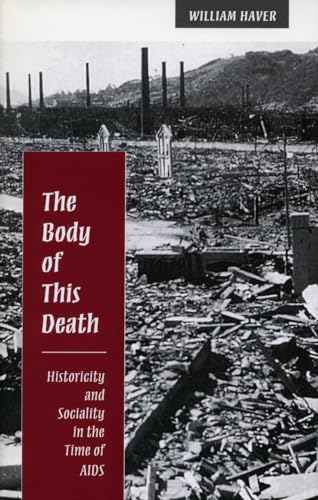
Examining the AIDS pandemic and Japanese A-bomb literature, this book asks the question of how the experience of unimaginable and unrepresentable loss affects the experience and constitution of the social and the discourses of history. It argues that those objects which are presumptively given to thought under the rubrics of "AIDS" and "Hiroshima/Nagasaki" pose an essential threat, in their existentiality, to conceptual thought and, ultimately, to rationality altogether. It therefore argues that any serious thinking about AIDS and nuclear terror must think the essential insufficiency of thought to its putative objects-the insufficiency of "society" to think sociality, the insufficiency of "history" to think historicity.
The author first attempts to think the incapacity of every invocation of historical consciousness (or, indeed, of "history" itself) to think the existential historicity of that event which is presumptively not only its object but its ground. Readings of works by Nishida Kitaro, Ota Yoko, and Takenishi Hiroko written in the aftermath of Hiroshima and Nagasaki attempt to mark the limit of historical consciousness. The author then considers erotic sociality in the time of AIDS, specifically as articulated in texts by David Wojnarowicz, focusing on the themes of vulnerability, anonymity, the erotic, and nomadism.
Die Inhaltsangabe kann sich auf eine andere Ausgabe dieses Titels beziehen.
Über die Autorinnen und Autoren
William Haver is Associate Professor of History at Binghamton University
William Haver is Associate Professor of History at Binghamton University.
Von der hinteren Coverseite
Examining the AIDS pandemic and Japanese A-bomb literature, this book asks the question of how the experience of unimaginable and unrepresentable loss affects the experience and constitution of the social and the discourses of history. It argues that those objects which are presumptively given to thought under the rubrics of “AIDS” and “Hiroshima/Nagasaki” pose an essential threat, in their existentiality, to conceptual thought and, ultimately, to rationality altogether. It therefore argues that any serious thinking about AIDS and nuclear terror must think the essential insufficiency of thought to its putative objects—the insufficiency of “society” to think sociality, the insufficiency of “history” to think historicity.
The author first attempts to think the incapacity of every invocation of historical consciousness (or, indeed, of “history” itself) to think the existential historicity of that event which is presumptively not only its object but its ground. Readings of works by Nishida Kitaro, Ota Yoko, and Takenishi Hiroko written in the aftermath of Hiroshima and Nagasaki attempt to mark the limit of historical consciousness. The author then considers erotic sociality in the time of AIDS, specifically as articulated in texts by David Wojnarowicz, focusing on the themes of vulnerability, anonymity, the erotic, and nomadism.
The author first attempts to think the incapacity of every invocation of historical consciousness (or, indeed, of “history” itself) to think the existential historicity of that event which is presumptively not only its object but its ground. Readings of works by Nishida Kitaro, Ota Yoko, and Takenishi Hiroko written in the aftermath of Hiroshima and Nagasaki attempt to mark the limit of historical consciousness. The author then considers erotic sociality in the time of AIDS, specifically as articulated in texts by David Wojnarowicz, focusing on the themes of vulnerability, anonymity, the erotic, and nomadism.
Aus dem Klappentext
Examining the AIDS pandemic and Japanese A-bomb literature, this book asks the question of how the experience of unimaginable and unrepresentable loss affects the experience and constitution of the social and the discourses of history. It argues that those objects which are presumptively given to thought under the rubrics of AIDS and Hiroshima/Nagasaki pose an essential threat, in their existentiality, to conceptual thought and, ultimately, to rationality altogether. It therefore argues that any serious thinking about AIDS and nuclear terror must think the essential insufficiency of thought to its putative objects the insufficiency of society to think sociality, the insufficiency of history to think historicity.
The author first attempts to think the incapacity of every invocation of historical consciousness (or, indeed, of history itself) to think the existential historicity of that event which is presumptively not only its object but its ground. Readings of works by Nishida Kitaro, Ota Yoko, and Takenishi Hiroko written in the aftermath of Hiroshima and Nagasaki attempt to mark the limit of historical consciousness. The author then considers erotic sociality in the time of AIDS, specifically as articulated in texts by David Wojnarowicz, focusing on the themes of vulnerability, anonymity, the erotic, and nomadism.
The author first attempts to think the incapacity of every invocation of historical consciousness (or, indeed, of history itself) to think the existential historicity of that event which is presumptively not only its object but its ground. Readings of works by Nishida Kitaro, Ota Yoko, and Takenishi Hiroko written in the aftermath of Hiroshima and Nagasaki attempt to mark the limit of historical consciousness. The author then considers erotic sociality in the time of AIDS, specifically as articulated in texts by David Wojnarowicz, focusing on the themes of vulnerability, anonymity, the erotic, and nomadism.
Auszug. © Genehmigter Nachdruck. Alle Rechte vorbehalten.
The Body of This Death
HISTORICITY AND SOCIALITY IN THE TIME OF AIDSBy WILLIAM HAVERSTANFORD UNIVERSITY PRESS
Copyright © 1996 Board of TrusteesAll right reserved.
ISBN: 978-0-8047-2728-0
Contents
Preface....................................................................xi1 Not Even a God Can Save Us Now...........................................12 First Excursus on the Divine Right of the Historian......................253 Apocalypse Now-Forever-Whenever..........................................514 Four Itineraries in Search of a Narrative................................745 Y Su Sangre Ya Viene Cantando............................................1196 Second Excursus on the Divine Right of the Historian.....................1607 The Death of Michel Foucault.............................................177Notes......................................................................205Index......................................................................217
Chapter One
Not Even a God Can Save Us Now
The Originary Multiplicity of the AIDS- Object
What is called AIDS is, for consciousness and for thought, a necessarily impossible object. As such, and in itself, AIDS is radically unthinkable, resisting objectification, interpretation, the understanding, meaning, and the aspiration to transcendental subjectivity absolutely; AIDS belongs to that to which every teratology, phenomenology, or hermeneutic is necessarily and forever inadequate. In this project I shall therefore not attempt to interpret and therefore understand AIDS, to think what is radically unthinkable. Rather, my project is to think the specific determinate unthinkability of what is strictly speaking unthinkable; to think the multiple impossibilities for thought designated by the term "AIDS"; to think the status of AIDS not only as object (in its objectness or objectity, its Gegenstandlichkeit), but also in and as the exigency that is its material objectivity; to think the impossibility of the object, but also the objectivity of its impossibility; to think AIDS as, and in, its material multiplicity, its material exigencies (both the multiplicity of its exigencies and the exigency of its multiplicity). In other words, I am trying to think the thought of AIDS as the limit that is at once the failure of thought and the sole condition of possibility for thought; I do so because I am persuaded that any thinking or acting with respect to the AIDS pandemic that aspires to any effective consequence must subject itself to such an onto-epistemological panic, not as a putatively salutary propaedeutic humiliation (the discipline that would subjectify us in disciplinary bondage), but as a necessary response to the exigency of the existential, the material force of the Real of AIDS.
There is now a substantial body of work that testifies to, records, and is itself part of the process by which the object we recognize and sometimes claim to know as AIDS has been constituted, and is continuously reconstituted, out of an amorphous terror. This process, which has produced for the subject who is supposed to know the massively overdetermined object called AIDS, is undoubtedly necessary, and in any event unavoidable. But it has nevertheless not been without its contradictions. For part of what has happened in this constitution of an object for consciousness in and through material discursive practices, particularly in the past few years, has been what might be termed the normalization, routinization, and, indeed, commodification of AIDS. AIDS has long since become big business, not only for the pharmaceutical industry, for governmental regulatory and social service agencies, and for the health-care industry, but also for those whose labor it is to produce knowledge, for scientists, philosophers, historians, and sociologists among others. AIDS is now a career, the business of topical papers and books produced by academics on the make, for example.
Concomitantly, the so-called phenomenon of AIDS has become very much part of the texture of the quotidian, central to our commonsense perceptions of the way the world is, and thereby to our sense of commonality. For example, many of our undergraduate students have never known, and perhaps never will know, sex without latex; we are now being urged to think of HIV seropositivity, and indeed of "AIDS itself," as a chronic condition on the order of diabetes; we are, in short, becoming persuaded that AIDS belongs to the normative rather than the extraordinary, that AIDS is chronic rather than a crisis. We have erected, in place, perhaps, of other erections, entire structures of intelligibility and comprehensibility on and around the pandemic, structures that themselves render AIDS normative and routine: the business of AIDS, constructed and carried on around an impossible object, has become—like genocide, nuclear terror, racism, misogyny, and heteronormativity (or what I would prefer to call orthosexua1ity)—business as usual. The unthinkable has been rendered thinkable, the impossible possible, the extraordinary normative. And this process, however inevitable and in fact necessary it may be, is nevertheless at the same time a forgetting of the Real of AIDS, an avoidance of the exigencies with which the force of that Real confronts us, a refusal to think the limits of what can be thought, a disavowal of historicity. What is at stake here is a "something" rather more than epistemological bad faith, a "something" that is quite central to the constitution, validation, and valorization of our knowledges; that "something" might be called the aspiration to transcend the limit at which predication (and specifically every discourse on AIDS) exhausts itself in an infinite congestion of the proper, an aspiration to transcend the Real of AIDS, to transcend historicity—a transcendence that would be achieved through rendering AIDS comprehensible, and a grounding of that comprehensibility in ontology, in taking the objectness of AIDS to reside in the presumptive positivity of what is. In other words, neither a god nor the social sciences can save us now. But perhaps salvation (transcendence) is beside the point; how, then—or rather, how now—might we begin to think the specific unthinkability, the determinate nontranscendent materiality, of AIDS?
In the first instance, I think we must work toward thinking of this impossible object that is called AIDS as a multiplicity. We must think the impossibility of the singular AIDS-object to be multiple, and that multiplicity to be central to both the objectness and objectivity of AIDS: the impossibility of the AIDS-object resides in its originary multiplicity. First, and perhaps most obviously, the phrase "Acquired Immune Deficiency Syndrome" refers precisely to a syndrome, which is to say, to a congeries of opportunistic (that is, radically contingent) infections: so-called "active" or "full-blown" AIDS is not a disease; there is no "AIDS virus." Indeed, scientific opinion remains divided on whether the Human Immunodeficiency Virus is singular; and there is mounting evidence that, even if it is a single virus, "it" may be mutating. AIDS certainly, and HIV possibly, are/is multiple. Second, and a large literature bears witness to the fact, AIDS is not, and never has been, merely a medico-scientific object; it has always already been at once also a social, political, economic, historical, philosophical, and literary object. Which...
„Über diesen Titel“ kann sich auf eine andere Ausgabe dieses Titels beziehen.
Suchergebnisse für The Body of This Death: Historicity and Sociality in...

Beispielbild für diese ISBN
Body of This Death: Historicity and Sociality in the Time of AIDS
Verlag:
Stanford University Press, 1997
ISBN 10: 0804727287
ISBN 13: 9780804727280
Gebraucht
Paperback
Anbieter: ThriftBooks-Dallas, Dallas, TX, USA
Verkäuferbewertung 5 von 5 Sternen

Paperback. Zustand: Good. No Jacket. Pages can have notes/highlighting. Spine may show signs of wear. ~ ThriftBooks: Read More, Spend Less. Artikel-Nr. G0804727287I3N00
Gebraucht kaufen
EUR 19,38
Versand gratis
Versand innerhalb von USA
Versand innerhalb von USA
Anzahl: 1 verfügbar
Beispielbild für diese ISBN
The Body of This Death: Historicity and Sociality in the Time of AIDS
Verlag:
Stanford University Press, 1997
ISBN 10: 0804727287
ISBN 13: 9780804727280
Gebraucht
paperback
Anbieter: Roundabout Books, Greenfield, MA, USA
Verkäuferbewertung 4 von 5 Sternen

paperback. Zustand: Good. Condition Notes: Moderate edge wear. Binding good. May have marking in text. We sometimes source from libraries. We ship in recyclable American-made mailers. 100% money-back guarantee on all orders. Artikel-Nr. 1772291
Gebraucht kaufen
EUR 20,07
Versand gratis
Versand innerhalb von USA
Versand innerhalb von USA
Anzahl: 1 verfügbar
Beispielbild für diese ISBN
The Body of This Death: Historicity and Sociality in the Time of AIDS
Verlag:
Stanford University Press, 1997
ISBN 10: 0804727287
ISBN 13: 9780804727280
Gebraucht
Paperback
Anbieter: Robinson Street Books, IOBA, Binghamton, NY, USA
Verkäuferbewertung 4 von 5 Sternen
Paperback. Zustand: Very Good. Prompt Shipment, shipped in Boxes, Tracking PROVIDEDVery good used book. Some creasing, light wear. Artikel-Nr. graytrpb16r3519
Gebraucht kaufen
EUR 12,05
EUR 8,23 Versand
Versand innerhalb von USA
Versand innerhalb von USA
Anzahl: 1 verfügbar
Beispielbild für diese ISBN
The Body of This Death
Anbieter: PBShop.store UK, Fairford, GLOS, Vereinigtes Königreich
Verkäuferbewertung 5 von 5 Sternen
PAP. Zustand: New. New Book. Shipped from UK. Established seller since 2000. Artikel-Nr. FW-9780804727280
Neu kaufen
EUR 25,66
EUR 4,86 Versand
Versand von Vereinigtes Königreich nach USA
Versand von Vereinigtes Königreich nach USA
Anzahl: 15 verfügbar
Beispielbild für diese ISBN
The Body of This Death: Historicity and Sociality in the Time of AIDS
Anbieter: Majestic Books, Hounslow, Vereinigtes Königreich
Verkäuferbewertung 4 von 5 Sternen
Zustand: New. pp. 244. Artikel-Nr. 3359581
Neu kaufen
EUR 31,46
EUR 7,60 Versand
Versand von Vereinigtes Königreich nach USA
Versand von Vereinigtes Königreich nach USA
Anzahl: 3 verfügbar
Beispielbild für diese ISBN
The Body of This Death: Historicity and Sociality in the Time of AIDS
Anbieter: Ria Christie Collections, Uxbridge, Vereinigtes Königreich
Verkäuferbewertung 5 von 5 Sternen
Zustand: New. In English. Artikel-Nr. ria9780804727280_new
Neu kaufen
EUR 28,34
EUR 10,95 Versand
Versand von Vereinigtes Königreich nach USA
Versand von Vereinigtes Königreich nach USA
Anzahl: Mehr als 20 verfügbar
Beispielbild für diese ISBN
The Body of This Death Historicity and Sociality in the Time of AIDS
Anbieter: Revaluation Books, Exeter, Vereinigtes Königreich
Verkäuferbewertung 5 von 5 Sternen
Paperback. Zustand: Brand New. 1st edition. 244 pages. 8.75x5.75x0.75 inches. In Stock. Artikel-Nr. x-0804727287
Neu kaufen
EUR 33,81
EUR 11,69 Versand
Versand von Vereinigtes Königreich nach USA
Versand von Vereinigtes Königreich nach USA
Anzahl: 2 verfügbar
Beispielbild für diese ISBN
The Body of This Death: Historicity and Sociality in the Time of AIDS
Anbieter: Kennys Bookstore, Olney, MD, USA
Verkäuferbewertung 5 von 5 Sternen
Zustand: New. Examining the AIDS pandemic and Japanese A-bomb literature, this book asks the question of how the experience of unimaginable and unrepresentable loss affects the experience and constitution of the social and the discourses of history. Num Pages: 244 pages. BIC Classification: DSA; HPCF. Category: (P) Professional & Vocational; (UP) Postgraduate, Research & Scholarly; (UU) Undergraduate. Dimension: 5817 x 3887 x 15. Weight in Grams: 390. . 1997. Paperback. . . . . Books ship from the US and Ireland. Artikel-Nr. V9780804727280
Neu kaufen
EUR 38,24
EUR 9,09 Versand
Versand innerhalb von USA
Versand innerhalb von USA
Anzahl: Mehr als 20 verfügbar
Foto des Verkäufers
The Body of This Death
Verlag:
STANFORD UNIV PR, 1997
ISBN 10: 0804727287
ISBN 13: 9780804727280
Neu
Kartoniert / Broschiert
Anbieter: moluna, Greven, Deutschland
Verkäuferbewertung 5 von 5 Sternen
Kartoniert / Broschiert. Zustand: New. Examining the AIDS pandemic and Japanese A-bomb literature, this book asks the question of how the experience of unimaginable and unrepresentable loss affects the experience and constitution of the social and the discourses of history.Über den . Artikel-Nr. 595013999
Neu kaufen
EUR 28,95
EUR 48,99 Versand
Versand von Deutschland nach USA
Versand von Deutschland nach USA
Anzahl: Mehr als 20 verfügbar
Foto des Verkäufers
Body of This Death : Historicity and Sociality in the Time of AIDS
Verlag:
Stanford University Press Feb 1997, 1997
ISBN 10: 0804727287
ISBN 13: 9780804727280
Neu
Taschenbuch
Anbieter: AHA-BUCH GmbH, Einbeck, Deutschland
Verkäuferbewertung 5 von 5 Sternen
Taschenbuch. Zustand: Neu. Neuware - Examining the AIDS pandemic and Japanese A-bomb literature, this book asks the question of how the experience of unimaginable and unrepresentable loss affects the experience and constitution of the social and the discourses of history. It argues that those objects which are presumptively given to thought under the rubrics of 'AIDS' and 'Hiroshima/Nagasaki' pose an essential threat, in their existentiality, to conceptual thought and, ultimately, to rationality altogether. It therefore argues that any serious thinking about AIDS and nuclear terror must think the essential insufficiency of thought to its putative objects-the insufficiency of 'society' to think sociality, the insufficiency of 'history' to think historicity. The author first attempts to think the incapacity of every invocation of historical consciousness (or, indeed, of 'history' itself) to think the existential historicity of that event which is presumptively not only its object but its ground. Readings of works by Nishida Kitaro, Ota Yoko, and Takenishi Hiroko written in the aftermath of Hiroshima and Nagasaki attempt to mark the limit of historical consciousness. The author then considers erotic sociality in the time of AIDS, specifically as articulated in texts by David Wojnarowicz, focusing on the themes of vulnerability, anonymity, the erotic, and nomadism. Artikel-Nr. 9780804727280
Neu kaufen
EUR 51,90
EUR 30,50 Versand
Versand von Deutschland nach USA
Versand von Deutschland nach USA
Anzahl: 2 verfügbar