
Verwandte Artikel zu Inventing Eastern Europe: The Map of Civilization on...
Inhaltsangabe
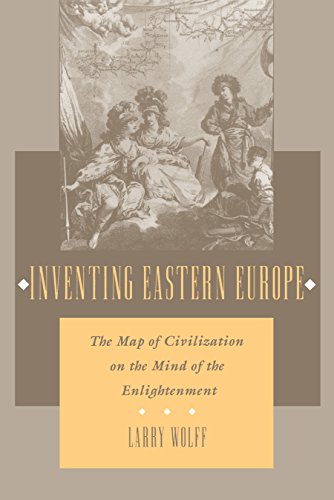
This is a wide-ranging intellectual history of how, in the 18th century, Europe came to be conceived as divided into "Western Europe" and "Eastern Europe". The author argues that this conceptual reorientation from the previously accepted "Northern" and "Southern" was a work of cultural construction and intellectual artifice created by the philosophes of the Enlightenment. He shows how the philosophers viewed the continent from the perspective of Paris and deliberately cultivated an idea of the backwardness of "Eastern Europe" the more readily to affirm the importance of "Western Europe".
Die Inhaltsangabe kann sich auf eine andere Ausgabe dieses Titels beziehen.
Von der hinteren Coverseite
“Thought-provoking and well written, . . . Wolff’s book provides a valuable treatment of the ways in which ‘Enlightened’ thinkers conceive of the lands east of the Elbe. . . . A very welcome contribution to both the history of the Enlightenment and the Western understanding of Eastern Europe.” —The Russian Review
“The distinction between East and West Europe is a seemingly immemorial cliché that desperately needs dismantling, and Wolff does it with erudition and a lively dramatic sense.”—Voice Literary Supplement
“The distinction between East and West Europe is a seemingly immemorial cliché that desperately needs dismantling, and Wolff does it with erudition and a lively dramatic sense.”—Voice Literary Supplement
Auszug. © Genehmigter Nachdruck. Alle Rechte vorbehalten.
Inventing Eastern Europe
The Map of Civilization on the Mind of the Enlightenment
By Larry WolffStanford University Press
Copyright © 1994 Board of Trustees of the Leland Stanford Junior University
All rights reserved.
ISBN: 978-0-8047-2702-0All rights reserved.
Contents
| Introduction............................................................... | 1 |
| One * Entering Eastern Europe: Eighteenth-Century Travelers on the Frontier................................................................... | 17 |
| Two * Possessing Eastern Europe: Sexuality, Slavery, and Corporal Punishment................................................................. | 50 |
| Three * Imagining Eastern Europe: Fiction, Fantasy, and Vicarious Voyages.. | 89 |
| Four * Mapping Eastern Europe: Political Geography and Cultural Cartography................................................................ | 144 |
| Five * Addressing Eastern Europe, Part I: Voltaire's Russia................ | 195 |
| Six * Addressing Eastern Europe, Part II: Rousseau's Poland................ | 235 |
| Seven * Peopling Eastern Europe, Part I: Barbarians in Ancient History and Modern Anthropology........................................................ | 284 |
| Eight * Peopling Eastern Europe, Part II: The Evidence of Manners and the Measurements of Race....................................................... | 332 |
| Conclusion................................................................. | 356 |
| Notes...................................................................... | 377 |
| Index...................................................................... | 407 |
CHAPTER 1
Entering Eastern Europe:Eighteenth-Century Travelerson the Frontier
"These Demi-Savage Figures"
In 1784 Count Louis-Philippe de Ségur left France for Russia, appointedas minister plenipotentiary and envoy extraordinaire of Louis XVI to thecourt of Catherine II at St. Petersburg. Ségur was only 31 and owed hisposting to the fact that his father was the French minister of war. The youngman went by way of Berlin and received a royal audience at Potsdam withthe already old and famous Frederick. The king observed aloud that Ségurwas wearing the decoration of Cincinnatus, the mark of his military serviceunder George Washington in the American Revolutionary War. "Howcould you for so long forget the delights of Paris," asked Frederick sarcastically,"in a land where civilization is just beginning?" Such condescensiontoward America was typical of eighteenth-century assumptions about thelocus of civilization, and both men, the Parisian and the Berliner, had tobe aware that the comment carried a double significance, for the presentposting to St. Petersburg as well as past service in America. In Russia, too,by enlightened consensus, civilization was just beginning in the eighteenthcentury, and Ségur would have many opportunities to reflect upon thatin the five years that followed. It was a matter of reflection that interestedhim, though, the stages and progress of civilization in backward places,and he was willing to sacrifice delights and encounter inconveniences thebetter to learn about lands that excited only sarcasm in Frederick. "Whatroute do you take to go to Petersburg, the shortest?" asked the king. Theshortest and most convenient route would have been by sea. The most directland route would have followed the Baltic coast. "No sire," said Ségur."I want to pass by Warsaw to see Poland." To which Frederick replied, "It'sa curious land."
Both Ségur's curiosity to see Poland and Frederick's sense of its curiousnesswere features of an evolving eighteenth-century interest that appliedto Russia as well as Poland. For Ségur they were linked in the same voyageby land, emphasizing their regional contiguity for him and for othereighteenth-century travelers. In the seventeenth century, commercial connectionsby sea—the Arctic passage from England to Archangel, the Balticcruise from Holland to Gdansk—masked the relation of Poland andRussia to each other. Nineteenth-century railroad travel would fully enforcethat geographical relation, making tracks from Warsaw to St. Petersburg,from Warsaw to Moscow, but Ségur's eighteenth-century curiositycost him more time and trouble. Frederick pretended to encourage himwith some ironic reflections on what made Poland curious: "a free landwhere the nation is enslaved, a republic with a king, a vast country almostwithout population." The Poles were keen warriors but their armies undisciplined.Polish men were brave and chevaleresque, but Polish womenseemed to have more firmness of character, even heroism. Thus Frederickconcluded on a note of mockery, "The women are truly the men." Contradictionand paradox were the rhetorical forms in which he elaborated uponthe curiousness of Poland, its nonsensical disordering and inversion ofeighteenth-century ideas about society, politics, demography, even chivalryand gender. Nonsense was the adjunct of anarchy, and anarchy hadprovided Frederick with a pretext in 1772 for proposing the partition ofPoland and acquiring a portion for Prussia.
It is remarkable that Frederick, who obviously intended to be clever inhis summing up and putting down of Poland, could not claim to understandit better, did not seek to define and explain its implied inadequacy.The comprehension of Poland was, paradoxically, a matter of outliningits incomprehensibility, presenting its paradoxical contrasts, unresolved.Ségur had no political designs on Poland, even claimed to detest the partitionof 1772 as an act of injustice, but his voyager's curiosity inspiredtravel observations in Poland remarkably similar in rhetorical form to thosethat Frederick employed without leaving Berlin. Furthermore, the samestyle of characterization by contradictions continued to serve Ségur in Russiaas well as in Poland. Such formulas, pronounced by the Prussian kingor the French diplomat and applied to Poland or to Russia, marked theeighteenth-century discovery of Eastern Europe. The curiousness of EasternEurope, that is, its difference from Western Europe, its backwardness,was formulated as an intellectual problem of unresolved contrasts.
When a traveler of the twentieth century looks back at Ségur's tripfrom Germany into Poland, it seems clear that he left Western Europe andentered Eastern Europe. Ségur could not explain it so neatly, though, sincein the eighteenth century the whole idea of Eastern Europe was not yetfixed, was still evolving, was taking shape in the minds and words of travelerslike himself. What was remarkable about his account of this passage,the 500 miles from Berlin to Warsaw, was how powerfully he felt that he wascrossing a border of great significance, even without possessing the moderndistinction between Western Europe and Eastern Europe to explainthat transition.
In traversing the eastern part of the estates of the king of Prussia, it seems that oneleaves the theatre where there reigns a nature embellished by the efforts of art anda perfected civilization. The eye is already saddened by arid sands, by vast forests.
But when one enters Poland, one believes one has left Europe entirely, and thegaze is struck by a new spectacle: an immense country almost totally covered withfir trees always green, but always sad,...
„Über diesen Titel“ kann sich auf eine andere Ausgabe dieses Titels beziehen.
Suchergebnisse für Inventing Eastern Europe: The Map of Civilization on...

Beispielbild für diese ISBN
Inventing Eastern Europe: The Map of Civilization on the Mind of the Enlightenment
Verlag:
Stanford University Press, 1996
ISBN 10: 0804727023
ISBN 13: 9780804727020
Gebraucht
Paperback
Anbieter: World of Books (was SecondSale), Montgomery, IL, USA
Verkäuferbewertung 5 von 5 Sternen

Paperback. Zustand: Very Good. In this provocative, wide-ranging history of how the continent of Europe came to be conceived as divided into "Western Europe" and "Eastern Europe," the author shows that it was not a natural distinction, or even an innocent one, but instead was a work of cultural creation, of intellectual artifice, of ideological self-interest and self-promotion. Artikel-Nr. 00108592314
Gebraucht kaufen
EUR 10,59
Versand gratis
Versand innerhalb von USA
Versand innerhalb von USA
Anzahl: 1 verfügbar
Beispielbild für diese ISBN
Inventing Eastern Europe : The Map of Civilization on the Mind of the Enlightenment
Verlag:
Stanford University Press, 1996
ISBN 10: 0804727023
ISBN 13: 9780804727020
Gebraucht
Softcover
Anbieter: Better World Books, Mishawaka, IN, USA
Verkäuferbewertung 5 von 5 Sternen
Zustand: Good. Pages intact with minimal writing/highlighting. The binding may be loose and creased. Dust jackets/supplements are not included. Stock photo provided. Product includes identifying sticker. Better World Books: Buy Books. Do Good. Artikel-Nr. 7811922-20
Gebraucht kaufen
EUR 12,63
Versand gratis
Versand innerhalb von USA
Versand innerhalb von USA
Anzahl: 1 verfügbar
Beispielbild für diese ISBN
Inventing Eastern Europe : The Map of Civilization on the Mind of the Enlightenment
Verlag:
Stanford University Press, 1996
ISBN 10: 0804727023
ISBN 13: 9780804727020
Gebraucht
Softcover
Anbieter: Better World Books Ltd, Dunfermline, Vereinigtes Königreich
Verkäuferbewertung 5 von 5 Sternen
Zustand: Very Good. Former library copy. Pages intact with possible writing/highlighting. Binding strong with minor wear. Dust jackets/supplements may not be included. Includes library markings. Stock photo provided. Product includes identifying sticker. Better World Books: Buy Books. Do Good. Artikel-Nr. 16134789-6
Gebraucht kaufen
EUR 11,83
EUR 5,90 Versand
Versand von Vereinigtes Königreich nach USA
Versand von Vereinigtes Königreich nach USA
Anzahl: 1 verfügbar
Beispielbild für diese ISBN
Inventing Eastern Europe
Anbieter: PBShop.store UK, Fairford, GLOS, Vereinigtes Königreich
Verkäuferbewertung 5 von 5 Sternen
PAP. Zustand: New. New Book. Shipped from UK. Established seller since 2000. Artikel-Nr. FW-9780804727020
Neu kaufen
EUR 36,68
EUR 5,92 Versand
Versand von Vereinigtes Königreich nach USA
Versand von Vereinigtes Königreich nach USA
Anzahl: 15 verfügbar
Beispielbild für diese ISBN
Inventing Eastern Europe The Map of Civilization on the Mind of the Enlightenment
Anbieter: Revaluation Books, Exeter, Vereinigtes Königreich
Verkäuferbewertung 5 von 5 Sternen
Paperback. Zustand: Brand New. reprint edition. 436 pages. 9.25x6.25x1.00 inches. In Stock. Artikel-Nr. __0804727023
Neu kaufen
EUR 32,80
EUR 14,75 Versand
Versand von Vereinigtes Königreich nach USA
Versand von Vereinigtes Königreich nach USA
Anzahl: 1 verfügbar
Beispielbild für diese ISBN
Inventing Eastern Europe: The Map of Civilization on the Mind of the Enlightenment
Anbieter: Majestic Books, Hounslow, Vereinigtes Königreich
Verkäuferbewertung 4 von 5 Sternen

Zustand: New. pp. 436. Artikel-Nr. 7989397
Neu kaufen
EUR 40,82
EUR 7,67 Versand
Versand von Vereinigtes Königreich nach USA
Versand von Vereinigtes Königreich nach USA
Anzahl: 3 verfügbar
Beispielbild für diese ISBN
Inventing Eastern Europe: The Map of Civilization on the Mind of the Enlightenment
Anbieter: Ria Christie Collections, Uxbridge, Vereinigtes Königreich
Verkäuferbewertung 5 von 5 Sternen
Zustand: New. In English. Artikel-Nr. ria9780804727020_new
Neu kaufen
EUR 38,67
EUR 13,32 Versand
Versand von Vereinigtes Königreich nach USA
Versand von Vereinigtes Königreich nach USA
Anzahl: Mehr als 20 verfügbar
Beispielbild für diese ISBN
Inventing Eastern Europe: The Map of Civilization on the Mind of the Enlightenment
Anbieter: Kennys Bookstore, Olney, MD, USA
Verkäuferbewertung 5 von 5 Sternen
Zustand: New. 1996. New edition. Paperback. . . . . . Books ship from the US and Ireland. Artikel-Nr. V9780804727020
Neu kaufen
EUR 48,70
EUR 9,36 Versand
Versand innerhalb von USA
Versand innerhalb von USA
Anzahl: Mehr als 20 verfügbar
Beispielbild für diese ISBN
Inventing Eastern Europe The Map of Civilization on the Mind of the Enlightenment
Anbieter: Revaluation Books, Exeter, Vereinigtes Königreich
Verkäuferbewertung 5 von 5 Sternen
Paperback. Zustand: Brand New. reprint edition. 436 pages. 9.25x6.25x1.00 inches. In Stock. Artikel-Nr. x-0804727023
Neu kaufen
EUR 45,32
EUR 14,75 Versand
Versand von Vereinigtes Königreich nach USA
Versand von Vereinigtes Königreich nach USA
Anzahl: 2 verfügbar
Foto des Verkäufers
Inventing Eastern Europe
Anbieter: moluna, Greven, Deutschland
Verkäuferbewertung 5 von 5 Sternen
Zustand: New. In this provocative, wide-ranging history of how the continent of Europe came to be conceived as divided into Western Europe and Eastern Europe, the author shows that it was not a natural distinction, or even an innocent one, but instead was a work of c. Artikel-Nr. 651929355
Neu kaufen
EUR 35,93
EUR 48,99 Versand
Versand von Deutschland nach USA
Versand von Deutschland nach USA
Anzahl: 1 verfügbar