
Verwandte Artikel zu The Setup Man (Johnny Adcock Series, Band 1)
Inhaltsangabe
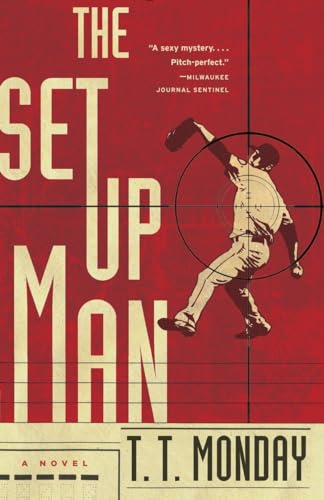
Johnny Adcock is an aging Major League pitcher, who moonlights as a private investigator. Major League Baseball, as it turns out, is a prime source of employment for a discreet detective who has both the brains and the brawn to handle the unique problems of professional athletes. On the bus after a game, teammate Frankie Herrera confides in Adcock that he has a “problem with his wife.” It sounds like the standard story of a pro athlete’s marriage gone sour. However, when Frankie dies in a car crash, Adcock knows there are way too many questions still unanswered, and he dives head first into the most dangerous investigation of his budding second career.
Die Inhaltsangabe kann sich auf eine andere Ausgabe dieses Titels beziehen.
Über die Autorin bzw. den Autor
T.T. MONDAY lives in San Jose, California. The Setup Man is his first thriller.
Auszug. © Genehmigter Nachdruck. Alle Rechte vorbehalten.
1
My dad wasn’t a ballplayer. In his teens he did some boxing, but he spent his adult life in the straight world, inspecting aircraft welds at the McDonnell Douglas plant in Long Beach. He told me that if I wanted to make easy money—and he always believed this was the best kind of money to make—I should look into relief pitching. I remember one afternoon we were sitting in the den, watching the Dodgers get clobbered by the Cincinnati Reds on TV. A left-handed reliever named Matt Young had just bounced a curveball off the plate, walking home a run. “Look at this fool,” Dad said. “Guy couldn’t find the strike zone with a pebble. He works ten minutes a day, and he’s making a killing. I bet his kids will never have to work a day in their lives.”
Dad was almost correct. This was 1987, a few years before the agents grabbed the owners by the balls and journeymen like Matt Young started buying vacation homes with cash. I did some research, and in 1987 the Dodgers paid Matt Young $350,000. He appeared in forty-seven games, pitched fifty-four innings, and posted an earned-run average of 4.47. Believe it or not, those are decent numbers. I put up a similar line last year. But times have changed. Last year I made a million five.
My name is Johnny Adcock. I am a thirty-five-year-old American man, six feet two inches tall, 190 pounds, with a cholesterol count on the high end of normal. Women have told me I’m handsome, but I know not to listen. Even ugly ballplayers get compliments. Here are the facts: I have gray eyes, a straight nose, and one slightly pronounced canine tooth. I wear a uniform to work. I travel the country on a chartered jet. I’m divorced, with a thirteen-year-old daughter who lives with her mother in Los Angeles. For now they live well—a house in Santa Monica, private school, organic groceries—but let’s be realistic, I am one torn ligament away from permanent unemployment. Ginny, my ex, knows that. She sends me vitamins to prevent injuries. That’s her idea of work.
In an average week, I spend approximately two hours throwing a baseball, including warm-ups. Roughly every other night I get called upon late in the game to face a single batter, always a lefty. Conventional wisdom says that it is better to have a left-handed pitcher face a left-handed batter, because the curveball will break down and away, out of the batter’s reach. I don’t throw a curve, but baseball is an orthodox religion, and orthodoxy resists exceptions. I can count on one hand the number of right-handed batters I have faced this season.
Here is a typical night’s work: I walk in from the bullpen, throw my eight warm-up pitches. The batter, too, takes his time to get ready. He says a prayer, checks his grip, maybe does a little baton flip with his bat. If he’s at home, he might check out the crowd. Then he steps into the box and we go at it. I throw my strikes and he takes his cuts. The whole dance lasts ten minutes, tops. If I get him, they pull me and put in the closer. If I don’t, they probably pull me anyway. Ten minutes a night, seventy-plus nights a year, plus the playoffs if we’re lucky.
If you look at this backward, you’ll notice that I have a lot of free time. Enough to stun an average man. The best relief pitchers are ruminants, men who desire nothing more than a seat on a bench, a game to watch, and a half-pound bag of David Sunflower Seeds. In college I read a poem about a man who measured out his life in coffee spoons. Good relievers measure theirs in seeds. But I am not a good reliever, because I’m restless. Maybe if I had been a position player—a shortstop, let’s say—things might have been different for me. I might have taken extra batting practice in the cages under the stands. I have that option. I carry in my wallet a magnetic card that gets me into the clubhouse twenty-four hours a day. But relievers don’t bat enough to make extra batting practice worthwhile. The last time I batted was four years ago. Nightcap of a doubleheader, the starter got in trouble early, and Skipper gave me the ball in the second inning. I went four frames, batted twice, and struck out both times, once on a foul bunt.
You might imagine that ballplayers go out and party after games. Some do, but there are lots of games, and the next is usually tomorrow. After a game, the next day’s starting pitcher goes directly to sleep. Most guys go back to the hotel and watch TV, maybe Skype with their kids. But hotel television has never been enough for me. I need something more stimulating—especially after those hours waiting on the bench. I could have taken graduate courses through the mail, studied for life after baseball. Lots of guys talk about doing that. This is my thirteenth year in the bigs; I probably could have had a Ph.D. by now. I could have read every book ever written. But reading requires a still mind. Mine darts around like a knuckleball. I suppose I could have written books like Jim Bouton, great tell-all books about baseball and America, but again there is the problem of stillness, and also the question of why readers would want to peek inside my head.
Luckily, I found something better to do with my free time. Ten years ago, my teammate Charley DeAngelo took me aside and told me his wife was fooling around. He had no evidence, but there were plenty of hints—jewelry he didn’t remember giving her, strange numbers on the caller ID. He was going to follow her around for a day, see what he came up with. Could be boring, he said, so did I want to keep him company? I was recently divorced and had nothing better to do in the endless mornings before reporting to the stadium. So I rented a car and drove to the rendezvous spot. But DeAngelo never showed. There I was, parked across the street from the wife’s gym, waiting for her to finish Tae Bo or whatever. What the hell, I said, I’m here, I will follow her, and, lo and behold, I discovered she was cheating—and not even hiding it. She went to an Italian restaurant for lunch, where she was joined by a gentleman in a business suit. They ordered Prosecco and oysters. Afterward they went to a hotel. I remember that I debated whether to tell DeAngelo. In the end I did, but only on the condition that he pass my name around to anyone else who needed this kind of help. DeAngelo thanked me for my effort and said he would put the word out.
An hour later, the phone rang. Word spreads fast in the major leagues.
A decade in, this sideline has earned me lovers and haters. The former are the guys who have required my services, at this point a cast of several hundred. The latter are those—managers, front-office folks, team PR personnel—who would prefer to ignore the ugly side of baseball. My detractors think the investigations represent a conflict of interest, even though I would never do anything to affect the outcome on the field. Mostly I think they’re scared. They know sometimes I find dirt that implicates the wrong people. We’re a tight group, baseball people, and our lives tend to touch like paper dolls. To some of us, that is frightening.
The appeal for me is the same as it ever was. Playing a child’s game for money can be hard on your self-respect. Even now, I’m still not a doctor or a diplomat, but I’m more than I was. I’m more than a guy on a bench cracking seeds, waiting for a lefty to bat in the eighth.
God help me if a man’s not entitled to that.
2
We are in Denver, last game of a road trip that started two weeks ago in Houston. The Bay...
„Über diesen Titel“ kann sich auf eine andere Ausgabe dieses Titels beziehen.
Suchergebnisse für The Setup Man (Johnny Adcock Series, Band 1)

Beispielbild für diese ISBN
The Setup Man (Johnny Adcock Series)
Verlag:
Vintage Crime/Black Lizard, 2014
ISBN 10: 0804169829
ISBN 13: 9780804169820
Gebraucht
Softcover
Anbieter: World of Books (was SecondSale), Montgomery, IL, USA
Verkäuferbewertung 5 von 5 Sternen

Zustand: Good. Item in good condition. Textbooks may not include supplemental items i.e. CDs, access codes etc. Artikel-Nr. 00056691713
Gebraucht kaufen
EUR 4,39
Versand gratis
Versand innerhalb von USA
Versand innerhalb von USA
Anzahl: 2 verfügbar
Beispielbild für diese ISBN
The Setup Man (Johnny Adcock Series)
Verlag:
Vintage Crime/Black Lizard, 2014
ISBN 10: 0804169829
ISBN 13: 9780804169820
Gebraucht
Softcover
Anbieter: World of Books (was SecondSale), Montgomery, IL, USA
Verkäuferbewertung 5 von 5 Sternen
Zustand: Very Good. Item in very good condition! Textbooks may not include supplemental items i.e. CDs, access codes etc. Artikel-Nr. 00100652124
Gebraucht kaufen
EUR 4,39
Versand gratis
Versand innerhalb von USA
Versand innerhalb von USA
Anzahl: 1 verfügbar
Beispielbild für diese ISBN
The Setup Man
Verlag:
Vintage Crime/Black Lizard, 2014
ISBN 10: 0804169829
ISBN 13: 9780804169820
Gebraucht
Paperback
Anbieter: ThriftBooks-Dallas, Dallas, TX, USA
Verkäuferbewertung 5 von 5 Sternen
Paperback. Zustand: Very Good. No Jacket. May have limited writing in cover pages. Pages are unmarked. ~ ThriftBooks: Read More, Spend Less. Artikel-Nr. G0804169829I4N00
Gebraucht kaufen
EUR 5,96
Versand gratis
Versand innerhalb von USA
Versand innerhalb von USA
Anzahl: 1 verfügbar
Beispielbild für diese ISBN
The Setup Man
Verlag:
Vintage Crime/Black Lizard, 2014
ISBN 10: 0804169829
ISBN 13: 9780804169820
Gebraucht
Paperback
Anbieter: ThriftBooks-Atlanta, AUSTELL, GA, USA
Verkäuferbewertung 5 von 5 Sternen
Paperback. Zustand: Good. No Jacket. Pages can have notes/highlighting. Spine may show signs of wear. ~ ThriftBooks: Read More, Spend Less. Artikel-Nr. G0804169829I3N00
Gebraucht kaufen
EUR 6,00
Versand gratis
Versand innerhalb von USA
Versand innerhalb von USA
Anzahl: 1 verfügbar
Beispielbild für diese ISBN
The Setup Man
Anbieter: Kennys Bookstore, Olney, MD, USA
Verkäuferbewertung 5 von 5 Sternen
Zustand: New. Artikel-Nr. V9780804169820
Neu kaufen
EUR 20,61
EUR 9,03 Versand
Versand innerhalb von USA
Versand innerhalb von USA
Anzahl: 15 verfügbar
Beispielbild für diese ISBN
The Setup Man
Anbieter: Revaluation Books, Exeter, Vereinigtes Königreich
Verkäuferbewertung 5 von 5 Sternen
Paperback. Zustand: Brand New. 262 pages. 7.00x5.00x1.00 inches. In Stock. Artikel-Nr. 0804169829
Neu kaufen
EUR 22,01
EUR 11,65 Versand
Versand von Vereinigtes Königreich nach USA
Versand von Vereinigtes Königreich nach USA
Anzahl: 1 verfügbar
Foto des Verkäufers
The Setup Man
Verlag:
Knopf Doubleday Publishing Group, 2014
ISBN 10: 0804169829
ISBN 13: 9780804169820
Neu
Softcover
Anbieter: moluna, Greven, Deutschland
Verkäuferbewertung 5 von 5 Sternen
Zustand: New. T.T. MONDAY lives in San Jose, California. The Setup Man is his first thriller.Johnny Adcock is an aging Major League pitcher, who moonlights as a private investigator. Major League Baseball, as it turns out, is a prime source of employment fo. Artikel-Nr. 898735671
Neu kaufen
EUR 20,84
EUR 48,99 Versand
Versand von Deutschland nach USA
Versand von Deutschland nach USA
Anzahl: Mehr als 20 verfügbar