
Inhaltsangabe
WINNER OF THE NOBEL PRIZE® IN LITERATURE 2013
A New York Times Notable Book
A Washington Post Notable Work of Fiction
A Best Book of the Year: The Atlantic, NPR, San Francisco Chronicle, Vogue, AV Club
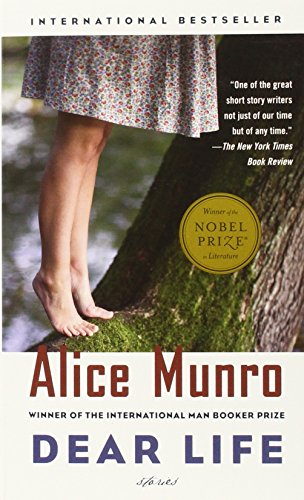
In story after story in this brilliant new collection, Alice Munro pinpoints the moment a person is forever altered by a chance encounter, an action not taken, or a simple twist of fate. Her characters are flawed and fully human: a soldier returning from war and avoiding his fiancée, a wealthy woman deciding whether to confront a blackmailer, an adulterous mother and her neglected children, a guilt-ridden father, a young teacher jilted by her employer. Illumined by Munro’s unflinching insight, these lives draw us in with their quiet depth and surprise us with unexpected turns. And while most are set in her signature territory around Lake Huron, some strike even closer to home: an astonishing suite of four autobiographical tales offers an unprecedented glimpse into Munro’s own childhood. Exalted by her clarity of vision and her unparalleled gift for storytelling, Dear Life shows how strange, perilous, and extraordinary ordinary life can be.
Die Inhaltsangabe kann sich auf eine andere Ausgabe dieses Titels beziehen.
Über die Autorin bzw. den Autor
Alice Munro grew up in Wingham, Ontario, and attended the University of Western Ontario. She has published thirteen collections of stories as well as a novel, Lives of Girls and Women, and two volumes of Selected Stories. During her distinguished career she has been the recipient of many awards and prizes, including three of Canada’s Governor General’s Literary Awards and two of its Giller Prizes, the Rea Award for the Short Story, the Lannan Literary Award, England’s W. H. Smith Book Award, the National Book Critics Circle Award, and the Man Booker International Prize. In 2013 she was awarded the Nobel Prize for Literature. Her stories have appeared in The New Yorker, The Atlantic Monthly, The Paris Review, Granta, and other publications, and her collections have been translated into thirteen languages. She lives in Clinton, Ontario, near Lake Huron.
Auszug. © Genehmigter Nachdruck. Alle Rechte vorbehalten.
Chapter 1
To Reach Japan
Once Peter had brought her suitcase on board the train he seemed eager to get himself out of the way. But not to leave. He explained to her that he was just uneasy that the train should start to move. Out on the platform looking up at their window, he stood waving. Smiling, waving. The smile for Katy was wide open, sunny, without a doubt in the world, as if he believed that she would continue to be a marvel to him, and he to her, forever. The smile for his wife seemed hopeful and trusting, with some sort of determination about it. Something that could not easily be put into words and indeed might never be. If Greta had mentioned such a thing he would have said, Don’t be ridiculous. And she would have agreed with him, thinking that it was unnatural for people who saw each other daily, constantly, to have to go through explanations of any kind.
When Peter was a baby, his mother had carried him across some mountains whose name Greta kept forgetting, in order to get out of Soviet Czechoslovakia into Western Europe. There were other people of course. Peter’s father had intended to be with them but he had been sent to a sanatorium just before the date for the secret departure. He was to follow them when he could, but he died instead.
“I’ve read stories like that,” Greta said, when Peter first told her about this. She explained how in the stories the baby would start to cry and invariably had to be smothered or strangled so that the noise did not endanger the whole illegal party.
Peter said he had never heard such a story and would not say what his mother would have done in such circumstances.
What she did do was get to British Columbia where she improved her English and got a job teaching what was then called Business Practice to high school students. She brought up Peter on her own and sent him to college, and now he was an engineer. When she came to their apartment, and later to their house, she always sat in the front room, never coming into the kitchen unless Greta invited her. That was her way. She carried not noticing to an extreme. Not noticing, not intruding, not suggesting, though in every single household skill or art she left her daughter-in-law far behind.
Also, she got rid of the apartment where Peter had been brought up and moved into a smaller one with no bedroom, just room for a foldout couch. So Peter can’t go home to Mother? Greta teased her, but she seemed startled. Jokes pained her. Maybe it was a problem of language. But English was her usual language now and indeed the only language Peter knew. He had learned Business Practice—though not from his mother—when Greta was learning Paradise Lost. She avoided anything useful like the plague. It seemed he did the opposite.
With the glass between them, and Katy never allowing the waving to slow down, they indulged in looks of comic or indeed insane goodwill. She thought how nice-looking he was, and how he seemed to be so unaware of it. He wore a brush cut, in the style of the time—particularly if you were anything like an engineer—and his light-colored skin was never flushed like hers, never blotchy from the sun, but evenly tanned whatever the season.
His opinions were something like his complexion. When they went to see a movie, he never wanted to talk about it afterwards. He would say that it was good, or pretty good, or okay. He didn’t see the point in going further. He watched television, he read a book in somewhat the same way. He had patience with such things. The people who put them together were probably doing the best they could. Greta used to argue, rashly asking whether he would say the same thing about a bridge. The people who did it did their best but their best was not good enough so it fell down.
Instead of arguing, he just laughed.
It was not the same thing, he said.
No?
No.
Greta should have realized that this attitude—hands off, tolerant—was a blessing for her, because she was a poet, and there were things in her poems that were in no way cheerful or easy to explain.
(Peter’s mother and the people he worked with—those who knew about it—still said poetess. She had trained him not to. Otherwise, no training necessary. The relatives she had left behind in her life, and the people she knew now in her role as a housewife and mother, did not have to be trained because they knew nothing about this peculiarity.)
It would become hard to explain, later on in her life, just what was okay in that time and what was not. You might say, well, feminism was not. But then you would have to explain that feminism was not even a word people used. Then you would get all tied up saying that having any serious idea, let alone ambition, or maybe even reading a real book, could be seen as suspect, having something to do with your child’s getting pneumonia, and a political remark at an office party might have cost your husband his promotion. It would not have mattered which political party either. It was a woman’s shooting off her mouth that did it.
People would laugh and say, Oh surely you are joking and you would have to say, Well, but not that much. Then she would say, one thing, though, was that if you were writing poetry it was somewhat safer to be a woman than a man. That was where the word poetess came in handy, like a web of spun sugar. Peter would not have felt that way, she said, but remember he had been born in Europe. He would have understood, though, how the men he worked with were supposed to feel about such things.
That summer Peter was going to spend a month or maybe longer in charge of a job that was being done at Lund, far up, in fact as far as you could go north, on the mainland. There was no accommodation for Katy and Greta.
But Greta had kept in touch with a girl she used to work with in the Vancouver library, who was married now and living in Toronto. She and her husband were going to spend a month in Europe that summer—he was a teacher—and she had written Greta wondering if Greta and her family would do them a favor—she was very polite—by occupying the house in Toronto for part of that time, not letting it stand empty. And Greta had written back telling her about Peter’s job but taking up the offer for Katy and herself.
That was why they were now waving and waving from the platform and from the train.
There was a magazine then, called The Echo Answers, published irregularly in Toronto. Greta had found it in the library and sent them some poems. Two of the poems had been published, and the result was that when the editor of the magazine came to Vancouver, last fall, she had been invited to a party, with other writers, to meet him. The party was at the house of a writer whose name had been familiar to her, it seemed, for her whole life. It was held in the late afternoon, when Peter was still at work, so she hired a sitter and set off on the North Vancouver bus across Lions Gate Bridge and through Stanley Park. Then she had to wait in front of the Hudson’s Bay for a long ride out to the university campus, which was where the writer lived. Let off at the bus’s last turning, she found the street and walked along peering at house numbers. She was...
„Über diesen Titel“ kann sich auf eine andere Ausgabe dieses Titels beziehen.
Weitere beliebte Ausgaben desselben Titels

Suchergebnisse für Dear Life: Stories (Vintage International)

Beispielbild für diese ISBN
Dear Life: Stories ( for dear life )(Chinese Edition)
Anbieter: World of Books (was SecondSale), Montgomery, IL, USA
Verkäuferbewertung 5 von 5 Sternen

Zustand: Good. Item in very good condition! Textbooks may not include supplemental items i.e. CDs, access codes etc. Artikel-Nr. 00074042105
Gebraucht kaufen
EUR 3,15
Versand gratis
Versand innerhalb von USA
Versand innerhalb von USA
Anzahl: 2 verfügbar
Beispielbild für diese ISBN
Dear Life: Stories ( for dear life )(Chinese Edition)
Verlag:
Vintage Books (edition ), 2013
ISBN 10: 0804168911
ISBN 13: 9780804168915
Gebraucht
Mass Market Paperback
Anbieter: BooksRun, Philadelphia, PA, USA
Verkäuferbewertung 5 von 5 Sternen
Mass Market Paperback. Zustand: Very Good. It's a well-cared-for item that has seen limited use. The item may show minor signs of wear. All the text is legible, with all pages included. It may have slight markings and/or highlighting. Artikel-Nr. 0804168911-11-1
Gebraucht kaufen
EUR 4,69
Versand gratis
Versand innerhalb von USA
Versand innerhalb von USA
Anzahl: 1 verfügbar
Beispielbild für diese ISBN
Dear Life: Stories ( for dear life )(Chinese Edition)
Anbieter: ThriftBooks-Dallas, Dallas, TX, USA
Verkäuferbewertung 5 von 5 Sternen
Unknown. Zustand: Very Good. No Jacket. May have limited writing in cover pages. Pages are unmarked. ~ ThriftBooks: Read More, Spend Less. Artikel-Nr. G0804168911I4N00
Gebraucht kaufen
EUR 6,26
Versand gratis
Versand innerhalb von USA
Versand innerhalb von USA
Anzahl: 1 verfügbar
Beispielbild für diese ISBN
Dear Life Exp
Verlag:
Penguin Random House USA Ex Mm, 2013
ISBN 10: 0804168911
ISBN 13: 9780804168915
Gebraucht
Paperback
Anbieter: AwesomeBooks, Wallingford, Vereinigtes Königreich
Verkäuferbewertung 5 von 5 Sternen
Paperback. Zustand: Very Good. Dear Life Exp This book is in very good condition and will be shipped within 24 hours of ordering. The cover may have some limited signs of wear but the pages are clean, intact and the spine remains undamaged. This book has clearly been well maintained and looked after thus far. Money back guarantee if you are not satisfied. See all our books here, order more than 1 book and get discounted shipping. . Artikel-Nr. 7719-9780804168915
Gebraucht kaufen
EUR 3,98
EUR 4,85 Versand
Versand von Vereinigtes Königreich nach USA
Versand von Vereinigtes Königreich nach USA
Anzahl: 2 verfügbar
Beispielbild für diese ISBN
Dear Life: Stories (Vintage International)
Anbieter: WorldofBooks, Goring-By-Sea, WS, Vereinigtes Königreich
Verkäuferbewertung 5 von 5 Sternen
Paperback. Zustand: Very Good. The book has been read, but is in excellent condition. Pages are intact and not marred by notes or highlighting. The spine remains undamaged. Artikel-Nr. GOR005418306
Gebraucht kaufen
EUR 2,54
EUR 6,59 Versand
Versand von Vereinigtes Königreich nach USA
Versand von Vereinigtes Königreich nach USA
Anzahl: 4 verfügbar
Beispielbild für diese ISBN
Dear Life: Stories ( for dear life )(Chinese Edition)
Anbieter: MusicMagpie, Stockport, Vereinigtes Königreich
Verkäuferbewertung 5 von 5 Sternen
Zustand: Very Good. 1757773951. 9/13/2025 2:32:31 PM. Artikel-Nr. U9780804168915
Gebraucht kaufen
EUR 3,80
EUR 6,46 Versand
Versand von Vereinigtes Königreich nach USA
Versand von Vereinigtes Königreich nach USA
Anzahl: 1 verfügbar
Beispielbild für diese ISBN
Dear Life Exp
Verlag:
Penguin Random House USA Ex Mm 30/07/2013, 2013
ISBN 10: 0804168911
ISBN 13: 9780804168915
Gebraucht
Softcover
Anbieter: Bahamut Media, Reading, Vereinigtes Königreich
Verkäuferbewertung 5 von 5 Sternen
Zustand: Very Good. Shipped within 24 hours from our UK warehouse. Clean, undamaged book with no damage to pages and minimal wear to the cover. Spine still tight, in very good condition. Remember if you are not happy, you are covered by our 100% money back guarantee. Artikel-Nr. 6545-9780804168915
Gebraucht kaufen
EUR 3,98
EUR 8,22 Versand
Versand von Vereinigtes Königreich nach USA
Versand von Vereinigtes Königreich nach USA
Anzahl: 2 verfügbar
Beispielbild für diese ISBN
Dear Life: Stories (Vintage International)
Anbieter: medimops, Berlin, Deutschland
Verkäuferbewertung 5 von 5 Sternen
Zustand: good. Befriedigend/Good: Durchschnittlich erhaltenes Buch bzw. Schutzumschlag mit Gebrauchsspuren, aber vollständigen Seiten. / Describes the average WORN book or dust jacket that has all the pages present. Artikel-Nr. M00804168911-G
Gebraucht kaufen
EUR 4,38
EUR 10,00 Versand
Versand von Deutschland nach USA
Versand von Deutschland nach USA
Anzahl: 11 verfügbar
Beispielbild für diese ISBN
Dear Life: Stories (Vintage International)
Anbieter: medimops, Berlin, Deutschland
Verkäuferbewertung 5 von 5 Sternen
Zustand: very good. Gut/Very good: Buch bzw. Schutzumschlag mit wenigen Gebrauchsspuren an Einband, Schutzumschlag oder Seiten. / Describes a book or dust jacket that does show some signs of wear on either the binding, dust jacket or pages. Artikel-Nr. M00804168911-V
Gebraucht kaufen
EUR 4,38
EUR 10,00 Versand
Versand von Deutschland nach USA
Versand von Deutschland nach USA
Anzahl: 10 verfügbar
Beispielbild für diese ISBN
Dear Life
Anbieter: Hamelyn, Madrid, M, Spanien
Verkäuferbewertung 5 von 5 Sternen
Zustand: Muy bueno. : En 'Dear Life', Alice Munro, ganadora del Premio Nobel, nos presenta una colección de relatos que exploran momentos cruciales en la vida de personas comunes. Con su estilo característico, Munro ilumina las complejidades de las relaciones humanas y los giros inesperados del destino. Ambientadas principalmente en la región del lago Hurón, estas historias nos invitan a reflexionar sobre la fragilidad y la belleza de la existencia cotidiana. Esta edición de Vintage International ofrece una mirada íntima a la maestría narrativa de una de las autoras más importantes de nuestro tiempo. EAN: 9780804168915 Tipo: Libros Categoría: Literatura y Ficción Título: Dear Life Autor: Alice Munro Editorial: Vintage Idioma: en Páginas: 336 Formato: tapa blanda. Artikel-Nr. Happ-2026-01-23-5544dac4
Gebraucht kaufen
EUR 8,08
EUR 12,99 Versand
Versand von Spanien nach USA
Versand von Spanien nach USA
Anzahl: 1 verfügbar