
Verwandte Artikel zu Triggers: Creating Behavior That Lasts--Becoming the...
Inhaltsangabe
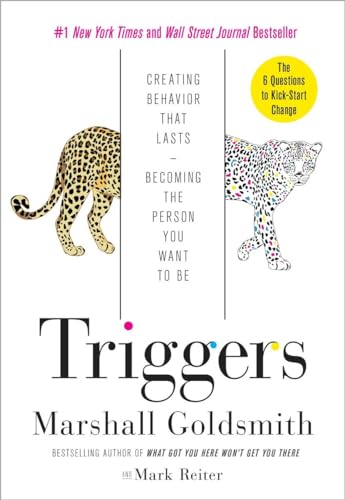
Bestselling author and world-renowned executive coach Marshall Goldsmith examines the environmental and psychological triggers that can derail us at work and in life.
Do you ever find that you are not the patient, compassionate problem solver you believe yourself to be? Are you surprised at how irritated or flustered the normally unflappable you becomes in the presence of a specific colleague at work? Have you ever felt your temper accelerate from zero to sixty when another driver cuts you off in traffic?
Our reactions don’t occur in a vacuum. They are usually the result of unappreciated triggers in our environment—the people and situations that lure us into behaving in a manner diametrically opposed to the colleague, partner, parent, or friend we imagine ourselves to be. These triggers are constant and relentless and omnipresent. So often the environment seems to be outside our control. Even if that is true, as Goldsmith points out, we have a choice in how we respond.
In Triggers, his most powerful and insightful book yet, Goldsmith shows how we can overcome the trigger points in our lives, and enact meaningful and lasting change. Goldsmith offers a simple “magic bullet” solution in the form of daily self-monitoring, hinging around what he calls “active” questions. These are questions that measure our effort, not our results. There’s a difference between achieving and trying; we can’t always achieve a desired result, but anyone can try. In the course of Triggers, Goldsmith details the six “engaging questions” that can help us take responsibility for our efforts to improve and help us recognize when we fall short.
Filled with revealing and illuminating stories from his work with some of the most successful chief executives and power brokers in the business world, Goldsmith offers a personal playbook on how to achieve change in our lives, make it stick, and become the person we want to be.
Die Inhaltsangabe kann sich auf eine andere Ausgabe dieses Titels beziehen.
Über die Autorin bzw. den Autor
Marshall Goldsmith is the leading executive coach in the world and the author of the New York Times bestsellers What Got You Here Won’t Get You There and Mojo. He received his PhD from UCLA Anderson School of Management. His client list is a who’s who of American CEOs. He and his wife live in San Diego.
Auszug. © Genehmigter Nachdruck. Alle Rechte vorbehalten.
Part One
Why Don't We Become the Person We Want to Be?
Chapter 1
The Immutable Truths of Behavioral Change
As an executive coach, I've been helping successful leaders achieve positive lasting change in behavior for more than thirty-five years. While almost all of my clients embrace the opportunity to change, some are a little reluctant in the beginning. Most are aware of the fact that behavioral change will help them become more effective leaders, partners, and even family members. A few are not.
My process of helping clients is straightforward and consistent. I interview and listen to my clients' key stakeholders. These stakeholders could be their colleagues, direct reports, or board members. I accumulate a lot of confidential feedback. Then I go over the summary of this feedback with my clients. My clients take ultimate responsibility for the behavioral changes that they want to make. My job is then very simple. I help my clients achieve positive, lasting change in the behavior that they choose as judged by key stakeholders that they choose. If my clients succeed in achieving this positive change-as judged by their stakeholders-I get paid. If the key stakeholders do not see positive change, I don't get paid.
Our odds of success improve because I'm with the client every step of the way, telling him or her how to stay on track and not regress to a former self. But that doesn't diminish the importance of these two immutable truths:
Truth #1: Meaningful behavioral change is very hard to do.
It's hard to initiate behavioral change, even harder to stay the course, hardest of all to make the change stick. I'd go so far as to say that adult behavioral change is the most difficult thing for sentient human beings to accomplish.
If you think I'm overstating its difficulty, answer these questions:
* What do you want to change in your life? It could be something major, such as your weight (a big one), your job (big too), or your career (even bigger). It could be something minor, such as changing your hairstyle or checking in with your mother more often or changing the wall color in your living room. It's not my place to judge what you want to change.
* How long has this been going on? For how many months or years have you risen in the morning and told yourself some variation on the phrase, "This is the day I make a change"?
* How's that working out? In other words, can you point to a specific moment when you decided to change something in your life and you acted on the impulse and it worked out to your satisfaction?
The three questions conform to the three problems we face in introducing change into our lives.
We can't admit that we need to change-either because we're unaware that a change is desirable, or, more likely, we're aware but have reasoned our way into elaborate excuses that deny our need for change. In the following pages, we'll examine-and dispense with-the deep-seated beliefs that trigger our resistance to change.
We do not appreciate inertia's power over us. Given the choice, we prefer to do nothing-which is why I suspect our answers to "How long has this been going on?" are couched in terms of years rather than days. Inertia is the reason we never start the process of change. It takes extraordinary effort to stop doing something in our comfort zone (because it's painless or familiar or mildly pleasurable) in order to start something difficult that will be good for us in the long run. I cannot supply the required effort in this book. That's up to you. But through a simple process emphasizing structure and self-monitoring I can provide you with the kick start that triggers and sustains positive change.
We don't know how to execute a change. There's a difference between motivation and understanding and ability. For example, we may be motivated to lose weight but we lack the nutritional understanding and cooking ability to design and stick with an effective diet. Or flip it over: we have understanding and ability but lack the motivation. One of the central tenets of this book is that our behavior is shaped, both positively and negatively, by our environment-and that a keen appreciation of our environment can dramatically lift not only our motivation, ability, and understanding of the change process, but also our confidence that we can actually do it.
I vividly recall my first decisive behavioral change as an adult. I was twenty-six years old, married to my first and only wife, Lyda, and pursuing a doctorate in organizational behavior at the University of California, Los Angeles. Since high school I had been a follicly challenged man, but back then I was loath to admit it. Each morning I would spend several minutes in front of the bathroom mirror carefully arranging the wispy blond stands of hair still remaining on the top of my head. I'd smooth the hairs forward from back to front, then curve them to a point in the middle of my forehead, forming a pattern that looked vaguely like a laurel wreath. Then I'd walk out into the world with my ridiculous comb-over, convinced I looked normal like everyone else.
When I visited my barber, I'd give specific instructions on how to cut my hair. One morning I dozed off in the chair, so he trimmed my hair too short, leaving insufficient foliage on the sides to execute my comb-over regimen. I could have panicked and put on a hat for a few weeks, waiting for the strands to grow back. But as I stood in front of the mirror later that day, staring at my reflected image, I said to myself, "Face it, you're bald. It's time you accepted it."
That's the moment when I decided to shave the few remaining hairs on the top of my head and live my life as a bald man. It wasn't a complicated decision and it didn't take great effort to accomplish. A short trim at the barber from then on. But in many ways, it is still the most liberating change I've made as an adult. It made me happy, at peace with my appearance.
I'm not sure what triggered my acceptance of a new way of self-grooming. Perhaps I was horrified at the prospect of starting every day with this routine forever. Or maybe it was the realization that I wasn't fooling anyone.
The reason doesn't matter. The real achievement is that I actually decided to change and successfully acted on that decision. That's not easy to do. I had spent years fretting and fussing with my hair. That's a long time to continue doing something that I knew, on the spectrum of human folly, fell somewhere between vain and idiotic. And yet I persisted in this foolish behavior for so many years because (a) I couldn't admit that I was bald, and (b) under the sway of inertia, I found it easier to continue doing my familiar routine than change my ways. The one advantage I had was (c) I knew how to execute the change. Unlike most changes-for example, getting in shape, learning a new language, or becoming a better listener-it didn't require months of discipline and measuring and following up. Nor did it require the cooperation of others. I just needed to stop giving my barber crazy instructions and let him do his job. If only all our behavioral changes were so uncomplicated.
Truth #2: No one can make us change unless we truly want to change.
This should be self-evident. Change has to come from within. It can't be dictated, demanded, or otherwise forced upon -people. A man or woman who does not wholeheartedly commit to change will never change.
I didn't absorb this simple truth until my twelfth year in the "change" business. By then I had done intensive one-on-one coaching with more than a hundred executives, nearly all successes but a smattering of failures, too.
As I reviewed my failures, one conclusion leapt out: Some people say they want to change, but they don't really mean it. I had erred profoundly in client selection. I...
„Über diesen Titel“ kann sich auf eine andere Ausgabe dieses Titels beziehen.
Suchergebnisse für Triggers: Creating Behavior That Lasts--Becoming the...

Beispielbild für diese ISBN
Triggers: Creating Behavior That Lasts--Becoming the Person You Want to Be
Anbieter: World of Books (was SecondSale), Montgomery, IL, USA
Verkäuferbewertung 5 von 5 Sternen

Hardback. Zustand: Very Good. Bestselling author and world-renowned executive coach Marshall Goldsmith examines the environmental and psychological triggers that can derail us at work and in life. Do you ever find that you are not the patient, compassionate problem solver you believe yourself to be? Are you surprised at how irritated or flustered the normally unflappable you becomes in the presence of a specific colleague at work? Have you ever felt your temper accelerate from zero to sixty when another driver cuts you off in traffic? Our reactions don't occur in a vacuum. They are usually the result of unappreciated triggers in our environment--the people and situations that lure us into behaving in a manner diametrically opposed to the colleague, partner, parent, or friend we imagine ourselves to be. These triggers are constant and relentless and omnipresent. So often the environment seems to be outside our control. Even if that is true, as Goldsmith points out, we have a choice in how we respond. In Triggers, his most powerful and insightful book yet, Goldsmith shows how we can overcome the trigger points in our lives, and enact meaningful and lasting change. Goldsmith offers a simple "magic bullet" solution in the form of daily self-monitoring, hinging around what he calls "active" questions. These are questions that measure our effort, not our results. There's a difference between achieving and trying; we can't always achieve a desired result, but anyone can try. In the course of Triggers, Goldsmith details the six "engaging questions" that can help us take responsibility for our efforts to improve and help us recognize when we fall short. Filled with revealing and illuminating stories from his work with some of the most successful chief executives and power brokers in the business world, Goldsmith offers a personal playbook on how to achieve change in our lives, make it stick, and become the person we want to be. Artikel-Nr. 00106406804
Gebraucht kaufen
EUR 3,78
Versand gratis
Versand innerhalb von USA
Versand innerhalb von USA
Anzahl: 2 verfügbar
Beispielbild für diese ISBN
Triggers: Creating Behavior That Lasts--Becoming the Person You Want to Be
Anbieter: World of Books (was SecondSale), Montgomery, IL, USA
Verkäuferbewertung 5 von 5 Sternen
Hardback. Zustand: Good. Bestselling author and world-renowned executive coach Marshall Goldsmith examines the environmental and psychological triggers that can derail us at work and in life. Do you ever find that you are not the patient, compassionate problem solver you believe yourself to be? Are you surprised at how irritated or flustered the normally unflappable you becomes in the presence of a specific colleague at work? Have you ever felt your temper accelerate from zero to sixty when another driver cuts you off in traffic? Our reactions don't occur in a vacuum. They are usually the result of unappreciated triggers in our environment--the people and situations that lure us into behaving in a manner diametrically opposed to the colleague, partner, parent, or friend we imagine ourselves to be. These triggers are constant and relentless and omnipresent. So often the environment seems to be outside our control. Even if that is true, as Goldsmith points out, we have a choice in how we respond. In Triggers, his most powerful and insightful book yet, Goldsmith shows how we can overcome the trigger points in our lives, and enact meaningful and lasting change. Goldsmith offers a simple "magic bullet" solution in the form of daily self-monitoring, hinging around what he calls "active" questions. These are questions that measure our effort, not our results. There's a difference between achieving and trying; we can't always achieve a desired result, but anyone can try. In the course of Triggers, Goldsmith details the six "engaging questions" that can help us take responsibility for our efforts to improve and help us recognize when we fall short. Filled with revealing and illuminating stories from his work with some of the most successful chief executives and power brokers in the business world, Goldsmith offers a personal playbook on how to achieve change in our lives, make it stick, and become the person we want to be. Artikel-Nr. 00088363484
Gebraucht kaufen
EUR 3,78
Versand gratis
Versand innerhalb von USA
Versand innerhalb von USA
Anzahl: Mehr als 20 verfügbar
Beispielbild für diese ISBN
Triggers Creating Behavior Tha
Anbieter: World of Books (was SecondSale), Montgomery, IL, USA
Verkäuferbewertung 5 von 5 Sternen
Zustand: Acceptable. Item in acceptable condition! Textbooks may not include supplemental items i.e. CDs, access codes etc. Artikel-Nr. 00099759754
Gebraucht kaufen
EUR 3,78
Versand gratis
Versand innerhalb von USA
Versand innerhalb von USA
Anzahl: 3 verfügbar
Foto des Verkäufers
Triggers: Creating Behavior That Lasts--Becoming the Person You Want to Be
Anbieter: Dream Books Co., Denver, CO, USA
Verkäuferbewertung 5 von 5 Sternen
Zustand: good. Gently used with minimal wear on the corners and cover. A few pages may contain light highlighting or writing, but the text remains fully legible. Dust jacket may be missing, and supplemental materials like CDs or codes may not be included. May be ex-library with library markings. Ships promptly! Artikel-Nr. 4EKGRJ006KD1_ns
Gebraucht kaufen
EUR 3,79
Versand gratis
Versand innerhalb von USA
Versand innerhalb von USA
Anzahl: 4 verfügbar
Foto des Verkäufers
Triggers: Creating Behavior That Lasts--Becoming the Person You Want to Be
Anbieter: Dream Books Co., Denver, CO, USA
Verkäuferbewertung 5 von 5 Sternen
Zustand: acceptable. This copy has clearly been enjoyedâ"expect noticeable shelf wear and some minor creases to the cover. Binding is strong, and all pages are legible. May contain previous library markings or stamps. Artikel-Nr. 4EKGU9007FY9_ns
Gebraucht kaufen
EUR 3,79
Versand gratis
Versand innerhalb von USA
Versand innerhalb von USA
Anzahl: 1 verfügbar
Beispielbild für diese ISBN
Triggers: Creating Behavior That Lasts--Becoming the Person You Want to Be
Anbieter: ThriftBooks-Dallas, Dallas, TX, USA
Verkäuferbewertung 5 von 5 Sternen
Hardcover. Zustand: Very Good. No Jacket. May have limited writing in cover pages. Pages are unmarked. ~ ThriftBooks: Read More, Spend Less. Artikel-Nr. G0804141231I4N00
Gebraucht kaufen
EUR 5,94
Versand gratis
Versand innerhalb von USA
Versand innerhalb von USA
Anzahl: 1 verfügbar
Beispielbild für diese ISBN
Triggers: Creating Behavior That Lasts--Becoming the Person You Want to Be
Anbieter: ThriftBooks-Phoenix, Phoenix, AZ, USA
Verkäuferbewertung 5 von 5 Sternen
Hardcover. Zustand: Very Good. No Jacket. Missing dust jacket; May have limited writing in cover pages. Pages are unmarked. ~ ThriftBooks: Read More, Spend Less. Artikel-Nr. G0804141231I4N01
Gebraucht kaufen
EUR 5,94
Versand gratis
Versand innerhalb von USA
Versand innerhalb von USA
Anzahl: 1 verfügbar
Beispielbild für diese ISBN
Triggers: Creating Behavior That Lasts--Becoming the Person You Want to Be
Anbieter: ThriftBooks-Atlanta, AUSTELL, GA, USA
Verkäuferbewertung 5 von 5 Sternen
Hardcover. Zustand: Very Good. No Jacket. Missing dust jacket; May have limited writing in cover pages. Pages are unmarked. ~ ThriftBooks: Read More, Spend Less. Artikel-Nr. G0804141231I4N01
Gebraucht kaufen
EUR 5,94
Versand gratis
Versand innerhalb von USA
Versand innerhalb von USA
Anzahl: 1 verfügbar
Beispielbild für diese ISBN
Triggers: Creating Behavior That Lasts--Becoming the Person You Want to Be
Anbieter: ThriftBooks-Phoenix, Phoenix, AZ, USA
Verkäuferbewertung 5 von 5 Sternen
Hardcover. Zustand: Very Good. No Jacket. May have limited writing in cover pages. Pages are unmarked. ~ ThriftBooks: Read More, Spend Less. Artikel-Nr. G0804141231I4N00
Gebraucht kaufen
EUR 5,94
Versand gratis
Versand innerhalb von USA
Versand innerhalb von USA
Anzahl: 1 verfügbar
Beispielbild für diese ISBN
Triggers: Creating Behavior That Lasts--Becoming the Person You Want to Be
Anbieter: ThriftBooks-Reno, Reno, NV, USA
Verkäuferbewertung 5 von 5 Sternen
Hardcover. Zustand: Very Good. No Jacket. Missing dust jacket; May have limited writing in cover pages. Pages are unmarked. ~ ThriftBooks: Read More, Spend Less. Artikel-Nr. G0804141231I4N01
Gebraucht kaufen
EUR 5,94
Versand gratis
Versand innerhalb von USA
Versand innerhalb von USA
Anzahl: 1 verfügbar