
Verwandte Artikel zu How to Kill a Unicorn: How the World's Hottest...
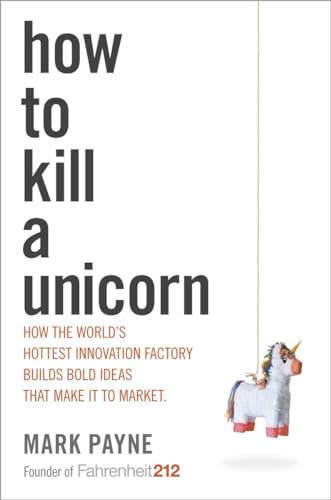
How to Kill a Unicorn: How the World's Hottest Innovation Factory Builds Bold Ideas That Make It to Market - Hardcover
Inhaltsangabe
A unique behind-the-scenes look at the groundbreaking methodology that today's most in-demand innovation factory uses to create some of the boldest products and successfully bring them to market.
Today, innovation is seen by business leaders and the media alike as the key to growth, a burning issue in every company, from startups to the Fortune 500. And in that space, Fahrenheit 212 is viewed as a high-performance innovation SWAT team, able to solve the most complex, mission-critical challenges. Under Mark Payne, the firm's president and head of Idea Development, Fahrenheit 212, since its inception a decade ago, has worked with such giants of industry as Coca-Cola, Samsung, Hershey's, Campbell's Soup, LG, Starbucks, Mattel, Office Depot, Citibank, P&G, American Express, Nutrisystem, GE, and Goldman Sachs, to name but a few. It has been praised as a hotspot for innovation in publications like Fortune, Esquire, Businessweek, and FastCompany.
What Drives Fahrenheit 212's success is its unique methodology, combining what it calls Magic--the creative side of innovation--with Money, the business side. They explore every potential idea with the end goal in mind--bringing an innovative product to market in a way that will transform a company's business and growth. In How to Kill a Unicorn, Mark Payne pulls back the curtain on how the company is able to bring more innovative products and ideas successfully to market than any other firm and offers blow by blow inside accounts of how they grapple with and solved their biggest challenges.
Die Inhaltsangabe kann sich auf eine andere Ausgabe dieses Titels beziehen.
Über die Autorin bzw. den Autor
Mark Payne is the cofounder, president, and head of Idea Development for Fahrenheit 212, today's hottest innovation consultancy firm. Known for ideas that transform business markets, the company works with many of the biggest and most prominent companies in America. The firm is based in New York City.
Auszug. © Genehmigter Nachdruck. Alle Rechte vorbehalten.
Chapter 1
Seeing Through It
It’s Cool, but So What?
It just might be the coolest technology we’ve ever seen.
We’re sitting in Fahrenheit 212’s offices, watching as grainy YouTube clips roll by, one after the other. In a rapid-fire montage of short video reports, a string of tech reporters from various corners of the globe sound as breathless as kids on Christmas morning.
The object of their awed fascination is a new translucent LCD screen technology Samsung has unveiled at the Consumer Electronics Show in Las Vegas. Showcased on a sleek fourteen-inch laptop, the translucent screens cause a feeding frenzy among the tech paparazzi working the floor. Shooting video for their audiences back home, the reporters can’t resist waving their hands behind the see-through screen as they proclaim it to be the most amazing thing they’ve seen in ages.
Welcome to another Fahrenheit 212 project briefing. On a crisp June afternoon, a dozen of us on Fahrenheit 212’s Samsung team--an amalgam of strategists, analysts, financial black belts, writers, designers, architects, film producers, and conceptual thinkers, are gathered around the back bar of our office in Manhattan’s West Village. In aggregate, the team spans what we call the Money and the Magic. They make up the two sides of our philosophy, our team structure, and our model for developing high-impact innovation solutions. It is the way we create new strategies, ideas, products, categories, and businesses.
The Money & Magic model is in essence an innovation aimed at innovation. Its purpose is to turn the pursuit of breakthrough ideas from a hopeful hit-or-miss rain dance in search of random lightning strikes, into the reliable growth engine modern business needs innovation to be. Money & Magic does this by forcing the collision of two power sources that have traditionally been kept apart--user-centered creativity and outcome-driven commercial grunt. The two forces are joined at the hip in full-bore end-to-end collaboration. Each side of the business comes to a project with equal intensity, equal influence, and equal accountability in shaping high-impact innovation solutions.
Embedded in our approach to new ideas are hard-earned lessons about what separates innovations that work from those that don’t. The ones that work make it to market and make good money. The ones that don’t are what we call unicorns--ideas that are lovely to think about but don’t become real. The lessons here are designed to help any innovator--from the Fortune 500 C-suite exec to the startup entrepreneur to your next-door neighbor tinkering in his garage to your cousin building apps in his dorm room--turn ambition, sweat, and the alchemy of human imagination into real products and businesses that change people’s lives.
My colleagues and I gather for project briefings like this kickoff for Samsung’s translucent screens around this same worktable every week. As kids kick balls around the park below us, we kick around visions of the future up here. Many of the world’s great companies invite us to help crack their most strategically important, commercially critical innovation challenges across a spectrum of businesses. From software to soft drinks. Money to music. E-commerce to eco-packaging. Hotels to haute jewels. Wellness to whiskey. Microchips to potato chips. Resorts to retail. Fashion to factory equipment. Productivity tools to perfume. Textiles to high-tech manufacturing systems. Lipstick to life insurance. And literally soup to nuts. The running joke around the company is that we’ve turned ADD into a business model.
As the video clips run and the buzz builds, project point man Jon Crawford-Phillips has seen enough. An eloquent pragmatist of British upbringing, Crawford-Phillips is an embodiment of Money & Magic. He hops off his bar stool and shuts down the video feed. In the silence that follows, he walks to the glass wall in front of the back bar where we jot down ideas, grabs a marker, and writes five words.
It’s cool. But so what?
Pointing at the words on the wall, he turns toward the rest of the group. “That’s the question Samsung has asked us to answer. We have four months to solve it.”
What Jon means is that our assignment is to help Samsung turn this cool technology from something interesting into something valuable. What lies ahead is a rapid march through a gauntlet of high-stakes questions. For starters, where should Samsung point this amazing technology? Dozens of industries are fair game. Within any of them, what pain points and unmet needs would translucent LCD address and for whom? What new user experiences, benefits, business models, revenue streams, and competitive advantage would it ignite? What would it replace? What specific products would be the door kickers to begin a revolution? What would those products do and how would they work? And in a technology sector that moves at light speed, how could Samsung get to this bold see-through future faster than competitors who might be chasing similar science?
Solving an innovation challenge like this is a bit like wrestling an octopus. Pin down one arm and another wriggles loose. Before diving into the variables we have to start with the few fixed parameters we have. In this case there are just two: the technology itself and the capabilities of the company behind it.
Jon reaches under the table and pulls out an early prototype Samsung has built for us to play with. It’s a TLCD screen mounted into a monitor. He flips it on and talks us through the nuts and bolts. Translucent LCD is a see-through glass panel with the ability to deliver digital content while allowing a viewer to see whatever lies behind or beyond the screen. Long the stuff of futurist films like Minority Report, it’s a piece of the future seemingly teleported into the here and now.
The technology is impressive. Samsung’s engineers have handed us a seemingly miraculous way to deliver imagery onto a piece of glass without the typical backlight and solid back panel that make today’s LCDs work, and without any external projection mechanism. It does this in part by recycling the ambient light around the screen and repurposing it for image creation. Eliminating the backlight has a number of positive side effects, including reduced weight, energy consumption, and cost.
Cool, cool, and cooler.
But at the back of our minds is Jon’s nagging question. So what?
WHERE TO PLAY
Job one is cracking the issue of what businesses this technology should be unleashed upon. Or at least where it should start. The laptop at CES was a showpiece to get reporters talking; it was not meant for market.
From a commercial point of view, Samsung had understandably high interest in opportunities beyond existing consumer electronics markets. They were looking for ways to drive their world-leading LCD capabilities into new industries, rather than purely chasing the next upgrade in current lines of business. In truth, the translucent screen could conceivably go anywhere a pane of glass could fit, electricity could flow, and added content could deliver added value. Entire cities built of LCD-skinned skyscrapers? Implausible, but not impossible.
Finding possibilities with this potentially transformative technology wouldn’t be the hard part. It never is. Making decisions on which opportunities to pursue and which to jettison is the tougher task. Veteran innovators know that this kind of breadth is both a blessing and a curse. As a design researcher named Dr. Sam Ladner once put it, “There is no shortage of creative solutions to unmet needs, only a shortage of profitable ways to provide them.”
Where the dazzling...
„Über diesen Titel“ kann sich auf eine andere Ausgabe dieses Titels beziehen.
Suchergebnisse für How to Kill a Unicorn: How the World's Hottest...

Beispielbild für diese ISBN
How to Kill a Unicorn: How the World's Hottest Innovation Factory Builds Bold Ideas That Make It to Market
Anbieter: World of Books (was SecondSale), Montgomery, IL, USA
Verkäuferbewertung 5 von 5 Sternen

Zustand: Very Good. Item in very good condition! Textbooks may not include supplemental items i.e. CDs, access codes etc. Artikel-Nr. 00100190555
Gebraucht kaufen
EUR 5,86
Versand gratis
Versand innerhalb von USA
Versand innerhalb von USA
Anzahl: 1 verfügbar
Beispielbild für diese ISBN
How to Kill a Unicorn: How the World's Hottest Innovation Factory Builds Bold Ideas That Make It to Market
Anbieter: World of Books (was SecondSale), Montgomery, IL, USA
Verkäuferbewertung 5 von 5 Sternen
Zustand: Good. Item in good condition. Textbooks may not include supplemental items i.e. CDs, access codes etc. Artikel-Nr. 00099349174
Gebraucht kaufen
EUR 5,86
Versand gratis
Versand innerhalb von USA
Versand innerhalb von USA
Anzahl: 1 verfügbar
Beispielbild für diese ISBN
How to Kill a Unicorn : How the World's Hottest Innovation Factory Builds Bold Ideas That Make It to Market
Anbieter: Better World Books: West, Reno, NV, USA
Verkäuferbewertung 5 von 5 Sternen
Zustand: Very Good. Former library copy. Pages intact with possible writing/highlighting. Binding strong with minor wear. Dust jackets/supplements may not be included. Includes library markings. Stock photo provided. Product includes identifying sticker. Better World Books: Buy Books. Do Good. Artikel-Nr. 7725950-6
Gebraucht kaufen
EUR 6,36
Versand gratis
Versand innerhalb von USA
Versand innerhalb von USA
Anzahl: 1 verfügbar
Beispielbild für diese ISBN
How to Kill a Unicorn : How the World's Hottest Innovation Factory Builds Bold Ideas That Make It to Market
Anbieter: Better World Books, Mishawaka, IN, USA
Verkäuferbewertung 5 von 5 Sternen
Zustand: Very Good. Former library copy. Pages intact with possible writing/highlighting. Binding strong with minor wear. Dust jackets/supplements may not be included. Includes library markings. Stock photo provided. Product includes identifying sticker. Better World Books: Buy Books. Do Good. Artikel-Nr. 7725950-6
Gebraucht kaufen
EUR 6,36
Versand gratis
Versand innerhalb von USA
Versand innerhalb von USA
Anzahl: 1 verfügbar
Beispielbild für diese ISBN
How to Kill a Unicorn: How the World's Hottest Innovation Factory Builds Bold Ideas That Make It to Market
Anbieter: Wonder Book, Frederick, MD, USA
Verkäuferbewertung 5 von 5 Sternen
Zustand: Good. Good condition. Acceptable dust jacket. A copy that has been read but remains intact. May contain markings such as bookplates, stamps, limited notes and highlighting, or a few light stains. Artikel-Nr. F01F-04015
Gebraucht kaufen
EUR 6,43
Versand gratis
Versand innerhalb von USA
Versand innerhalb von USA
Anzahl: 1 verfügbar
Beispielbild für diese ISBN
How to Kill a Unicorn: How the World's Hottest Innovation Factory Builds Bold Ideas That Make It to Market
Anbieter: Wonder Book, Frederick, MD, USA
Verkäuferbewertung 5 von 5 Sternen
Zustand: Very Good. Very Good condition. Very Good dust jacket. A copy that may have a few cosmetic defects. May also contain light spine creasing or a few markings such as an owner's name, short gifter's inscription or light stamp. Artikel-Nr. K06A-02561
Gebraucht kaufen
EUR 6,43
Versand gratis
Versand innerhalb von USA
Versand innerhalb von USA
Anzahl: 2 verfügbar