
Verwandte Artikel zu The Diet Fix: Why Diets Fail and How to Make Yours...
Inhaltsangabe
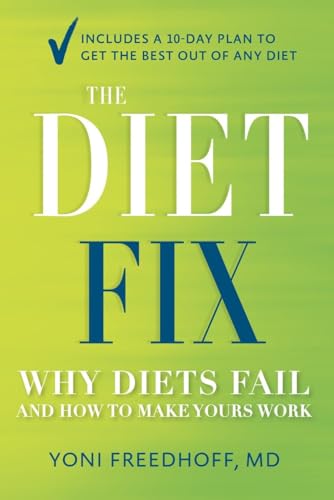
With The Diet Fix, weight loss expert Dr. Yoni Freedhoff offers a groundbreaking, useable guide to begin living happily while losing weight permanently.
It is time to break the cycle of traumatic dieting. Despite the success stories publicized by Atkins, South Beach, Weight Watchers, and others, 90% of all diets end in failure. How can we fix the way we lose weight so that we make results last? Whether used on its own or in conjunction with any other diet, Dr. Freedhoff’s program shows how to replace a toxic dieting mindset with positive beliefs and behaviors.
Dr. Freedhoff has uncovered the flawed thinking that sabotages even the most earnest weight loss efforts. The majority of dieting or weight loss programs call for regular sacrifice: Give up an entire food group; fight hunger day and night; undertake exhausting and grueling exercise regiments. These approaches are unrealistic, unhealthy, and make it nearly impossible to maintain results.
Now, at last, there is hope. In The Diet Fix, Dr. Freedhoff offers a tested program for breaking down the negative thought patterns that prevent people from losing weight and keeping it off. Through the course of years of research and patient treatment, he has developed a 10-Day Reset that supports losing weight while maintaining a healthy, enjoyable lifestyle. This reset is designed to eliminate the habits that so often lead to weight gain: use it to shut down cravings, prevent indulgences from turning into binges, and break up with the scale once and for all. The 10-Day Reset can make any diet more effective, whether it’s low-carb, low-fat, meal replacement, calorie tracking, or anything in between.
Die Inhaltsangabe kann sich auf eine andere Ausgabe dieses Titels beziehen.
Über die Autorin bzw. den Autor
Dr. Yoni Freedhoff, MD, CCFP, is widely considered to be Canada's most outspoken obesity expert. His weekly column in U.S. News & World Report's online Eat + Run edition is regularly the most read on the site, and he writes periodically on issues of health, weight management, and fitness for a variety of publications including Psychology Today and The Huffington Post, and daily on his award winning blog Weighty Matters. He is also an Assistant Professor in the Faculty of Medicine at the University of Ottawa and a sought after international speaker. Dr. Freedhoff graduated with honors from the University of Toronto Faculty of Medicine, where he received the Betty Stewart Sisam Award as the graduating student who "has shown the greatest human understanding and care for the welfare and health of patients."
Auszug. © Genehmigter Nachdruck. Alle Rechte vorbehalten.
A (Very) Brief History of Dieting
Diets are anything but new. The first popular diet was a lowcarb diet written by a British coffin maker in 1863. His name was William Banting, and the diet he championed and detailed in his Letter on Corpulence, Addressed to the Public was of the lowcarb variety with an emphasis on eating meat, greens, and fruit while avoiding sugar, starches, dairy, and beer. His book was so incredibly popular that at the time, the word banting was used in conversation in place of dieting. Believe it or not, the book is still in print and you can even buy it in Kindle format. But it’s been over the past 50 or so years, not coincidentally the time period in which obesity rates have nearly quadrupled, that the number of diets has grown by multiple orders of magnitude. At the time I’m writing this paragraph, over on Amazon there are over 37,000 books in their “diets and weight loss” racks.
Their strategies may all vary wildly, but ultimately we can subdivide all diet books and programs into seven broad categories:
1. Good/bad diets: These are among the simplest to follow. They have very clear rules that either cut out entire categories of foods or provide very specific meal plans. People on these types of diets are told that they don’t need to track intake in terms of calories; instead they’re told to avoid virtually an entire food group and they’ll do fine. The most obvious examples of these are the ultralowfat diet of Dr. Dean Ornish and the ultralowcarb diet of Dr. Robert Atkins.
2. Scientific and pseudoscientific diets: Rather than vilify an entire food group, these diets tend to focus only on specific foods within the group. Beans are good, carrots are bad. Oatmeal is good, rice is bad, and so on. Some, like the GI diet and the various surging paleo diets, are built on true scientific principles; others, like the blood type diet, and Suzanne Somers’ food combination diet, tend to lapse into what might be described as common sense or intuitive, but are not in fact rooted in a rigorous, scientifically defensible evidence base.
3. Counting diets and programs: Food gets assigned points (or calories) and you’re allotted a certain number with the aim of not going over. Perhaps the first counting diet was that of Dr. Lulu Hunt Peters, whose 1918 book, Diet and Health, with the Key to the Calories, was the first to recommend tracking calories. At the time, no one had heard of calories, and early on in the book Dr. Peters had to explain to readers how to pronounce the word. Of course, as far as counting diets go, there’s no doubt that the grand champion is Weight Watchers, which in 50 years has enrolled tens of millions of people in more than 30 countries.
4. Crash diets: From the get‑go, this type of diet is meant to be temporary. These diets aren’t meant to be a “for good” solution but rather just a “for now” solution. Often they’re undertaken as a way to lose weight before a particular event--a wedding, a trip, a high school reunion. They’re usually massively restrictive, and the aim is to lose the weight to get to the event and then start eating again. Generally, they just involve eating very little of anything and sometimes as much as you want of just one very specific thing. The cabbage soup diet, the grapefruit diet, and the so‑called master cleanse (that modified juice fast based on lemon juice and cayenne pepper) are this category’s most obvious examples.
5. Exercise diets: These aren’t necessarily diets so much as they are aggressive exercise programs undertaken with the expectation of weight loss. Invariably, the exercise is either highly intense (like boot camps, for instance) or exceedingly lengthy, sometimes even involving hours of daily activity.
6. Magic diets: Simply pop a magic pill or potion, or sidle up to some newfangled exercise contraption, and presto chango, with zero effort and zero dietary change, the weight will just melt off. While I’m guessing magic diets aren’t going to help melt weight, I’m positive they’ll help melt bank accounts.
And then, of course, there’s the most common and the most popular diet in history. The one diet that virtually anyone who has ever been unhappy or concerned about their weight has tried on at least one occasion. There’s no book to read, or guru to follow. I call it the “Eat Smarter diet.”
7. Eat Smarter diet: Honestly, who hasn’t tried this one at least once? Even folks who aren’t concerned about their weight have likely tried to “watch what they eat,” “eat smarter,” “be more aware,” “be more thoughtful”--with the dual aims of “eating less” and “being more healthy.” No books to purchase. No programs to consult. Just “eat less and exercise more” and “be smarter.” And while it certainly makes sense and reflects the truism of energy balance, our bodies and our environment conspire to make this approach almost invariably useless.
“DOC, WHICH DIET SHOULD I GO ON?”
Is there one right diet for you? Is there some test you could take where you’d plug in your lifestyle, personality, and dietary preferences and out would come your perfect answer? If only it were that simple.
There are just so many variables. Some may be modifiable, but others simply aren’t. It would be no easier to give yourself a palate that loves spinach and hates chocolate than it would be to swap out your genes. And don’t kid yourself into thinking those things don’t matter--they do. As the father of three beautiful little girls, I can tell you I sure had a great deal more free time to cook, sleep, and exercise before they came into my life. And although I know I’d probably be healthier if my favorite guilty pleasures were organic vegetables, I just can’t seem to convince my mouth not to adore pizza, wings, burgers, and potato chips.
At the end of the day, all diets work, every last one. Even diets with nonsensical approaches can help people lose weight. But losing, of course, isn’t the issue. I hear it all the time in my office and it’s absolutely true: “Losing weight is easy; it’s keeping it off that’s hard.”
So is there a common theme that makes keeping lost weight off difficult? Absolutely, and putting it simply, the common theme that makes longterm success difficult is the notion that suffering is a prerequisite to success.
TRAUMATIC DIETING
The questions people ask themselves when failing any given diet may sound familiar to you: Why can’t I just stick with it? What’s wrong with me? What’s my problem? Why am I such a failure? It’s the “it’s not you, it’s me” speech we give when we break up with someone, only unlike our breakups, where the statement’s usually a sugarcoated lie, with weight management, we believe it. We failed, not our approach. It’s not the diet, it’s me.
If that’s really true--that it’s not the diet but rather us--how is it that failure is the norm? Can it really be that the past 50 years have seen a global pandemic loss of willpower? That somehow as a species we’ve become powerless to resist weight gain? That as individuals we simply can’t control ourselves?
Maybe it’s not you.
I’d be willing to wager that if you’ve been battling your weight for a while, you’ve invested more willpower in weight loss than in virtually any other area of your life. You’ve probably undertaken various whiteknuckle diets, have set your alarm clock for 5:00...
„Über diesen Titel“ kann sich auf eine andere Ausgabe dieses Titels beziehen.
Suchergebnisse für The Diet Fix: Why Diets Fail and How to Make Yours...

Beispielbild für diese ISBN
The Diet Fix : Why Diets Fail and How to Make Yours Work
Verlag:
Potter/Ten Speed/Harmony/Rodale, 2014
ISBN 10: 0804137579
ISBN 13: 9780804137577
Gebraucht
Hardcover
Erstausgabe
Anbieter: Better World Books, Mishawaka, IN, USA
Verkäuferbewertung 5 von 5 Sternen

Zustand: Very Good. 1st Edition. Pages intact with possible writing/highlighting. Binding strong with minor wear. Dust jackets/supplements may not be included. Stock photo provided. Product includes identifying sticker. Better World Books: Buy Books. Do Good. Artikel-Nr. 9681789-6
Gebraucht kaufen
EUR 15,04
Versand gratis
Versand innerhalb von USA
Versand innerhalb von USA
Anzahl: 2 verfügbar
Beispielbild für diese ISBN
The Diet Fix : Why Diets Fail and How to Make Yours Work
Verlag:
Potter/Ten Speed/Harmony/Rodale, 2014
ISBN 10: 0804137579
ISBN 13: 9780804137577
Gebraucht
Hardcover
Erstausgabe
Anbieter: Better World Books: West, Reno, NV, USA
Verkäuferbewertung 5 von 5 Sternen
Zustand: Good. 1st Edition. Former library copy. Pages intact with minimal writing/highlighting. The binding may be loose and creased. Dust jackets/supplements are not included. Includes library markings. Stock photo provided. Product includes identifying sticker. Better World Books: Buy Books. Do Good. Artikel-Nr. 6272487-6
Gebraucht kaufen
EUR 15,04
Versand gratis
Versand innerhalb von USA
Versand innerhalb von USA
Anzahl: 1 verfügbar
Beispielbild für diese ISBN
The Diet Fix : Why Diets Fail and How to Make Yours Work
Verlag:
Potter/Ten Speed/Harmony/Rodale, 2014
ISBN 10: 0804137579
ISBN 13: 9780804137577
Gebraucht
Hardcover
Erstausgabe
Anbieter: Better World Books: West, Reno, NV, USA
Verkäuferbewertung 5 von 5 Sternen
Zustand: Very Good. 1st Edition. Pages intact with possible writing/highlighting. Binding strong with minor wear. Dust jackets/supplements may not be included. Stock photo provided. Product includes identifying sticker. Better World Books: Buy Books. Do Good. Artikel-Nr. 9681789-6
Gebraucht kaufen
EUR 15,04
Versand gratis
Versand innerhalb von USA
Versand innerhalb von USA
Anzahl: 1 verfügbar
Beispielbild für diese ISBN
The Diet Fix: Why Diets Fail and How to Make Yours Work
Anbieter: ThriftBooks-Dallas, Dallas, TX, USA
Verkäuferbewertung 5 von 5 Sternen
Hardcover. Zustand: Very Good. No Jacket. May have limited writing in cover pages. Pages are unmarked. ~ ThriftBooks: Read More, Spend Less. Artikel-Nr. G0804137579I4N00
Gebraucht kaufen
EUR 20,18
Versand gratis
Versand innerhalb von USA
Versand innerhalb von USA
Anzahl: 1 verfügbar
Beispielbild für diese ISBN
The Diet Fix: Why Diets Fail and How to Make Yours Work
Anbieter: ThriftBooks-Atlanta, AUSTELL, GA, USA
Verkäuferbewertung 5 von 5 Sternen
Hardcover. Zustand: Very Good. No Jacket. May have limited writing in cover pages. Pages are unmarked. ~ ThriftBooks: Read More, Spend Less. Artikel-Nr. G0804137579I4N00
Gebraucht kaufen
EUR 20,18
Versand gratis
Versand innerhalb von USA
Versand innerhalb von USA
Anzahl: 1 verfügbar
Beispielbild für diese ISBN
The Diet Fix: Why Diets Fail and How to Make Yours Work
Anbieter: ThriftBooks-Dallas, Dallas, TX, USA
Verkäuferbewertung 5 von 5 Sternen
Hardcover. Zustand: Good. No Jacket. Former library book; Pages can have notes/highlighting. Spine may show signs of wear. ~ ThriftBooks: Read More, Spend Less. Artikel-Nr. G0804137579I3N10
Gebraucht kaufen
EUR 20,18
Versand gratis
Versand innerhalb von USA
Versand innerhalb von USA
Anzahl: 1 verfügbar
Beispielbild für diese ISBN
The Diet Fix: Why Diets Fail and How to Make Yours Work
Anbieter: WorldofBooks, Goring-By-Sea, WS, Vereinigtes Königreich
Verkäuferbewertung 5 von 5 Sternen
Paperback. Zustand: Very Good. The book has been read, but is in excellent condition. Pages are intact and not marred by notes or highlighting. The spine remains undamaged. Artikel-Nr. GOR008078726
Gebraucht kaufen
EUR 24,45
EUR 6,65 Versand
Versand von Vereinigtes Königreich nach USA
Versand von Vereinigtes Königreich nach USA
Anzahl: 4 verfügbar
Beispielbild für diese ISBN
The Diet Fix: Why Everything You've Been Taught About Dieting Is Wrong and a 10-day Plan to Fix It
Anbieter: Revaluation Books, Exeter, Vereinigtes Königreich
Verkäuferbewertung 5 von 5 Sternen
Hardcover. Zustand: Brand New. 1st edition. 336 pages. 9.75x6.75x1.25 inches. In Stock. Artikel-Nr. 0804137579
Neu kaufen
EUR 70,82
EUR 14,84 Versand
Versand von Vereinigtes Königreich nach USA
Versand von Vereinigtes Königreich nach USA
Anzahl: 1 verfügbar