
Verwandte Artikel zu Superforecasting: The Art and Science of Prediction
Inhaltsangabe
NEW YORK TIMES BESTSELLER • NAMED ONE OF THE BEST BOOKS OF THE YEAR BY THE ECONOMIST
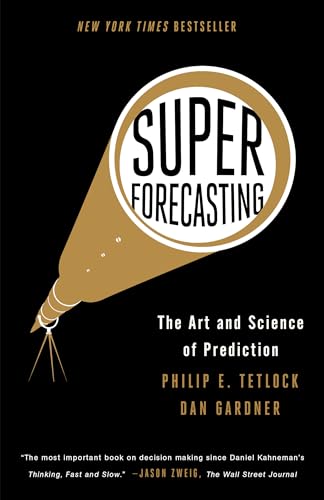
“The most important book on decision making since Daniel Kahneman's Thinking, Fast and Slow.”—Jason Zweig, The Wall Street Journal
Everyone would benefit from seeing further into the future, whether buying stocks, crafting policy, launching a new product, or simply planning the week’s meals. Unfortunately, people tend to be terrible forecasters. As Wharton professor Philip Tetlock showed in a landmark 2005 study, even experts’ predictions are only slightly better than chance. However, an important and underreported conclusion of that study was that some experts do have real foresight, and Tetlock has spent the past decade trying to figure out why. What makes some people so good? And can this talent be taught?
In Superforecasting, Tetlock and coauthor Dan Gardner offer a masterwork on prediction, drawing on decades of research and the results of a massive, government-funded forecasting tournament. The Good Judgment Project involves tens of thousands of ordinary people—including a Brooklyn filmmaker, a retired pipe installer, and a former ballroom dancer—who set out to forecast global events. Some of the volunteers have turned out to be astonishingly good. They’ve beaten other benchmarks, competitors, and prediction markets. They’ve even beaten the collective judgment of intelligence analysts with access to classified information. They are "superforecasters."
In this groundbreaking and accessible book, Tetlock and Gardner show us how we can learn from this elite group. Weaving together stories of forecasting successes (the raid on Osama bin Laden’s compound) and failures (the Bay of Pigs) and interviews with a range of high-level decision makers, from David Petraeus to Robert Rubin, they show that good forecasting doesn’t require powerful computers or arcane methods. It involves gathering evidence from a variety of sources, thinking probabilistically, working in teams, keeping score, and being willing to admit error and change course.
Superforecasting offers the first demonstrably effective way to improve our ability to predict the future—whether in business, finance, politics, international affairs, or daily life—and is destined to become a modern classic.
Die Inhaltsangabe kann sich auf eine andere Ausgabe dieses Titels beziehen.
Über die Autorin bzw. den Autor
Philip E. Tetlock is the Annenberg University Professor at the University of Pennsylvania and holds appointments in the psychology and political science departments and the Wharton School of Business. He and his wife, Barbara Mellers, are the co-leaders of the Good Judgment Project, a multi-year forecasting study. He is also the author of Expert Political Judgment and (with Aaron Belkin) Counterfactual Thought Experiments in World Politics.
Dan Gardner is a New York Times bestselling author, speaker, and consultant. His three books on psychology and decision-making—published in 25 countries and 19 languages—have been praised by everyone from The Economist to Nobel laureate Daniel Kahneman. Prior to becoming an author, Gardner was a newspaper columnist, talking head, and investigative journalist who won or was nominated for every major award in Canadian newspaper journalism. He is an honorary senior fellow at the University of Ottawa’s Graduate School of Public Policy and International Affairs and lives in Ottawa, Canada.
Auszug. © Genehmigter Nachdruck. Alle Rechte vorbehalten.
1
An Optimistic Skeptic
We are all forecasters. When we think about changing jobs, getting married, buying a home, making an investment, launching a product, or retiring, we decide based on how we expect the future will unfold. These expectations are forecasts. Often we do our own forecasting. But when big events happen--markets crash, wars loom, leaders tremble--we turn to the experts, those in the know. We look to people like Tom Friedman.
If you are a White House staffer, you might find him in the Oval Office with the president of the United States, talking about the Middle East. If you are a Fortune 500 CEO, you might spot him in Davos, chatting in the lounge with hedge fund billionaires and Saudi princes. And if you don’t frequent the White House or swanky Swiss hotels, you can read his New York Times columns and bestselling books that tell you what’s happening now, why, and what will come next.1 Millions do.
Like Tom Friedman, Bill Flack forecasts global events. But there is a lot less demand for his insights.
For years, Bill worked for the US Department of Agriculture in Arizona--“part pick-and-shovel work, part spreadsheet”--but now he lives in Kearney, Nebraska. Bill is a native Cornhusker. He grew up in Madison, Nebraska, a farm town where his parents owned and published the Madison Star-Mail, a newspaper with lots of stories about local sports and county fairs. He was a good student in high school and he went on to get a bachelor of science degree from the University of Nebraska. From there, he went to the University of Arizona. He was aiming for a PhD in math, but he realized it was beyond his abilities--“I had my nose rubbed in my limitations” is how he puts it--and he dropped out. It wasn’t wasted time, however. Classes in ornithology made Bill an avid bird-watcher, and because Arizona is a great place to see birds, he did fieldwork part-time for scientists, then got a job with the Department of Agriculture and stayed for a while.
Bill is fifty-five and retired, although he says if someone offered him a job he would consider it. So he has free time. And he spends some of it forecasting.
Bill has answered roughly three hundred questions like “Will Russia officially annex additional Ukrainian territory in the next three months?” and “In the next year, will any country withdraw from the eurozone?” They are questions that matter. And they’re difficult. Corporations, banks, embassies, and intelligence agencies struggle to answer such questions all the time. “Will North Korea detonate a nuclear device before the end of this year?” “How many additional countries will report cases of the Ebola virus in the next eight months?” “Will India or Brazil become a permanent member of the UN Security Council in the next two years?” Some of the questions are downright obscure, at least for most of us. “Will NATO invite new countries to join the Membership Action Plan (MAP) in the next nine months?” “Will the Kurdistan Regional Government hold a referendum on national independence this year?” “If a non-Chinese telecommunications firm wins a contract to provide Internet services in the Shanghai Free Trade Zone in the next two years, will Chinese citizens have access to Facebook and/or Twitter?” When Bill first sees one of these questions, he may have no clue how to answer it. “What on earth is the Shanghai Free Trade Zone?” he may think. But he does his homework. He gathers facts, balances clashing arguments, and settles on an answer.
No one bases decisions on Bill Flack’s forecasts, or asks Bill to share his thoughts on CNN. He has never been invited to Davos to sit on a panel with Tom Friedman. And that’s unfortunate. Because Bill Flack is a remarkable forecaster. We know that because each one of Bill’s predictions has been dated, recorded, and assessed for accuracy by independent scientific observers. His track record is excellent.
Bill is not alone. There are thousands of others answering the same questions. All are volunteers. Most aren’t as good as Bill, but about 2% are. They include engineers and lawyers, artists and scientists, Wall Streeters and Main Streeters, professors and students. We will meet many of them, including a mathematician, a filmmaker, and some retirees eager to share their underused talents. I call them superforecasters because that is what they are. Reliable evidence proves it. Explaining why they’re so good, and how others can learn to do what they do, is my goal in this book.
How our low-profile superforecasters compare with cerebral celebrities like Tom Friedman is an intriguing question, but it can’t be answered because the accuracy of Friedman’s forecasting has never been rigorously tested. Of course Friedman’s fans and critics have opinions one way or the other--“he nailed the Arab Spring” or “he screwed up on the 2003 invasion of Iraq” or “he was prescient on NATO expansion.” But there are no hard facts about Tom Friedman’s track record, just endless opinions--and opinions on opinions.2 And that is business as usual. Every day, the news media deliver forecasts without reporting, or even asking, how good the forecasters who made the forecasts really are. Every day, corporations and governments pay for forecasts that may be prescient or worthless or something in between. And every day, all of us--leaders of nations, corporate executives, investors, and voters--make critical decisions on the basis of forecasts whose quality is unknown. Baseball managers wouldn’t dream of getting out the checkbook to hire a player without consulting performance statistics. Even fans expect to see player stats on scoreboards and TV screens. And yet when it comes to the forecasters who help us make decisions that matter far more than any baseball game, we’re content to be ignorant.3
In that light, relying on Bill Flack’s forecasts looks quite reasonable. Indeed, relying on the forecasts of many readers of this book may prove quite reasonable, for it turns out that forecasting is not a “you have it or you don’t” talent. It is a skill that can be cultivated. This book will show you how.
The One About the Chimp
I want to spoil the joke, so I’ll give away the punch line: the average expert was roughly as accurate as a dart-throwing chimpanzee.
You’ve probably heard that one before. It’s famous--in some circles, infamous. It has popped up in the New York Times, the Wall Street Journal, the Financial Times, the Economist, and other outlets around the world. It goes like this: A researcher gathered a big group of experts--academics, pundits, and the like--to make thousands of predictions about the economy, stocks, elections, wars, and other issues of the day. Time passed, and when the researcher checked the accuracy of the predictions, he found that the average expert did about as well as random guessing. Except that’s not the punch line because “random guessing” isn’t funny. The punch line is about a dart-throwing chimpanzee. Because chimpanzees are funny.
I am that researcher and for a while I didn’t mind the joke. My study was the most comprehensive assessment of expert judgment in the scientific literature. It was a long slog that took about twenty years, from 1984 to 2004, and the results were far richer and more constructive than the punch line suggested. But I didn’t mind the joke because it raised awareness of my research (and, yes, scientists savor their fifteen minutes of fame too). And I myself had used the old “dart-throwing chimp” metaphor, so I couldn’t complain too...
„Über diesen Titel“ kann sich auf eine andere Ausgabe dieses Titels beziehen.
Suchergebnisse für Superforecasting: The Art and Science of Prediction

Beispielbild für diese ISBN
Superforecasting: The Art and Science of Prediction
Verlag:
Crown Publishing Group (NY), 2016
ISBN 10: 0804136718
ISBN 13: 9780804136716
Gebraucht
Paperback
Anbieter: ThriftBooks-Atlanta, AUSTELL, GA, USA
Verkäuferbewertung 5 von 5 Sternen

Paperback. Zustand: Very Good. No Jacket. Former library book; May have limited writing in cover pages. Pages are unmarked. ~ ThriftBooks: Read More, Spend Less. Artikel-Nr. G0804136718I4N10
Gebraucht kaufen
EUR 9,16
Versand gratis
Versand innerhalb von USA
Versand innerhalb von USA
Anzahl: 1 verfügbar
Beispielbild für diese ISBN
Superforecasting: The Art and Science of Prediction
Verlag:
Crown Publishing Group (NY), 2016
ISBN 10: 0804136718
ISBN 13: 9780804136716
Gebraucht
Paperback
Anbieter: World of Books (was SecondSale), Montgomery, IL, USA
Verkäuferbewertung 5 von 5 Sternen
Paperback. Zustand: Fair. NEW YORK TIMES BESTSELLER * NAMED ONE OF THE BEST BOOKS OF THE YEAR BY THE ECONOMIST "The most important book on decision making since Daniel Kahneman's Thinking, Fast and Slow."--Jason Zweig, The Wall Street Journal Everyone would benefit from seeing further into the future, whether buying stocks, crafting policy, launching a new product, or simply planning the week's meals. Unfortunately, people tend to be terrible forecasters. As Wharton professor Philip Tetlock showed in a landmark 2005 study, even experts' predictions are only slightly better than chance. However, an important and underreported conclusion of that study was that some experts do have real foresight, and Tetlock has spent the past decade trying to figure out why. What makes some people so good? And can this talent be taught? In Superforecasting, Tetlock and coauthor Dan Gardner offer a masterwork on prediction, drawing on decades of research and the results of a massive, government-funded forecasting tournament. The Good Judgment Project involves tens of thousands of ordinary people--including a Brooklyn filmmaker, a retired pipe installer, and a former ballroom dancer--who set out to forecast global events. Some of the volunteers have turned out to be astonishingly good. They've beaten other benchmarks, competitors, and prediction markets. They've even beaten the collective judgment of intelligence analysts with access to classified information. They are "superforecasters." In this groundbreaking and accessible book, Tetlock and Gardner show us how we can learn from this elite group. Weaving together stories of forecasting successes (the raid on Osama bin Laden's compound) and failures (the Bay of Pigs) and interviews with a range of high-level decision makers, from David Petraeus to Robert Rubin, they show that good forecasting doesn't require powerful computers or arcane methods. It involves gathering evidence from a variety of sources, thinking probabilistically, working in teams, keeping score, and being willing to admit error and change course. Superforecasting offers the first demonstrably effective way to improve our ability to predict the future--whether in business, finance, politics, international affairs, or daily life--and is destined to become a modern classic. Artikel-Nr. 00110770852
Gebraucht kaufen
EUR 10,88
Versand gratis
Versand innerhalb von USA
Versand innerhalb von USA
Anzahl: 2 verfügbar
Beispielbild für diese ISBN
Superforecasting: The Art and Science of Prediction
Verlag:
Crown Publishing Group (NY), 2016
ISBN 10: 0804136718
ISBN 13: 9780804136716
Gebraucht
Paperback
Anbieter: World of Books (was SecondSale), Montgomery, IL, USA
Verkäuferbewertung 5 von 5 Sternen
Paperback. Zustand: Good. NEW YORK TIMES BESTSELLER * NAMED ONE OF THE BEST BOOKS OF THE YEAR BY THE ECONOMIST "The most important book on decision making since Daniel Kahneman's Thinking, Fast and Slow."--Jason Zweig, The Wall Street Journal Everyone would benefit from seeing further into the future, whether buying stocks, crafting policy, launching a new product, or simply planning the week's meals. Unfortunately, people tend to be terrible forecasters. As Wharton professor Philip Tetlock showed in a landmark 2005 study, even experts' predictions are only slightly better than chance. However, an important and underreported conclusion of that study was that some experts do have real foresight, and Tetlock has spent the past decade trying to figure out why. What makes some people so good? And can this talent be taught? In Superforecasting, Tetlock and coauthor Dan Gardner offer a masterwork on prediction, drawing on decades of research and the results of a massive, government-funded forecasting tournament. The Good Judgment Project involves tens of thousands of ordinary people--including a Brooklyn filmmaker, a retired pipe installer, and a former ballroom dancer--who set out to forecast global events. Some of the volunteers have turned out to be astonishingly good. They've beaten other benchmarks, competitors, and prediction markets. They've even beaten the collective judgment of intelligence analysts with access to classified information. They are "superforecasters." In this groundbreaking and accessible book, Tetlock and Gardner show us how we can learn from this elite group. Weaving together stories of forecasting successes (the raid on Osama bin Laden's compound) and failures (the Bay of Pigs) and interviews with a range of high-level decision makers, from David Petraeus to Robert Rubin, they show that good forecasting doesn't require powerful computers or arcane methods. It involves gathering evidence from a variety of sources, thinking probabilistically, working in teams, keeping score, and being willing to admit error and change course. Superforecasting offers the first demonstrably effective way to improve our ability to predict the future--whether in business, finance, politics, international affairs, or daily life--and is destined to become a modern classic. Artikel-Nr. 00109182144
Gebraucht kaufen
EUR 10,88
Versand gratis
Versand innerhalb von USA
Versand innerhalb von USA
Anzahl: 4 verfügbar
Beispielbild für diese ISBN
Superforecasting: The Art and Science of Prediction
Verlag:
Crown (edition Reprint), 2016
ISBN 10: 0804136718
ISBN 13: 9780804136716
Gebraucht
Paperback
Anbieter: BooksRun, Philadelphia, PA, USA
Verkäuferbewertung 5 von 5 Sternen
Paperback. Zustand: Very Good. Reprint. It's a well-cared-for item that has seen limited use. The item may show minor signs of wear. All the text is legible, with all pages included. It may have slight markings and/or highlighting. Artikel-Nr. 0804136718-8-1
Gebraucht kaufen
EUR 11,46
Versand gratis
Versand innerhalb von USA
Versand innerhalb von USA
Anzahl: 1 verfügbar
Beispielbild für diese ISBN
Superforecasting : The Art and Science of Prediction
Verlag:
Crown Publishing Group, The, 2016
ISBN 10: 0804136718
ISBN 13: 9780804136716
Gebraucht
Softcover
Anbieter: Better World Books: West, Reno, NV, USA
Verkäuferbewertung 5 von 5 Sternen
Zustand: Good. Pages intact with minimal writing/highlighting. The binding may be loose and creased. Dust jackets/supplements are not included. Stock photo provided. Product includes identifying sticker. Better World Books: Buy Books. Do Good. Artikel-Nr. 15101662-6
Gebraucht kaufen
EUR 14,79
Versand gratis
Versand innerhalb von USA
Versand innerhalb von USA
Anzahl: 1 verfügbar
Beispielbild für diese ISBN
Superforecasting: The Art and Science of Prediction
Anbieter: medimops, Berlin, Deutschland
Verkäuferbewertung 5 von 5 Sternen
Zustand: good. Befriedigend/Good: Durchschnittlich erhaltenes Buch bzw. Schutzumschlag mit Gebrauchsspuren, aber vollständigen Seiten. / Describes the average WORN book or dust jacket that has all the pages present. Artikel-Nr. M00804136718-G
Gebraucht kaufen
EUR 10,57
EUR 10,00 Versand
Versand von Deutschland nach USA
Versand von Deutschland nach USA
Anzahl: 1 verfügbar
Beispielbild für diese ISBN
Superforecasting: The Art and Science of Prediction
Anbieter: Magers and Quinn Booksellers, Minneapolis, MN, USA
Verkäuferbewertung 5 von 5 Sternen
paperback. Zustand: New. Reprint. Brand New. Artikel-Nr. 941777
Neu kaufen
EUR 20,10
EUR 3,56 Versand
Versand innerhalb von USA
Versand innerhalb von USA
Anzahl: 1 verfügbar
Foto des Verkäufers
Superforecasting: The Art and Science of Prediction
Anbieter: WeBuyBooks, Rossendale, LANCS, Vereinigtes Königreich
Verkäuferbewertung 5 von 5 Sternen
paperback. Zustand: Like New. Most items will be dispatched the same or the next working day. An apparently unread copy in perfect condition. Dust cover is intact with no nicks or tears. Spine has no signs of creasing. Pages are clean and not marred by notes or folds of any kind. Artikel-Nr. rev3424259093
Gebraucht kaufen
EUR 16,54
EUR 11,99 Versand
Versand von Vereinigtes Königreich nach USA
Versand von Vereinigtes Königreich nach USA
Anzahl: 1 verfügbar
Beispielbild für diese ISBN
Superforecasting: The Art and Science of Prediction
Anbieter: Majestic Books, Hounslow, Vereinigtes Königreich
Verkäuferbewertung 4 von 5 Sternen

Zustand: New. pp. 352. Artikel-Nr. 372217132
Neu kaufen
EUR 20,80
EUR 7,75 Versand
Versand von Vereinigtes Königreich nach USA
Versand von Vereinigtes Königreich nach USA
Anzahl: 1 verfügbar
Beispielbild für diese ISBN
Superforecasting: The Art and Science of Prediction
Anbieter: Revaluation Books, Exeter, Vereinigtes Königreich
Verkäuferbewertung 5 von 5 Sternen
Paperback. Zustand: Brand New. reprint edition. 340 pages. 8.00x5.25x0.75 inches. In Stock. Artikel-Nr. __0804136718
Neu kaufen
EUR 18,91
EUR 11,93 Versand
Versand von Vereinigtes Königreich nach USA
Versand von Vereinigtes Königreich nach USA
Anzahl: 1 verfügbar