
Verwandte Artikel zu Devil Takes a Bride (Knight Miscellany, Band 5)
Inhaltsangabe
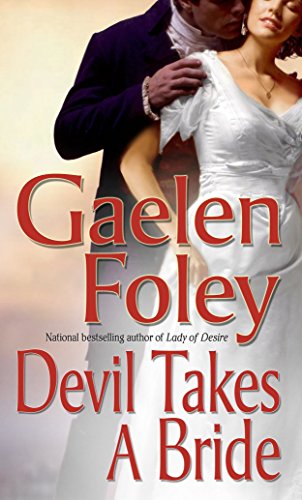
Celebrated storyteller Gaelen Foley brings her craft to new heights with Devil Takes a Bride, the seductive tale of a man bent on revenge and the beauty who teaches him to love again. . . .
In the quiet English countryside, far from the intrigues of London, Lizzie Carlisle slowly mends her broken heart, devoting herself to her new position as lady’s companion to the Dowager Viscountess Strathmore— until her peaceful life is turned upside down by a visit from “Devil” Strathmore, the old woman’s untamed nephew—a dangerously handsome man whose wicked reputation hides a tortured soul.
Devlin Kimball, Lord Strathmore, has spent years adventuring on the high seas, struggling to make his peace with the tragedy that claimed the lives of his family. But now he has uncovered the dark truth behind the so-called accident and swears retribution. He has no intention of taking a bride—until his eccentric aunt’s will forces he and Lizzie together, and Devlin finds his path to vengeance blocked by the stubborn but oh-so-tempting Miss Carlisle. Her passionate nature rivals his own. But disillusioned once by love, Lizzie will accept nothing less than his true devotion. . . .
Die Inhaltsangabe kann sich auf eine andere Ausgabe dieses Titels beziehen.
Über die Autorin bzw. den Autor
A Pennsylvania native, Gaelen Foley holds a B.A. in English literature from S.U.N.Y. College at Fredonia. It was while studying the Romantic poets, such as Wordsworth, Byron, and Shelley, that she first became interested in the Regency period, in which her novels are set. After college, she moonlighted as a waitress for five years to keep her daylight hours free for writing and honing her craft. Her dedication paid off in 1998 when Ballantine published her first novel, The Pirate Prince, which went on to win the Romantic Times Reviewers Choice Award for Best First Historical Romance. Since then, her books have won the National Readers’ Choice Award, the Bookseller’s Best Award, the Colorado Award of Excellence, the Beacon, and for two years running, the esteemed Golden Leaf.
Foley lives in Pittsburgh with her husband, Eric, and two spoiled bichons frises. She is hard at work on her next book in the Knight family series. Readers can write to her at P.O. Box 522, South Park, PA, 15129, or visit her on the Web at www.gaelenfoley.com.
Von der hinteren Coverseite
"Celebrated storyteller Gaelen Foley brings her craft to new heights with Devil Takes a Bride," the seductive tale of a man bent on revenge and the beauty who teaches him to love again. . . .
In the quiet English countryside, far from the intrigues of London, Lizzie Carlisle slowly mends her broken heart, devoting herself to her new position as lady's companion to the Dowager Viscountess Strathmore-- until her peaceful life is turned upside down by a visit from "Devil" Strathmore, the old woman's untamed nephew--a dangerously handsome man whose wicked reputation hides a tortured soul.
Devlin Kimball, Lord Strathmore, has spent years adventuring on the high seas, struggling to make his peace with the tragedy that claimed the lives of his family. But now he has uncovered the dark truth behind the so-called accident and swears retribution. He has no intention of taking a bride--until his eccentric aunt's will forces he and Lizzie together, and Devlin finds his path to vengeance blocked by the stubborn but oh-so-tempting Miss Carlisle. Her passionate nature rivals his own. But disillusioned once by love, Lizzie will accept nothing less than his true devotion. . . .
Auszug. © Genehmigter Nachdruck. Alle Rechte vorbehalten.
Chapter One
London, 1817
The fanciful cupola-topped pavilion languished in desolation on the frozen marshes south of the Thames, a gaudy ruin, with a gray February sleet blowing against its rusty, fake turrets and boarded-up windows. Some said the place was haunted. Others claimed it was cursed. All that His Lordship’s unassuming little man-of-business knew, however, was that if his glamorous patron did not soon arrive, he was sure to catch his death in this weather.
Clutching his umbrella over his head, Charles Beecham, Esquire, stood wrapped in his brown wool greatcoat, his beaver hat pulled low over his receding hairline, and a look of abject misery on his face. He sneezed abruptly into his handkerchief.
“God bless ye.” Mr. Dalloway, standing nearby, slid him a greasy grin.
“Thank you,” Charles clipped out before turning away from the unkempt property agent with a respectable humph.
Dalloway was the opposition in this matter, determined to bilk His Lordship out of three thousand pounds for the dubious privilege of owning the godforsaken place. Charles meant to advise his patron against the purchase in the strongest possible terms, not the least because it would fall to him to explain the mad expenditure to old Lady Ironsides. Stealing another discreet glance at his fob watch, he pursed his lips. Late.
Alas, his staid life as the Strathmore family’s solicitor had become alarmingly interesting since His Lordship’s return from his high adventures on the seven seas and elsewhere.
Though barely thirty, the viscount had done the sorts of things Charles preferred to read about from the safety of his favorite armchair. Her Ladyship had oft regaled Charles with tales of her dashing nephew’s exploits: battling pirates, chasing down slave ships, living with savages, fending off mountain lions, surveying temples in the wilds of Malaysia, crossing deserts with the nomad caravans of Kandahar. Charles had thought them a lot of cock-and-bull tales until he’d met the man. What on earth could he want with this place? he wondered, then rehearsed a diplomatic warning in his head: This, my lord, is precisely the sort of rash adventure that drove your uncle into dun territory. . . .
Ah, but thinking a thing and saying it to Devil Strathmore were two different matters entirely.
Just then, a drumming sound approached from behind the wintry shroud of pewter fog and needling rain, like thunder rumbling in the distance. Barely discernible at first, it swiftly formed into the deep, recognizable rhythm of pounding hoofbeats.
At last. Charles stared in the direction of the plea- sure grounds’ great iron gates. The ominous cadence grew louder—driving, relentless—reverberating across the marshes, until it shook the earth. Suddenly, a large black coach hurtled out of the indistinguishable gray, barreling up the graveled drive that offered the only safe course through the boggy waste.
The quartet of fine, jet-black horses moved like liquid night, their hooves striking sure over the mud and ice, steam puffing from their nostrils. Stationed fore and aft on the shiny body of the coach, His Lordship’s driver, groom, and two footmen stared straight ahead, impervious to the weather. They were clad in traditional Strathmore livery, a sedate dun color with smart black piping, stiff felt tricornes on their heads, and frothy, white lace jabots at their throats.
Charles looked askance at his opponent as Mr. Dalloway ambled down from his shelter atop the flamboyant curved steps of the pavilion. His wily stare was fixed on the approaching vehicle. Noting the gleam of greed in Dalloway’s eyes, Charles fretted with the unhappy premonition that his rival would win the day, and then what on earth would he tell Her Ladyship? He could only cork his terror at the thought of the formidable dowager’s displeasure by reminding himself of her stern orders seven months ago, upon her nephew’s return to London.
“Send all of Devlin’s bills to me,” the old dragon had instructed in no uncertain terms. When Charles had tactfully questioned the command, seeking only to pro- tect the elderly woman, Her Ladyship had pooh-poohed his hesitancy. “It is enough that he has come home at last, Charles. My handsome nephew must cut a dash in Town! You will send his bills to me.”
And so, obediently, Charles had.
His Lordship’s bills, like a flock of ink-smudged doves, had winged their way to the dowager’s elegant villa in the Bath countryside: the handsome house on Portman Street and all its elegant furnishings, Aubusson carpets, French damask drapes, Classical paintings and nude marble statues; the wine cellar; the staff’s wages; the coach, the drag, the curricle; the horses; the clothes; the boots; the club dues for White’s and Brooke’s; the opera box, the parties, the jewels for himself and a number of unnamed women; even the IOU’s from a few unlucky hands at the gaming tables. Dear old Aunt Augusta had paid them all without a peep. But three thousand quid for an old, abandoned pleasure-ground? It seemed excessive even for him.
As his coachman pulled the team to a halt in front of the pavilion, Charles swallowed hard, his heart beating faster. The footmen jumped down from their post in back of the coach and marched forward like soulless clockwork automata, one opening the carriage door, the other producing an umbrella, which he held at the ready. Dalloway cast Charles a nervous glance, no longer looking quite so cocky.
“You haven’t met His Lordship yet, have you?” Charles murmured under his breath, feeling a trifle smug.
Dalloway did not answer. He looked again at the coach, where the footman knocked down the folding metal steps and then held the door, staring forward in stone-faced efficiency.
The first person to climb out of the coach was the amiable Bennett Freeman, a neatly dressed, young black man from America who served as His Lordship’s gentleman’s gentleman, had followed him on his journeys around the globe, and attended the viscount in much of his day-to-day business. Behind his wire-rimmed spectacles, Mr. Freeman’s intelligent brown eyes scanned the bizarre location with a perplexed glance, but when he saw Charles, he waved affably and dashed toward the pavilion to escape the weather.
Next, a dainty, gloved hand emerged from the carriage, accepting the footman’s assistance. Charles sneezed again as His Lordship’s latest elegant ladybird stepped down from the coach and minced toward the stairs, teetering over the mud on her high metal pattens. It was not her clothes but her mercenary eyes and wiggly walk that gave away her profession—these days the top courtesans dressed as fine as the ton’s best hostesses. She wore a tight spencer of maroon velvet and held up her skirts with one gloved hand, while with the other, she tried to shield her magnificent hat with its clutch of ostrich plumes from the steady drizzle.
Gentleman enough to show chivalry even to her sort, Charles hurried over and gave the high-priced harlot his umbrella.
“Oh, thank you, sir,” she responded in a breathy purr.
Dalloway eagerly assisted the hussy in going up the wet stairs.
Last of all came Devil Strathmore.
The footman with the umbrella had to hold his arm higher in order to shelter his towering master from the weather. His Lordship slid out of the coach with a sinuous motion, then paused to adjust the fur-trimmed greatcoat of luxurious black wool that hung carelessly from his massive shoulders and draped his powerful frame. Small, tinted spectacles shaded his eyes from the flat, gray glare of afternoon; he wore his long,...
„Über diesen Titel“ kann sich auf eine andere Ausgabe dieses Titels beziehen.
Suchergebnisse für Devil Takes a Bride (Knight Miscellany, Band 5)

Beispielbild für diese ISBN
Devil Takes a Bride (Knight Miscellany)
Verlag:
Ivy Books (edition First Edition), 2004
ISBN 10: 0804119759
ISBN 13: 9780804119757
Gebraucht
Mass Market Paperback
Erstausgabe
Anbieter: BooksRun, Philadelphia, PA, USA
Verkäuferbewertung 5 von 5 Sternen

Mass Market Paperback. Zustand: Fair. First Edition. The item might be beaten up but readable. May contain markings or highlighting, as well as stains, bent corners, or any other major defect, but the text is not obscured in any way. Artikel-Nr. 0804119759-7-1
Gebraucht kaufen
EUR 5,53
Versand gratis
Versand innerhalb von USA
Versand innerhalb von USA
Anzahl: 1 verfügbar
Beispielbild für diese ISBN
Devil Takes a Bride
Verlag:
Random House Publishing Group, 2004
ISBN 10: 0804119759
ISBN 13: 9780804119757
Gebraucht
Softcover
Erstausgabe
Anbieter: Better World Books, Mishawaka, IN, USA
Verkäuferbewertung 5 von 5 Sternen
Zustand: Good. 1st. Pages intact with minimal writing/highlighting. The binding may be loose and creased. Dust jackets/supplements are not included. Stock photo provided. Product includes identifying sticker. Better World Books: Buy Books. Do Good. Artikel-Nr. GRP97903069
Gebraucht kaufen
EUR 6,19
Versand gratis
Versand innerhalb von USA
Versand innerhalb von USA
Anzahl: 2 verfügbar
Beispielbild für diese ISBN
Devil Takes a Bride
Verlag:
Random House Publishing Group, 2004
ISBN 10: 0804119759
ISBN 13: 9780804119757
Gebraucht
Softcover
Erstausgabe
Anbieter: Better World Books: West, Reno, NV, USA
Verkäuferbewertung 5 von 5 Sternen
Zustand: Good. 1st. Former library copy. Pages intact with minimal writing/highlighting. The binding may be loose and creased. Dust jackets/supplements are not included. Includes library markings. Stock photo provided. Product includes identifying sticker. Better World Books: Buy Books. Do Good. Artikel-Nr. GRP20031812
Gebraucht kaufen
EUR 6,19
Versand gratis
Versand innerhalb von USA
Versand innerhalb von USA
Anzahl: 1 verfügbar
Beispielbild für diese ISBN
Devil Takes a Bride
Anbieter: World of Books (was SecondSale), Montgomery, IL, USA
Verkäuferbewertung 5 von 5 Sternen
Zustand: Fair. Celebrated storyteller Gaelen Foley brings her craft to new heights with Devil Takes a Bride, the seductive tale of a man bent on revenge and the beauty who teaches him to love again. . . . In the quiet English countryside, far from the intrigues of London, Lizzie Carlisle slowly mends her broken heart, devoting herself to her new position as lady's companion to the Dowager Viscountess Strathmore-- until her peaceful life is turned upside down by a visit from "Devil" Strathmore, the old woman's untamed nephew--a dangerously handsome man whose wicked reputation hides a tortured soul. Devlin Kimball, Lord Strathmore, has spent years adventuring on the high seas, struggling to make his peace with the tragedy that claimed the lives of his family. But now he has uncovered the dark truth behind the so-called accident and swears retribution. He has no intention of taking a bride--until his eccentric aunt's will forces he and Lizzie together, and Devlin finds his path to vengeance blocked by the stubborn but oh-so-tempting Miss Carlisle. Her passionate nature rivals his own. But disillusioned once by love, Lizzie will accept nothing less than his true devotion. . . . Artikel-Nr. 00094691608
Gebraucht kaufen
EUR 6,56
Versand gratis
Versand innerhalb von USA
Versand innerhalb von USA
Anzahl: 1 verfügbar
Beispielbild für diese ISBN
Devil Takes a Bride
Anbieter: World of Books (was SecondSale), Montgomery, IL, USA
Verkäuferbewertung 5 von 5 Sternen
Zustand: Good. Celebrated storyteller Gaelen Foley brings her craft to new heights with Devil Takes a Bride, the seductive tale of a man bent on revenge and the beauty who teaches him to love again. . . . In the quiet English countryside, far from the intrigues of London, Lizzie Carlisle slowly mends her broken heart, devoting herself to her new position as lady's companion to the Dowager Viscountess Strathmore-- until her peaceful life is turned upside down by a visit from "Devil" Strathmore, the old woman's untamed nephew--a dangerously handsome man whose wicked reputation hides a tortured soul. Devlin Kimball, Lord Strathmore, has spent years adventuring on the high seas, struggling to make his peace with the tragedy that claimed the lives of his family. But now he has uncovered the dark truth behind the so-called accident and swears retribution. He has no intention of taking a bride--until his eccentric aunt's will forces he and Lizzie together, and Devlin finds his path to vengeance blocked by the stubborn but oh-so-tempting Miss Carlisle. Her passionate nature rivals his own. But disillusioned once by love, Lizzie will accept nothing less than his true devotion. . . . Artikel-Nr. 00100097378
Gebraucht kaufen
EUR 6,56
Versand gratis
Versand innerhalb von USA
Versand innerhalb von USA
Anzahl: 2 verfügbar
Beispielbild für diese ISBN
Devil Takes a Bride
Anbieter: World of Books (was SecondSale), Montgomery, IL, USA
Verkäuferbewertung 5 von 5 Sternen
Zustand: Very Good. Celebrated storyteller Gaelen Foley brings her craft to new heights with Devil Takes a Bride, the seductive tale of a man bent on revenge and the beauty who teaches him to love again. . . . In the quiet English countryside, far from the intrigues of London, Lizzie Carlisle slowly mends her broken heart, devoting herself to her new position as lady's companion to the Dowager Viscountess Strathmore-- until her peaceful life is turned upside down by a visit from "Devil" Strathmore, the old woman's untamed nephew--a dangerously handsome man whose wicked reputation hides a tortured soul. Devlin Kimball, Lord Strathmore, has spent years adventuring on the high seas, struggling to make his peace with the tragedy that claimed the lives of his family. But now he has uncovered the dark truth behind the so-called accident and swears retribution. He has no intention of taking a bride--until his eccentric aunt's will forces he and Lizzie together, and Devlin finds his path to vengeance blocked by the stubborn but oh-so-tempting Miss Carlisle. Her passionate nature rivals his own. But disillusioned once by love, Lizzie will accept nothing less than his true devotion. . . . Artikel-Nr. CIN0804119759VG
Gebraucht kaufen
EUR 6,56
Versand gratis
Versand innerhalb von USA
Versand innerhalb von USA
Anzahl: 1 verfügbar
Beispielbild für diese ISBN
Devil Takes a Bride
Verlag:
Random House Publishing Group, 2004
ISBN 10: 0804119759
ISBN 13: 9780804119757
Gebraucht
Mass Market Paperback
Anbieter: ThriftBooks-Dallas, Dallas, TX, USA
Verkäuferbewertung 5 von 5 Sternen
Mass Market Paperback. Zustand: Good. No Jacket. Former library book; Pages can have notes/highlighting. Spine may show signs of wear. ~ ThriftBooks: Read More, Spend Less. Artikel-Nr. G0804119759I3N10
Gebraucht kaufen
EUR 6,91
Versand gratis
Versand innerhalb von USA
Versand innerhalb von USA
Anzahl: 1 verfügbar
Beispielbild für diese ISBN
Devil Takes a Bride
Verlag:
Random House Publishing Group, 2004
ISBN 10: 0804119759
ISBN 13: 9780804119757
Gebraucht
Mass Market Paperback
Anbieter: ThriftBooks-Atlanta, AUSTELL, GA, USA
Verkäuferbewertung 5 von 5 Sternen
Mass Market Paperback. Zustand: Good. No Jacket. Former library book; Pages can have notes/highlighting. Spine may show signs of wear. ~ ThriftBooks: Read More, Spend Less. Artikel-Nr. G0804119759I3N10
Gebraucht kaufen
EUR 6,91
Versand gratis
Versand innerhalb von USA
Versand innerhalb von USA
Anzahl: 1 verfügbar
Beispielbild für diese ISBN
Devil Takes a Bride
Verlag:
Random House Publishing Group, 2004
ISBN 10: 0804119759
ISBN 13: 9780804119757
Gebraucht
Mass Market Paperback
Anbieter: ThriftBooks-Reno, Reno, NV, USA
Verkäuferbewertung 5 von 5 Sternen
Mass Market Paperback. Zustand: Good. No Jacket. Pages can have notes/highlighting. Spine may show signs of wear. ~ ThriftBooks: Read More, Spend Less. Artikel-Nr. G0804119759I3N00
Gebraucht kaufen
EUR 6,91
Versand gratis
Versand innerhalb von USA
Versand innerhalb von USA
Anzahl: 1 verfügbar
Beispielbild für diese ISBN
Devil Takes a Bride
Verlag:
Random House Publishing Group, 2004
ISBN 10: 0804119759
ISBN 13: 9780804119757
Gebraucht
Mass Market Paperback
Anbieter: ThriftBooks-Atlanta, AUSTELL, GA, USA
Verkäuferbewertung 5 von 5 Sternen
Mass Market Paperback. Zustand: Good. No Jacket. Pages can have notes/highlighting. Spine may show signs of wear. ~ ThriftBooks: Read More, Spend Less. Artikel-Nr. G0804119759I3N00
Gebraucht kaufen
EUR 6,91
Versand gratis
Versand innerhalb von USA
Versand innerhalb von USA
Anzahl: 1 verfügbar