
Verwandte Artikel zu Code Talker: A Novel About the Navajo Marines of World...
Inhaltsangabe
Throughout World War II, in the conflict fought against Japan, Navajo code talkers were a crucial part of the U.S. effort, sending messages back and forth in an unbreakable code that used their native language. They braved some of the heaviest fighting of the war, and with their code, they saved countless American lives. Yet their story remained classified for more than twenty years.
But now Joseph Bruchac brings their stories to life for young adults through the riveting fictional tale of Ned Begay, a sixteen-year-old Navajo boy who becomes a code talker. His grueling journey is eye-opening and inspiring. This deeply affecting novel honors all of those young men, like Ned, who dared to serve, and it honors the culture and language of the Navajo Indians.
Die Inhaltsangabe kann sich auf eine andere Ausgabe dieses Titels beziehen.
Über die Autorin bzw. den Autor
Joseph Bruchac is a highly acclaimed children's book author, poet, novelist and storyteller, as well as a scholar of Native American culture. Coauthor with Michael Caduto of the bestselling Keepers of the Earth series, Bruchac's poems, articles and stories have appeared in hundreds of publications, from Akwesasne Notes and American Poetry Review to National Geographic and Parabola. He has authored many books for adults and children including Code Talker: A Novel About the Navajo Marines of World War Two, Skeleton Man, and The Heart of a Chief. For more information about Joseph, please visit his website www.josephbruchac.com.
Auszug. © Genehmigter Nachdruck. Alle Rechte vorbehalten.
NAVAJOS WANTED.
Grandchildren, you asked me about this medal of mine. There is much to be said about it. This small piece of metal holds a story that I was not allowed to speak for many winters. It is the true story of how Navajo Marines helped America win a great war. There is much that I must remember to speak for this medal, to tell its story as it should be told. I must remember not only the great secret with which I was trusted, but also all that happened to me and those like me. That is a lot. But I think that I can do it well enough. After all, I was expected to remember, as were the other men trained with me. The lives of many men depended entirely on our memories.
OTHER BOOKS BY JOSEPH BRUCHAC
The Arrow Over the Door
Children of the Longhouse
Eagle’s Song
The Heart of a Chief
The Winter People
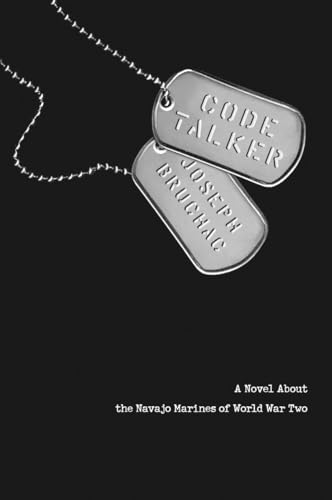
CODE TALKER
A Novel About the Navajo Marines of World War Two
JOSEPH BRUCHAC
Listen, My Grandchildren
Grandchildren, you asked me about this medal of mine. There is much to be said about it. This small piece of metal holds a story that I was not allowed to speak for many winters. It is the true story of how Navajo Marines helped America win a great war. There is much that I must remember to speak for this medal, to tell its story as it should be told. I must remember not only the great secret with which I was trusted, but also all that happened to me and those like me. That is a lot. But I think that I can do it well enough. After all, I was expected to remember, as were the other men trained with me. The lives of many men depended entirely on our memories.
Look here. The man you see riding a horse on the back of this medal was an Indian. He is also one of those raising that flag there behind him. I knew him when we were both young men. His name was Ira Hayes. He was a fine person, even though he was not one of our people, but Akimel O’odam, a Pima Indian. We both fought on a distant island far off in the Pacific Ocean. There was smoke all around us from the exploding shells, the snapping sound of Japanese .25 caliber rifles, the thumping of mortars, and the rattling of machine guns. We could hear the pitiful cries of wounded men, our own Marines and the enemy soldiers, too.
It was a terrible battle. But our men were determined as they struggled up that little mountain. On top of it is where Ira was photographed, raising the flag of Nihimá. I was not one of those who fought to the top of Mount Suribachi, but I had my own special part to play. I helped send the message about our success, about the brave deeds so many Marines did that day for Nihimá.
Nihimá, “Our Mother.” That is the Navajo word we chose to mean our country, this United States. It was a good name to use. When we Indians fought on those far-off islands, we always kept the thought in our minds that we were defending Our Mother, the sacred land that sustains us.
Nihimá is only one of the Navajo words we chose for places with bilagáanaa names. South America became Sha-de-ah-Nihimá, “Our Mother to the South.” Alaska we called Bee hai, “With Winter.” Because we knew that Britain is an island, we gave it the name of Tó tah, “Surrounded by Water.” When we did not know much about a place, we described something about the people there. So we named Germany Béésh bich’ahii, “Iron Hat,” and Japan was Bináá’ádaálts’ozí, “Slant-eyed.”
Sometimes we didn’t know much about either the country or the people there, but that did not stop us. We used our sense of humor and played with the English. The word we used for Spain was Dibé diniih, which means “Sheep Pain.”
But I am getting ahead of myself. I have not even explained to you yet why we made up such names. I have not told you why being able to speak our Navajo language, the same Navajo language they tried to beat out of me when I was a child, was so important during World War Two. It was because I was a Navajo code talker.
What was a code talker and what did we code talkers do? Why was the secret we shared so great that we could not tell even our families about it until long after the war ended?
You cannot weave a rug before you set up the loom. So I will go back to the beginning, pound the posts in the ground, and build the frame. I will start where my own story of words and warriors begins.
CHAPTER ONE
Sent Away
I was only six years old and I was worried. I sat behind our hogan, leaning against its familiar walls and looking up toward the mesa. I hoped I would see an eagle, for that would be a good sign. I also hoped I would not hear anyone call my name, for that would be a sign of something else entirely. But the eagle did not appear. Instead, my mother’s voice, not much louder than a whisper, broke the silence.
“Kii Yázhí, come. Your uncle is in the wagon.”
The moment I dreaded had arrived. I stood and looked toward the hills. I could run up there and hide. But I did not do so, for I had always obeyed my mother—whose love for me was as certain as the firmness of the sacred earth beneath my moccasins. However, I did drag my feet as I came out from behind our hogan to see what I knew I would see. There stood my tall, beautiful mother. Her thick black hair was tied up into a bun. She was dressed in her finest clothing—a new, silky blue blouse and a blue pleated skirt decorated with bands of gold ribbons. On her feet were soft calf-high moccasins, and she wore all her silver and turquoise jewelry. Her squash-blossom necklace, her bracelets, her concha belt, her earrings—I knew she had adorned herself with all of these things for me. She wanted me to have this image of her to keep in my mind, to be with me when I was far from home.
However, the thing I saw most clearly was what she held in her arms. It was a small bundle of my clothes tied in a blanket. My heart sank. I really was going to be sent away.
My mother motioned toward the door of our hogan and I went inside. My great-grandfather was waiting for me on his bed. He was too weak to walk and was so old that he had shrunk in size. He had never been a big man, but now he was almost as small as me. Great-grandfather took my hand in both of his.
“Be strong, Kii Yázhí,” he rasped, his voice as creaky as an old saddle. I stood up on my toes so that I could put my arms around his neck and then pressed my cheek against his leathery face. “Kii Yázhí,” he said again, patting my back. “Our dear little boy.”
I had always been small for my age. My father used to tease me about it, saying that when I was born he made my cradleboard out of the handle of a wooden spoon. My baby name was Awéé Yázhí. Little Baby. Little I was and little I stayed. I went from being Awéé Yázhí, Little Baby, to Kii Yázhí, Little Boy.
“You are small,” my grandfather said, as if he could hear what I was thinking. “But your heart is large. You will do your best.”
I nodded.
When I stepped outside, my mother bent down and embraced me much harder than my grandfather had hugged me. Then she stepped back to stand by the door of our hogan.
“Travel safely, my son,” Mother said. Her voice was so sad.
My father came up to me and put his broad, calloused hands on my shoulders. He, too, was wearing his best clothing and jewelry. Though he said nothing, I think Father was even sadder than my mother, so sad that words failed him. He was shorter...
„Über diesen Titel“ kann sich auf eine andere Ausgabe dieses Titels beziehen.
Weitere beliebte Ausgaben desselben Titels

Suchergebnisse für Code Talker: A Novel About the Navajo Marines of World...

Beispielbild für diese ISBN
Code Talker: A Novel About the
Anbieter: World of Books (was SecondSale), Montgomery, IL, USA
Verkäuferbewertung 5 von 5 Sternen

Zustand: Good. Item in good condition. Textbooks may not include supplemental items i.e. CDs, access codes etc. Artikel-Nr. 00106045763
Gebraucht kaufen
EUR 3,93
Versand gratis
Versand innerhalb von USA
Versand innerhalb von USA
Anzahl: 2 verfügbar
Beispielbild für diese ISBN
Code Talker: A Novel About the
Anbieter: World of Books (was SecondSale), Montgomery, IL, USA
Verkäuferbewertung 5 von 5 Sternen
Zustand: Acceptable. Item in acceptable condition! Textbooks may not include supplemental items i.e. CDs, access codes etc. Artikel-Nr. 00105563124
Gebraucht kaufen
EUR 3,93
Versand gratis
Versand innerhalb von USA
Versand innerhalb von USA
Anzahl: 1 verfügbar
Beispielbild für diese ISBN
Code Talker: A Novel About the Navajo Marines of World War Two
Anbieter: BooksRun, Philadelphia, PA, USA
Verkäuferbewertung 5 von 5 Sternen
Hardcover. Zustand: Fair. With dust jacket. The item might be beaten up but readable. May contain markings or highlighting, as well as stains, bent corners, or any other major defect, but the text is not obscured in any way. Artikel-Nr. 0803729219-7-1-29
Gebraucht kaufen
EUR 5,17
Versand gratis
Versand innerhalb von USA
Versand innerhalb von USA
Anzahl: 1 verfügbar
Beispielbild für diese ISBN
Code Talker: A Novel about the Navajo Marines of World War Two
Anbieter: ThriftBooks-Dallas, Dallas, TX, USA
Verkäuferbewertung 5 von 5 Sternen
Hardcover. Zustand: Good. No Jacket. Former library book; Pages can have notes/highlighting. Spine may show signs of wear. ~ ThriftBooks: Read More, Spend Less. Artikel-Nr. G0803729219I3N10
Gebraucht kaufen
EUR 5,86
Versand gratis
Versand innerhalb von USA
Versand innerhalb von USA
Anzahl: 1 verfügbar
Beispielbild für diese ISBN
Code Talker: A Novel about the Navajo Marines of World War Two
Anbieter: ThriftBooks-Dallas, Dallas, TX, USA
Verkäuferbewertung 5 von 5 Sternen
Hardcover. Zustand: Good. No Jacket. Missing dust jacket; Pages can have notes/highlighting. Spine may show signs of wear. ~ ThriftBooks: Read More, Spend Less. Artikel-Nr. G0803729219I3N01
Gebraucht kaufen
EUR 5,86
Versand gratis
Versand innerhalb von USA
Versand innerhalb von USA
Anzahl: 1 verfügbar
Beispielbild für diese ISBN
Code Talker: A Novel about the Navajo Marines of World War Two
Anbieter: ThriftBooks-Phoenix, Phoenix, AZ, USA
Verkäuferbewertung 5 von 5 Sternen
Hardcover. Zustand: Good. No Jacket. Former library book; Pages can have notes/highlighting. Spine may show signs of wear. ~ ThriftBooks: Read More, Spend Less. Artikel-Nr. G0803729219I3N10
Gebraucht kaufen
EUR 5,86
Versand gratis
Versand innerhalb von USA
Versand innerhalb von USA
Anzahl: 1 verfügbar
Beispielbild für diese ISBN
Code Talker: A Novel about the Navajo Marines of World War Two
Anbieter: ThriftBooks-Reno, Reno, NV, USA
Verkäuferbewertung 5 von 5 Sternen
Hardcover. Zustand: Fair. No Jacket. Former library book; Readable copy. Pages may have considerable notes/highlighting. ~ ThriftBooks: Read More, Spend Less. Artikel-Nr. G0803729219I5N10
Gebraucht kaufen
EUR 5,86
Versand gratis
Versand innerhalb von USA
Versand innerhalb von USA
Anzahl: 1 verfügbar
Beispielbild für diese ISBN
Code Talker: A Novel about the Navajo Marines of World War Two
Anbieter: ThriftBooks-Atlanta, AUSTELL, GA, USA
Verkäuferbewertung 5 von 5 Sternen
Hardcover. Zustand: Fair. No Jacket. Readable copy. Pages may have considerable notes/highlighting. ~ ThriftBooks: Read More, Spend Less. Artikel-Nr. G0803729219I5N00
Gebraucht kaufen
EUR 5,86
Versand gratis
Versand innerhalb von USA
Versand innerhalb von USA
Anzahl: 1 verfügbar
Beispielbild für diese ISBN
Code Talker: A Novel about the Navajo Marines of World War Two
Anbieter: ThriftBooks-Reno, Reno, NV, USA
Verkäuferbewertung 5 von 5 Sternen
Hardcover. Zustand: Good. No Jacket. Missing dust jacket; Pages can have notes/highlighting. Spine may show signs of wear. ~ ThriftBooks: Read More, Spend Less. Artikel-Nr. G0803729219I3N01
Gebraucht kaufen
EUR 5,86
Versand gratis
Versand innerhalb von USA
Versand innerhalb von USA
Anzahl: 1 verfügbar
Beispielbild für diese ISBN
Code Talker: A Novel about the Navajo Marines of World War Two
Anbieter: ThriftBooks-Dallas, Dallas, TX, USA
Verkäuferbewertung 5 von 5 Sternen
Hardcover. Zustand: Fair. No Jacket. Former library book; Readable copy. Pages may have considerable notes/highlighting. ~ ThriftBooks: Read More, Spend Less. Artikel-Nr. G0803729219I5N10
Gebraucht kaufen
EUR 5,86
Versand gratis
Versand innerhalb von USA
Versand innerhalb von USA
Anzahl: 1 verfügbar