
Verwandte Artikel zu Bringing the Dark Past to Light: The Reception of the...
Inhaltsangabe
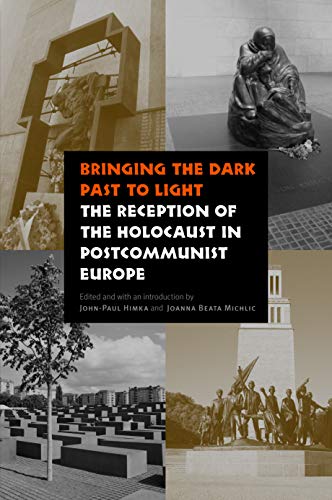
Despite the Holocaust’s profound impact on the history of Eastern Europe, the communist regimes successfully repressed public discourse about and memory of this tragedy. Since the collapse of communism in 1989, however, this has changed. Not only has a wealth of archival sources become available, but there have also been oral history projects and interviews recording the testimonies of eyewitnesses who experienced the Holocaust as children and young adults. Recent political, social, and cultural developments have facilitated a more nuanced and complex understanding of the continuities and discontinuities in representations of the Holocaust. People are beginning to realize the significant role that memory of Holocaust plays in contemporary discussions of national identity in Eastern Europe.
This volume of original essays explores the memory of the Holocaust and the Jewish past in postcommunist Eastern Europe. Devoting space to every postcommunist country, the essays in Bringing the Dark Past to Light explore how the memory of the “dark pasts” of Eastern European nations is being recollected and reworked. In addition, it examines how this memory shapes the collective identities and the social identity of ethnic and national minorities. Memory of the Holocaust has practical implications regarding the current development of national cultures and international relationships.
Die Inhaltsangabe kann sich auf eine andere Ausgabe dieses Titels beziehen.
Über die Autorin bzw. den Autor
John-Paul Himka is a professor of history and classics at the University of Alberta. He is the author of Last Judgment Iconography in the Carpathians. Joanna Beata Michlic is the director and founder of the Hadassah–Brandeis Institute Project on Families, Children, and the Holocaust at Brandeis University and is the author of Poland’s Threatening Other (Nebraska, 2006).
Auszug. © Genehmigter Nachdruck. Alle Rechte vorbehalten.
Bringing the Dark Past to Light
The Reception of the Holocaust in Postcommunist Europe
By John-Paul Himka, Joanna Beata MichlicUNIVERSITY OF NEBRASKA PRESS
Copyright © 2013 Board of Regents of the University of Nebraska
All rights reserved.
ISBN: 978-0-8032-2544-2All rights reserved.
Contents
List of Illustrations,
Preface and Acknowledgments,
Introduction JOHN-PAUL HIMKA & JOANNA BEATA MICHLIC,
1. "Our Conscience Is Clean": Albanian Elites and the Memory of the Holocaust in Postsocialist Albania DANIEL PEREZ,
2. The Invisible Genocide: The Holocaust in Belarus PER ANDERS RUDLING,
3. Contemporary Responses to the Holocaust in Bosnia and Herzegovina FRANCINE FRIEDMAN,
4. Debating the Fate of Bulgarian Jews during World War II JOSEPH BENATOV,
5. Representations of the Holocaust and Historical Debates in Croatia since 1989 MARK BIONDICH,
6. The Sheep of Lidice: The Holocaust and the Construction of Czech National History MICHAL FRANKL,
7. Victim of History: Perceptions of the Holocaust in Estonia ANTON WEISS-WENDT,
8. Holocaust Remembrance in the German Democratic Republic—and Beyond PETER MONTEATH,
9. The Memory of the Holocaust in Postcommunist Hungary,
Part 1: The Politics of Holocaust Memory PAUL HANEBRINK,
Part 2: Cinematic Memory of the Holocaust CATHERINE PORTUGES,
10. The Transformation of Holocaust Memory in Post-Soviet Latvia BELLA ZISERE,
11. Conflicting Memories: The Reception of the Holocaust in Lithuania SAULIUS SUzIEDeLIS & šARuNAS LIEKIS,
12. The Combined Legacies of the "Jewish Question" and the "Macedonian Question" HOLLY CASE,
13. Public Discourses on the Holocaust in Moldova: Justification, Instrumentalization, and Mourning VLADIMIR SOLONARI,
14. The Memory of the Holocaust in Post-1989 Poland: Renewal—Its Accomplishments and Its Powerlessness JOANNA BEATA MICHLIC & MA?GORZATA MELCHIOR,
15. Public Perceptions of the Holocaust in Postcommunist Romania FELICIA WALDMAN & MIHAI CHIOVEANU,
16. The Reception of the Holocaust in Russia: Silence, Conspiracy, and Glimpses of Light KLAS-GöRAN KARLSSON,
17. Between Marginalization and Instrumentalization: Holocaust Memory in Serbia since the Late 1980s JOVAN BYFORD,
18. The "Unmasterable Past"? The Reception of the Holocaust in Postcommunist Slovakia NINA PAULOVIcOVá,
19. On the Periphery: Jews, Slovenes, and the Memory of the Holocaust GREGOR JOSEPH KRANJC,
20. The Reception of the Holocaust in Postcommunist Ukraine JOHN-PAUL HIMKA,
Conclusion OMER BARTOV,
Contributors,
Index,
CHAPTER 1
"Our Conscience Is Clean"
Albanian Elites and the Memory of the Holocaust in Postsocialist Albania
Compared to the contentious postsocialist debates over the Holocaust that have occurred in the other countries of Eastern Europe, the wartime history of prewar Albania's 156 native Jews has generated scant public attention and scholarly research both in Albania and abroad. Nearly all Albania's Jews and hundreds of nonnative refugees survived the Second World War in Albania. A small group of government officials, historians, and journalists based in the country's capital, Tirana, formulated Albania's first published perceptions of the Holocaust after the fall of Albanian communism in 1992. Albanian elites have since addressed the subject within the context of issues that tend to arouse broader Albanian public interest and controversy than does the Holocaust itself, such as the present-day rehabilitation of prominent Albanian leaders persecuted by the country's communist dictatorship, and Kosovo's independence movement. Elite Albanian perceptions of the Holocaust also reflect the spirit and biases behind contemporary government-scholarly initiatives to rewrite twentieth-century national history and debunk the tenets of Albania's socialist historical scholarship. In official, scholarly, and media representations, the Final Solution resembles the Albanian communist persecution of Albanians in 1945–91 and the Serbian military and political oppression of Kosovar Albanians in the 1990s. Further, the Holocaust symbolizes Albanians' sense of humanity, which drove the nation to rescue Jews from being deported by occupation forces to extermination camps in Axis-occupied Europe. Drawing primarily on Albanian historical literature, newspapers, and interviews, this chapter analyzes the work and research motivations of Albanian elites who have writtenthe country's nascent Holocaust narrative since the collapse of communism in Albania.
Albanians and Jews during the Second World War
Italy invaded Albania on 7 April 1939 and then annexed the country of approximately one million people. Following the German invasion of Yugoslavia in April 1941, German foreign minister Joachim von Ribbentrop and his Italian counterpart, Count Galeazzo Ciano, agreed to transfer portions of Kosovo, western Macedonia, and southern Montenegro — all with Albanian majorities — to Italian-occupied Albania. Germany took over the Albanian territories incorporated by Italy after Rome's formal surrender in September 1943. German military offensives against communist-led Albanian partisan forces began in the winter of 1943–44 but failed to prevent the resistance movement's takeover of most of Albania's southern territories by October 1944. Following the German retreat from Albania in November 1944, Josip Broz Tito's Yugoslav partisans suppressed a local Albanian rebellion in Kosovo in February 1945 and then reinstated Yugoslav jurisdiction over the region.
The shortage of research into Albanian wartime history as a whole and the dearth of primary sources specifically related to Albanian Jews make it difficult to reconstruct even a basic narrative of the Holocaust in Albania. The scant literature permits only tentative answers to questions concerning Axis policy toward Jews in Albania, the level of policy implementation, and local–Axis collaboration in the execution of policy. After invading Albania, fascist Italian authorities, under the direction of viceroy general Francesco Jacomoni, introduced Italian legislation that prohibited Jewish emigration to Albania and mandated the deportation of foreign Jews. The Albanian interior ministry forwarded Jacomoni's instructions to the local prefectures, but the level of compliance of Italian subordinates and local Albanian officials is unclear. To deter Jewish emigration, Jacomoni ordered the house arrest of foreign Jews or their confinement in concentration camps that Italian authorities had set up in the Albanian interior in 1940. The nonnative Jewish population in Albania, however, continued to increase, reaching one thousand in June 1943, according to Italian estimates.
Explaining the difference in the fates of Jews in the annexed territories of Kosovo and those in the Albanian interior presents a particularly difficult challenge for Albanian historians. Five hundred to six hundred Sephardim inhabited the territories of Kosovo prior to the Second World War. Prishtina was Kosovo's economic center and home to the region's largest Jewish community, around four hundred out of a population of sixteen thousand. During the Italian and German occupations of Albania, an unknown number of native and nonnative Jews were transferred from Kosovo to the Reich and the Albanian interior, while, according to testimonies in the Yad Vashem files of the Righteous among the Nations, only two Jewish families were deported...
„Über diesen Titel“ kann sich auf eine andere Ausgabe dieses Titels beziehen.
Suchergebnisse für Bringing the Dark Past to Light: The Reception of the...

Beispielbild für diese ISBN
Bringing the Dark Past to Light: The Reception of the Holocaust in Postcommunist Europe
Verlag:
University of Nebraska Press (edition 0), 2013
ISBN 10: 080322544X
ISBN 13: 9780803225442
Gebraucht
Hardcover
Anbieter: BooksRun, Philadelphia, PA, USA
Verkäuferbewertung 5 von 5 Sternen

Hardcover. Zustand: Very Good. 0. With dust jacket. It's a well-cared-for item that has seen limited use. The item may show minor signs of wear. All the text is legible, with all pages included. It may have slight markings and/or highlighting. Artikel-Nr. 080322544X-8-1-29
Gebraucht kaufen
EUR 12,03
Versand gratis
Versand innerhalb von USA
Versand innerhalb von USA
Anzahl: 1 verfügbar
Beispielbild für diese ISBN
Bringing the Dark Past to Ligh
Verlag:
University of Nebraska Press, 2013
ISBN 10: 080322544X
ISBN 13: 9780803225442
Gebraucht
Hardcover
Anbieter: World of Books (was SecondSale), Montgomery, IL, USA
Verkäuferbewertung 5 von 5 Sternen
Zustand: Very Good. Item in very good condition! Textbooks may not include supplemental items i.e. CDs, access codes etc. Artikel-Nr. 00110641617
Gebraucht kaufen
EUR 12,38
Versand gratis
Versand innerhalb von USA
Versand innerhalb von USA
Anzahl: 1 verfügbar
Beispielbild für diese ISBN
Bringing the Dark Past to Light: The Reception of the Holocaust in Postcommunist Europe
Anbieter: Ria Christie Collections, Uxbridge, Vereinigtes Königreich
Verkäuferbewertung 5 von 5 Sternen
Zustand: New. In English. Artikel-Nr. ria9780803225442_new
Neu kaufen
EUR 66,72
EUR 17,65 Versand
Versand von Vereinigtes Königreich nach USA
Versand von Vereinigtes Königreich nach USA
Anzahl: 1 verfügbar
Beispielbild für diese ISBN
Bringing the Dark Past to Light
Anbieter: PBShop.store UK, Fairford, GLOS, Vereinigtes Königreich
Verkäuferbewertung 5 von 5 Sternen
HRD. Zustand: New. New Book. Shipped from UK. Established seller since 2000. Artikel-Nr. FW-9780803225442
Neu kaufen
EUR 77,87
EUR 9,01 Versand
Versand von Vereinigtes Königreich nach USA
Versand von Vereinigtes Königreich nach USA
Anzahl: 1 verfügbar
Beispielbild für diese ISBN
Bringing the Dark Past to Light: The Reception of the Holocaust in Postcommunist Europe
Anbieter: Kennys Bookstore, Olney, MD, USA
Verkäuferbewertung 5 von 5 Sternen
Zustand: New. Explores the memory of the Holocaust and the Jewish past in post-communist Eastern Europe Editor(s): Himka, John-Paul; Michlic, Joanna Beata. Num Pages: 792 pages, 6 photographs. BIC Classification: 1DV; 3JJH; HBJD; HBLW; HBTZ1; HBWQ. Category: (P) Professional & Vocational. Dimension: 232 x 179 x 59. Weight in Grams: 1300. . 2013. 0th Edition. Hardcover. . . . . Books ship from the US and Ireland. Artikel-Nr. V9780803225442
Neu kaufen
EUR 87,08
EUR 9,37 Versand
Versand innerhalb von USA
Versand innerhalb von USA
Anzahl: 1 verfügbar
Beispielbild für diese ISBN
Bringing the Dark Past to Light The Reception of the Holocaust in Postcommunist Europe
Anbieter: Revaluation Books, Exeter, Vereinigtes Königreich
Verkäuferbewertung 5 von 5 Sternen
Hardcover. Zustand: Brand New. 0th edition edition. 792 pages. 9.00x6.25x2.50 inches. In Stock. Artikel-Nr. x-080322544X
Neu kaufen
EUR 91,97
EUR 17,72 Versand
Versand von Vereinigtes Königreich nach USA
Versand von Vereinigtes Königreich nach USA
Anzahl: 2 verfügbar
Foto des Verkäufers
Bringing the Dark Past to Light : The Reception of the Holocaust in Postcommunist Europe
Anbieter: AHA-BUCH GmbH, Einbeck, Deutschland
Verkäuferbewertung 5 von 5 Sternen
Buch. Zustand: Neu. Neuware - Despite the Holocaust's profound impact on the history of Eastern Europe, the communist regimes successfully repressed public discourse about and memory of this tragedy. Since the collapse of communism in 1989, however, this has changed. Not only has a wealth of archival sources become available, but there have also been oral history projects and interviews recording the testimonies of eyewitnesses who experienced the Holocaust as children and young adults. Recent political, social, and cultural developments have facilitated a more nuanced and complex understanding of the continuities and discontinuities in representations of the Holocaust. People are beginning to realize the significant role that memory of Holocaust plays in contemporary discussions of national identity in Eastern Europe. This volume of original essays explores the memory of the Holocaust and the Jewish past in postcommunist Eastern Europe. Devoting space to every postcommunist country, the essays in Bringing the Dark Past to Light explore how the memory of the 'dark pasts' of Eastern European nations is being recollected and reworked. In addition, it examines how this memory shapes the collective identities and the social identity of ethnic and national minorities. Memory of the Holocaust has practical implications regarding the current development of national cultures and international relationships. Artikel-Nr. 9780803225442
Neu kaufen
EUR 92,49
EUR 43,95 Versand
Versand von Deutschland nach USA
Versand von Deutschland nach USA
Anzahl: 1 verfügbar