
Verwandte Artikel zu Commanding Grace: Studies in Karl Barth's Ethics
Inhaltsangabe
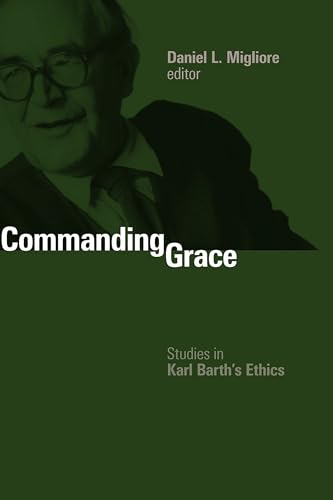
In this seminal volume, contemporary theologians revisit the theological ethics of Karl Barth as it bears on such topics as the moral significance of Jesus Christ, the Christian as ethical agent, the just war theory, the relationship between doctrines of the atonement and modern penal justice systems, the virtues and limits of democracy, and the difference between an economy of competition and possession and an economy of grace.
Die Inhaltsangabe kann sich auf eine andere Ausgabe dieses Titels beziehen.
Über die Autorin bzw. den Autor
Daniel L. Migliore is the Charles Hodge Professor Emeritus of Systematic Theology at Princeton Theological Seminary. His other books include Faith Seeking Understanding: An Introduction to Christian Theology (Eerdmans).
Auszug. © Genehmigter Nachdruck. Alle Rechte vorbehalten.
Commanding Grace
Studies in Karl Barth's EthicsWilliam B. Eerdmans Publishing Company
Copyright © 2010 Wm. B. Eerdmans Publishing Co.All right reserved.
ISBN: 978-0-8028-6570-0
Contents
Acknowledgments............................................................................................................................................................viiAbbreviations..............................................................................................................................................................viiiContributors...............................................................................................................................................................ix1. Commanding Grace: Karl Barth's Theological Ethics Daniel L. Migliore...................................................................................................12. Karl Barth's Ethics Revisited Nigel Biggar.............................................................................................................................263. The Spirit and the Letter: Protestant Thomism and Nigel Biggar's "Karl Barth's Ethics Revisited" Eric Gregory..........................................................504. Karl Barth and Just War: A Conversation with Roman Catholicism William Werpehowski.....................................................................................605. Barth and Werpehowski on War, Presumption, and Exception John R. Bowlin................................................................................................836. Barth and Democracy: Political Witness without Ideology David Haddorff.................................................................................................967. Karl Barth and the Varieties of Democracy: A Response to David Haddorff's "Barth and Democracy: Political Witness without Ideology" Todd V. Cioffi.....................1228. Crime, Punishment, and Atonement: Karl Barth on the Death of Christ Timothy Gorringe...................................................................................1369. For Us and for Our Salvation: A Response to Timothy Gorringe Katherine Sonderegger.....................................................................................16210. Barth and the Economy of Grace Kathryn Tanner.........................................................................................................................17611. Karl Barth on the Economy: In Dialogue with Kathryn Tanner Christopher R. J. Holmes...................................................................................19812. Barth and the Christian as Ethical Agent: An Ontological Study of the Shape of Christian Ethics Paul T. Nimmo.........................................................21613. Karl Barth's Conception(s) of Human and Divine Freedom(s) Jesse Couenhoven............................................................................................239
Chapter One
Commanding Grace: Karl Barth's Theological EthicsDaniel L. Migliore
Interest in Barth's theology continues to grow. Its consistently high quality, often stunning originality, remarkable comprehensiveness, and strong provocations to fresh theological reflection in both church and academy assure its place among the most influential theological writings of the modern era. Best known for its singular christocentric exposition of the core doctrines of Christian faith, Barth's theology is also notable for its contributions to the history of doctrine, to biblical exegesis, to the interface of theology and philosophy, and by no means least, to theological ethics, the topic that receives special attention in this volume. A number of the articles included here were presented at the conference "Karl Barth and Theological Ethics" held at Princeton Theological Seminary, June 22-25, 2008. Others were subsequently written by participants at the conference in response to the original presentations.
From the beginning, the project that we know as Church Dogmatics was also a project in the reconstruction of Christian ethics. In the current renaissance of Barth studies, the study of his theological ethics has an important place even if this aspect of his thought has not received as much attention as many of his doctrinal topics. That is reason enough for the present volume. One way of formulating the wider question that the volume attempts to address is: Can Barth the magisterial dogmatic theologian offer significant help to theology and church today in the area of Christian ethics, a discipline Oliver O'Donovan has succinctly defined as thinking "from truths of Christian faith to conclusions in Christian action"?
Already in 1911, in a speech to members of a factory union in Safenwil, Barth explored the "inner connection" between the message and work of Jesus the incarnate Word of God and the values and aspirations of modern social democracy. In that address he advanced the blockbuster thesis that "Jesus is the movement for social justice, and the movement for social justice is Jesus in the present." In later years, Barth would express himself quite differently; nevertheless, it is clear that for the Safenwil pastor Christology and ethics were already tightly intertwined.
As Barth would later explain, when WWI broke out, he was shocked to learn that ninety-three German intellectuals, including many of his revered teachers, had issued a manifesto supporting the war policy of the kaiser. He describes the impact of that event as "the twilight of the gods," a failure of the theology of his revered teachers in the face of the ideology of war, exposing the fact that religion and scholarship could be so easily changed into "intellectual 42 cm cannons." By the end of WWI, in his famous Tambach lecture, "The Christian's Place in Society," Barth approached the question of the relationship between Christian faith and social responsibility much more critically than he had in his earlier lecture to Safenwil workers. He now distanced himself from an uncritical affiliation with Christian socialism even as in the intervening years he had taken leave of the theology and ethics of nineteenth-century liberal Protestant theology. The true Christian, Barth argued, is not any Christian, whether conservative or revolutionary; the true Christian is the Christ. The kingdom of God is not the kingdom we build but "the wholly other Kingdom which is God's." Barth did not then, nor did he ever, understand this emphasis in a quietist or merely otherworldly sense. Toward the end of his life, in an exposition of the petition "Thy kingdom come," Barth wrote that Christians "not only wait but also hasten.... Their waiting takes place in the hastening.... [T]he petition 'Thy kingdom come' is not an indolent and despondent prayer but one that is zealous and brave."
It is not my task in this introductory essay to trace the continuities and discontinuities in the development of Barth's theological ethics. It is sufficient to make the point that, early and late, Barth saw dogmatics and ethics as inseparable. For him, when rightly understood, both are based on the living Word of God that announces a gift to be freely and joyfully received and that contains a command to be freely and joyfully obeyed. From the Romans commentary where Barth states that "The problem of ethics is identical with the problem of dogmatics: Soli Deo Gloria"; to the Mnster Ethics of 1928 (repeated in Bonn in 1930-31), which he wrote as the necessary companion to his first two cycles of dogmatics in Gttingen and Mnster, and in which he...
„Über diesen Titel“ kann sich auf eine andere Ausgabe dieses Titels beziehen.
Suchergebnisse für Commanding Grace: Studies in Karl Barth's Ethics

Beispielbild für diese ISBN
Commanding Grace: Studies in Karl Barth's Ethics
Verlag:
William B. Eerdmans Publishing Company, 2010
ISBN 10: 0802865704
ISBN 13: 9780802865700
Gebraucht
Paperback
Anbieter: ThriftBooks-Dallas, Dallas, TX, USA
Verkäuferbewertung 5 von 5 Sternen

Paperback. Zustand: Good. No Jacket. Pages can have notes/highlighting. Spine may show signs of wear. ~ ThriftBooks: Read More, Spend Less. Artikel-Nr. G0802865704I3N00
Gebraucht kaufen
EUR 8,47
Versand gratis
Versand innerhalb von USA
Versand innerhalb von USA
Anzahl: 1 verfügbar
Beispielbild für diese ISBN
Commanding Grace: Studies in Karl Barth's Ethics
Anbieter: Windows Booksellers, Eugene, OR, USA
Verkäuferbewertung 5 von 5 Sternen
Paperback. VG 255 pp. Artikel-Nr. 729539
Gebraucht kaufen
EUR 9,16
EUR 6,67 Versand
Versand innerhalb von USA
Versand innerhalb von USA
Anzahl: 1 verfügbar
Foto des Verkäufers
COMMANDING GRACE: Studies in Karl Barth's Ethics
Anbieter: Arches Bookhouse, Portland, OR, USA
Verkäuferbewertung 5 von 5 Sternen
Trade Paperback. Zustand: NEAR FINE. 265pp. Clean, sharp copy. Artikel-Nr. 511057
Gebraucht kaufen
EUR 10,08
EUR 6,23 Versand
Versand innerhalb von USA
Versand innerhalb von USA
Anzahl: 1 verfügbar
Beispielbild für diese ISBN
Commanding Grace: Studies in Karl Barth's Ethics
Verlag:
Wm. B. Eerdmans Publishing Co. -, 2010
ISBN 10: 0802865704
ISBN 13: 9780802865700
Gebraucht
paperback
Anbieter: Bahamut Media, Reading, Vereinigtes Königreich
Verkäuferbewertung 4 von 5 Sternen

paperback. Zustand: Very Good. Shipped within 24 hours from our UK warehouse. Clean, undamaged book with no damage to pages and minimal wear to the cover. Spine still tight, in very good condition. Remember if you are not happy, you are covered by our 100% money back guarantee. Artikel-Nr. 6545-9780802865700
Gebraucht kaufen
EUR 12,19
EUR 8,28 Versand
Versand von Vereinigtes Königreich nach USA
Versand von Vereinigtes Königreich nach USA
Anzahl: 1 verfügbar
Beispielbild für diese ISBN
Commanding Grace: Studies in Karl Barth's Ethics
Anbieter: AwesomeBooks, Wallingford, Vereinigtes Königreich
Verkäuferbewertung 5 von 5 Sternen
Paperback. Zustand: Very Good. Commanding Grace: Studies in Karl Barth's Ethics This book is in very good condition and will be shipped within 24 hours of ordering. The cover may have some limited signs of wear but the pages are clean, intact and the spine remains undamaged. This book has clearly been well maintained and looked after thus far. Money back guarantee if you are not satisfied. See all our books here, order more than 1 book and get discounted shipping. Artikel-Nr. 7719-9780802865700
Gebraucht kaufen
EUR 28,81
EUR 4,89 Versand
Versand von Vereinigtes Königreich nach USA
Versand von Vereinigtes Königreich nach USA
Anzahl: 2 verfügbar
Beispielbild für diese ISBN
Commanding Grace: Studies in Karl Barth's Ethics
Anbieter: Revaluation Books, Exeter, Vereinigtes Königreich
Verkäuferbewertung 5 von 5 Sternen
Paperback. Zustand: Brand New. 272 pages. 8.90x6.00x0.80 inches. In Stock. Artikel-Nr. x-0802865704
Neu kaufen
EUR 36,20
EUR 11,86 Versand
Versand von Vereinigtes Königreich nach USA
Versand von Vereinigtes Königreich nach USA
Anzahl: 2 verfügbar
Beispielbild für diese ISBN
Commanding Grace: Studies in Karl Barth's Ethics
Verlag:
Wm. B. Eerdmans Publishing Co., 2010
ISBN 10: 0802865704
ISBN 13: 9780802865700
Neu
Softcover
Anbieter: Ria Christie Collections, Uxbridge, Vereinigtes Königreich
Verkäuferbewertung 5 von 5 Sternen
Zustand: New. In English. Artikel-Nr. ria9780802865700_new
Neu kaufen
EUR 36,48
EUR 13,39 Versand
Versand von Vereinigtes Königreich nach USA
Versand von Vereinigtes Königreich nach USA
Anzahl: Mehr als 20 verfügbar