
Verwandte Artikel zu Between Relativism and Fundamentalism: Religious Resources...
Inhaltsangabe
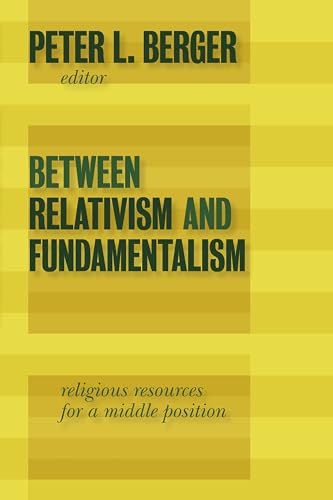
The current religious scene is dominated by two extremes -- relativism and fundamentalism. Neither is desirable: relativism claims that all questions of truth are irrelevant, whereas fundamentalism insists on sole possession of absolute truth. Internationally renowned sociologist of religion Peter Berger has gathered a group of scholars to consider how, from out of different traditions, one can define a middle position between both extremes. After an extensive introductory overview, three essays ("sociological descriptions") give an objective picture of how relativism and fundamentalism play out in today's world. In the second part ("theological directions") authors from several different Christian traditions and one conservative Jewish tradition flesh out a normative middle ground that is neither relativist -- they affirm specific truth claims -- nor fundamentalist -- their affirmations include tolerance of the claims of others.
Die Inhaltsangabe kann sich auf eine andere Ausgabe dieses Titels beziehen.
Über die Autorin bzw. den Autor
Peter L. Berger (1929-2017) was a renowned sociologist and theologian. Over the course of his career, he taught at The New School for Social Research, Rutgers University, and Boston University, where he directed the Institute for the Study of Economic Culture. In 2010, he was awarded the Dr. Leopold Lucas Prize by the Faculty of Protestant Theology at the University of Tübingen. Berger was the author or editor of numerous books, including The Social Construction of Reality (coauthored with Thomas Luckmann), Dialogue between Religious Traditions in an Age of Relativity, and The Many Altars of Modernity: Toward a Paradigm for Religion in a Pluralist Age.
Auszug. © Genehmigter Nachdruck. Alle Rechte vorbehalten.
Between Relativism and Fundamentalism
Religious Resources for a Middle PositionWilliam B. Eerdmans Publishing Company
Copyright © 2010 Wm. B. Eerdmans Publishing Co.All right reserved.
ISBN: 978-0-8028-6387-4
Contents
Contributors..................................................................................................................................viiPreface.......................................................................................................................................ixIntroduction: Between Relativism and Fundamentalism Peter L. Berger..........................................................................1Fundamentalism and Relativism Together: Reflections on Genealogy James Davison Hunter........................................................17An English Example: Exploring the Via Media in the Twenty-First Century Grace Davie..........................................................35Evangelicals in Search of a Political Theology Craig M. Gay..................................................................................56Religious Conviction in a Diverse World: A Jewish Perspective on Fundamentalism and Relativism David M. Gordis...............................105Christianity in an Age of Uncertainty: A Catholic Perspective Ingeborg Gabriel...............................................................124A Lutheran Approach Peter L. Berger..........................................................................................................152Pilgrim at the Spaghetti Junction: An Evangelical Perspective on Relativism and Fundamentalism Os Guinness...................................164Relativism and Fundamentalism: An Eastern Church Perspective from the "Paris School" and Living Tradition Michael Plekon.....................180
Chapter One
Fundamentalism and Relativism Together: Reflections on GenealogyJames Davison Hunter
No one predicted what is now commonplace. And for several decades, as history has unfolded and evidence has mounted, a generation of intellectuals has been in denial, hoping against hope, that it was a grotesque abnormality and that it would quickly disappear. Even at present, many believe it to be anomalous and thus the best strategy is to just wait it out until it disappears.
Yet now it is plain to see that the emergence and persistence of fundamentalist movements globally is an established reality of our time, unlikely to go away anytime soon. The reason is that the emergence of fundamentalism is intrinsic to the late modern world. In this, fundamentalism does not represent a resurgence of traditional religion but is, rather, a distinct variant of traditional religion; one that emerges out of the dynamics of its encounter with the modern and late modern world and the discontents the contemporary world generates. Fundamentalism, at its core, is defined and shaped by the present world order; it is a natural expression of the very world it rejects.
To be more specific, fundamentalism is a phenomenon that is rooted in the epistemic dynamics of late modernity. Whatever else fundamentalism may be — and it is a very complex and multidimensional phenomenon — it is a defensive reaction to the fragmentation, pluralization, and relativization of knowledge and understanding that are part and parcel of our time. In this way, fundamentalism and relativism are at least partially symbiotic — one feeds off of the other. The central contention here then can be restated this way: the tensions between fundamentalism and relativism are an enduring and perhaps permanent structural feature of the present and emerging global order and as such, the dynamic between these polarizing tendencies provides one of the dominant narratives of culture and civilization for our time. In this essay, I want to explore how and why this has come to be and the quandary it presents for those who are neither fundamentalists nor relativists.
The Conceptual Challenge
As a historical phenomenon, the concept "fundamentalism" should generate some pause. Religious historians and area specialists are rightly annoyed by the cavalier usage of the word. The term originally came to life in the first decade of the twentieth century to describe a movement of conservative Protestants who believed that the core doctrines of their faith were being undermined by higher criticism. They reacted by publishing twelve volumes, written by a range of scholars, all defending the central elements of historic Christian orthodoxy. These were "The Fundamentals," and they contained the arguments by which historic Christian (Protestant) orthodoxy would stand its ground against the corrosive forces of theological liberalism. Those who embraced these doctrines were, naturally, "fundamentalists." Rightly understood, then, fundamentalism is bound by a particular context, within a particular tradition, and given expression by a particular group of social actors. What often goes under the name of fundamentalism in Islam, Judaism, Sikhism, and Hinduism, at best has family resemblances to the original. The word has become a synonym for reactionary religious dogmatism of whatever historical manifestation.
At least Protestant fundamentalism was a recognizable social movement in history. Relativism is not a social movement at all. It is most recognizable as theory of truth, beauty, and the good; namely, a theory that states or implies that these qualities are not in any way grounded or universal but, rather, are dependent upon time, place, context, and other factors. In the history of ideas, it has been implicit in some forms of romanticism, in existentialism, and postmodernism — all of which valorize subjectivity in the apprehension of reality and in the attribution of meaning. Each of these claims, in effect, that relativism is reality; that absence is all there is.
In our own day, then, both concepts have lost historical specificity and analytical usefulness by virtue of being overused or misused. One even finds these concepts employed as shibboleths, the function of which is to caricature and discredit enemies. Even when used honestly and without political purpose, they reflect a social analysis with cleaver rather than scalpel.
Making matters worse, fundamentalism and relativism are also related to a range of other paired opposites in contemporary discourse that range from psychology (authoritarianism vs. libertarianism), lifestyle (rigidity vs. permissivism), aesthetics (traditionalism vs. modernism/postmodernism), and worldview (religion vs. secular), to politics (conservative vs. liberal), cultural politics (orthodox vs. progressive), foreign affairs (Islam vs. the West), and globalizing ambitions (jihad vs. McWorld). Needless to say, these too are all ham-fisted in similar ways.
Thus, we have inherited concepts that at best lack parity and worse, are clumsy and tendentious to the point of uselessness. Still, the concepts survive. They do so in part because they point to something meaningful and enduring about the world in which we live. The question is, in what way might the concepts of fundamentalism and relativism be most useful in cultural analysis?
I would suggest that today the concepts of fundamentalism and relativism may be most useful when descriptive of epistemic propensities (or orientations in the way knowledge and understanding are grounded) that are at the root of opposing and competing cultural systems. There are several aspects of this conceptual approach that need unpacking.
First, when speaking of epistemic...
„Über diesen Titel“ kann sich auf eine andere Ausgabe dieses Titels beziehen.
Suchergebnisse für Between Relativism and Fundamentalism: Religious Resources...

Beispielbild für diese ISBN
Between Relativism and Fundamentalism: Religious Resources for a Middle Position
Anbieter: World of Books (was SecondSale), Montgomery, IL, USA
Verkäuferbewertung 5 von 5 Sternen

Zustand: Good. Item in good condition. Textbooks may not include supplemental items i.e. CDs, access codes etc. Artikel-Nr. 00106725827
Gebraucht kaufen
EUR 3,46
Versand gratis
Versand innerhalb von USA
Versand innerhalb von USA
Anzahl: 1 verfügbar
Beispielbild für diese ISBN
Between Relativism and Fundamentalism: Religious Resources for a Middle Position
Verlag:
William B. Eerdmans Publishing Company, 2009
ISBN 10: 0802863876
ISBN 13: 9780802863874
Gebraucht
Paperback
Anbieter: ThriftBooks-Atlanta, AUSTELL, GA, USA
Verkäuferbewertung 5 von 5 Sternen
Paperback. Zustand: Very Good. No Jacket. May have limited writing in cover pages. Pages are unmarked. ~ ThriftBooks: Read More, Spend Less. Artikel-Nr. G0802863876I4N00
Gebraucht kaufen
EUR 6,23
Versand gratis
Versand innerhalb von USA
Versand innerhalb von USA
Anzahl: 1 verfügbar
Beispielbild für diese ISBN
Between Relativism and Fundamentalism: Religious Resources for a Middle Position
Verlag:
William B. Eerdmans Publishing Company, 2009
ISBN 10: 0802863876
ISBN 13: 9780802863874
Gebraucht
Paperback
Anbieter: ThriftBooks-Dallas, Dallas, TX, USA
Verkäuferbewertung 5 von 5 Sternen
Paperback. Zustand: As New. No Jacket. Pages are clean and are not marred by notes or folds of any kind. ~ ThriftBooks: Read More, Spend Less. Artikel-Nr. G0802863876I2N00
Gebraucht kaufen
EUR 6,23
Versand gratis
Versand innerhalb von USA
Versand innerhalb von USA
Anzahl: 1 verfügbar
Beispielbild für diese ISBN
Between Relativism and Fundamentalism : Religious Resources for a Middle Position
Verlag:
Eerdmans Publishing Company, William B., 2009
ISBN 10: 0802863876
ISBN 13: 9780802863874
Gebraucht
Softcover
Anbieter: Better World Books, Mishawaka, IN, USA
Verkäuferbewertung 5 von 5 Sternen
Zustand: Very Good. Pages intact with possible writing/highlighting. Binding strong with minor wear. Dust jackets/supplements may not be included. Stock photo provided. Product includes identifying sticker. Better World Books: Buy Books. Do Good. Artikel-Nr. 17497398-6
Gebraucht kaufen
EUR 6,55
Versand gratis
Versand innerhalb von USA
Versand innerhalb von USA
Anzahl: 1 verfügbar
Beispielbild für diese ISBN
Between Relativism and Fundamentalism: Religious Resources for a Middle Position
Verlag:
Wm. B. Eerdmans Publishing Co., 2009
ISBN 10: 0802863876
ISBN 13: 9780802863874
Gebraucht
Soft cover
Anbieter: Saturday Books, Dudley, Vereinigtes Königreich
Verkäuferbewertung 4 von 5 Sternen

Soft cover. Zustand: As New. The book has been carefully stored, is unused, and there is no evidence of wear from shelving or light. Artikel-Nr. 1511
Gebraucht kaufen
EUR 4,30
EUR 11,03 Versand
Versand von Vereinigtes Königreich nach USA
Versand von Vereinigtes Königreich nach USA
Anzahl: 1 verfügbar
Beispielbild für diese ISBN
Between Relativism and Fundamentalism: Religious Resources for a Middle Position
Verlag:
Wm. B. Eerdmans Publishing Co., 2009
ISBN 10: 0802863876
ISBN 13: 9780802863874
Gebraucht
Soft cover
Anbieter: Saturday Books, Dudley, Vereinigtes Königreich
Verkäuferbewertung 4 von 5 Sternen
Soft cover. Zustand: As New. The book has been carefully stored, is practically unused (some very light pencil markings in opening pages), and there is no evidence of wear from shelving or light. Artikel-Nr. 1664
Gebraucht kaufen
EUR 4,30
EUR 11,03 Versand
Versand von Vereinigtes Königreich nach USA
Versand von Vereinigtes Königreich nach USA
Anzahl: 1 verfügbar
Beispielbild für diese ISBN
Between Relativism and Fundamentalism: Religious respones for a middle position
Anbieter: Windows Booksellers, Eugene, OR, USA
Verkäuferbewertung 5 von 5 Sternen
Paperback. Previous owner's stamp and label on ffep. Slight wear on outer and lower edges of text. Otherwise VG. 209 pp. Artikel-Nr. 732973
Gebraucht kaufen
EUR 9,17
EUR 6,68 Versand
Versand innerhalb von USA
Versand innerhalb von USA
Anzahl: 1 verfügbar
Beispielbild für diese ISBN
Between Relativism and Fundamentalism: Religious Resources for a Middle Position
Verlag:
Wm. B. Eerdmans Publishing Co., 2009
ISBN 10: 0802863876
ISBN 13: 9780802863874
Gebraucht
Paperback
Anbieter: WorldofBooks, Goring-By-Sea, WS, Vereinigtes Königreich
Verkäuferbewertung 5 von 5 Sternen
Paperback. Zustand: Very Good. The book has been read, but is in excellent condition. Pages are intact and not marred by notes or highlighting. The spine remains undamaged. Artikel-Nr. GOR014981852
Gebraucht kaufen
EUR 10,71
EUR 6,68 Versand
Versand von Vereinigtes Königreich nach USA
Versand von Vereinigtes Königreich nach USA
Anzahl: 1 verfügbar
Beispielbild für diese ISBN
Between Relativism and Fundamentalism: Religious Resources for a Middle Position
Verlag:
Wm. B. Eerdmans Publishing Co., 2009
ISBN 10: 0802863876
ISBN 13: 9780802863874
Gebraucht
Paperback
Anbieter: WorldofBooks, Goring-By-Sea, WS, Vereinigtes Königreich
Verkäuferbewertung 5 von 5 Sternen
Paperback. Zustand: Fine. Artikel-Nr. GOR014935973
Gebraucht kaufen
EUR 10,71
EUR 6,68 Versand
Versand von Vereinigtes Königreich nach USA
Versand von Vereinigtes Königreich nach USA
Anzahl: 1 verfügbar
Foto des Verkäufers
Between Relativism and Fundamentalism: Religious Resources for a Middle Position
Verlag:
Wm. B. Eerdmans Publishing Co., 2009
ISBN 10: 0802863876
ISBN 13: 9780802863874
Gebraucht
paperback
Anbieter: WeBuyBooks, Rossendale, LANCS, Vereinigtes Königreich
Verkäuferbewertung 5 von 5 Sternen
paperback. Zustand: Very Good. Most items will be dispatched the same or the next working day. A copy that has been read, but is in excellent condition. Pages are intact and not marred by notes or highlighting. The spine remains undamaged. Artikel-Nr. rev9608845932
Gebraucht kaufen
EUR 13,63
EUR 6,75 Versand
Versand von Vereinigtes Königreich nach USA
Versand von Vereinigtes Königreich nach USA
Anzahl: 1 verfügbar