
Verwandte Artikel zu Christ Plays in Ten Thousand Places Study Guide
Inhaltsangabe
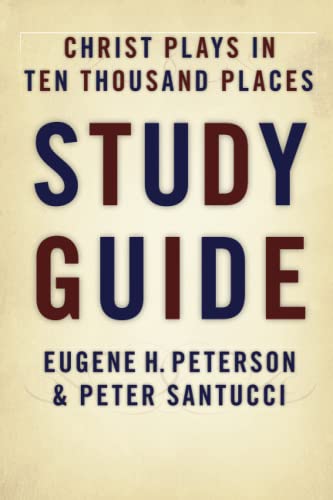
The foundational book in Eugene Peterson's monumental five-volume work on spiritual theology, Christ Plays in Ten Thousand Places reminds us that spiritual theology must be about God and not about us. It reunites spirituality and theology in a cultural context where these two vital facets of Christian faith have been torn apart. What better way to continue that conversation than through an intensive study with other readers? This helpful study guide is designed to enable small groups in schools or churches -- or even individuals -- to delve deeper into the timely wisdom of Christ Plays in Ten Thousand Places. Peterson's discussion is here broken up into fourteen "sessions," each of which contains a summary, key terms, quotations to consider, and questions for interaction, ending with suggestions for prayer.
Die Inhaltsangabe kann sich auf eine andere Ausgabe dieses Titels beziehen.
Über die Autorin bzw. den Autor
Rebecca Manley Pippert is the author of Out of the Saltshaker and a popular speaker living in the Chicago suburbs. Ruth Siemens spent twenty-one years pioneering IFES campus fellowships in Latin America and Europe, and founded Global Opportunities, which helps missions-motivated Christians support themselves abroad as they integrate work and witness.
Von der hinteren Coverseite
The foundational book in Eugene Peterson's monumental five-volume work on spiritual theology, "Christ Plays in Ten Thousand Places" reminds us that spiritual theology must be about God and not about us. It reunites spirituality and theology in a cultural context where these two vital facets of Christian faith have been torn apart. What better way to continue that conversation than through an intensive study with other readers?
This helpful study guide is designed to enable small groups in schools or churches -- or even individuals -- to delve deeper into the timely wisdom of "Christ Plays in Ten Thousand Places." Peterson's discussion is here broken up into fourteen "sessions," each of which contains a summary, key terms, quotations to consider, and questions for interaction, ending with suggestions for prayer.
Aus dem Klappentext
"Christ Plays in Ten Thousand Places" reunites spirituality and theology in a cultural context where these two vital facets of Christian faith have been rent asunder. Lamenting the vacuous, often pagan nature of contemporary American spirituality, Eugene Peterson here firmly grounds spirituality once more in Trinitarian theology and offers a clear, practical statement of what it means to actually "live out" the Christian life.
Writing in the conversational style that he is well known for, Peterson boldly sweeps out the misunderstandings that clutter conversations on spiritual theology and refurnishes the subject only with what is essential. As Peterson shows, spiritual theology, in order to be at once biblical and meaningful, must remain sensitive to ordinary life, present the Christian gospel, follow the narrative of Scripture, and be rooted in the "fear of the Lord" -- in short, spiritual theology must be about "God" and not about "us."
The foundational book in a five-volume series on spiritual theology emerging from Peterson's pen, "Christ Plays in Ten Thousand Places" provides the conceptual and directional help we all need to live the Christian gospel well and maturely in the conditions that prevail in the church and world today.
Auszug. © Genehmigter Nachdruck. Alle Rechte vorbehalten.
Christ Plays in Ten Thousand Places
By Eugene H. PetersonWm. B. Eerdmans Publishing Company
Copyright © 2006 Eugene H. PetersonAll right reserved.
ISBN: 9780802832351
Chapter One
Clearing the Playing Field
"Come to me ... learn from me; for I am gentle and humble in heart...." MATTHEW 11:28-29
As soon as the Gospels were written, speech without experience began to dabble with the new facts proposed by the existence of the Church.... People tried to think the new life without being touched by it first in some Form of call, listening, passion or change of heart. EUGEN ROSENSTOCK-HUESSY
There are seething energies of spirituality in evidence everywhere. To begin with this is a good thing. But spirituality is also prone to imprecisions that clutter the playing field and make it difficult to carry on a conversation. Four are common: First, spirituality easily, almost inevitably, develops elitist postures as it notices that so many of the men and women that we rub shoulders with in our work and worship are so "unspiritual." Then, in the enthusiasm of firsthand experience, spirituality imperceptibly wanders away from its basic spirituality text, the Bible, and embraces the inviting world of self-help. Now, exposed and vulnerable to a culture that is only too happy to supply the terms of discourse, spirituality is diluted or emptied of any gospel distinctiveness. Finally, in reaction to what is assumed to be "dead" theology, spirituality easily becomes theologically amnesiac and ends up isolated from any awareness of the grand and spacious God horizons, the truly vast landscapes in which we are invited to live out the Christian life.
I want to harness these contemporary but imprecise spirituality energies in biblical leather and direct them in entering the company of Jesus in preparation for joining the actual "play" of Christ in creation, history, and community. I will employ two stories, three texts, four terms, and a dance to clear the field for conversation, get rid of the clutter of misconceptions and misunderstanding in these four areas: two stories to level the playing field so that we live humbly and without pretense (countering elitism); three texts that define a scriptural foundation so that we live obediently (countering self-helpism); four terms that provide gospel foci for living accurately (countering cultural fuzziness); and a dance to bring theology prominently into the field of action so that our imagination is large enough to accommodate our life (countering the shrunken secular horizon).
Two Stories
Story is the most natural way of enlarging and deepening our sense of reality, and then enlisting us as participants in it. Stories open doors to areas or aspects of life that we didn't know were there, or had quit noticing out of over-familiarity, or supposed were out-of-bounds to us. They then welcome us in. Stories are verbal acts of hospitality.
St. John tells two stories early in his Gospel that definitively welcome all into the Christian life.
The first story is of Nicodemus, a Jewish rabbi (John 3). Nervous about his reputation, he came to talk with Jesus under cover of darkness. He would have lost credibility with his rabbi colleagues if it became known that he was consulting this disreputable itinerant teacher, this loose prophetic cannon out of nowhere, the no-place Nazareth in Galilee, so he came to Jesus by night. He came, it seems, without an agenda, simply to get acquainted, opening the conversation by complimenting Jesus: "Rabbi, we know that you are a teacher who has come from God; for no one can do these signs that you do apart from the presence of God" (John 3:2).
But Jesus discerned an agenda, a yet unspoken question; Nicodemus was after something. Jesus brushed aside the introductory small talk and got down to business; he read Nicodemus's heart and addressed himself to that: "Very truly I tell you, no one can see the kingdom of God without being born from above" (3:3). So that is what Nicodemus was there for, to inquire about getting into the kingdom of God, living under the rule of God, participating in the reality of God. That's odd.
Odd, because this is the kind of thing in which Nicodemus was supposed to be an expert. So why is he sneaking around, having a clandestine conversation with Jesus? Was it out of humility? That is plausible. Leaders who are looked up to constantly, who give out answers competently, who everyone assumes are living what they are saying, often have acute experiences of dissonance: "Who I am and what people think I am aren't anywhere close to being the same thing. The better I get as a rabbi and the more my reputation grows, the more I feel like a fraud. I know so much more than I live. The longer I live, the more knowledge I acquire, the wider the gap between what I know and what I live. I'm getting worse by the day...."
So perhaps it was this deep sense of unease, grounded in a true humility, that brought Nicodemus that night to Jesus. He wasn't looking for theological information but for a way in, not for anything more about the kingdom of God but for a personal guide/friend to show him the door and lead him in: "How do I enter ...?"
Or was he there simply out of curiosity? Leaders, if they are to maintain their influence, have to stay ahead of the competition, have to keep up with the trends, know what sells best in the current market. Jesus was attracting an enormous amount of attention these days-so what's his angle? What's his secret? How does he do it? Nicodemus was good at his work, but he knew he couldn't simply rest on his laurels. The world was changing fast. Israel was in a vortex of cultures-Greek learning and Roman government and Jewish moral traditions mixed in with gnostic sects, mystery cults, terrorist bands, and assorted messianic adventurers and fanatics. The mix changed weekly. Nicodemus had to be alert to every shift in the wind if he was going to keep his leadership out in front and on course. Jesus was the latest attraction and so Nicodemus was there that night to dig out some useful piece of strategy or lore. This also is plausible.
But our interest in teasing out the motive that brought Nicodemus to Jesus is not shared by the storyteller, St. John. There is no authorial interest in motive here; this is a story about Jesus, not Nicodemus. Jesus does not question Nicodemus's motives, and John does not explore them. After the brief opening gambit, Jesus seizes the initiative by introducing a startling, attention-demanding metaphor, "born again" or "born from above": "I tell you, no one can see the kingdom of God without being born from above" (3:3); and then, before Nicodemus can so much as catch his breath, Jesus adds anothermetaphor, even odder than the first: "I tell you, no one can enter the kingdom of God without being born of water and Spirit" (3:5). Wind, Breath, and Spirit are the same word in the Aramaic that Jesus presumably spoke and also in the Greek that St. John wrote. The necessity in those languages of using the same term for the movement of air caused by a contraction of the lungs, the movement of air caused by a shift in barometric pressure, and the life-giving movement of the living God in us, required an exercise of the imagination every time the word was used: What's being talked about here, breathing or weather or God?
No sooner have we asked the question than John clarifies matters by putting the...
„Über diesen Titel“ kann sich auf eine andere Ausgabe dieses Titels beziehen.
Suchergebnisse für Christ Plays in Ten Thousand Places Study Guide

Beispielbild für diese ISBN
Christ Plays in Ten Thousand Places (Study Guide)
Verlag:
Wm. B. Eerdmans Publishing Co., 2006
ISBN 10: 0802832350
ISBN 13: 9780802832351
Gebraucht
Softcover
Anbieter: World of Books (was SecondSale), Montgomery, IL, USA
Verkäuferbewertung 5 von 5 Sternen

Zustand: Very Good. Item in very good condition! Textbooks may not include supplemental items i.e. CDs, access codes etc. Artikel-Nr. 00105503402
Gebraucht kaufen
EUR 5,36
Versand gratis
Versand innerhalb von USA
Versand innerhalb von USA
Anzahl: 1 verfügbar
Beispielbild für diese ISBN
Christ Plays in Ten Thousand Places Study Guide
Verlag:
William B. Eerdmans Publishing Company, 2006
ISBN 10: 0802832350
ISBN 13: 9780802832351
Gebraucht
Paperback
Anbieter: ThriftBooks-Atlanta, AUSTELL, GA, USA
Verkäuferbewertung 5 von 5 Sternen
Paperback. Zustand: Fair. No Jacket. Readable copy. Pages may have considerable notes/highlighting. ~ ThriftBooks: Read More, Spend Less. Artikel-Nr. G0802832350I5N00
Gebraucht kaufen
EUR 6,63
Versand gratis
Versand innerhalb von USA
Versand innerhalb von USA
Anzahl: 1 verfügbar
Beispielbild für diese ISBN
Christ Plays in Ten Thousand Places Study Guide
Verlag:
William B. Eerdmans Publishing Company, 2006
ISBN 10: 0802832350
ISBN 13: 9780802832351
Gebraucht
Paperback
Anbieter: ThriftBooks-Dallas, Dallas, TX, USA
Verkäuferbewertung 5 von 5 Sternen
Paperback. Zustand: Very Good. No Jacket. May have limited writing in cover pages. Pages are unmarked. ~ ThriftBooks: Read More, Spend Less. Artikel-Nr. G0802832350I4N00
Gebraucht kaufen
EUR 6,63
Versand gratis
Versand innerhalb von USA
Versand innerhalb von USA
Anzahl: 1 verfügbar
Beispielbild für diese ISBN
Christ Plays in Ten Thousand Places (Study Guide)
Verlag:
Wm. B. Eerdmans Publishing Co., 2006
ISBN 10: 0802832350
ISBN 13: 9780802832351
Gebraucht
paperback
Anbieter: Books From California, Simi Valley, CA, USA
Verkäuferbewertung 4 von 5 Sternen

paperback. Zustand: Good. Book shows minor shelf & handling wear. Pages are clean, text and pictures are intact and unmarred. Good reading copy. Artikel-Nr. mon0003869017
Gebraucht kaufen
EUR 5,40
EUR 4,34 Versand
Versand innerhalb von USA
Versand innerhalb von USA
Anzahl: 1 verfügbar
Beispielbild für diese ISBN
Christ Plays in Ten Thousand Places (Study Guide)
Verlag:
Wm. B. Eerdmans Publishing Co., 2006
ISBN 10: 0802832350
ISBN 13: 9780802832351
Gebraucht
Softcover
Anbieter: World of Books (was SecondSale), Montgomery, IL, USA
Verkäuferbewertung 5 von 5 Sternen
Zustand: Good. Item in good condition. Textbooks may not include supplemental items i.e. CDs, access codes etc. Artikel-Nr. 00069308345
Gebraucht kaufen
EUR 10,88
Versand gratis
Versand innerhalb von USA
Versand innerhalb von USA
Anzahl: 1 verfügbar
Beispielbild für diese ISBN
Study Guide to Accompany Christ Plays in Ten Thousand Places
Anbieter: Revaluation Books, Exeter, Vereinigtes Königreich
Verkäuferbewertung 5 von 5 Sternen
Paperback. Zustand: Brand New. study guide edition. 96 pages. 9.00x6.25x0.50 inches. In Stock. Artikel-Nr. x-0802832350
Neu kaufen
EUR 17,20
EUR 11,66 Versand
Versand von Vereinigtes Königreich nach USA
Versand von Vereinigtes Königreich nach USA
Anzahl: 2 verfügbar