
Verwandte Artikel zu Joshua (The Two Horizons Old Testament Commentary)
Joshua (The Two Horizons Old Testament Commentary) - Softcover
Buch 5 von 10: Two Horizons New Testament Commentary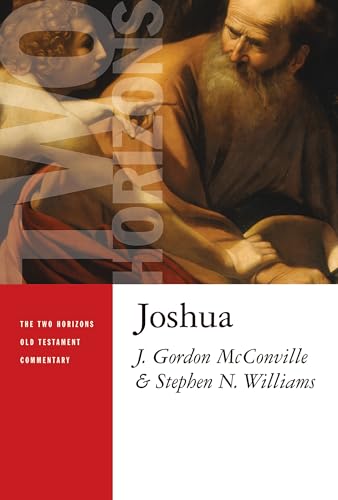
Inhaltsangabe
In this volume Gordon McConville and Stephen Williams interpret the book of Joshua in relation to Christian theology, providing exegetical commentary and reflection on an often-troubling book that nonetheless plays a key role in the biblical drama of salvation. McConville and Williams address significant theological themes in Joshua, such as land, covenant, law, miracle, judgment (including the problem of genocide), and idolatry. They posit that the theological topics engaged in Joshua are not limited to the horizons of the author and first readers of the book, but that Joshua is part of a much larger testimony that concerns readers yet today.
Die Inhaltsangabe kann sich auf eine andere Ausgabe dieses Titels beziehen.
Über die Autorin bzw. den Autor
Gordon McConville is professor of Old Testament theology at the University of Gloucestershire, Cheltenham, England.
Auszug. © Genehmigter Nachdruck. Alle Rechte vorbehalten.
Joshua
By J. Gordon McConville Stephen N. WilliamsWilliam B. Eerdmans Publishing Company
Copyright © 2010 J. Gordon McConville and Stephen N. WilliamsAll right reserved.
ISBN: 978-0-8028-2702-9
Contents
Preface...............................................................xAbbreviations.........................................................xiIntroduction to Joshua (Gordon McConville)............................1Commentary on Joshua (Gordon McConville)..............................13Theological Horizons of Joshua (Stephen Williams).....................93Bibliography..........................................................236Author Index..........................................................246Scripture Index.......................................................249
Chapter One
Commentary
Joshua 1
1:1-5 The new stage in the story of Israel opens by recalling the death of Moses. (The book of Judges begins in a similar way.) Joshua is already known to readers of the Pentateuch as Moses' "servant" ([TEXT NOT REPRODUCIBLE IN ASCII]/me?aret; Exod 24:13; 33:11; Num 11:28), a term which points to a religious role (esp. Exod 33:11). Joshua had accompanied Moses when he went up Mount Sinai to receive the commandments from God (Exod 24:13), on that occasion apparently going further than Nadab, Abihu, and the seventy elders who also set out with Moses (Exod 24:9). This marks him out as preeminent among those who would survive Moses.
From the first verse, God now addresses Joshua directly. The crossing of the Jordan which he is to lead (v. 2) will be symptomatic of the possession of the land, a full circle from the exodus from Egypt, which had also involved a crossing (of the Reed Sea; Exodus 14–15). His special assignment is to lead the people of Israel into the land that God had promised to give them, as far back in the story as Abraham (Gen 12:7). For a moment, God's address shifts to the people as a whole (vv. 3-4), when he expands on the promise of land, in terms close to those of Genesis and Deuteronomy (e.g., Gen 15:18-21; Deut 1:6-8; 11:24; 17:14; 34:1-4). Joshua's role was always to have a military aspect (Num 13:16; 14:6, 30; Deut 31:3, 7-8, 23). It is in this connection that God promises to be with Joshua (v. 5), a promise that has been made to him once already (Deut 31:23c), and which reminds us of God's assurance to Moses himself (Exod 3:12). The continuation, "I will never leave you or forsake you," was first spoken to Israel (Deut 4:31; 31:6), but now to Joshua (as later recalled in Heb 13:5).
1:6-9 The next short paragraph records Joshua's commissioning for the task. It is not a first charge to Joshua, but a reaffirmation, for God had already commissioned him while Moses was still alive (Deut 31:7, 14-15, 23). Indeed, v. 6 virtually repeats Deut 31:7. The charge to "be strong and courageous" is suitable for the military task ahead. But the word used, "cause to inherit" (ESV; cf. "put in possession," NRSV), speaks of more than victory, rather of legitimate occupation. The idea of "inheritance" is a way of expressing Israel's God-given right to the land, frequent in Deuteronomy (Deut 4:21). The story of Joshua will tell first of the victory (chs. 2–12), then of the "causing to inherit," as the tribes in turn receive their portions of the territory (chs. 13–22).
The possession of the land will be in fulfilment of God's promise to their "fathers" (v. 6). In itself, "fathers" might refer to the preceding generation. However, in the context it should be taken to mean Abraham and the generations after him, to whom the promise of the land first came (Gen 12:1-3; 28:1315), and this is the basis of NRSV's "ancestors." That is, God swore to the patriarchs (Abraham, Isaac, and Jacob) that he would give the land to their descendants. This is the generation that will now benefit from that promise.
The exhortation to be strong and courageous is now repeated (v. 7), and with a new end in view. The repetition is surprising at first glance, for now Joshua's courage is directed towards keeping the law of Moses. This is primarily the laws and commands as given by Moses in Deuteronomy, for it is there that such laws are commanded to be written in the "Book of the Law" (Deut 28:58, 61; 31:9, 24-26). Moreover, any future king of Israel was especially required to keep his own copy of this book and obey the laws in it (Deut 17:1820). The command to Joshua here is very like that given to the king in that place, so that many have thought that Joshua is a royal figure in all but name. It is not necessary to go so far, however. Rather, the standard for all leaders of Israel is set by these terms.
The focus remains on law-keeping in vv. 7-8, before returning to the military context in v. 9. The turn to law-keeping is sometimes regarded as intrusive at this point and indicative of the special interest of a "nomistic" editor (one with a strong interest in law). However, vv. 6-8 make a point that is fundamental to Joshua, namely that possession of the land, though legitimated first of all by God's gift, can continue to be legitimate only when it is held according to God's law. God's writ will run in the land that he gives to his people.
The narrative's horizon returns to the taking of the land (v. 9). The command to be strong and courageous is given again in this context. This is clear first from its accompaniment, that Joshua should not fear or be dismayed, which is like what was said to Israel through Moses in Deut 1:21. In that place we saw that this "not fearing" was the test of faith on which the taking of the land would depend, a test which Israel first failed (Deut 1:26-33). The test of faith now comes to Joshua himself. But God reassures him in words which he had already heard from Moses (Deut 31:7). The promise that God would be with him also recalls God's words to Moses himself at the beginning of that leader's own great test of faith (Exod 3:12). There are prophetic overtones here as well (Jer 1:17-19).
1:10-11 Joshua's command here testifies to an organization of the people for war already in place. The "officers" are administrative figures. In Deut 1:15 they are among officials appointed by Moses to ease his burden of leadership, and in Deut 16:18 they are to be appointed alongside judges, in that case to assist in judicial administration. It may be supposed that the officials are here appointed according to tribe, as in those cases. Here (as in Deut 1:15) they are part of a military chain of command. The command itself shows a mix of prudence and faith: they will be prepared for the march, but also go in faith that the struggle is in principle won, because God gives them the land to possess.
Israel is about to "cross" the Jordan, "to take possession of the land the Lord your God is giving you for your own." The phrasing is typical in Deuteronomy (e.g., 9:1; 11:31). The time long heralded has come. Yahweh not only "gives" the land for Israel to "inherit" it, but they will then "possess" it, a term used now for the first time in Joshua, and immediately repeated. These different terms have their own significance. By Yahweh's gift Israel will be the legitimate holders of this land.
1:12-18 The narrative now remembers that part of the land has already been given and possessed, that is, the Transjordanian part (to the east of the River Jordan). This was territory already acquired under Moses by victories over the Amorite kings Sihon and Og and given to the tribes of Reuben, Gad, and half-Manasseh. The story is told in Numbers 32 and Deut...
„Über diesen Titel“ kann sich auf eine andere Ausgabe dieses Titels beziehen.
Suchergebnisse für Joshua (The Two Horizons Old Testament Commentary)

Foto des Verkäufers
Joshua (Two Horizons New Testament Commentary (THNTC))
Verlag:
Wm. B. Eerdmans Publishing Co, 2010
ISBN 10: 0802827020
ISBN 13: 9780802827029
Gebraucht
Trade Paperback
Anbieter: Arches Bookhouse, Portland, OR, USA
Verkäuferbewertung 5 von 5 Sternen

Trade Paperback. Zustand: VERY GOOD. xii, 257pp. Paperback. Some underlining in blue pen from p.18-22. Crisp and sound copy otherwise. Artikel-Nr. 509507
Gebraucht kaufen
EUR 9,96
EUR 6,15 Versand
Versand innerhalb von USA
Versand innerhalb von USA
Anzahl: 1 verfügbar
Beispielbild für diese ISBN
Joshua [The Two Horizons Old Testament Commentary]
Verlag:
William B. Eerdmans Publishing Company, 2010
ISBN 10: 0802827020
ISBN 13: 9780802827029
Gebraucht
Softcover
Anbieter: Windows Booksellers, Eugene, OR, USA
Verkäuferbewertung 5 von 5 Sternen
Paperback. Previous owner's stamp on ffep. Cover worn on corners. Slight wear on outer and lower edge of text. Otherwise VG! 257 pp. Artikel-Nr. 731742
Gebraucht kaufen
EUR 10,87
EUR 6,59 Versand
Versand innerhalb von USA
Versand innerhalb von USA
Anzahl: 1 verfügbar
Beispielbild für diese ISBN
Joshua (The Two Horizons Old Testament Commentary)
Verlag:
Wm. B. Eerdmans Publishing Co., 2010
ISBN 10: 0802827020
ISBN 13: 9780802827029
Gebraucht
Paperback
Anbieter: WorldofBooks, Goring-By-Sea, WS, Vereinigtes Königreich
Verkäuferbewertung 5 von 5 Sternen
Paperback. Zustand: Very Good. The book has been read, but is in excellent condition. Pages are intact and not marred by notes or highlighting. The spine remains undamaged. Artikel-Nr. GOR006545181
Gebraucht kaufen
EUR 13,76
EUR 6,50 Versand
Versand von Vereinigtes Königreich nach USA
Versand von Vereinigtes Königreich nach USA
Anzahl: 1 verfügbar
Beispielbild für diese ISBN
Joshua (Two Horizons Old Testament Commentary) (The Two Horizons Old Testament Commentary)
Verlag:
William B Eerdmans Publishing Co, 2010
ISBN 10: 0802827020
ISBN 13: 9780802827029
Gebraucht
Soft cover
Anbieter: Tall Stories BA, Stoneyford, Irland
Verkäuferbewertung 4 von 5 Sternen

Soft cover. Zustand: Very Good. very minor shelf wear only. Artikel-Nr. 2000026421
Gebraucht kaufen
EUR 15,55
EUR 12,00 Versand
Versand von Irland nach USA
Versand von Irland nach USA
Anzahl: 1 verfügbar
Beispielbild für diese ISBN
Joshua
Anbieter: Revaluation Books, Exeter, Vereinigtes Königreich
Verkäuferbewertung 5 von 5 Sternen
Paperback. Zustand: Brand New. 272 pages. 9.50x6.50x0.75 inches. In Stock. Artikel-Nr. x-0802827020
Neu kaufen
EUR 33,76
EUR 11,61 Versand
Versand von Vereinigtes Königreich nach USA
Versand von Vereinigtes Königreich nach USA
Anzahl: 2 verfügbar
Beispielbild für diese ISBN
Joshua (Two Horizons New Testament Commentary (THNTC))
Verlag:
Wm. B. Eerdmans Publishing Co., 2010
ISBN 10: 0802827020
ISBN 13: 9780802827029
Neu
Softcover
Anbieter: Ria Christie Collections, Uxbridge, Vereinigtes Königreich
Verkäuferbewertung 5 von 5 Sternen
Zustand: New. In English. Artikel-Nr. ria9780802827029_new
Neu kaufen
EUR 34,54
EUR 13,11 Versand
Versand von Vereinigtes Königreich nach USA
Versand von Vereinigtes Königreich nach USA
Anzahl: Mehr als 20 verfügbar