
Verwandte Artikel zu Marriage and Modernization: How Globalization Threatens...
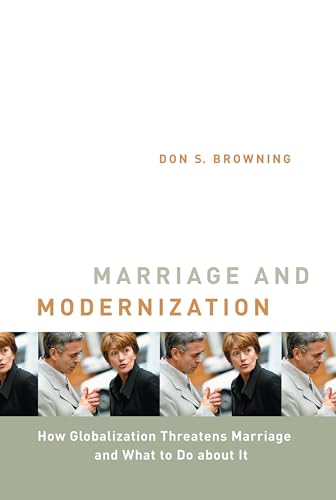
Marriage and Modernization: How Globalization Threatens Marriage (Religion, Marriage, and Famiy) - Softcover
Inhaltsangabe
The processes of modernization and globalization promise more wealth and health for many people. But they are also a threat to the stability and quality of marriage and family life. This new book -- at once sobering and constructive -- looks at the impact of these processes on marriage and asks what Christianity, in cooperation with other religions, can do to strengthen married life today. Among the deleterious effects of modernization and globalization on marriage are a worldwide drift of men away from the responsibility of parenthood and the tendency of mothers too readily to take on the task of childrearing alone. After looking at recent research on these and other problems, Don Browning suggests that the cure for modern marital disruption entails reforming and reconstructing the institution of marriage while also nurturing relevant forms of social support. Yet the effort to initiate a "world marriage revival" requires a complex cultural work, and Browning explores the key contributions that the religions of the world must make for such an effort to be successful.
Die Inhaltsangabe kann sich auf eine andere Ausgabe dieses Titels beziehen.
Über die Autorin bzw. den Autor
Don S. Browning (1934-2010) was Alexander Campbell Professor Emeritus of Religious Ethics and the Social Sciences at the University of Chicago Divinity School and director of the Lilly Project on Religion, Culture, and the Family. He coauthored From C
Von der hinteren Coverseite
The processes of modernization and globalization promise more wealth and health for many people. But they are also a threat to the stability and quality of marriage and family life. This new book -- at once sobering and constructive -- looks at the impact of these processes on marriage and asks what Christianity, in cooperation with other religions, can do to strengthen married life today.
Among the deleterious effects of modernization and globalization on marriage are a worldwide drift of men away from the responsibility of parenthood and the tendency of mothers too readily to take on the task of childrearing alone. After looking at recent research on these and other problems, Don Browning suggests that the cure for modern marital disruption entails reforming and reconstructing the institution of marriage while also nurturing relevant forms of social support. Yet the effort to initiate a "world marriage revival" requires a complex cultural work, and Browning explores the key contributions that the religions of the world must make for such an effort to be successful.
Auszug. © Genehmigter Nachdruck. Alle Rechte vorbehalten.
MARRIAGE AND MODERNIZATION
How Globalization Threatens Marriage and What to Do about ItBy Don S. BrowningWilliam B. Eerdmans Publishing Company
Copyright © 2003 Wm. B. Eerdmans Publishing Co.All right reserved.
ISBN: 978-0-8028-1112-7
Contents
Series Foreword.................................................................................viiPreface.........................................................................................ix1. The World Situation of Families: Marriage Reformation as a Cultural Work.....................12. From West to East: Modernization and Family in the U.S. and South Korea......................303. Christianity and the Western Family..........................................................554. Marriage and the Male Problematic in Aquinas and Luther......................................775. Nature and Creation: Evolutionary Psychology, Marriage, and Family...........................996. A Practical Theology of Families.............................................................1297. Feminism, Family, and Global Trends..........................................................1558. Cultural, Social, and Educational Strategies.................................................1869. World Family Strategies......................................................................211Index of Subjects and Names.....................................................................245Index of Scripture References...................................................................258
Chapter One
The World Situation of Families: Marriage Reformation as a Cultural Work
Over the last several decades, there has been a momentous debate sweeping across the world over the present health and future prospects of families. This debate has been especially intense in the United States, but during recent trips to Australia, South Korea, England, and South Africa, I learned that these countries have conflicts analogous to those in the United States.
These debates are about real issues. There are powerful trends affecting both advanced and underdeveloped countries that are changing families and undermining their ability to perform customary tasks. These trends are often called the forces of modernization. Of course, theories of modernization are now being extended by theories of globalization. However one refers to them — and they are distinguishable — these processes are having disruptive consequences on families in all corners of the earth. Older industrial countries have the wealth to cushion the blows of this disruption, but family upset throws economically fragile countries deeper into poverty. There are many sources of poverty in the world; family decline is one of them.
Of course, there are other sources of family disruption besides the forces of modernization and globalization. Wars, oppression, racial discrimination, and conflicts between cultures and religions are additional factors. The family disruptions of Bosnia and Afghanistan are fresh on our minds. Before that, there were the sad family tragedies of Vietnam, Cambodia, and apartheid South Africa. But this book is mainly about modernization and globalization as such. From time to time, however, we will see how these forces interact with political oppression, conflicts between racial and ethnic groups, and collisions between alternative cultural and religious ways of life. There is no way to avoid the observation that a significant subtext of the world struggle between Western democracies and the new terrorism is the perceived conflict between modernity and certain family patterns in Islam and other religions that modernization is thought to threaten. This includes traditional privileges of men and women, their roles in and out of the home, their respective responsibilities to children, and the place of children in family and society.
Most social scientists now acknowledge that modernization, independent of factors such as wars and famine, can by itself be disruptive to families in certain ways. But many distinguished sociologists believe there is little that can be done to allay these negative consequences. The social forces producing them, they believe, are simply too deep and powerful to be stopped or changed. I do not share this view. I argue that much can be done, but only if we understand the task as a complex cultural work — one that is like weaving a richly designed tapestry containing many threads. The threads needed for this cultural task are religious, political, legal, economic, and psychological. No one perspective can accomplish alone what needs to be done. In addition, this cultural work must be worldwide in scope. Finally, because there is an inevitable religious dimension to this cultural task, I see it as a work of practical theology conceived as an international ecumenical endeavor. At least from the perspective of what the Christian churches and their theological disciplines can contribute, the field of practical theology may have the most to offer to this complex cultural work.
Central to this practical-theological work is the worldwide revival and reconstruction of marriage. Admittedly, this is a big idea. Some people will call it grandiose, perhaps hallucinatory. And, of course, I do not envision this renewal and reconstruction happening tomorrow. My point, rather, is this: the world disruption of families cannot be addressed solely with policies emphasizing jobs, education, and the economic liberation of women — the favorite strategies of the United Nations, the World Council of Churches, and other international agencies. It is true that such strategies are essential, but more is needed. Without this "more," economic and development strategies can go awry. This additional emphasis should entail a culturally sensitive reconstruction of marriage and the roles that males and females play in this institution. I am calling for a new international practical-religious dialogue (indeed, practical-theological dialogue) between the major world religions designed to place the matter of marriage before the world community. Later in this book, I will outline a method for conducting this dialogue in a manner that preserves the core identities of various world traditions yet also effects real reconstruction. This book will not, however, conduct this full practical conversation, but it will investigate and illustrate its possibility. The actual dialogue itself requires other real voices speaking about and for the other religions. I have assigned myself the task of giving voice to the possible contribution of Christianity. Even then, it will be primarily a Christianity viewed from the eye of liberal Protestantism.
A Brief Definition of Practical Theology
Since I am taking a practical-theological perspective on these world family transformations, I need to give some hint as to how I envision that discipline. Practical theology, as I view it, begins theological reflection with concrete questions in social and cultural life — questions that confront both church and society. Practical theology acknowledges that the very task of defining such issues and questions is itself a major intellectual undertaking. To define a major social issue, practical theology first views it from the angle of the grand themes of the Christian faith such as creation, the fall, redemption, and sanctification. But it also should employ the social sciences in a subordinate way to refine its grasp of empirical facts and trends that...
„Über diesen Titel“ kann sich auf eine andere Ausgabe dieses Titels beziehen.
Suchergebnisse für Marriage and Modernization: How Globalization Threatens...

Beispielbild für diese ISBN
Marriage and Modernization: How Globalization Threatens Marriage and What to Do About It (Religion, Marriage, and Family)
Verlag:
Wm. B. Eerdmans Publishing Co., 2003
ISBN 10: 0802811124
ISBN 13: 9780802811127
Gebraucht
Softcover
Anbieter: World of Books (was SecondSale), Montgomery, IL, USA
Verkäuferbewertung 5 von 5 Sternen

Zustand: Good. Item in good condition and has highlighting/writing on text. Used texts may not contain supplemental items such as CDs, info-trac etc. Artikel-Nr. 00095158753
Gebraucht kaufen
EUR 4,61
Versand gratis
Versand innerhalb von USA
Versand innerhalb von USA
Anzahl: 1 verfügbar
Beispielbild für diese ISBN
Marriage and Modernization: How Globalization Threatens Marriage and What to Do About It (Religion, Marriage, and Family)
Verlag:
Wm. B. Eerdmans Publishing Co. (edition ), 2003
ISBN 10: 0802811124
ISBN 13: 9780802811127
Gebraucht
Paperback
Anbieter: BooksRun, Philadelphia, PA, USA
Verkäuferbewertung 5 von 5 Sternen
Paperback. Zustand: Very Good. It's a well-cared-for item that has seen limited use. The item may show minor signs of wear. All the text is legible, with all pages included. It may have slight markings and/or highlighting. Artikel-Nr. 0802811124-11-1
Gebraucht kaufen
EUR 4,62
Versand gratis
Versand innerhalb von USA
Versand innerhalb von USA
Anzahl: 1 verfügbar
Beispielbild für diese ISBN
Marriage and Modernization : How Globalization Threatens Marriage
Verlag:
Eerdmans Publishing Company, William B., 2003
ISBN 10: 0802811124
ISBN 13: 9780802811127
Gebraucht
Softcover
Anbieter: Better World Books, Mishawaka, IN, USA
Verkäuferbewertung 5 von 5 Sternen
Zustand: Very Good. Pages intact with possible writing/highlighting. Binding strong with minor wear. Dust jackets/supplements may not be included. Stock photo provided. Product includes identifying sticker. Better World Books: Buy Books. Do Good. Artikel-Nr. 4531407-6
Gebraucht kaufen
EUR 6,19
Versand gratis
Versand innerhalb von USA
Versand innerhalb von USA
Anzahl: 1 verfügbar
Beispielbild für diese ISBN
Marriage and Modernization : How Globalization Threatens Marriage
Verlag:
Eerdmans Publishing Company, William B., 2003
ISBN 10: 0802811124
ISBN 13: 9780802811127
Gebraucht
Softcover
Anbieter: Better World Books, Mishawaka, IN, USA
Verkäuferbewertung 5 von 5 Sternen
Zustand: Good. Pages intact with minimal writing/highlighting. The binding may be loose and creased. Dust jackets/supplements are not included. Stock photo provided. Product includes identifying sticker. Better World Books: Buy Books. Do Good. Artikel-Nr. 5104561-75
Gebraucht kaufen
EUR 6,19
Versand gratis
Versand innerhalb von USA
Versand innerhalb von USA
Anzahl: 1 verfügbar
Beispielbild für diese ISBN
Marriage and Modernization: How Globalization Threatens Marriage
Verlag:
William B. Eerdmans Publishing Company, 2003
ISBN 10: 0802811124
ISBN 13: 9780802811127
Gebraucht
Hardcover
Anbieter: ThriftBooks-Dallas, Dallas, TX, USA
Verkäuferbewertung 5 von 5 Sternen
Hardcover. Zustand: Fair. No Jacket. Readable copy. Pages may have considerable notes/highlighting. ~ ThriftBooks: Read More, Spend Less. Artikel-Nr. G0802811124I5N00
Gebraucht kaufen
EUR 6,60
Versand gratis
Versand innerhalb von USA
Versand innerhalb von USA
Anzahl: 1 verfügbar
Beispielbild für diese ISBN
Marriage and Modernization: How Globalization Threatens Marriage and What to Do About it (Religion, Marriage, and Famiy)
Verlag:
Wm. B. Eerdmans Publishing Co., 2003
ISBN 10: 0802811124
ISBN 13: 9780802811127
Gebraucht
Paperback
Anbieter: WorldofBooks, Goring-By-Sea, WS, Vereinigtes Königreich
Verkäuferbewertung 5 von 5 Sternen
Paperback. Zustand: Very Good. The book has been read, but is in excellent condition. Pages are intact and not marred by notes or highlighting. The spine remains undamaged. Artikel-Nr. GOR003390850
Gebraucht kaufen
EUR 23,26
EUR 6,62 Versand
Versand von Vereinigtes Königreich nach USA
Versand von Vereinigtes Königreich nach USA
Anzahl: 1 verfügbar
Beispielbild für diese ISBN
Marriage and Modernization: How Globalization Threatens Marriage and What to Do About It
Anbieter: Revaluation Books, Exeter, Vereinigtes Königreich
Verkäuferbewertung 5 von 5 Sternen
Paperback. Zustand: Brand New. 280 pages. 9.00x6.25x0.75 inches. In Stock. Artikel-Nr. x-0802811124
Neu kaufen
EUR 37,18
EUR 11,81 Versand
Versand von Vereinigtes Königreich nach USA
Versand von Vereinigtes Königreich nach USA
Anzahl: 2 verfügbar