
Verwandte Artikel zu The Divine Dramatist: George Whitefield and the Rise...
The Divine Dramatist: George Whitefield and the Rise of Modern Evangelicalism (Library of Religious Biography) - Softcover
Buch 1 von 36: Library of Religious Biography (LRB)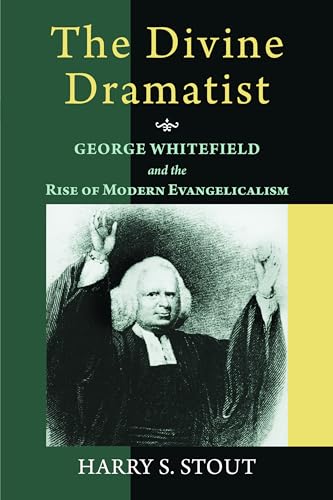
Inhaltsangabe
Commonly acknowledged as Anglo-America's most popular eighteenth-century preacher, George Whitefield commanded mass audiences across two continents through his personal charisma. Harry Stout draws on a number of sources, including the newspapers of Whitefield's day, to outline his subject's spectacular career as a public figure. Although Whitefield here emerges as very much a modern figure, given to shameless self-promotion and extravagant theatricality, Stout also shows that he was from first to last a Calvinist, earnest in his support of orthodox theological tenets and sincere in his concern for the spiritual welfare of the thousands to whom he preached.
Die Inhaltsangabe kann sich auf eine andere Ausgabe dieses Titels beziehen.
Von der hinteren Coverseite
The Library Of Religious Biography is a series of original biographies on important religious figures throughout American and British history.
Auszug. © Genehmigter Nachdruck. Alle Rechte vorbehalten.
The Divine Dramatist
George Whitefield and the Rise of Modern EvangelicalismBy Harry S. StoutWilliam B. Eerdmans Publishing Company
Copyright © 1991 Wm. B. Eerdmans Publishing Co.All right reserved.
ISBN: 978-0-8028-0154-8
Contents
Foreword, by Nathan O. Hatch.....................ixAcknowledgments..................................xiIntroduction.....................................xiii1 The Young Rake.................................12 Oxford Odd Fellow..............................163 London Boy Preacher............................304 Colonial Missionary............................495 London Field Preacher..........................666 American Awakener..............................877 A New Religious History........................1138 Scottish Stranger Preacher.....................1339 Women and Marriage.............................15610 Growing Up....................................17411 Revivals in a New Key.........................20112 An Uncommon Friendship........................22013 Dr. Squintum..................................23414 American Icon.................................24915 Final Scene...................................269A Note on the Sources............................288Index............................................297
Chapter One
The Young Rake
I was born in Gloucester, in the month of December, 1714. My father and Mother kept the Bell Inn. The former died when I was two years old; the latter is now alive, and has often told me how she endured fourteen weeks' sickness after she brought me into the world but was used to say, even when I was an infant, that she expected more comfort from me than any other of her children. This, with the circumstance of my being born in an inn, has been often of service to me in exciting my endeavors to make good my mother's expectation, and so follow the example of my dear Saviour, who was born in a manger belonging to an inn.
So begins George Whitefield's gospel-sounding account of his nativity. The passage was written at age 26, by which time he had already established himself as the most sensational and controversial preacher in the great London metropolis. For one who had risen so far so fast, the analogy to Jesus in the manger was both terribly egocentric and, at the same time, perfectly natural. It expressed exactly the conflicting impulses that raged in the young evangelist, pitting a deep-set piety against a determined ambition to be "somebody" in the cause of Christ.
Besides offering an unequaled window into the psyche of the young evangelist, Whitefield's Journal remains the only source of information we have about his youth. When the didactic and self-promoting aims are stripped away from the text, several critical facts emerge that help to locate the formative influences of Whitefield's youth. Taken together, they provide indispensable clues to the character and qualities of the future evangelist.
First is family. Whitefield was born December 16, 1714, in the Bell Inn on Southgate Street, Bristol, the youngest of seven children. If his circumstances were not as bleak as the analogy to Bethlehem suggests, neither were they the usual stuff of which an Oxford gentleman was made. In the sharply stratified and hierarchical society of eighteenth-century England, Whitefield's family circumstances could best be summarized as one of declining status. His great-grandfather Samuel Whitefield was an Oxford graduate and rector of Rockhampton in Gloucestershire, and his grandfather Andrew succeeded Samuel at the family estate as a "private gentleman of means." But there the upward climb seems to have stopped. George's father, Thomas, began his career as an apprentice wine merchant in Bristol and eventually took over the ownership of the Bell Inn. Although a respectable establishment, the inn was not especially lucrative or prestigious. From the edge of gentility, the family had declined at a time when many other mercantile families were moving in the opposite direction.
The slide grew even sharper when George's father died suddenly at age 35, leaving a widow, Elizabeth, and seven children. In 1724 Elizabeth sought to recoup some losses by marrying an ironmonger named Capel Longden. The marriage proved disastrous. After failing to wrest control of the inn from Elizabeth, Longden took what he could, deserted the family, and eventually filed for divorce. Of the marriage itself, Whitefield says practically nothing except that Longden's departure was a godsend to his "troubled Mother." It was undoubtedly a relief to young George as well. As a result, however, Whitefield would grow up without a strong father figure in his life.
George's older brothers helped to run the inn and eventually owned it. But it was George's mother who exercised the major influence on his childhood. From earliest memory he recalled her singling him out as the son who would make something of himself and the family. As long as she ran the inn she refused to let him work there. Both mother and elder siblings protected George from the world and held out high hopes for him. Inasmuch as earlier generations had made their mark in the Church of England, Elizabeth pointed George in that direction too. A clerical career would recapture the family's lost distinction and reestablish it on the fringes of English polite society.
Though Whitefield linked himself to Bethlehem, his mother was no Mary, nor — her name notwithstanding — was she a New Testament Elizabeth. Her vision for George was probably more social than spiritual. There was certainly no deep spiritual concern or biblical instruction in Elizabeth comparable to that of a Susannah Wesley or an Esther Edwards. Nor did it ever occur to her to depart from the established church or to plumb the depths of religious experience for herself. In fact, Whitefield wrote to his mother in later life urging her to move beyond her nominal faith and examine her heart for evidence of the "New Birth."
The religious career that Elizabeth Whitefield encouraged was powerful, but more in terms of a lost status than any of the internal calling or character formation for ministry found in many dissenters' homes. In contrast to Baptist, Congregational, and Presbyterian dissenters, George grew up with no alienation from the established church, without even a nonconformist's sense that some "truer" or more "faithful" recovery lay outside the state church. Recovering lost status was as significant as kindling spirituality as far as the family and young George were concerned.
The psychological effect of declining status engendered a deep sense of inferiority in Whitefield. This sense, moreover, was not simply subjective; in the context of eighteenth-century society, it was a social fact. In the finely gradated society of eighteenth-century England, the only distinction that really mattered was that between "gentleman" and commoner. In George, this reality kindled a mounting ambition. He could not claim gentility, but he could reclaim it and win back the respect due his family and himself. Yet even while he continued to covet respectability and status, he nonetheless dismissed the trappings of the world, including the church. This love/hate relationship with the world, status, and achievement was evident throughout his life.
In part through his mother's influence, and in part through his own fertile imagination, Whitefield resolved this inferiority-based tension through an all-compelling sense of personal destiny. Unlike the...
„Über diesen Titel“ kann sich auf eine andere Ausgabe dieses Titels beziehen.
Suchergebnisse für The Divine Dramatist: George Whitefield and the Rise...

Beispielbild für diese ISBN
Divine Dramatist: George Whitefield and the Rise of Modern Evangelicalism
Verlag:
William B Eerdmans Publishing Co, 1991
ISBN 10: 0802801544
ISBN 13: 9780802801548
Gebraucht
Paperback
Anbieter: World of Books (was SecondSale), Montgomery, IL, USA
Verkäuferbewertung 5 von 5 Sternen

Paperback. Zustand: Good. Commonly acknowledged as Anglo-America's most popular eighteenth-century preacher, George Whitefield commanded mass audiences across two continents through his personal charisma. Harry Stout draws on a number of sources, including the newspapers of Whitefield's day, to outline his subject's spectacular career as a public figure. Although Whitefield here emerges as very much a modern figures, given to shameless self-promotion and extravagant theatricality, Stout also shows that he was from first to last a Calvinist, earnest in his support of orthodox theological tenets and sincere in his concern for the spiritual welfare of the thousands to whom he preached. Artikel-Nr. 00108311995
Gebraucht kaufen
EUR 4,50
Versand gratis
Versand innerhalb von USA
Versand innerhalb von USA
Anzahl: 4 verfügbar
Beispielbild für diese ISBN
The Divine Dramatist: George Whitefield and the Rise of Modern Evangelicalism (Library of Religious Biography (LRB))
Verlag:
Wm. B. Eerdmans Publishing Co., 1991
ISBN 10: 0802801544
ISBN 13: 9780802801548
Gebraucht
Softcover
Anbieter: Wonder Book, Frederick, MD, USA
Verkäuferbewertung 5 von 5 Sternen
Zustand: Very Good. Very Good condition. A copy that may have a few cosmetic defects. May also contain light spine creasing or a few markings such as an owner's name, short gifter's inscription or light stamp. Artikel-Nr. J07Q-00166
Gebraucht kaufen
EUR 6,35
Versand gratis
Versand innerhalb von USA
Versand innerhalb von USA
Anzahl: 1 verfügbar
Beispielbild für diese ISBN
The Divine Dramatist: George Whitefield and the Rise of Modern Evangelicalism
Verlag:
William B. Eerdmans Publishing Company, 1991
ISBN 10: 0802801544
ISBN 13: 9780802801548
Gebraucht
Paperback
Anbieter: ThriftBooks-Phoenix, Phoenix, AZ, USA
Verkäuferbewertung 5 von 5 Sternen
Paperback. Zustand: Good. No Jacket. Pages can have notes/highlighting. Spine may show signs of wear. ~ ThriftBooks: Read More, Spend Less. Artikel-Nr. G0802801544I3N00
Gebraucht kaufen
EUR 6,45
Versand gratis
Versand innerhalb von USA
Versand innerhalb von USA
Anzahl: 1 verfügbar
Beispielbild für diese ISBN
The Divine Dramatist: George Whitefield and the Rise of Modern Evangelicalism
Verlag:
William B. Eerdmans Publishing Company, 1991
ISBN 10: 0802801544
ISBN 13: 9780802801548
Gebraucht
Paperback
Anbieter: ThriftBooks-Reno, Reno, NV, USA
Verkäuferbewertung 5 von 5 Sternen
Paperback. Zustand: Good. No Jacket. Pages can have notes/highlighting. Spine may show signs of wear. ~ ThriftBooks: Read More, Spend Less. Artikel-Nr. G0802801544I3N00
Gebraucht kaufen
EUR 6,45
Versand gratis
Versand innerhalb von USA
Versand innerhalb von USA
Anzahl: 1 verfügbar
Beispielbild für diese ISBN
The Divine Dramatist: George Whitefield and the Rise of Modern Evangelicalism
Verlag:
William B. Eerdmans Publishing Company, 1991
ISBN 10: 0802801544
ISBN 13: 9780802801548
Gebraucht
Paperback
Anbieter: ThriftBooks-Phoenix, Phoenix, AZ, USA
Verkäuferbewertung 5 von 5 Sternen
Paperback. Zustand: Fair. No Jacket. Readable copy. Pages may have considerable notes/highlighting. ~ ThriftBooks: Read More, Spend Less. Artikel-Nr. G0802801544I5N00
Gebraucht kaufen
EUR 6,45
Versand gratis
Versand innerhalb von USA
Versand innerhalb von USA
Anzahl: 1 verfügbar
Beispielbild für diese ISBN
The Divine Dramatist: George Whitefield and the Rise of Modern Evangelicalism
Verlag:
William B. Eerdmans Publishing Company, 1991
ISBN 10: 0802801544
ISBN 13: 9780802801548
Gebraucht
Paperback
Anbieter: ThriftBooks-Reno, Reno, NV, USA
Verkäuferbewertung 5 von 5 Sternen
Paperback. Zustand: Fair. No Jacket. Readable copy. Pages may have considerable notes/highlighting. ~ ThriftBooks: Read More, Spend Less. Artikel-Nr. G0802801544I5N00
Gebraucht kaufen
EUR 6,45
Versand gratis
Versand innerhalb von USA
Versand innerhalb von USA
Anzahl: 1 verfügbar
Beispielbild für diese ISBN
The Divine Dramatist: George Whitefield and the Rise of Modern Evangelicalism
Verlag:
William B. Eerdmans Publishing Company, 1991
ISBN 10: 0802801544
ISBN 13: 9780802801548
Gebraucht
Paperback
Anbieter: ThriftBooks-Atlanta, AUSTELL, GA, USA
Verkäuferbewertung 5 von 5 Sternen
Paperback. Zustand: Good. No Jacket. Pages can have notes/highlighting. Spine may show signs of wear. ~ ThriftBooks: Read More, Spend Less. Artikel-Nr. G0802801544I3N00
Gebraucht kaufen
EUR 6,47
Versand gratis
Versand innerhalb von USA
Versand innerhalb von USA
Anzahl: 1 verfügbar
Beispielbild für diese ISBN
The Divine Dramatist: George Whitefield and the Rise of Modern Evangelicalism
Verlag:
William B. Eerdmans Publishing Company, 1991
ISBN 10: 0802801544
ISBN 13: 9780802801548
Gebraucht
Paperback
Anbieter: ThriftBooks-Atlanta, AUSTELL, GA, USA
Verkäuferbewertung 5 von 5 Sternen
Paperback. Zustand: Fair. No Jacket. Readable copy. Pages may have considerable notes/highlighting. ~ ThriftBooks: Read More, Spend Less. Artikel-Nr. G0802801544I5N00
Gebraucht kaufen
EUR 6,50
Versand gratis
Versand innerhalb von USA
Versand innerhalb von USA
Anzahl: 1 verfügbar
Beispielbild für diese ISBN
The Divine Dramatist: George Whitefield and the Rise of Modern Evangelicalism
Verlag:
William B. Eerdmans Publishing Company, 1991
ISBN 10: 0802801544
ISBN 13: 9780802801548
Gebraucht
Paperback
Anbieter: ThriftBooks-Dallas, Dallas, TX, USA
Verkäuferbewertung 5 von 5 Sternen
Paperback. Zustand: Good. No Jacket. Pages can have notes/highlighting. Spine may show signs of wear. ~ ThriftBooks: Read More, Spend Less. Artikel-Nr. G0802801544I3N00
Gebraucht kaufen
EUR 6,50
Versand gratis
Versand innerhalb von USA
Versand innerhalb von USA
Anzahl: 1 verfügbar
Beispielbild für diese ISBN
The Divine Dramatist: George Whitefield and the Rise of Modern Evangelicalism
Verlag:
William B. Eerdmans Publishing Company, 1991
ISBN 10: 0802801544
ISBN 13: 9780802801548
Gebraucht
Paperback
Anbieter: ThriftBooks-Dallas, Dallas, TX, USA
Verkäuferbewertung 5 von 5 Sternen
Paperback. Zustand: Fair. No Jacket. Readable copy. Pages may have considerable notes/highlighting. ~ ThriftBooks: Read More, Spend Less. Artikel-Nr. G0802801544I5N00
Gebraucht kaufen
EUR 6,50
Versand gratis
Versand innerhalb von USA
Versand innerhalb von USA
Anzahl: 1 verfügbar